
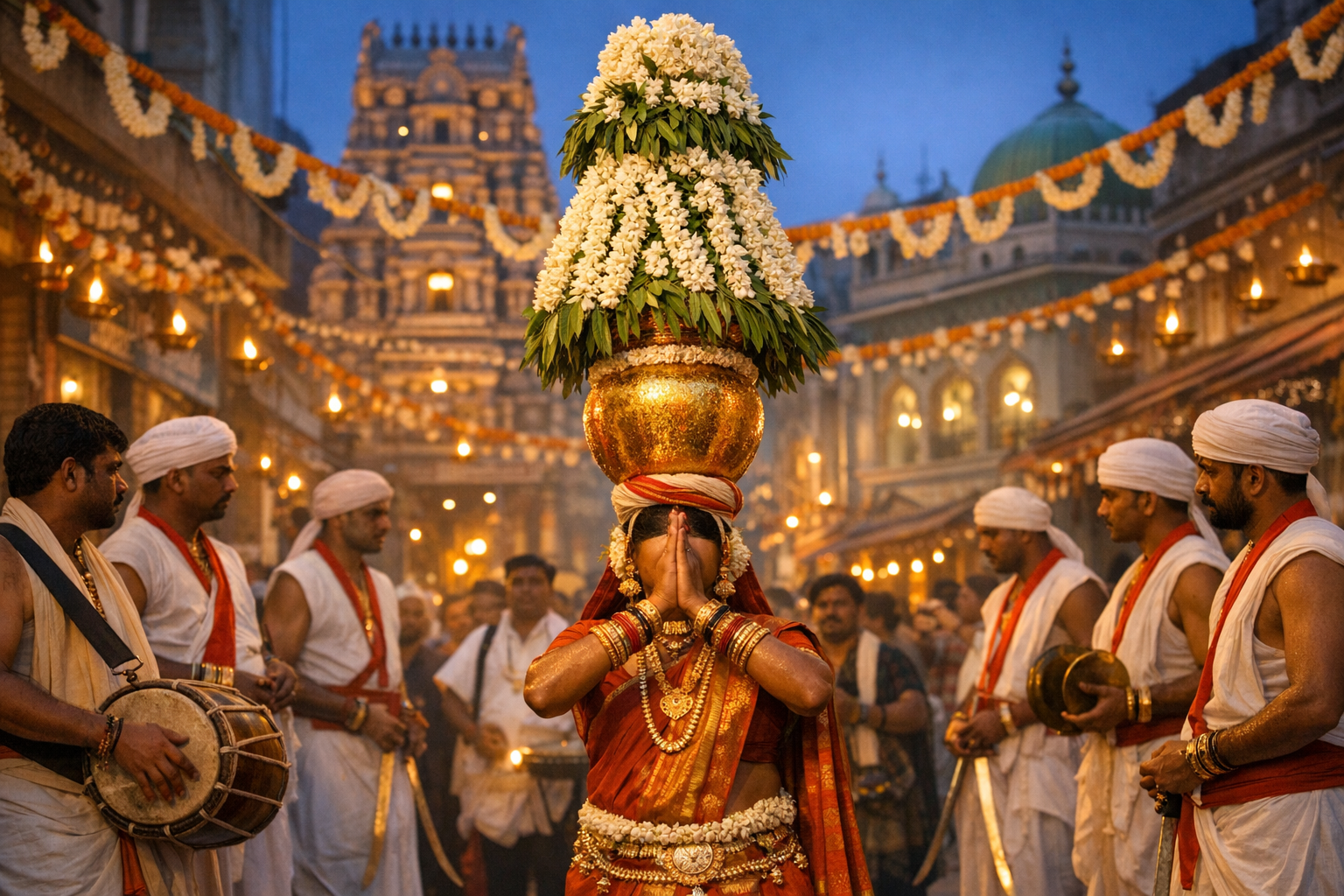
The Karaga festival is one of South India’s most profound Shakta observances, venerating Draupadirevered locally as Draupadi Ammanfrom the Mahabharata as a living manifestation of Devi Shakti. Celebrated primarily in Karnataka and Tamil Nadu, and most prominently in Bengaluru, the ritual complex embodies devotion, discipline, and dharmic values while consolidating community bonds across diverse neighborhoods. Rooted in regional retellings of the epic and sustained through temple traditions, the festival functions as both sacred rite and cultural heritage, preserving an enduring grammar of symbolism, ethics, and shared memory.
Historically, Draupadi’s cult in the Tamil-Kannada region emerges through local mahakavyas, folk narratives, and sthala-purāṇas that accentuate her moral force, protective motherhood, and unwavering commitment to dharma. While textual and epigraphic references are fragmentary, the continuity of practice is unmistakable: for centuries, communities have honored Draupadi Amman as a grāma-devatā who safeguards social order, fertility, and moral courage. In parallel, allied observances such as Theemithi (fire-walking) among Tamil communities in South India and the diaspora underscore Draupadi’s chastity and resilience, enriching a broader devotional ecosystem in which Karaga occupies a central Shakta position.
In Karnataka, the Bengaluru Karagacentering on the Sri Dharmaraya Swamy Templeoffers the festival’s canonical profile. Timed around Chaitra Purnima, a multi-day liturgical cycle of vrata, alankara, and temple processions culminates in a nocturnal, city-spanning yātra. The ritual body of the celebration interlaces yajna-like purity codes with performative devotion: sacred fasts, seclusion, and vow-keeping prepare the officiants and the community for the moment when the goddess is believed to descend into the ritual vessel (karaga), transforming the cityscape into a moving sanctum.
At the heart of the rite stands the karagaan earthen pot filled with sanctified water and crowned with a towering floral superstructure of mallige (jasmine) and bevu (neem). The vessel, often turmeric-anointed, is balanced on the head by the chosen bearer without manual support for the duration of the procession. In Shakta metaphysics, the karaga operates as a mobile kalasha: a womb-like axis that holds prāṇa-saturated waters (āpaḥ), channels śrī-śakti, and radiates auspiciousness (mangalya) across the urban ritual field. Jasmine symbolizes purity and sattva; neem conveys apotropaic protection; water indexes life, abundance, and cosmic renewal.
The Karaga bearertraditionally drawn from the Vahnikula Kshatriya (Thigala) communityundertakes rigorous vrata: celibacy, dietary discipline, ritual bathing, and mental stillness. The bearer is ritually feminized in attire, bangles, and anklets, not as theater but as theology in motion. The temporary embodiment of the goddess (āveśa) affirms a pan-Indic principle of complementarity: Purusha and Prakriti are not binaries to be opposed but energies to be harmonized. The moment collapses gendered boundaries in favor of metaphysical truthardhanārīśvara-like unitywhere the human becomes a conscious instrument of Shakti.
Encircling the karaga are the Veerakumaras, a martial retinue pledged to protect the sanctity of the yātra. Armed with ceremonial swords and governed by fierce vows, they personify Kshatra Dharma: courage, restraint, protection of the weak, and unwavering fidelity to dharma. The martial imagery is not an incitement to violence; it is a strict, ritually bounded discipline that sublimates power into guardianship of the sacred. In this grammar, strength flows from self-mastery, and authority is legitimated by service to the divine and to society.
As the procession threads through Bengaluru’s pete areas and adjoining localities, it institutes a moving commons where marketplace and mandir converge into shared sacrality. One of the notable halts historically associated with the route includes a Sufi dargah, widely understood as a gesture of goodwill and neighborhood concord. The wider ethic resonates across Dharmic traditionsHinduism, Buddhism, Jainism, and Sikhismthrough shared values of self-discipline, seva, truthfulness, and compassion. In practice, the Karaga becomes a civic pedagogy: it models how plural communities can gather around a sacred center without surrendering diversity.
Beyond Bengaluru, Karaga processionslinked to Draupadi Amman temples and local agrarian calendarsare observed across Bengaluru Urban and Rural districts and in parts of Tamil Nadu. While ritual grammars vary, core elements persist: the sanctified pot (karaga/kalasha), vows of purity, floral-crown iconography, and the moral imagination of Draupadi as protector and exemplar. In Tamil regions, allied Draupadi Amman festivals often interlace with Theemithi, weaving a complementary tapestry in which chastity, vow-keeping, and moral endurance are enacted through embodied devotion.
The ritual sequence is both precise and pedagogical. Preliminary observances consecrate space and participants; temple deities receive alankara and daily upacharas; and the community undergoes collective preparation through sankalpa and dana. On the climactic night, the karaga emergesoften after midnightto traverse a codified pilgrimage-map of shrines, markets, and memory sites before returning at dawn. The vessel is then ritually decommissioned or reintegrated into the temple’s liturgical cycle, signaling the restoration of cosmic and civic equilibrium.
From an analytical perspective, Karaga exemplifies a refined ritual technology. It enacts liminality and communitasthreshold moments that recalibrate social relationswhile also staging a durable civil theology: dharma is not abstract doctrine but lived practice. Ritual purity (śauca) aligns body and mind; vow (vrata) focuses intention; the kalasha operationalizes symbol into experience; and processional choreography transforms urban space into a sanctified field. The result is a multi-sensory sādhanā that fuses cognition, emotion, and ethics.
The symbolic load-bearing of Draupadi within Karaga articulates several interlocking themes: protection of honor without hatred, righteous indignation restrained by counsel, and steadfast fidelity to justice. These are dharmic universals echoed across Hinduism, Buddhism, Jainism, and Sikhismin ahiṃsā, maitri/karuṇā, satya, and seva. The festival’s moral arc thus extends beyond sectarian identity, presenting a shared compass for dharmic society: valor tempered by compassion, strength guided by wisdom, and community sustained by truth.
Contemporary challenges and opportunities have refined the festival’s civic expression. Urban growth necessitates thoughtful route management, crowd safety, environmental responsibility, and documentation as intangible cultural heritage. Communities increasingly emphasize natural materials, responsible waste practices, and the preservation of artisanal knowledgegarland-making, percussion, and temple craftsthat anchor the ritual economy. Done with care, these adaptations ensure the Karaga’s continuity without diluting its theological or aesthetic integrity.
For respectful participation, several norms are widely upheld. Observers maintain decorum, avoid obstructing the procession, and honor local codes around photography during especially sacral phases. Donations, when offered, are made through designated channels; volunteers assist with crowd flow rather than impeding it; and elders, children, and those with special needs are prioritized for safe viewing. Such civic dharma is not ancillary; it is intrinsic to the rite, translating reverence into responsibility.
In sum, the Karaga festival presents Draupadi not merely as an epic heroine but as living Shakti who animates the moral center of South Indian public life. Its ritual science, aesthetic power, and social reach demonstrate how dharmic traditions translate metaphysics into community practice. By renewing vows, protecting sanctity, and uplifting the vulnerable, Karaga binds neighborhoods into a single, moving sanctuaryan ever-returning reminder that dharma thrives when strength and compassion walk together.
Inspired by this post on Hindu Blog.










