
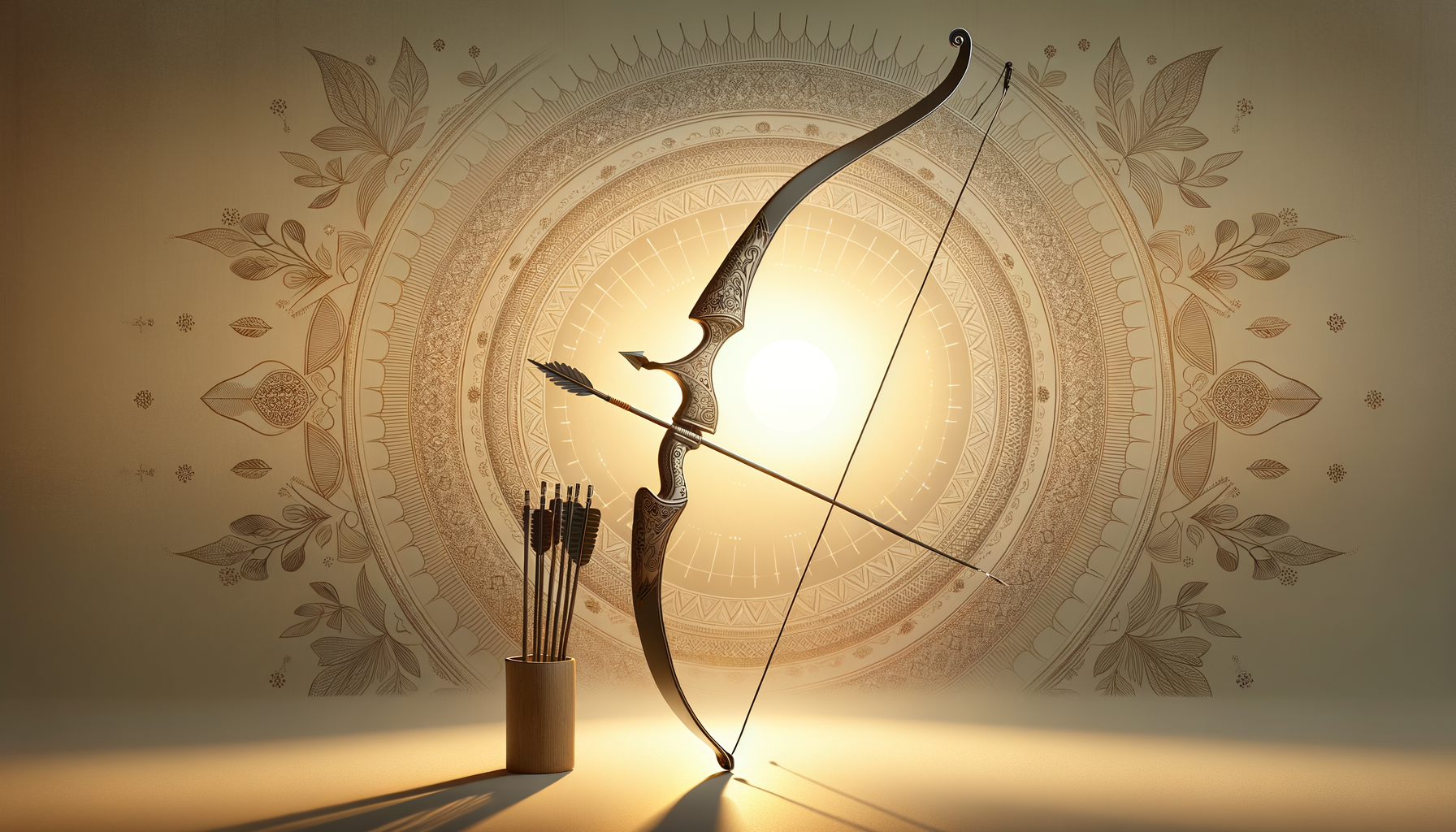
Goddess Durga’s bow (Dhanush) and arrow (Tir or Baan) occupy a central place in Hindu symbolism, uniting cosmic power with focused energy. Across Puranic and regional traditionsincluding the Devi Mahatmyadevas are portrayed as bestowing their strengths upon the Goddess before her victory over adharma. In several tellings, the bow and arrows are linked to deities such as Surya and guardians of the forests, emphasizing both radiant clarity and rooted resilience. Together, these sacred instruments articulate a vision of will aligned to dharma and action refined by discipline.
The bow signifies universal willthe capacity to hold, direct, and govern potential energy without dispersion. Curved yet controlled, it represents the restraint that precedes right action, harmonizing personal intention with ṛta (cosmic order). In this sense, the bow is not merely a weapon but a principle of governance over one’s inner forces, reminding that authentic power is steadied by self-mastery and ethical resolve.
The arrow embodies one-pointed concentration (ekāgratā). Its flight is a metaphor for unwavering focus guided by wisdom, courage, and clarity. When released, the arrow converts gathered potential into purposeful motion, illustrating how disciplined intention culminates in transformative outcomes. In spiritual practice, this mirrors the movement from contemplation to decisive, compassionate action.
Every component reinforces this teaching: the bowstring bridges intention and action; the quiver symbolizes preparedness and steady sādhanā; the archer’s stance reflects balance between strength and sensitivity. Read through the lens of yoga, the bow resonates with yama and niyama, the drawing of the string with pratyāhāra, the calm aim with dhāraṇā, and the arrow’s flight with dhyāna culminating in right action. The imagery refines conduct not by force but by alignment.
For devotees during Navaratri and Durga Puja, contemplation on Dhanush and Baan becomes a practice of inner alignment. Visualizing the bow as disciplined will and the arrow as focused purpose encourages a way of life that is courageous yet compassionate, strong yet measured. In daily decisionsprofessional, familial, or socialthis symbolism offers a practical guide: gather energy responsibly, aim with clarity, and release at the right time for the good of all.
This symbolism also resonates across dharmic traditions. In Buddhism, right intention and samyak-samādhi echo the arrow’s one-pointed course; in Jainism, self-restraint (saṃyama) and ahiṃsā reflect the bow’s disciplined control; in Sikhism, the saint-soldier ideal harmonizes spiritual depth with righteous courage. Such convergences affirm a shared dharmic emphasis on disciplined will, ethical clarity, and compassionate actionvalues that foster unity across Hinduism, Buddhism, Jainism, and Sikhism.
Textual and regional variations enrich, rather than contradict, this insight. While specific attributions differ by source, the enduring core remains consistent: Durga’s bow and arrow teach the union of Shakti with wisdom, the stewardship of power, and the art of acting without haste or hesitation. The iconography instructs that victory over inner and outer disorder is won through disciplined focus, morally guided intent, and a heart anchored in dharma.
Ultimately, the Dhanush and Baan invite a way of living where strength is neither suppressed nor squandered but consciously directed. By embodying universal will and spiritual discipline, they offer a timeless framework for mindful leadership, ethical decision-making, and compassionate service to societyan ideal at once personal and universal, practical and profound.
Inspired by this post on Hindu Blog.










