Within the sacred traditions of Hinduism, Shakti discloses innumerable manifestations that together articulate a comprehensive theology of divine power, protection, and transformation. Among these forms, Bhramari Devietymologically rooted in bhramara, “bee”embodies a profound symbolism in which black bees figure as vivid emblems of the Goddess’s dark, protective radiance. Read as a Hindu symbol of concentrated energy and communal strength, the black bee opens a pathway into the theological core of Shakta thought: Shakti as vibrant, many-voiced, and collectively invincible.
Linguistically, bhramara refers to the bee whose humming, motion, and unwavering attraction to fragrance give rise to Bhramari Devi, “She who is like the bee.” The semantic field around bhram (“to move, to vibrate, to hum”) enriches the iconography of this form of the Hindu Goddess, where sound, movement, and dark luminosity converge. In visual and ritual idioms, bees signify the Goddess’s alert, all-encompassing awareness, while their black sheen parallels the auspicious “dark” aspect of Shakti seen also in Kālī and Kālī’s Navadurga form Kalaratri.
Puranic and regional narratives (sthala-purāṇas) preserve accounts in which the Goddess, as Bhramari, deploys a multitude of bees to subdue demonic forces that cannot be vanquished by conventional weaponry. The swarm’s cooperative intelligence acts as a precise, surgical expression of Shakti, demonstrating how divine agency can manifest through countless small yet coordinated powers. Theological exegesis thus reads Bhramari Devi as a statement that the Supreme Feminine can assume subtle, many-bodied forms to protect dharma when macro-forms are constrained by a boon or condition.
In several South Indian traditions, notably in the revered shrines of Śrīśailam (Bhramaramba) and in coastal Karnataka’s Kateel Durga Parameshwari lore, the bee motif retains ritual potency. While local tellings vary, a consistent motif holds: a demon fortified by exceptional protections is finally overcome when the Goddess becomes an innumerable host of black bees. The narrative is less about force and more about configurationthe many aligned as onemirroring how dharma is safeguarded by the concert of countless right actions rather than by isolated heroics alone.
The “darkness” of Shakti in this context signals not negation but plenitude. In Shakta philosophy and Tantric hermeneutics, the dark hue (śyāma/kr̥ṣṇa) is a metaphysical shorthand for the cosmic womb (garbha), the fertile unmanifest that absorbs all colors and returns them as creation. As Kalaratri, the Goddess is the night that unthreads chaos; as Bhramari, the night hums and movesan intelligent dark radiance. Black bees, therefore, are not ominous figures; they are auspicious vessels of condensed, protective awareness.
Ethologically, bees amplify this symbolism. Their social organization, communication by vibration, and orientation to nectar (rasa) map elegantly onto Shakta metaphors. A hive displays distributed cognition; the Goddess’s swarm demonstrates distributed Shakti. The bee’s precisionnavigating by subtle cues and harmonicsresonates with yogic descriptions of how prāṇa and mantra orchestrate fine adjustments within body and mind to restore balance and resilience.
This sound-centric symbolism flowers in practice as Bhramari Prāṇāyāma, the “bee-breath,” where a gentle humming on exhalation evokes the bhramara-nāda (the bee’s tone). In classical yoga pedagogy, this technique quiets mental proliferation, draws attention inward, and can support autonomic balance. Practitioners often report improved focus, reduced reactivity, and a felt sense of sanctuaryphenomenology consistent with contemporary understandings of how slow, sonorous exhalations can enhance parasympathetic (vagal) tone.
A practical, concise protocol is standard: sit comfortably with the spine aligned; soften facial muscles; inhale naturally through the nose; exhale with a low, steady hum (lips closed, tongue relaxed), attending to vibration across the sinus, throat, and chest. Begin with 5–7 rounds, remaining non-straining and receptive. In Shakta-focused sādhanā, some align this practice with contemplation of the heart center (anāhata), where the innate “unstruck” sound meets the intentional hum, an intersection of inner and outer resonance.
Textual resonances reinforce the bee-honey motif across Indian thought. The Upanishadic Madhu-Vidyā (notably in the Chāndogya and Bṛhadāraṇyaka Upanishads) treats “honey” (madhu) as a cosmological metaphor for interdependenceeach being as nectar to anotheranticipating ecological and ethical visions where all life shares in one sweetness. The Srimad-Bhāgavata Purāṇa’s celebrated Bhramara-gītā (10.47) poetically stages the bumblebee as a messenger, a reflective device that draws out the gopīs’ radical devotional insights. Classical kāvya, too, evokes Kāma-deva’s bowstring as a line of bees, yoking desire, fragrance, and vibration into a single aesthetic image.
Kindred themes also appear across the broader dharmic spectrum, underscoring a shared civilizational intuition. In Buddhism, the Madhupiṇḍika Sutta (MN 18) engages “honey” as an image in a discourse on perception and conceptual proliferation (papañca). In Jain traditions, the ideal of madhukarī bhikṣātaking small alms from many households “as a bee gathers nectar”instantiates aparigraha (non-possessiveness) and ahiṁsā (non-harm) in daily discipline. Sikh Gurmat literature frequently employs nature metaphors; the bee’s one-pointed attraction to fragrance becomes a parable for focused nām-simran. These convergences neither conflate doctrines nor erase distinctions; rather, they reveal a unifying ethical and contemplative imagination within India’s dharmic family.
The ritual economy surrounding Bhramari Devi often integrates honey as an offering, situating sweetness as a sacramental acknowledgment of life’s interdependence. In Shakta worship, especially during Navaratri and on Kalaratri’s tithi, devotees may meditate upon the Goddess’s dark protective aspect while offering madhu alongside customary pañcopacāra/pūjā items. Contemporary practice rightly emphasizes ecological responsibility: honoring Bhramari Devi entails reverence for living bees and their habitatsno ritual should disrupt or harm pollinators. Devotion becomes ecological stewardship.
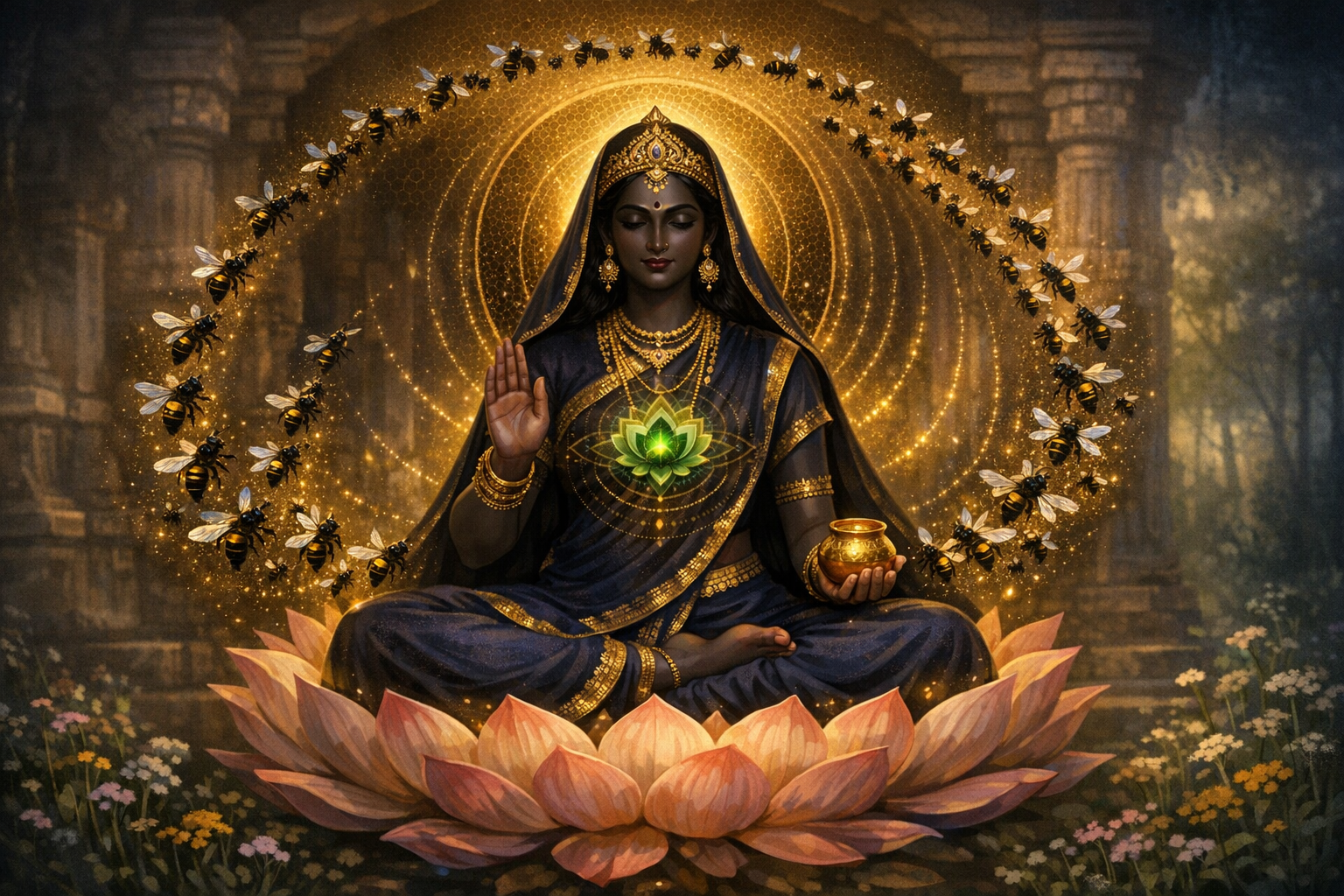
Iconographically, bees clustering around the Goddess signify concentric fields of Shaktiwhat Tantric commentators sometimes describe as kalā-s (energetic rays) cohering into a single will. The black color unifies these rays into a depth-charge of grace: black absorbs, quiets, and protects. Where Kālī dissolves bondage with decisive ferocity, Bhramari reorganizes discord into cooperative harmonyan aesthetic of protection as orchestration rather than as blunt force.
Thematically, Bhramari Devi offers a hermeneutic bridge between scripture, sādhanā, and society. The scriptural bee conjures interdependence (Madhu-Vidyā), the meditative bee refines attention (Bhramari Prāṇāyāma), and the social bee models ethical community (a hive of mutual service). Understood in this integrated way, the symbol becomes a living pedagogy: sweetness sought without grasping, vibration harnessed without noise, and strength exercised through collective alignment.
The ecological corollary is compelling. Bees sustain biodiversity and food security, making the Bhramari motif a practical summons to protect pollinators, preserve wildflower corridors, and support traditional, low-chemical agriculture. In this light, Bhramari Devi is not only a sacred figure within Hindu iconography but also a theological warrant for environmental stewardshipa dharmic call to safeguard the delicate hum upon which life depends.
For seekers weaving devotion and discipline, a simple integrated observance can be meaningful: contemplate Bhramari Devi’s dark radiance at dawn or dusk; practice 5–10 rounds of Bhramari Prāṇāyāma; recite a chosen Śakti mantra; conclude with a dedication (pariṇāmanā) for the well-being of all beingshumans, animals, and the pollinators that nourish the earth. Such a sequence aligns body, breath, and intention, translating symbol into embodied clarity.
In sum, the black bee and Bhramari Devi illuminate a distinctive thread in Hindu symbols: the smallest agents, rightly aligned, can redeem the largest crises; the darkest hue, rightly understood, is the most capacious light. Set within the wider dharmic tapestryHindu, Buddhist, Jain, and Sikhthis symbolism invites unity without uniformity, encouraging shared ethical action, contemplative depth, and cultural reverence. The hum of Bhramari is thus more than sound; it is a reminder that Shakti’s protection often arrives as a chorus rather than a shout, as a swarm of grace rather than a single stroke.
Inspired by this post on Hindu Blog.