

Law can restrain behavior, but it rarely transforms the states of mind that generate harm. Sustainable crime prevention requires addressing the inner drivers of violence, exploitation, and deceit—dispositions that dharmic traditions consistently describe as unregulated desire (kama), anger (krodha), attachment (moha), pride (ahankara), and greed (lobha). When these tendencies are purified, harmful conduct declines at its source.
Within this ethical and psychological frame, Sankirtana—collective devotional chanting—emerges as a uniquely accessible, non-coercive intervention that acts on the roots of crime. By steadily cultivating self-regulation, empathy, and belonging, Sankirtana complements legal deterrence with inner transformation. Among community-led methods designed to purify the heart (citta-shuddhi) and strengthen social cohesion, it stands out for low cost, scalability, and immediate experiential impact.
Dharmic literature often contrasts the “pure-hearted” person with the “soiled” mind driven by uncontrolled impulses. The language of impurity is not moral condemnation; it is a practical diagnosis. Hindu thought outlines the kleshas (afflictions); Buddhist traditions identify the kilesas (e.g., raga, dosa, moha); Jain philosophy examines the kasayas (anger, pride, deceit, greed); Sikh teachings name the five “thieves” (kam, krodh, lobh, moh, ahankar). Across these paths, the analysis converges: criminality thrives where these mental patterns go unexamined and untrained.
Conventional criminology likewise recognizes that sanctions and surveillance can produce compliance but rarely reconfigure identity or impulse control. Instrumental compliance (acting well to avoid punishment) struggles to hold when opportunity and anonymity increase. Normative compliance (acting well because values have changed) is more durable. Sankirtana works precisely where laws do not—at the level of motivation, attention, affect regulation, and social identity.
Sankirtana (kirtan) uses rhythm, melody, breath pacing, and meaningful sound to engage body and mind as a single system. Prolonged, gentle vocalization and elongated exhalations support parasympathetic activation and improved vagal tone, mechanisms associated with calmer arousal states and enhanced impulse control. The vagus nerve’s role in heart–breath synchrony and social connection offers a plausible bridge between chanting practice and measurable reductions in aggression and anxiety.
Group chanting produces synchrony—shared tempo, shared breath, shared intention. Research on collective music-making indicates increases in prosocial hormones (e.g., oxytocin) and reductions in stress biomarkers (e.g., cortisol) alongside subjective reports of bonding and trust. These physiological and psychological shifts underpin the social capital that neighborhoods require to prevent crime: watchfulness without suspicion, guardianship without hostility, and shared norms without coercion.
From a cognitive perspective, repetitive sacred sound reduces perseverative thinking and rumination, modulates the default-mode network (associated with self-referential chatter), and anchors attention in the present. Imaging and physiological studies of mantra recitation and meditative vocalization suggest downregulation of threat-responsive circuits and improved emotion regulation—key capacities that correlate inversely with violent reactivity.
The social effects are equally important. Regular Sankirtana creates durable ties (satsanga) across age, caste, class, and occupation. It replaces isolated evenings with shared, uplifting routines; it provides non-intoxicant pleasure and structured recreation; and it supplies a valued identity that competes with deviant subcultures. In criminological terms, this strengthens collective efficacy and weakens the conditions for opportunistic and impulsive crime.
Evidence from adjacent contemplative and musical domains is instructive. Mindfulness and compassion trainings have been associated with reduced aggression and improved self-control in adolescents and institutional settings. Group singing has repeatedly shown increases in bonding and well-being. Notably, large-scale meditation programs in correctional environments (for example, Vipassana courses introduced in Tihar Jail) have reported improvements in inmate behavior and post-release adjustment. Sankirtana integrates these benefits—breath regulation, attention training, and social bonding—in a culturally rooted, joyful format that communities can adopt immediately.
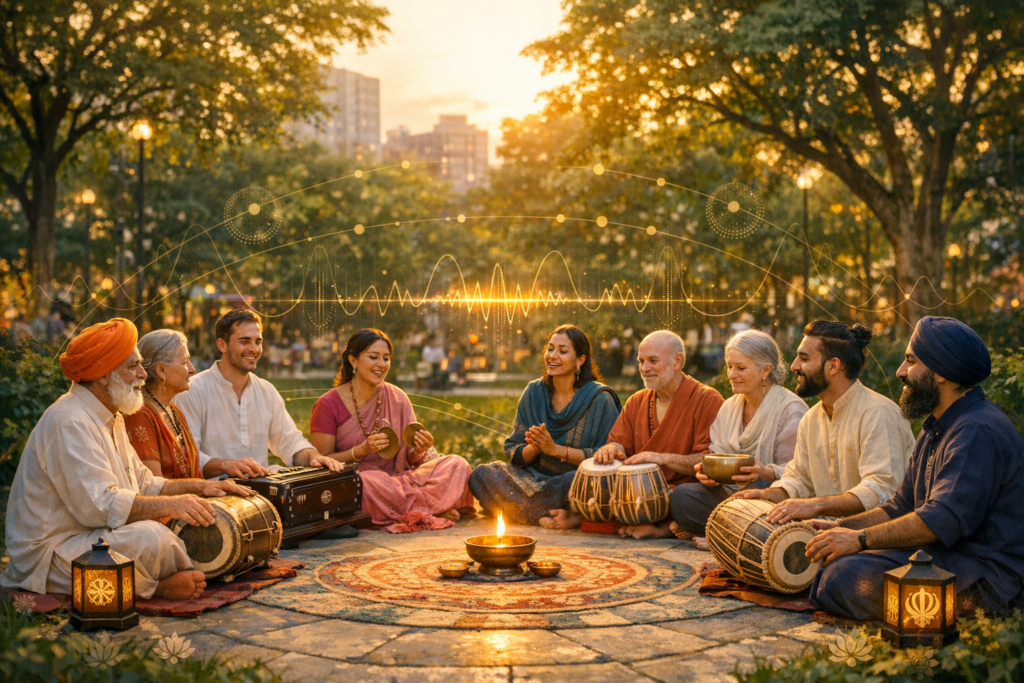
Crucially, Sankirtana is not sectarian when framed through the dharmic principle of unity in diversity. Hindu bhakti offers names and mantras for collective singing; Sikh tradition centers on shabad kirtan; Buddhist communities sustain paritta and refuge chants; Jain practice honors the Navkār Mantra and collective samayik. All are sound-based contemplative paths that cultivate non-violence (ahimsa), compassion (karuna), service (seva), and ethical restraint—values at the heart of crime prevention.
A unifying, plural template is therefore both faithful to the spirit of dharma and optimally inclusive. A neighborhood circle might rotate invocations such as “Hare Krishna,” “Waheguru,” “Buddham saranam gacchāmi,” and “Namo Arihantanam” alongside simple universal refrains (e.g., “Om” or “Shanti”). The intent is not to homogenize traditions but to celebrate them collectively, deepening mutual respect while strengthening the local fabric of trust and care.
Program design for community safety can proceed as a public-health style intervention: low barrier, high repetition, measurable outcomes. A weekly 60–75 minute Sankirtana gathering in parks, community halls, or school courtyards builds predictable, pro-social rhythm. Sessions can begin with a few minutes of silent breath awareness, proceed to call-and-response chanting at comfortable tempos, include brief reflective pauses, and close with a short period of mauna (silence) and a circle of gratitude (seva commitments for the week).
An example structure: 5 minutes of grounding breath; 15 minutes of kirtan in a Hindu bhakti style; 10 minutes of Sikh shabad kirtan; 10 minutes of Buddhist refuge/paritta chanting; 10 minutes of Jain Navkār or pratikraman elements; 10 minutes of a common peace refrain (e.g., “Shanti, Shanti, Shanti”); and 10 minutes of silent sitting. Facilitators rotate monthly across traditions. All participation remains strictly voluntary to safeguard freedom of conscience.
Implementation benefits from simple protocols: a shared repertoire booklet in transliteration and local scripts; moderate amplification that respects noise regulations; clearly communicated community guidelines (no proselytizing, no political slogans, equal voice and space for all dharmic participants); and basic facilitator training in breath pacing, inclusive language, and de-escalation skills.
Evaluation should be rigorous and transparent. Communities can track short-term indicators (attendance, subjective calm, neighborly help, school disciplinary incidents) and long-term outcomes (property damage complaints, youth-police friction, repeat-offense patterns). Where feasible, physiological measures like heart-rate variability can be explored in voluntary sub-samples to study vagal tone improvements associated with chanting and breath coordination.
Education settings are especially promising. Integrated Sankirtana and mindfulness periods can be framed within social–emotional learning (SEL) objectives—attention control, emotion labeling, conflict resolution, and prosocial action—while honoring the cultural heritage of students from Hindu, Buddhist, Jain, and Sikh families. The result is character education that is simultaneously local, plural, and evidence-aligned.
Police–community partnerships can leverage Sankirtana as a bridge in community policing and restorative justice contexts. Officers need not lead or endorse any theology; their role is to support safe spaces, ensure lawful assembly, and participate as neighbors in shared non-violent routines. Joint presence at these gatherings humanizes all sides, reduces misperception, and builds informal channels for problem-solving.
Correctional and re-entry programs can incorporate chanting circles as part of wellness, addiction recovery, and impulse-control curricula. Here, kirtan-based breath pacing and reflective silence pair effectively with yoga, mindfulness, and counseling. The aim is not mere compliance inside institutions but the cultivation of new identities that travel home—neighbor, caregiver, artisan, volunteer—in place of gang or criminal affiliations.
Ethically, the practice must remain inclusive and rights-respecting. Participation must be voluntary; no public resources should privilege one doctrine over another; and facilitation should emphasize shared dharmic ethics—ahimsa, satya (truthfulness), asteya (non-stealing), daya (compassion), and seva (service). In this way, Sankirtana functions as a civic practice of well-being, not as religious imposition.
Anticipating concerns is essential. Noise regulations are addressed through time-bound sessions, moderate volume, and acoustic choices (hand harmonium, mridanga/dholak, or cajón at restrained dynamics). Inter-tradition equity is maintained by rotating repertoires and facilitators. Language barriers are reduced via transliteration and call-and-response formats. Skepticism is engaged respectfully by inviting observation, offering opt-in breathwork segments, and publishing outcome data.
From a cost–benefit perspective, Sankirtana is unusually efficient. It requires minimal infrastructure, builds local leadership, and scales horizontally through peer-to-peer diffusion. Most importantly, it shifts the prevention paradigm from external surveillance to internal steadiness and communal care, a combination that addresses both opportunistic and reactive harm.
Historical sources within bhakti emphasize the transformative centrality of sacred name recitation—famously, “harer nāma harer nāma harer nāmaiva kevalam.” Read through a plural lens consistent with India’s lived traditions, this points to the salvific power of sacred sound itself rather than a single confessional path. In practice, the “names” are those honored across Hindu, Buddhist, Jain, and Sikh lineages, chanted in mutual respect and shared purpose.
Technically, the mechanisms that make Sankirtana promising for crime prevention map well onto contemporary science: breath-regulated vocalization supporting parasympathetic balance; rhythmic synchrony fostering trust and cooperation; meaningful narrative refrains reorienting identity toward service and restraint; and communal routine building protective time-use patterns for youth and adults alike. Together, these form a multi-layered intervention aligned with public-health models of violence reduction.
Beyond the metrics, communities frequently report qualitative shifts: quarrels resolved more quickly, elders and youth collaborating in seva, and neighborhood WhatsApp groups repurposed from complaint channels into coordination for collective meals, tutoring, and cleanup drives. Such “small” outcomes are precisely the fabric in which serious crime struggles to root.
For policymakers, educators, and civic leaders seeking practical tools that honor India’s civilizational heritage while meeting modern security needs, Sankirtana offers a rare synthesis: a practice that is spiritual yet non-sectarian, joyful yet disciplined, ancient yet supported by contemporary behavioral science. It does not replace law; it completes it where law cannot reach—inside the heart and between neighbors.
In sum, crime cannot be stopped by law alone because law neither pacifies restless minds nor knits fractured communities. Sankirtana, practiced in a dharmic spirit of unity across Hinduism, Buddhism, Jainism, and Sikhism, is among the most potent, inclusive, and evidence-aligned ways to reduce violence at the root. When people are cleansed of the “dirt” of uncontrollable lust and greed through steady, shared practice, harmful impulses weaken, prosocial identities strengthen, and the conditions that nourish crime quietly disappear.
Inspired by this post on Hindu Pad.








Leave a Reply
You must be logged in to post a comment.