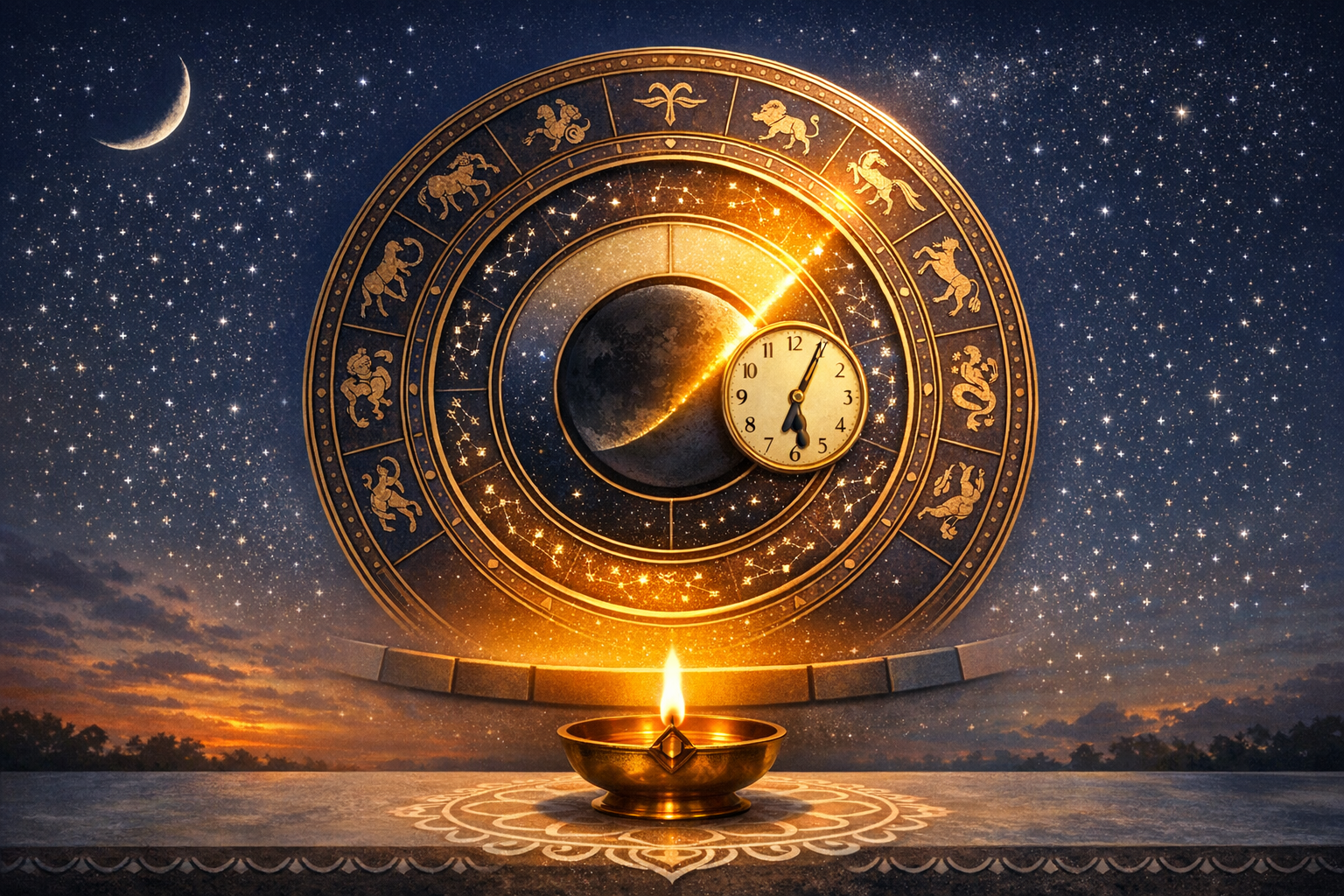
On Tuesday, June 2, 2026, according to the Hindu calendar (Panchang) followed in most regions, the tithi is Krishna Paksha Dwitiya (the second lunar day of the waning Moon) until 5:03 PM. From 5:03 PM onward, the day transitions to Krishna Paksha Tritiya (the third lunar day of the waning phase). Because Panchang calculations are location-sensitive, local sunrise, sunset, and Moon–Sun positions may slightly shift the exact end time; regional Panchangam references should be consulted for precision.
Tithi in the Panchang is a precise astronomical measure: each tithi corresponds to a 12-degree elongation in the angular distance between the Moon and the Sun. Krishna Paksha denotes the waning fortnight that begins the day after Purnima (Full Moon) and culminates on Amavasya (New Moon). Dwitiya signifies the second such 12-degree interval; Tritiya denotes the third. The shift from Dwitiya to Tritiya at 5:03 PM on June 2 indicates that the lunar elongation crosses the next 12-degree threshold at that moment for most Indian Panchang conventions.
In practical terms, activities and observances specifically aligned to Krishna Paksha Dwitiya are ideally completed before the tithi ends at 5:03 PM, while those recommended for Krishna Paksha Tritiya begin after that time. Panchang practice typically anchors tithi observance to the tithi prevailing at local sunrise; however, time-bound vows (vrata), sankalpa, or specific rites may also account for the precise moment of tithi transition when instructions so require. When a tithi spans two civil dates, sunrise prevalence and the exact end time guide observance decisions.
Krishna Paksha, as a period of decreasing lunar light, is widely interpreted across dharmic traditions as supportive of introspection, simplification, and release of excess. Many households find that routine disciplinessuch as early meditation, mindful recitation, or quiet studyresonate more deeply when aligned with this waning rhythm. The day’s cadence, especially near the evening transition point, lends itself to reflective practices and gentle self-audit of habits.
Krishna Paksha Dwitiya is often associated with steadiness and relational balance. It is considered supportive of short-term planning, reviews, and the consolidation of recent learnings. In family settings, concise, constructive conversations and acts of seva (service) that foster harmony are favored. The emphasis is less on expansion and more on careful curationmaintaining what matters and setting aside what does not.
With the onset of Krishna Paksha Tritiya after 5:03 PM, the tone becomes incrementally initiatory within the waning context: small, deliberate beginnings, tentative pilots, and measured commitments are appropriate. Tritiya, by tradition, can favor skills practice, iterative improvements, and stepwise progress on tasks that benefit from patience and method. It is prudent to prefer clarity over speed, particularly on a Tuesday, and to select windows deemed auspicious by muhurta norms.
Regarding Shubh Muhurat (auspicious time), the following classical guidelines are commonly used. Abhijit Muhuratpositioned around local solar noonis traditionally considered universally auspicious for many undertakings when other strong contraindications are absent. To locate it, determine local solar noon (midpoint between sunrise and sunset) and apply the standard duration: approximately 24 minutes before and 24 minutes after local solar noon for a typical day. Because day length varies by season and location, exact Abhijit intervals should be computed from local sunrise and sunset.
Rahu Kalam, Yamaganda, and Gulika are daily segments generally avoided for new beginnings. The operational method is to divide the daylight interval (sunrise to sunset) into eight equal parts. For Tuesday, Rahu Kalam falls in the 7th part of the day, Yamaganda in the 3rd part, and Gulika in the 4th part. Using this rule ensures location-specific accuracy: once sunrise and sunset are known, the lengths and positions of these segments can be computed precisely for June 2, 2026.
Nakshatra and Rashi complement tithi in muhurta selection. Nakshatra refers to the Moon’s position among the 27 lunar mansions, shaping the qualitative tone of the day, while Rashi denotes the Moon’s sign (zodiacal placement), indicating the broader emotional and contextual tenor of activities. Because both depend on the Moon’s exact longitude and local time zone, reliable regional Panchang data or authoritative astronomy software should be consulted for the June 2, 2026 specifics in each locality.
Technically, comprehensive muhurta balances five limbs (Panchang): Tithi, Vara (weekday), Nakshatra, Yoga, and Karana. For decision-making on June 2, 2026, the principal anchors provided here are Tithi and Vara (Tuesday). Incorporating the day’s Nakshatra, Yoga, and Karana yields a fine-grained muhurta profile. Advanced practitioners also consider planetary horas (e.g., Jupiter’s hora for learning, Mercury’s for trade), ensuring they do not coincide with Rahu Kalam or Yamaganda.
Regional Panchang traditionssuch as Amanta and Purnimanta month reckoningsdo not affect the astronomical basis of tithi but may influence festival dating and household customs. Diaspora communities across time zones should prioritize local sunrise and sunset and verify tithi end times with a trusted regional almanac or observatory-grade calculation, given that the 5:03 PM transition is referenced for most Indian-region conventions.
These calendrical frameworks reflect a shared civilizational heritage across Hinduism, Buddhism, Jainism, and Sikh traditions. Lunar day observances (tithi/Uposatha) inform Buddhist mindfulness cycles; Jains align many vratas and upavāsa days to tithis; and the Sikh Panth has historically referenced the Bikrami calendar for several gurpurabs, even as many gurdwaras also use updated calendrical practices. Read with mutual respect, these timekeeping systems underscore unity-in-diversityone astronomical sky, interpreted through multiple, harmonious dharmic lenses.
In summary: Tuesday, June 2, 2026, carries Krishna Paksha Dwitiya until 5:03 PM and Krishna Paksha Tritiya thereafter. Those planning time-sensitive observances can align actions with these transitions, prefer Abhijit Muhurat for widely auspicious undertakings, and avoid Rahu Kalam, Yamaganda, and Gulika as computed from local sunrise and sunset. For refined personalization, incorporate the day’s Nakshatra and Rashi from a reliable regional Panchang. This approach preserves accuracy while honoring the inclusive, plural ethos at the heart of dharmic calendrical wisdom.
Inspired by this post on Hindu Blog.