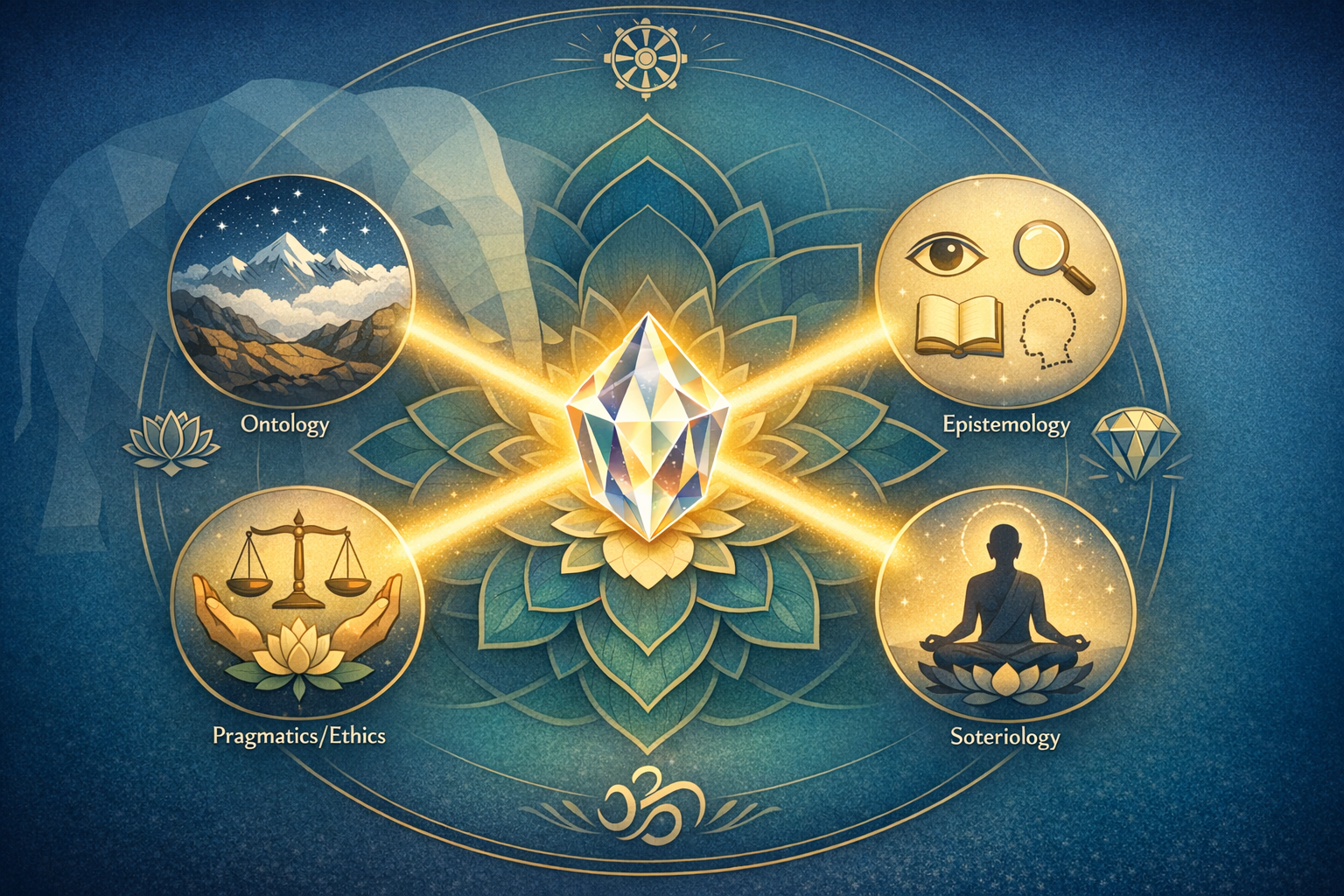
Across dharmic traditions, the statement “truth is multi-dimensional” appears frequently, yet its meaning is not always clear. In philosophical terms, it indicates that truth has many facets depending on what is being examined (ontology), how it is known (epistemology), why it matters (pragmatics and ethics), and the horizon toward which it points (spiritual realization). Rather than diluting truth, this view insists on a disciplined, context-aware understanding that integrates reason, experience, scripture, and contemplative insight.
A classic illustration is the well-known parable of the “blind men and the elephant.” Each participant grasps a parttrunk, ear, legand names it the whole. The lesson is not that anything goes, but that partial perspectives require integration. Dharmic philosophies refine this intuition into rigorous methods so that partial truths become complementary rather than contradictory, enabling a fuller view of satya.
This multi-dimensional approach is deeply rooted in Hinduism, Buddhism, Jainism, and Sikhism. In Jain thought it is codified as Anekantavada (non-one-sidedness); in Buddhism as the two truths doctrine (conventional and ultimate); in Vedanta as paramarthika, vyavaharika, and pratibhasika levels of reality; and in Sikhism as living in alignment with Ik Onkar and satnam through remembrance (simran) and service (seva). These traditions, while distinct, converge on a shared ethic: humility before the vastness of reality and openness to multiple pramanas (means of knowledge).
To understand what “multi-dimensional truth” means in practice, consider four complementary lenses common to the dharmic world: ontological, epistemic, pragmatic, and soteriological. Ontologically, reality is not flat. It is frequently described across layersfrom gross (sthula) to subtle (sukshma) to causal (karana)each disclosing valid truths suited to its level. A medical scan, vital signs, and lived pain are not rival accounts; they are distinct windows on the same condition.
Epistemically, the Indian traditions formalize multiple pramanaspratyaksha (perception), anumana (inference), upamana (comparison), shabda (reliable testimony), arthapatti (postulation), and anupalabdhi (non-cognition). Each pramana is calibrated to a class of truths. Empirical regularities require perception and inference; metaphysical claims may rely on scripture, reasoned postulation, and contemplative verification. This plurality does not relativize truth; it right-sizes the tool to the task.
Pragmatically and ethically, perspectives (naya) organize the many ways phenomena can be approachedfunctional, causal, moral, or spiritual. Sound inquiry names its standpoint explicitly. A nutritional analysis of food, a ritual offering, and a family’s cultural memory of the same dish each reveal a different, context-bound truth about what the food is and why it matters.
Finally, the soteriological lens asks how truth liberates. Dharmic traditions agree that truthful seeing dissolves avidya (misapprehension), reorders desire, and aligns action with dharma. The test of profound truth is transformative clarity: less delusion, more compassion, steadier discernment.
In Jainism, Anekantavada asserts that reality has infinitely many aspects. Syadvada (the doctrine of conditioned predication) articulates how statements can be true “in a certain respect” and false “in another respect,” without contradiction. Nayavada (perspective theory) systematizes standpoints so that discourse is careful rather than careless. Crucially, Anekantavada is not an invitation to “anything goes”; it is a disciplined pluralism that honors precision, non-violence in thought (ahimsa), and dialogical humility.
In Buddhism, the two truthssamvrti-satya (conventional) and paramartha-satya (ultimate)organize the path of wisdom. Conventional truth guides language, ethics, and everyday causality (pratityasamutpada). Ultimate truth reveals emptiness (shunyata): phenomena lack independent essence. The point is practical: by understanding dependent origination at the conventional level and emptiness at the ultimate level, clinging loosens and compassion flows more freely.
In Hindu Vedanta, Advaita distinguishes paramarthika (absolute), vyavaharika (empirical), and pratibhasika (illusory) levels. This threefold schema prevents category errorswhat is “empirically real” in common dealings may be “ultimately dependent” and “provisionally illusory” from the highest standpoint. Non-Advaita schools (Vishishtadvaita, Dvaita) differ metaphysically yet concur that truth should be read by level and purpose, not flattened. Nyaya-Vaisheshika, with its robust realism and pramana theory, ensures that logical and empirical rigor anchor philosophy to experience.
Sikh thought centers on Ik Onkar and satnamthe One Reality and its truthful Nameknown through shabad (sacred Word) and embodied in hukam (cosmic order). Here, multi-dimensional truth is lived devotionally and ethically: remembrance of the One (simran), service (seva), honest living, and equality in sangat (community). The heart of the view is integrative: ultimate unity expresses itself through compassionate action, aligning everyday life with the ineffable Real.
Insights from contemporary teachers harmonize with this inheritance. Sri Sri Ravishankar (Art of Living), for example, has often emphasized honoring multiple perspectives in spiritual inquiryrecognizing factual, experiential, and transcendental registers of satyaso that discernment is both kind and accurate. Such guidance echoes the classical insistence that clarity improves when reason, meditation, and ethics work together.
It is helpful to distinguish objective, subjective, and intersubjective truth. Objective truths are stance-independent factssuch as measurable propertiesbest accessed through pratyaksha and anumana. Subjective truths concern first-person experiencepain, meaning, devotionand require introspective refinement and phenomenological honesty. Intersubjective truths are stabilized by shared conventions and institutionslanguage rules, money value, social normsand are carried by testimony (shabda) and communal practice. Multi-dimensional thinking integrates all three without confusing their domains.
Common misunderstandings fall away under this framework. Multi-dimensional truth is not a denial of objective facts; it is a reminder that facts sit within horizons of meaning. Nor does it collapse into relativism; standards of adequacy remain, set by the right pramana for the right domain, coherence within a tradition’s metaphysics, and transformative fruit in life. The statement “all views are equally true” is itself a one-sided claimprecisely what Anekantavada and the two truths warn against.
Dharmic epistemology also guards against absolutism. A single metric rarely captures the whole field. The “map is not the territory” applies: a correct map in one scale can mislead at another. The Upanishadic method of neti-neti (not this, not this) trains the mind to loosen premature certainties while moving toward insight that is more comprehensive and less entangled in error.
In lived practice, multi-dimensional truth becomes tangible through disciplined habits. First, name the lens in use: Is the claim empirical, ethical, devotional, or metaphysical? Second, match method to lens: experiment and inference for empirical questions; contemplative attention and guidance from shabda for inner transformation; reasoning about coherence for metaphysical propositions. Third, triangulate: when different lenses converge, confidence grows; when they diverge, investigate the category boundaries.
Consider health as an example. Laboratory results disclose objective markers; felt fatigue and mood reveal subjective states; clinical guidelines embody intersubjective consensus. A wise responsewhether allopathic care, yogic lifestyle changes, or botharises from integrating these layers, not privileging one at the expense of the others. The same integrative logic applies to ethics, ecology, education, and spiritual sadhana.
From gross to subtle to causal, practices also track levels. Asana and balanced diet tune the sthula body; pranayama and dhyana refine sukshma energies and attention; inquiry (vichara), devotion (bhakti), and self-surrender (Ishvara-pranidhana) address the karana roots of identity and bondage. The result is cumulative clarity: perception becomes cleaner, reactions calmer, and decisions more attuned to dharma.
The social fruit of this view is inter-traditional friendship. Anekantavada’s non-one-sidedness, Buddhism’s compassion married to wisdom, Vedanta’s level-sensitive discernment, and Sikhism’s unity in love all underwrite respectful dialogue. Each tradition preserves its integrity while assisting others to see what they themselves highlight more clearly. This is unity in spiritual diversityneither syncretism without standards nor isolation without learning.
In sum, to say “truth is multi-dimensional” is to commit to a rigorous, compassionate, and level-aware way of knowing. It honors objective facts, protects the dignity of first-person experience, sustains the conventions that make social life possible, and orients all three toward liberation from ignorance and suffering. When inquiry is guided by appropriate pramanas, clarified by contemplative practice, and softened by humility, truth discloses its many faces without losing its One light.
Inspired by this post on Hindu Pad.