June 2026 at Tirumala–Tirupati unfolds within a liturgical cadence in which virtually every day is a festival, as Tirumala Tirupati Devasthanams (TTD) conducts close to 450 utsavams annually spanning annual, monthly, fortnightly, weekly, daily observances, and Tirunakshatrotsavams. This academically grounded guide synthesizes established TTD practices to outline what devotees can expect in June 2026, how festival dates are computed, and how to plan darshan and seva while honoring temple protocol and the shared dharmic values that speak across Hinduism, Buddhism, Jainism, and Sikhism.
Festival dating at TTD follows the Hindu lunisolar Panchang. In Gregorian June, observances generally fall in Jyeshtha transitioning into Ashadha (Tamil Vaikasi into Aani). The operative principle is the prevalence of a given tithi and relevant nakshatra at Tirumala’s local sunrise or within the prescribed ritual window, as guided by the Vaikhanasa Agama for Sri Venkateswara Swamy Temple and by respective agamic traditions for other TTD-managed shrines. Because tithis can bridge Gregorian dates, a festival may shift by a day compared to general almanacs; devotees are therefore encouraged to verify final timings with official TTD notifications.
TTD’s utsavams can be understood as a structured continuum: daily sevas that preserve the nitya-puja cycle; weekly and fortnightly observances that punctuate the liturgical rhythm; monthly vratas aligned to lunar phases; and special annual festivals (Brahmotsavams, Teppotsavams, Pushpayagams, Pavitrotsavams), alongside Tirunakshatrotsavams marking Acharya and Alvar birth stars. June features this full spectrum in practice, even as specific dates vary with the Panchang.
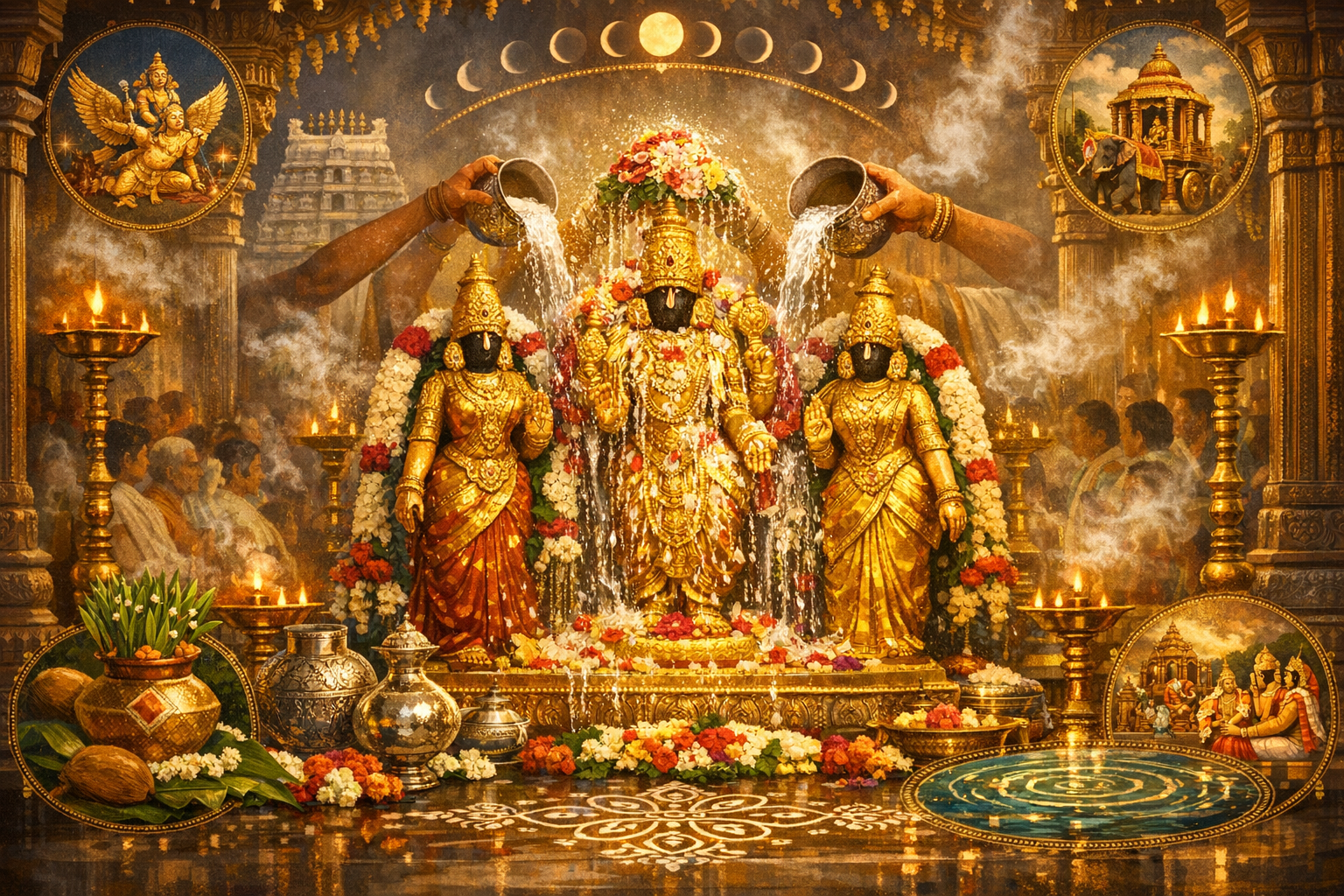
A hallmark of June at Tirumala is the Jyeshtha Abhishekam, also known as Abhidyeyaka Abhishekam, performed to the processional icons (Utsava Murti) of Sri Malayappa Swamy with Sridevi and Bhudevi. Rooted in Vaikhanasa ritual logic, this multi-day festival emphasizes both ritual purification (snapana tirumanjanam) and the theological motif of divine protection and welfare. Abhishekam is typically performed on three consecutive days, with the Utsava Murti graced by specially consecrated kavachams (armors) during the course of the observance. The emphasis on the Abhidheyaka Murti underscores a key Vaishnava insight: the Lord’s processional presence as immediate, compassionate, and accessible to all devotees.
For many pilgrims, the experiential heart of Jyeshtha Abhishekam lies in a sequence that begins at dawn with the temple bells and Suprabhata Seva and culminates in the serene cadence of abhisheka mantras. The sight of the Utsava Murti adorned in luminous kavacham evokes a palpable stillness, blending learned devotion (shraddha guided by shastra) with lived devotion (bhakti as darshan). It is a moment where technical ritual exactitude and deep personal feeling meet.
Beyond the hill shrine, TTD’s temple network in and around Tirupati sustains its own June highlights. Sri Prasanna Venkateswara Swamy Temple at Appalayagunta customarily schedules its annual Brahmotsavams in the Jyeshtha–Ashadha window. Devotees encounter the complete Brahmotsava grammar hereAnkurarpanam (seed-sowing rite that ritually inaugurates the festival), vahana sevas on the mada streets, and concluding sacred baths such as Chakra Snanameach step designed to externalize cosmic order through measured processions and soundscape.
Srinivasa Mangapuram’s Sri Kalyana Venkateswara Swamy Temple typically observes Sakshatkara Vaibhavotsavams in this period. Focused on the Lord’s manifest grace (sakshatkara), the festival recollects kalyana (divine marriage) theology while inviting the community to participate through kalyana-related rituals and parayanas. As with all Brahmotsavams and special utsavams, Ankurarpanam precedes the main days, aligning the consecrated seed with the unfolding of the festival’s dharmic intent.
In Tirupati town, Sri Govindaraja Swamy Temple’s Vaikasi Brahmotsavams frequently occur across late May into early June, often intersecting with June observances depending on the lunar calendar. The temple’s liturgical architecture mirrors classical Vaishnava patternsvahana sevas, rathotsavam, and concluding snanamsforming an urban pilgrimage within the larger sacred geography of Tirupati.
Monthly vratas that mark June 2026 include Ekadashi, Amavasya, Purnima, and Sankatahara Chaturthi, each carrying its own vrata-dharma and recitational tradition. At Sri Kapileswara Swamy Temple (TTD) in Tirupati, Masa Shivaratri of the applicable lunar month is observed, offering Saiva devotees a complementary path of worship in the same sacred ecosystem. This integrated calendar exemplifies how TTD nurtures a plural yet cohesive devotional field.
Daily and arjitha sevas continue in June subject to festival-day adjustments. The Suprabhata Seva opens the day; Thomala and Archana maintain the nitya-puja continuum; and arjitha offerings such as Kalyanotsavam, Arjitha Vasanthotsavam, and Sahasra Deepalankara Seva proceed on notified days. On Fridays, the Abhishekam to the Mula Virat follows longstanding practice, with specific darshan arrangements governed by crowd management protocols and TTD rules.
Koil Alwar Tirumanjanam, the comprehensive sanctum and temple precinct purification performed quarterly, is generally scheduled in proximity to major festivals or administrative milestones. When it falls in the June–July corridor, it prepares the temple for subsequent observances (e.g., Anivara Asthanam later in the season). Final 2026 scheduling should be confirmed through TTD announcements and the official almanac.
Practical planning for June entails a thoughtful balance of devotion and logistics. Weather in Tirumala–Tirupati transitions from pre-monsoon heat to early showers; hydration, light cotton attire, and adherence to TTD’s dress code are advisable. Early June can see elevated footfall due to school vacations in parts of India; mid-to-late June may moderate slightly but varies year to year with the Panchang-driven festival slate.
Temple etiquette supports both spiritual depth and operational order. Devotees should deposit mobile phones and restricted items at designated counters, respect queue discipline, arrive early for sevas, and maintain a contemplative silence in the sanctum areas. Annadanam runs on fixed schedules; those partaking may plan darshan to align with meal timings without compromising ritual priorities.
Darshan access and seva participation typically involve time-slotted systems that improve predictability while protecting sanctity. While modalities evolve, principles remain consistent: book arjitha sevas through official channels, monitor press releases for festival-day restrictions, and allow generous buffers in transit and queueing windows. For complex itineraries spanning Tirumala and multiple TTD-managed temples, a two- to three-day plan yields a more immersive, less hurried experience.
Beyond ritual mechanics, the June festival arc at TTD offers a lucid expression of values held across dharmic traditions. Seva (selfless service), dana (giving), ahimsa (care for all beings), bhakti (devotion), and dhyana (meditative presence) resonate not only within Vaishnava worship but also in the ethical and contemplative currents of Buddhism, Jainism, and Sikhism. The shared vocabulary of compassion and service makes the experience accessible and meaningful across the broader dharmic family.
Those seeking authoritative date confirmations for June 2026 should consult TTD’s official festival calendar, press communiques, and temple-specific notices, which incorporate precise tithi, nakshatra, and muhurta windows for each utsavam. Because the liturgical clock is lunar, minor shifts are integral to accuracy; final plans should be anchored to the latest TTD release rather than generic almanacs or third-party summaries.
Key terms encountered in June merit a concise orientation. Utsavam denotes a festival or ritual celebration that externalizes inner devotion through processions, music, and mantra. Ankurarpanam inaugurates major festivals through consecrated seed-sowing, ritually planting auspicious intent. Snapana tirumanjanam is the ceremonial bath that purifies and enlivens the icon. Kavacham refers to ritual armor placed on the deity, signifying protection and radiance. Tirunakshatrotsavams mark the birth stars of saints and acharyas, weaving historical memory into present devotion.
In effect, TTD festivals in June 2026 do not present a discrete season so much as a living continuum in which daily nitya-puja, monthly vrata, and signature June utsavams like Jyeshtha Abhishekam co-create a textured spiritual atmosphere. With thoughtful planning, attention to TTD guidance, and a spirit attuned to seva and quiet wonder, devotees can experience June at Tirumala–Tirupati as both technically precise and deeply movingan exemplar of how sacred time and shared dharmic values harmonize for collective uplift.
Inspired by this post on Hindu Pad.