Questions often arise when encountering vivid imagery in Hindu scriptures. A line in the Lalita Sahasranamafrequently rendered as ‘Devi is dressed in a blood-red sari’and the verse, ‘Rakta-varna mansanishta gudanna pritamanasa. Samsta bhakta sukhada lakinyamba svarupini’ (V. 103), prompt one such inquiry: Why do references that appear non-vegetarian or starkly corporeal occur in a deeply devotional hymn?
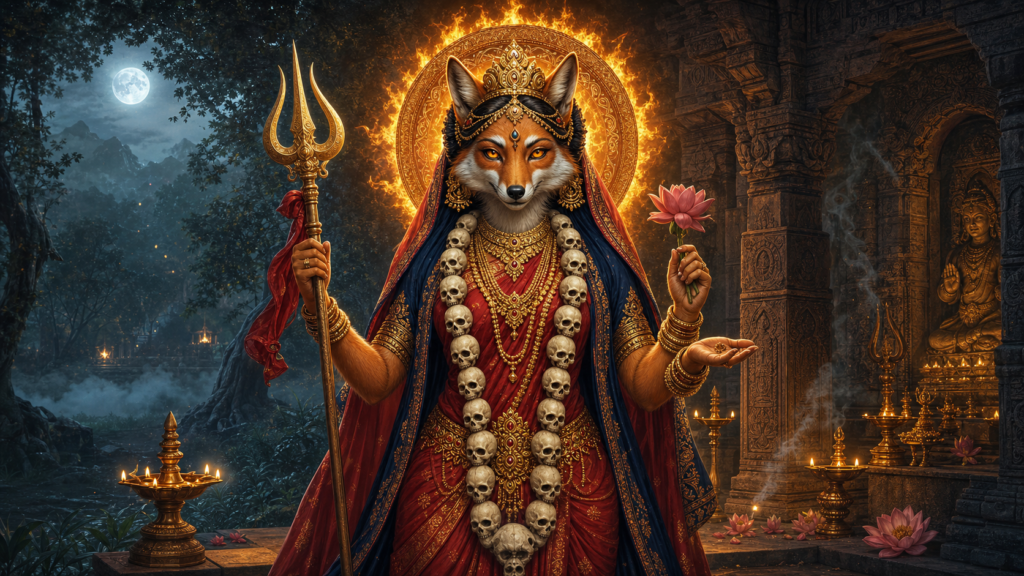
Within the Lalita Sahasranama’s chakra-structured sequence, this verse describes Lakinyambathe Shakti presiding over the Manipura Chakrausing layered, symbolic language. ‘Rakta-varna’ signals the blood-red hue associated with life-force, vitality, courage, and transformative fire. In Shakta traditions, such coloration is less about literal apparel and more a marker of energy (Shakti), radiance (tejas), and the inner blaze of spiritual will located at the navel center.
The terms ‘mansanishta’ and ‘gudanna pritamanasa’ frequently puzzle readers. Commentarial traditions explain that such phrases, especially in tantric contexts, map ritual associations to subtle energies rather than prescribing universal dietary norms. ‘Mansanishta’ is interpreted in many schools as a ritual shorthand embedded in esoteric frameworks, while ‘gudanna’ (jaggery-sweet rice) highlights the devotional sweetness offered by householders. Together, the pair suggests the spectrum of offerings historically listed in textsranging from symbolic to strictly sattvicdepending on desha-kala-patra (context, time, and the devotee’s capacity).
Crucially, the verse culminates in compassion: ‘Samsta bhakta sukhada lakinyamba svarupini’Lakinyamba, in that form, grants well-being to all devotees. The emphasis is not on the offering itself but on the grace that embraces diverse pathways. This aligns with the broader Hindu ethos, where scriptures describe many modes of worship for different temperaments without mandating one path for all.
Historically, Shakta-tantra catalogued offerings across sattva–rajas–tamas to accommodate varied practitioners. Over centuries, mainstream household practice has overwhelmingly preferred sattvic worshipflowers, fruits, jaggery rice (gudanna), and red kumkumwhile retaining the symbolic vocabulary of earlier ritual manuals. Commentators note that textual allowances function descriptively, not prescriptively; many sampradayas explicitly substitute non-vegetarian references with symbolic or purely vegetarian items, upholding ahimsa and focusing on inner transformation.
Read in this light, the Lalita Sahasranama does not conflict with ahimsa; rather, it uses powerful symbols to communicate inner alchemy. The blood-red motif evokes courage to burn impurities; the mention of strong offerings signifies the mastery of instinctual drives at the Manipura center; the sweet rice signals bhakti’s softness and nourishment. Devotional experience in homes across regions often mirrors this balanceelders reciting the names of Devi at dawn, offering red hibiscus, lighting a lamp, and serving simple sweet rice as prasada. The resonance is emotional and accessible, even when the underlying language is esoteric.
Unity across dharmic traditions is strengthened by recognizing this common symbolic method. Buddhism’s language of skillful means, Jainism’s steadfast commitment to ahimsa, and Sikhism’s dignified martial symbolism all employ evocative imagery to serve ethical and spiritual growth. The Lalita Sahasranama’s verse functions similarly: it invites contemplation of inner strength and compassion, not literalism.
For contemporary practitioners seeking practical guidance, most gurus and temple traditions advise sattvic worship: red flowers or cloth to honor ‘rakta-varna’, gudanna or other sweet offerings for ‘pritamanasa’, and meditation at the navel center to align with Lakinyamba’s Manipura energy. This approach preserves scriptural fidelity while honoring ahimsa and the devotional heart of household puja.
Read with care, the verse emphasizes inclusivity: varied offerings reflect varied adhikaris (eligibilities), yet the Devi’s grace‘samsta bhakta sukhada’is universal. The message is clear and unifying: sacred language can be intense, but its purpose is to elevate character, deepen devotion, and foster harmony across the broad Dharmic family.
Inspired by this post on Hindu Pad.