
Within the vast tapestry of Hinduism, fierce manifestations of Shiva operate as catalytic forces that restore equilibrium when dharma is imperiled. Among them, Virabhadra and Bhairava are preeminent. Each concentrates Shiva’s raudra shakti in distinct waysone as an event-specific avenger correcting ritual injustice, the other as an abiding guardian whose gaze spans time itself (kāla). Understanding how they differ in origin, iconography, ritual presence, and philosophical import clarifies not only Shaiva theology but also the shared civilizational grammar of the broader dharmic family.
This comparative study draws on narratives preserved in the Puranas and living temple traditions, as well as the interpretive lenses of Agamic practice and Kashmir Shaivism. It situates Virabhadra and Bhairava in relation to Dharma and Adharma, explores their symbolism, and examines how communities across India experience these deities in worship, art, and seasonal observances. The aim is not sectarian division but an integrated view that honors diversity within unity across Hindu, Buddhist, Jain, and Sikh sensibilities.
Etymology signposts function. Virabhadra unites vīra (heroic) and bhadra (auspicious), indicating the auspiciousness of righteous courage. Bhairava is often parsed from the root bhī (fear) as “the one who removes fear” (bhaya-rava), though popular reception emphasizes his awe-inspiring ferocity. These names encode complementary modes of grace: the heroism that protects and the fearlessness that liberates.
In the Puranas (notably Shiva Purana and Skanda Purana), Virabhadra arises amid the Daksha Yajna crisis. When Sati immolates herself in protest against the desecration of familial and ritual ethics, Shiva’s krodha (indignant grief) externalizes as Virabhadra, a towering commander who dismantles the sacrificial assembly’s arrogance. He decapitates Daksha yet ultimately, by Shiva’s will, restores the rite’s moral arc by returning Daksha to life with a goat’s head, thereby reaffirming that correction in Sanatana Dharma serves renewal rather than nihilism.
Bhairava’s emergence, narrated in Puranic and Tantric sources, centers on Shiva as Kālabhairava. In a mythic dispute, Brahma’s fifth headembodying unchecked pridemeets Bhairava’s blade. The story turns on the pedagogy of humility: Bhairava bears the skull (kapāla) as a mendicant until cosmic justice is resolved at Kashi, where he is revered as the Kotwal of Kashi, the sentinel of sacred order. As guardian (kṣetrapāla), he patrols thresholdsof cities, temples, and consciousnesswhere purity of intent must be safeguarded.
Philosophically, Virabhadra concentrates krodha into a dharmically bounded intervention that corrects a specific historical-ritual violation. Bhairava, by contrast, expands raudra across kāla, embodying both dissolution and fearless presence. If Virabhadra is the righteous flash of the sword that stops a transgression, Bhairava is the unblinking gaze that renders falsehood unsustainable through time.
Read through Dharma and Adharma, the two forms enact pedagogy rather than punishment. Virabhadra dramatizes the principle that sacrificial precision without ethical humility courts collapse. Bhairava instructs that pride, the subtlest impurity, must surrender to the law of reality, an insight mirrored in multiple dharmic traditions where fierce protectors signal compassionate rigor rather than cruelty.
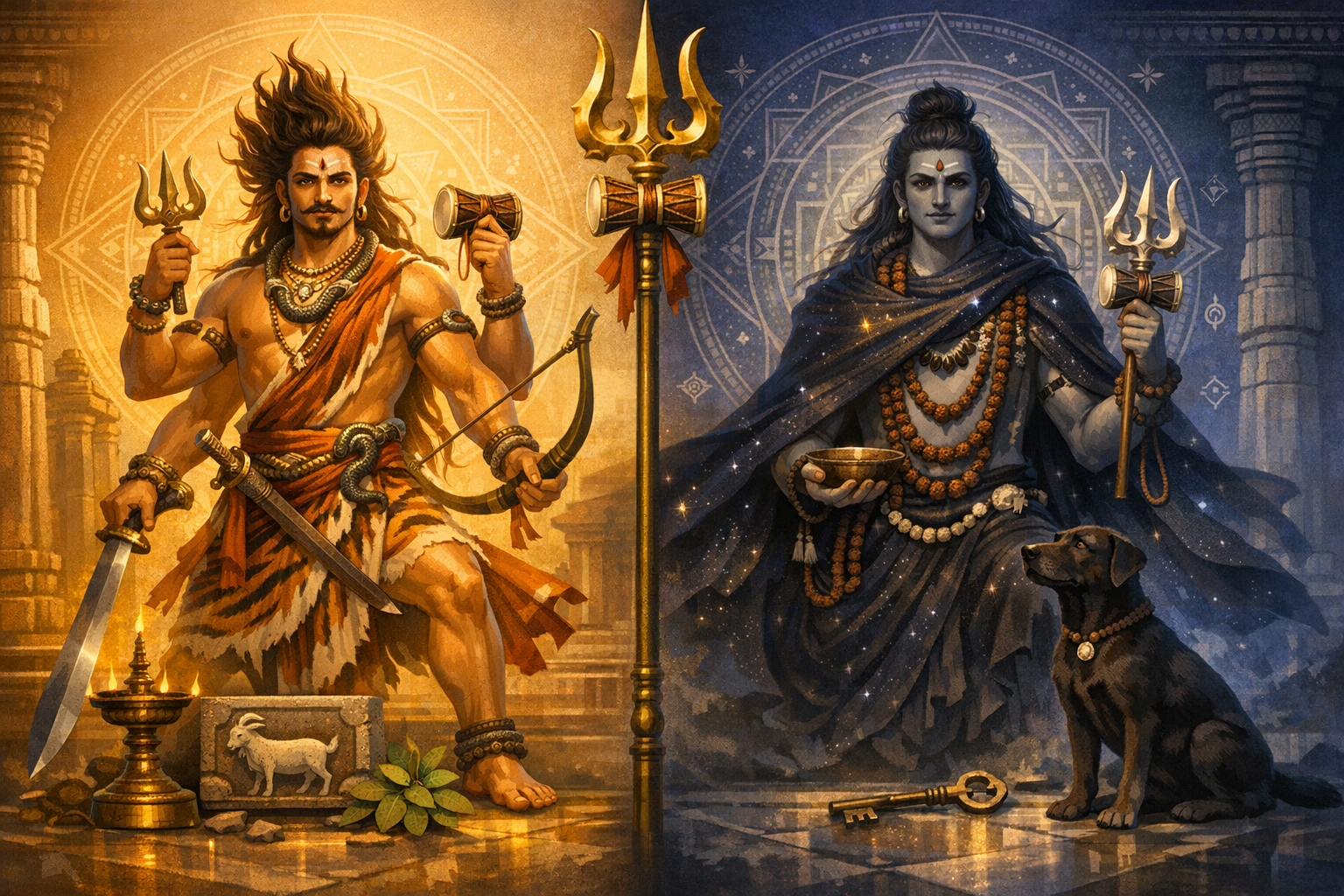
Iconographically, Virabhadra appears as a formidable warrior, often mustachioed, with three eyes and four or more arms bearing weapons such as khadga (sword), dhanus (bow), bana (arrows), trishula (trident), and damaru. Hair radiates upward in dynamic locks, the body clad in tiger skin and adorned with serpent ornaments. Panels may depict Bhadrakali nearby and the goat-headed Daksha in scenes from the yajna narrative, visually encoding the cycle of transgression, consequence, and restoration.
Lepakshi’s 16th-century Veerabhadra temple in Andhra Pradesh, a Vijayanagara masterpiece, has long served as a classroom for devotees and scholars alike. Its mural programs and sculptural registers capture the kinetic tension of Virabhadra’s stancethe inflection point where fury turns medicinal, correcting adharma without abandoning compassion. Across Andhra, Telangana, Karnataka, and Tamil Nadu, Veerabhadra shrines preserve this martial-auspicious synthesis in stone and ritual.
While Virabhadra’s posture is classically “heroic avenger,” contextual renderings vary: from village guardian forms in South India to processional images where vows of courage and protection are ritually renewed. These variations echo the expansive tolerance of Hindu temples where Agamic norms accommodate regional aesthetics without compromising theological clarity.
Bhairava’s iconography is at once stark and layered. As digambara (sky-clad), he wears the cosmos as garment; ash covers the body; serpents and a skull-garland (muṇḍamālā) announce the mastery of mortality. Typical attributes include kapāla (skull bowl), trishula, damaru, pāśa (noose), and a khaṭvāṅga (club). The vahana is the dog (śvāna), whose loyalty and liminality mark Bhairava’s station at thresholdssocial, spatial, and spiritual.
Traditions enumerate Ashta BhairavasAsitanga, Ruru, Chanda, Krodha, Unmatta, Kapala, Bhishana, and Samharaeach aligned with directions, weapons, and rasas within a single protective mandala. This plurality makes Bhairava both intimate and cosmic: a household kṣetrapāla and a grand metaphysical principle of saṁhāra (dissolution) that clears the way for anugraha (grace).
As a living temple presence, Bhairava is ubiquitous. Kaal Bhairav in Ujjain and Kashi’s Bhairava in Varanasi exemplify roles as civic guardians and arbiters of ethical order. In many temples, the keys symbolically “belong” to Bhairava, acknowledging that custodianship comes with accountability. In Nepal’s Kathmandu Valley, public masks and processions of Bhairava underscore his social-contract functionfierce compassion in defense of community.
The ritual calendar distinguishes the two forms. Bhairava’s worship is prominent on Kalashtami (the Krishna Paksha Ashtami each lunar month) and on Bhairava Ashtami, commemorating his appearance. Offerings vary by sampradayafrom fruits and bilva leaves in sattvic puja to regionally sanctioned tantric upacarasyet Agamic discipline remains the norm in established temples. Virabhadra’s worship often intensifies during Maha Shivaratri and in local utsavams that recall the Daksha narrative, aligning martial vows with ethical self-restraint.
In practice, Virabhadra aligns naturally with vows of protection and courage, invoked in rites that fortify communities against fear and injustice. Bhairava aligns with inner vigilanceguarding attention at the doorway of the senses (indriya-dvāra) and dissolving pride. Together, they map a two-step sadhana: act rightly, then abide fearlessly.
Bhairava’s philosophical centrality in Kashmir Shaivism is well known. Texts of the Bhairava corpus, notably the Vijnana Bhairava Tantra, present contemplative methods that refine attention into revelation. There, Bhairava is not merely fierce; he is the very ground of consciousness. Virabhadra, conversely, is less a meditative absolute than a narrative catalyst whose appearance in the Puranas demonstrates how Shiva’s will restores balance when ritual formalism outpaces moral substance.
Art and performance preserve these meanings. In Kerala’s ritual theatre, forms such as Vīrabhadran Theyyam embody redressive action as sacred drama, while urban festivals across the subcontinent stage Bhairava’s vigilant presence at junctions and gates. Temple sculpture, mural iconography, and devotional music all converge to teach that wrath, rightly harnessed, becomes a vessel of wisdom.
Across the dharmic spectrum, homologous insights recur. In Vajrayana Buddhism, wrathful protectors such as Mahākāla mirror the Bhairava principle of fierce compassion. Jain traditions recognize kṣetrapāla figures that function as ethical guardians of space. Sikh reflections on bir ras (the valorous mood) valorize righteous strength in defense of the weak. These convergences affirm a shared axiom: fierceness is sanctified when yoked to the protection of life and truth.
Several practical distinctions summarize the comparative frame without dissolving the kinship of these deities. Virabhadra is event-anchored, narrative-forward, and emblematic of dharmic correction in history; his rasa tilts toward vīra fused with raudra. Bhairava is perennial, threshold-centered, and emblematic of cosmic vigilance; his rasa integrates bhayānaka into a final freedom from fear. Both spring from Shiva’s compassion, differing more in scope and soteriological emphasis than in moral orientation.
For devotees and students of the Puranas, the twin forms translate into complementary disciplines. Virabhadra encourages unequivocal action when ethics are at stakespeaking truth, setting boundaries, and refusing complicity with adharma. Bhairava teaches courageous interioritywatchfulness over pride, humility before time, and steadiness in liminal passages of life. Together they cultivate a complete practice: justice without cruelty and fearlessness without arrogance.
Contemporary relevance follows naturally. In an age of rapid change, temples and texts alike point to these archetypes as guides for civic and personal integrity. Communities honor Virabhadra when they redress wrongs with clarity and compassion; they honor Bhairava when they guard institutions, traditions, and inner life at the gates where corruption can slip in. Such readings keep Sanatana Dharma responsive, rigorous, and inclusive.
Ultimately, Virabhadra and Bhairava reveal the same source refracted through different needshistorical repair and timeless guardianship. Their symbolism invites a unified dharmic imagination in which courage, humility, and devotion are not competing virtues but mutually reinforcing paths. In that light, Shiva’s fierceness is not a threat; it is the surest refuge for those committed to truth.
Inspired by this post on Hindu Blog.
