
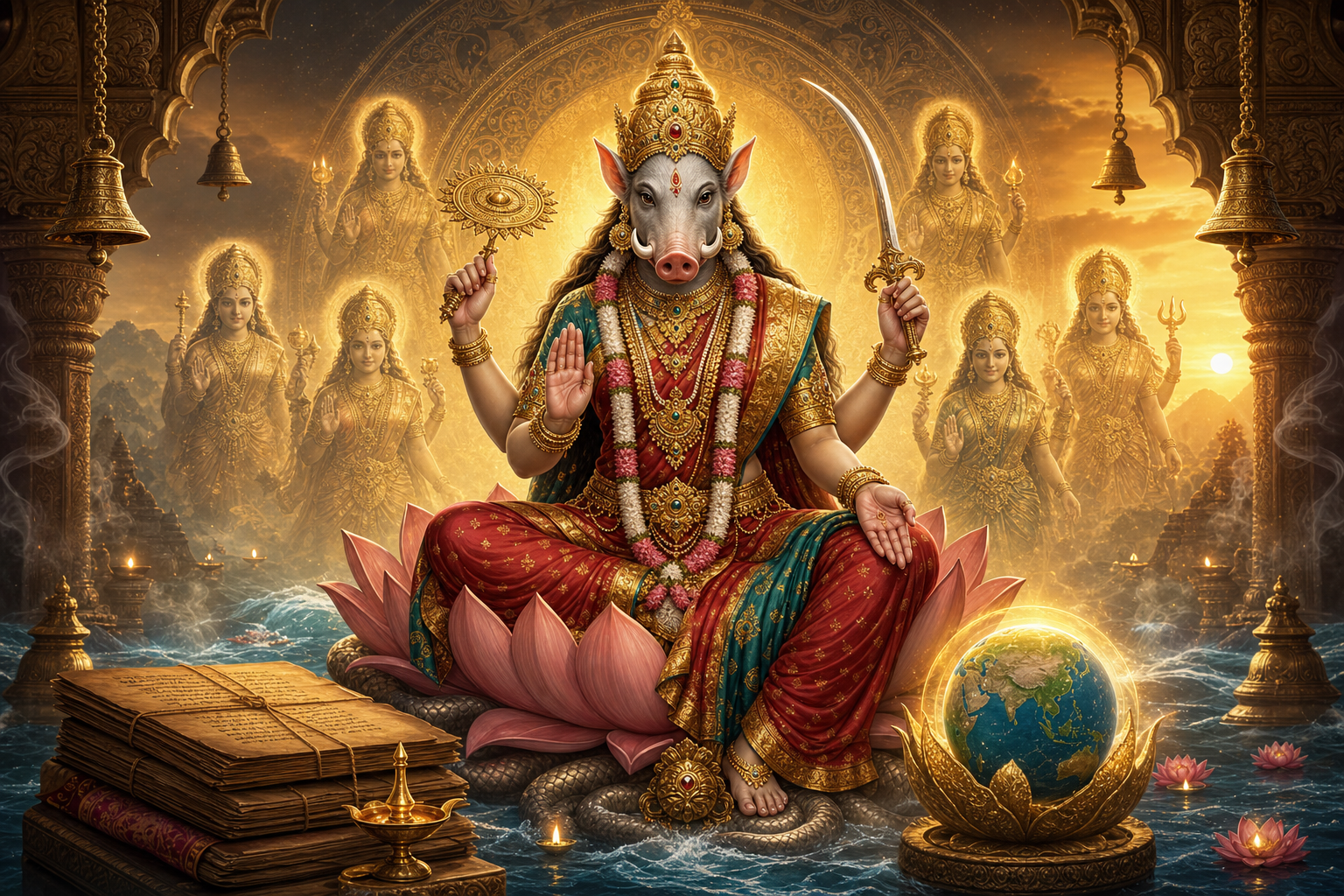
Varahi Devi, also revered as Varahi Mata, occupies a distinctive and powerful place in Hindu sacred imagination. She is counted among the Sapta Matrikas, the Seven Mother Goddesses, and is understood as the Shakti associated with Varaha, the boar incarnation of Lord Vishnu. Her story is preserved across Puranic and Shakta traditions, especially in narratives connected with the Devi Mahatmya of the Markandeya Purana, the Varaha Purana, and the Matsya Purana.
The Varahi Devi Katha is not merely a mythological account of a warrior goddess. It is a theological map of how divine power appears when cosmic order is threatened, how feminine energy acts as protection, and how the Divine Mother manifests in many forms without losing her underlying unity. For devotees, Varahi Mata represents fierce compassion: the protective force that confronts danger, removes inner weakness, and guards the path of dharma.
In the tradition of the Sapta Matrikas, Varahi stands alongside other motherly powers such as Brahmani, Maheshwari, Kaumari, Vaishnavi, Indrani, and Chamunda or Narasimhi, depending on the textual and regional tradition. These Matrikas are not minor goddesses in the ordinary sense; they are concentrated expressions of cosmic functions. They show that divine motherhood in Hinduism is not limited to gentleness alone. It includes wisdom, discipline, battle-readiness, nourishment, moral clarity, and the ability to destroy destructive forces.
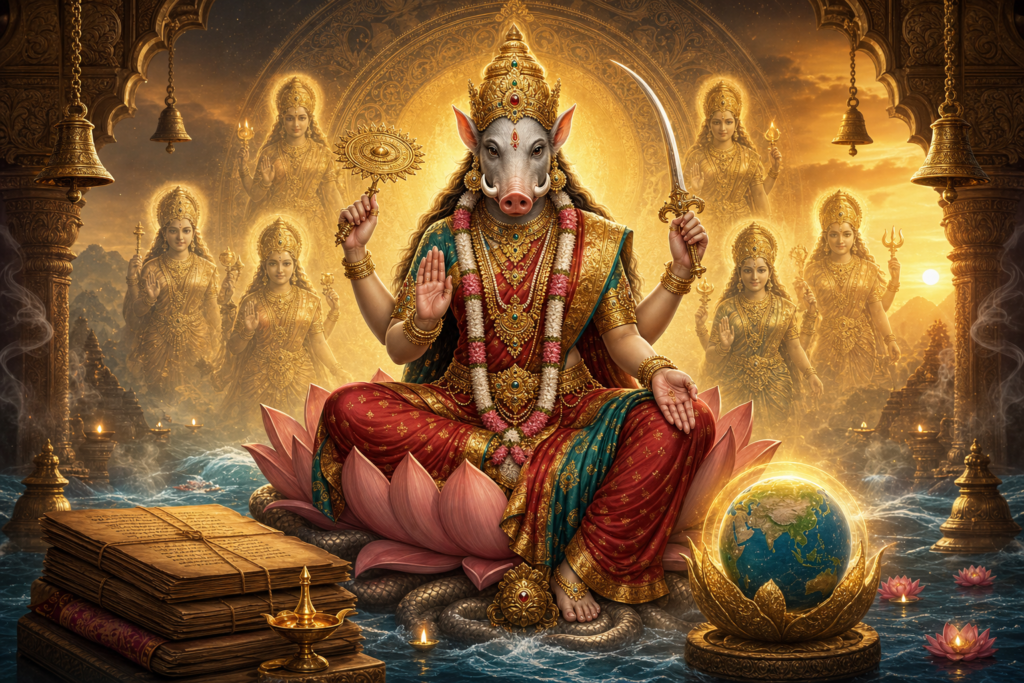
The Devi Mahatmya places the Matrikas within the larger conflict between Devi and the asuric forces represented by Shumbha-Nishumbha and their armies. In this sacred account, divine powers emerge from the devas as feminine energies who assist the Goddess in restoring cosmic balance. Varahi arises as the Shakti of Varaha, bearing the symbolic force of the boar avatar who lifts and protects the earth. Her form therefore combines earth-protection, martial strength, and the uncompromising defense of dharma.
Varahi’s boar-faced iconography is central to her meaning. The boar in Hindu symbolism is not crude or accidental; it is a sign of strength, instinctive intelligence, and the ability to enter difficult terrain. Just as Varaha rescues Bhudevi from the cosmic waters, Varahi is understood as a goddess who reaches into the hidden, troubled, and neglected regions of existence. She confronts what refined appearances often avoid: fear, envy, violence, impurity, and the stubborn residues of adharma.
Traditional descriptions associate Varahi with weapons such as the chakra and sword, and some accounts describe her battling demons with her tusks. These details should be read both as sacred imagery and as psychological symbolism. The chakra suggests discernment and divine order. The sword suggests the cutting away of confusion. The tusks suggest direct force against hardened negativity. Together, they communicate a form of Shakti that does not negotiate with forces that continually regenerate harm.
The Raktabija episode gives this symbolism particular intensity. Raktabija is the demon whose spilled blood produces more demons, making ordinary warfare ineffective. The story communicates a profound insight: some forms of disorder multiply when handled superficially. Anger can create more anger, greed can generate more greed, and violence can reproduce itself if its root is not addressed. In this setting, the Matrikas, including Varahi, become essential because they represent specialized powers of containment, transformation, and decisive action.
In one strand of the Devi Mahatmya tradition, Durga manifests the Matrikas from herself to defeat the demonic army. When Shumbha later challenges the Goddess, she absorbs these powers back into herself. This moment is theologically important. It teaches that the many goddesses are not separate in a competitive or fragmented sense. They are diverse expressions of one Supreme Shakti. The multiplicity of Hindu worship is therefore not disorder, but a sacred recognition that divine reality can be approached through many forms, names, temperaments, and devotional relationships.
The Vamana Purana offers another interpretive layer by describing the Matrikas as arising from different parts of Chandika. In that account, Varahi emerges from Chandika’s back. Such imagery does not reduce the goddess to anatomy; rather, it encodes theological meaning through sacred form. The back can suggest support, hidden strength, and the unseen power that upholds visible action. Varahi is thus associated with the protective force that stands behind dharma even when it is not immediately visible.
The Markandeya Purana praises Varahi as a bestower of blessings and a guardian associated with the northern direction. Directional guardianship is a technical feature of Hindu cosmology, where space itself becomes spiritually ordered. A deity’s relation to a direction does not merely mark geography; it establishes sacred orientation. Varahi’s role as a protector of direction reflects her function as a guardian of boundaries, thresholds, and moral space.
Some Puranic accounts describe Varahi as riding a buffalo, while other narratives present her seated on a preta or upon Shesha-nāga. These variations are not necessarily contradictions. Hindu textual tradition often preserves multiple symbolic registers. A buffalo can signify immense force and grounded power. A preta can represent mastery over death, fear, and the unsettling realities of impermanence. Shesha-nāga connects Varahi to the Vaishnava cosmic order through the serpent associated with Lord Vishnu’s repose.
The Varaha Purana retells the Raktabija theme with a distinctive genealogy in which Matrikas emerge from one another. In that version, Varahi appears from Vaishnavi, the Shakti of Vishnu, and is seated upon Shesha-nāga. This form of narration highlights continuity between Vaishnava and Shakta theology. Varahi is not outside the Vishnu tradition; she is the fierce maternal power of the same sustaining principle that protects the universe.
The same Purana associates Varahi with asuya, often translated as envy. This should not be misunderstood as a condemnation of the goddess. In many Puranic and Tantric frameworks, deities are linked with inner tendencies not because they possess those defects, but because they govern, expose, or transform them. Varahi’s association with envy can therefore be read as a spiritual teaching: the worshipper must confront comparison, insecurity, and resentment before deeper devotion can mature.
The Matsya Purana gives another origin account by placing Varahi and the other Matrikas in the battle against Andhakasura. Like Raktabija, Andhakasura is associated with the terrifying ability of blood to generate further danger. This repeating motif suggests that the ancient texts were deeply attentive to cycles of violence and moral contagion. They understood that certain problems cannot be solved by external force alone; they require disciplined, sacred, and transformative power.
Varahi Mata’s story also reveals the depth of Hindu goddess traditions. Devi is not treated as a decorative presence but as the active principle of cosmic intelligence. She creates, protects, withdraws, and transforms. She appears as beauty, learning, nourishment, terror, justice, and silence. Varahi belongs to the fierce side of this sacred spectrum, yet her fierceness remains protective rather than chaotic. She is frightening to adharma, but sheltering to the devotee.
In devotional life, Varahi is often approached for protection, courage, removal of hostile influences, and the strengthening of inner will. Her worship is especially significant in some Shakta and Tantric lineages, where she is understood as a powerful guardian deity. Yet the broader meaning of Varahi is accessible even outside specialized ritual contexts. Her presence reminds practitioners that spiritual life requires more than sentiment. It also requires vigilance, discipline, and the courage to face one’s own inner darkness.
Varahi Navratri, observed in Ashada Masam in many traditions, reflects this devotional focus. While the more widely known Navratri festivals emphasize the worship of the Divine Mother in public and household forms, Ashada Navratri is often more inward, protective, and sadhana-oriented. For devotees of Varahi Mata, this period becomes a time to seek strength, clarity, and spiritual protection through mantra, puja, vrata, and contemplation.
Texts and devotional compositions such as Varahi Sahasranamam and Varahi Nigrahashtakam deepen the worshipper’s understanding of her many attributes. A sahasranama tradition presents the deity through a thousand names, allowing devotion to become a contemplative study of divine qualities. A stotra such as Nigrahashtakam reflects the protective and corrective aspect of the goddess, emphasizing her power to restrain harmful forces and restore balance.
Academically, Varahi’s iconography shows how Hindu traditions encode theology through form. Her animal face is not a primitive remnant but a sophisticated symbol of divine capacity. Her weapons are not merely instruments of violence but emblems of cosmic function. Her vehicles and seats express layered relationships with death, earth, serpent symbolism, and dharmic protection. Her presence among the Sapta Matrikas demonstrates how Hindu religious imagination integrates local, Puranic, Tantric, and philosophical streams.
The emotional power of Varahi Devi Katha lies in its refusal to simplify spiritual life. Human beings know from lived experience that not every difficulty is gentle, and not every fear disappears through passive hope. Some challenges require a motherly force that is also stern, alert, and fearless. Varahi speaks to that need. She embodies the confidence that divine grace may arrive not only as comfort, but also as the strength to resist what diminishes life.
Her story also supports a wider Dharmic understanding of unity in diversity. Hinduism, Buddhism, Jainism, and Sikhism differ in theology, ritual, and philosophical emphasis, yet they share deep concerns with discipline, ethical transformation, liberation from harmful tendencies, and the cultivation of inner strength. Varahi’s mythology belongs specifically to Hindu Shakta and Puranic tradition, but its moral message resonates broadly: destructive impulses must be recognized, restrained, and transformed through wisdom and disciplined practice.
Within Hinduism itself, Varahi helps bridge Vaishnava and Shakta devotional worlds. Because she is linked to Varaha and Vaishnavi while also functioning as a fierce form of Devi, she illustrates how sectarian boundaries often become porous in sacred literature. The Divine Mother can be worshipped as Supreme Shakti, as the power of Vishnu, as a Matrika, as a guardian, and as an intimate protector. These approaches need not cancel one another; they enrich the tradition’s spiritual vocabulary.
The Varahi Devi Katha therefore deserves careful attention not only as a story of battle but as a study in sacred power. It teaches that divine protection is active, that moral disorder can multiply if left unchecked, and that the feminine divine includes both tenderness and formidable strength. Varahi Mata stands as a guardian of dharma, a transformer of inner vice, and a reminder that the Divine Mother appears in precisely the form needed for the crisis at hand.
For the modern reader, the lesson is practical as well as devotional. Envy, fear, anger, and confusion may not appear as mythic demons, yet they can reproduce themselves in thought, speech, family life, institutions, and society. Varahi’s symbolism encourages a disciplined response: name the disorder, cut through illusion, protect what is sacred, and return to dharma with steadiness. In this sense, Varahi Mata is not only a goddess of ancient scripture; she remains a living symbol of courage, protection, and transformative wisdom.
Inspired by this post on Hindu Pad.

Leave a Reply
You must be logged in to post a comment.