
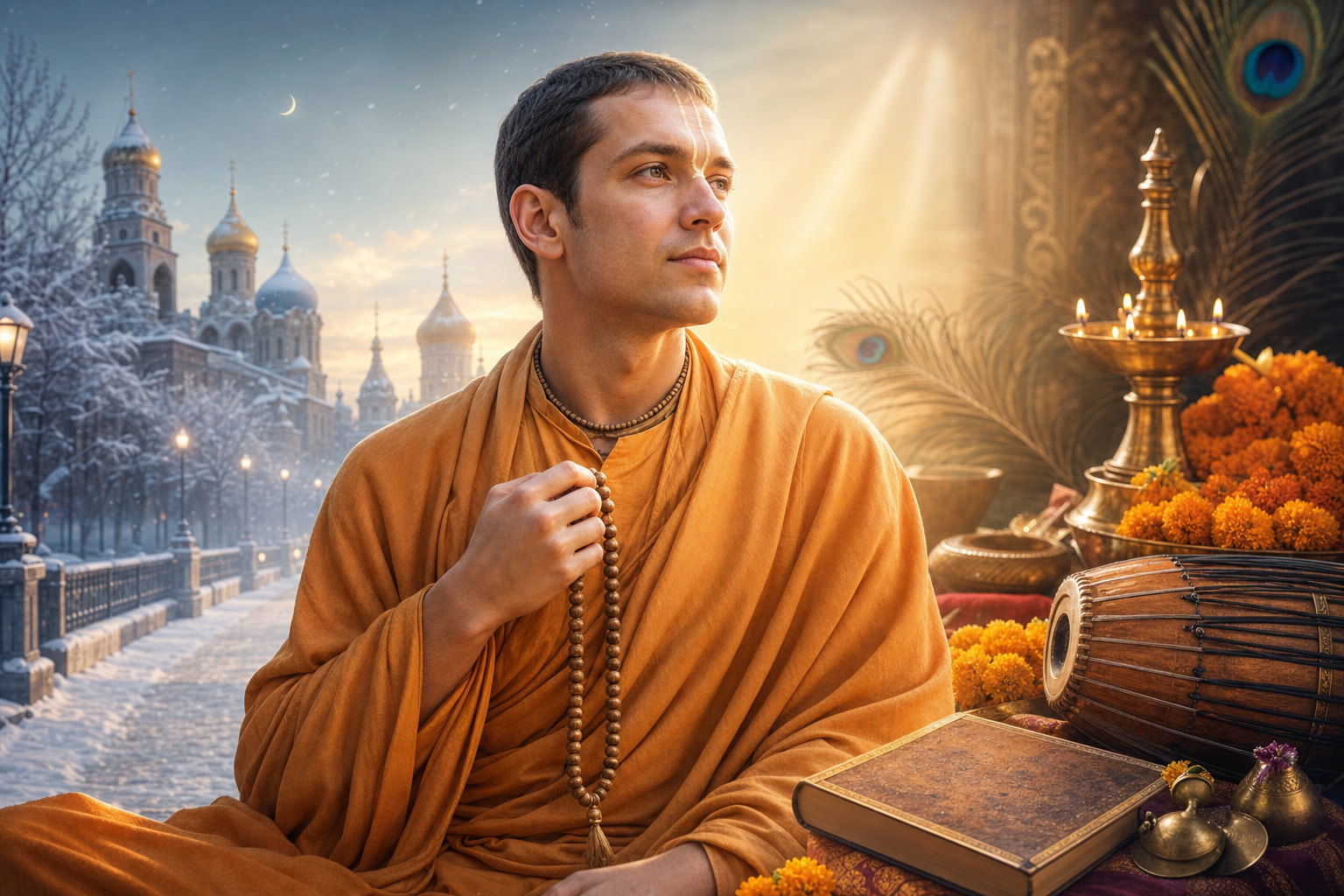

The journey from a Muslim family in Russia to life as a Hare Krishna monk is not merely a story of religious change. It is a study in spiritual longing, cultural transition, disciplined practice, and the universal human search for meaning. At its deepest level, this transformation shows how inherited identity and personal realization can meet without hatred, denial, or contempt. A person may be shaped by one family tradition, encounter another spiritual path, and still carry forward respect for the sincerity, devotion, and moral seriousness found in the first home.
Such a life story is especially significant because it brings together worlds that are often described as separate: Russian society, Muslim family culture, Hindu devotional practice, and the global Hare Krishna movement. Yet lived spirituality rarely follows neat boundaries. A seeker may begin with childhood memories of prayer, family discipline, modesty, community life, and reverence for God, and later discover that the language of bhakti gives those inner instincts a new form. The result is not a simple break with the past, but a reorientation of the heart toward a chosen discipline.
The Hare Krishna tradition belongs to Gaudiya Vaishnavism, a devotional stream of Sanatana Dharma centered on loving service to Sri Krishna. Its modern global presence is closely associated with A. C. Bhaktivedanta Swami Prabhupada, who founded the International Society for Krishna Consciousness, or ISKCON, in New York in 1966. Through public kirtan, scriptural teaching, vegetarian prasadam, temple worship, and disciplined daily sadhana, ISKCON carried the teachings of the Bhagavad Gita and Srimad Bhagavatam into cultures far removed from Bengal, Vrindavan, and the sacred geography of India.
For a seeker raised in Russia, the encounter with Krishna consciousness is also an encounter with a different understanding of the self. In many modern societies, identity is often described through nationality, family, profession, ethnicity, or inherited religion. Gaudiya Vaishnava philosophy begins from another premise: the living being is not merely the body or the social label attached to it, but an eternal atman whose fulfillment lies in relationship with the Supreme. This philosophical shift can be intellectually demanding, but it is also emotionally powerful because it addresses loneliness, anxiety, pride, guilt, and spiritual hunger at their root.
The transition from ordinary social life to monastic discipline requires more than attraction to an idea. It requires a new rhythm of living. A Hare Krishna monk, whether serving as a brahmachari or in another form of renounced devotional life, typically organizes the day around japa meditation, study, worship, seva, kirtan, and community responsibility. The external signs of monkhood may be visible in clothing, diet, and temple routine, but the deeper change concerns consciousness. The aim is to train the mind away from restless consumption and toward remembrance of Krishna.
The central practice of the movement is the chanting of the Hare Krishna maha-mantra: Hare Krishna Hare Krishna Krishna Krishna Hare Hare, Hare Rama Hare Rama Rama Rama Hare Hare. In academic terms, this is a form of nama-sankirtana, devotional invocation through the divine names. In lived experience, it becomes a way of steadying the mind, softening the heart, and aligning speech with sacred memory. The practice is simple enough for a beginner and profound enough to occupy a lifetime of spiritual refinement.
What makes this particular journey compelling is the movement from inherited faith to deliberate practice. A Muslim family background often emphasizes reverence for God, prayer, discipline, purity, and moral accountability. Krishna bhakti also asks for surrender, humility, regulated conduct, and remembrance of the Divine. The vocabulary differs, the theology differs, and the ritual world differs; however, the ethical seriousness of spiritual life creates a meaningful point of contact. A respectful account of such a journey should therefore avoid triumphalism. It should recognize that sincere spiritual seeking can grow from the moral soil of one tradition and flower through another.
Russia adds another layer of historical complexity. The Soviet period produced decades of official suspicion toward organized religion, yet religious memory survived in families, local communities, and private practice. Post-Soviet Russia became a space where Orthodox Christianity, Islam, Buddhism, Judaism, and new religious movements all had to negotiate visibility, legitimacy, and continuity. Within that landscape, the presence of Hare Krishna devotees demonstrated the portability of bhakti. Krishna consciousness did not remain confined to India or the Indian diaspora; it became a spiritual language adopted by Russians, Central Asians, Europeans, Americans, and many others.
The personal cost of such a transformation should not be minimized. Leaving the expected path of family and community can produce misunderstanding, emotional distance, and difficult questions. Relatives may worry that a familiar identity has been abandoned. Friends may mistake devotion for extremism or simplicity for weakness. The seeker must then learn how to be firm without becoming harsh, and grateful without becoming confused. Mature spirituality is tested not only inside the temple but also in conversations with parents, siblings, neighbors, and the wider society.
In the best expression of dharmic life, devotion deepens compassion rather than narrowing it. A Hare Krishna monk is not called to despise the world, but to serve it with a purified intention. This is why prasadam distribution, kirtan, teaching, temple service, cow protection, vegetarian ethics, and community care have become recognizable features of ISKCON practice. Bhakti is not only emotion; it is disciplined action offered to Krishna. The heart is trained through service, and service becomes the visible form of theology.
The journey also illustrates an important principle shared across dharmic traditions: spiritual identity is cultivated through practice. Hinduism, Buddhism, Jainism, and Sikhism differ in metaphysics, scriptures, and forms of worship, yet all place immense value on disciplined transformation. Whether described as sadhana, meditation, seva, naam, ahimsa, tapas, self-control, or compassion, the central insight remains practical: the human being can be refined. One is not condemned to remain a bundle of impulses, anxieties, and inherited assumptions.
Krishna consciousness gives this refinement a specifically Vaishnava shape. The practitioner learns that knowledge alone is insufficient if the heart remains proud. Ritual alone is insufficient if it lacks devotion. Renunciation alone is incomplete if it produces contempt for others. The Bhagavad Gita presents bhakti as a path in which action, knowledge, meditation, and surrender become harmonized. The monk’s life therefore becomes a laboratory of applied philosophy, where the claims of scripture are tested in daily discipline.
Food is one of the most visible examples of this transformation. In Vaishnava practice, vegetarian food prepared with devotion and offered to Krishna becomes prasadam, sacred grace. This changes the meaning of eating. Food is no longer merely fuel, pleasure, or cultural habit; it becomes part of a moral and spiritual ecology. For someone entering this path from another background, prasadam can become an early experience of belonging. It is theology made tangible, hospitality made sacred, and discipline made nourishing.
Clothing and outward symbols also carry meaning, but they should not be mistaken for the essence. A shaved head, tilaka, beads, robes, or a new spiritual name may mark entry into a devotional community, yet the inner work is slower and more demanding. Anger, ego, attachment, fear, and the need for approval do not disappear merely because a person changes external identity. The seriousness of monkhood lies in the willingness to submit those inner tendencies to long-term purification.
The role of the guru is central in this process. In the guru-shishya tradition, the teacher is not simply a lecturer or cultural representative. The guru functions as a guide who connects the disciple to parampara, the living chain of spiritual transmission. For a seeker from Russia or any other non-Indian background, this relationship can be transformative because it places personal experience within a larger lineage. The path is no longer self-invention; it becomes disciplined participation in a tradition older and wider than the individual self.
At the same time, a responsible discussion of conversion and spiritual transformation must acknowledge human complexity. A person’s movement into Hare Krishna life should not be reduced to romantic rebellion, cultural exoticism, or rejection of family. It may involve intellectual study, emotional healing, mystical attraction, community experience, ethical conviction, and the search for a life that feels coherent. The decision to become a monk is especially serious because it asks the individual to place spiritual service above ordinary ambitions for wealth, status, and domestic comfort.
There is also a broader cultural lesson here. Dharmic traditions have historically shown a remarkable capacity to receive seekers from different backgrounds while preserving distinct philosophical identities. Hindu, Buddhist, Jain, and Sikh communities have all produced forms of discipline that are not limited to birth identity alone. The dignity of the seeker lies in sincerity, practice, and transformation. This does not erase the importance of ancestry or community, but it prevents spirituality from becoming a closed inheritance rather than a living path.
The story therefore speaks to anyone who has felt spiritually displaced. Modern life often produces people who inherit one language of meaning but inwardly search for another. Some remain within the religion of birth and deepen it. Others encounter a new path that gives structure to questions they could not previously articulate. In either case, the movement from confusion to commitment is never merely intellectual. It involves the body, the senses, the habits, the friendships, the calendar, the diet, the speech, and the use of time.
A Hare Krishna monk’s discipline may appear austere from the outside, but its inner logic is relational. The purpose is not self-punishment. The purpose is to remember Krishna, serve Krishna, and see all living beings as connected to Krishna. This theological vision can soften social divisions because it places spiritual dignity before worldly labels. Nationality, family background, and previous religious identity remain part of biography, but they no longer exhaust the meaning of the person.
For dharmic unity, this is an important lesson. Unity does not require flattening all traditions into sameness. Hinduism, Buddhism, Jainism, and Sikhism should be understood with their own texts, practices, histories, and philosophical distinctions. Yet they share a civilizational respect for disciplined transformation, ethical living, reverence for teachers, and the possibility of liberation from ego-centered existence. A Russian seeker becoming a Hare Krishna monk can therefore be read as one individual story and also as part of a wider global movement of people turning toward dharma for depth, clarity, and purpose.
The emotional power of the journey lies in its combination of rupture and continuity. There is rupture because the monk chooses a life that may differ sharply from family expectation. There is continuity because the hunger for God, purity, surrender, and moral seriousness may already have been present from childhood. Krishna bhakti gives that hunger a specific name, sound, discipline, and community. The transformation is not from nothing to faith, but from seeking to surrendered practice.
In an age of identity conflict, such narratives should be handled with care. They should not be used to insult one tradition or glorify another through hostility. The deeper value of the story is that it reveals the soul’s search for truth. A society committed to spiritual maturity must allow individuals to seek, study, practice, and commit without coercion or contempt. Genuine dharma is strengthened when spiritual choice is guided by knowledge, humility, and responsibility.
The journey from a Muslim family in Russia to Hare Krishna monkhood ultimately becomes a meditation on belonging. The monk belongs to a family history, to a Russian cultural context, to a wider human community, and now to a Vaishnava lineage of bhakti. These layers need not be treated as enemies. When understood with maturity, they show how the human heart can travel across boundaries and still seek harmony, gratitude, and service.
The enduring message is clear: spiritual life becomes credible when it produces humility, steadiness, compassion, and service. Krishna consciousness, at its best, is not an escape from responsibility but a disciplined way of reordering responsibility around the Divine. For seekers across the world, this story offers a powerful reminder that dharma is not an abstract category. It is lived in daily choices, tested in relationships, strengthened through practice, and fulfilled through love of God.
Inspired by this post on Dandavats.




Leave a Reply
You must be logged in to post a comment.