
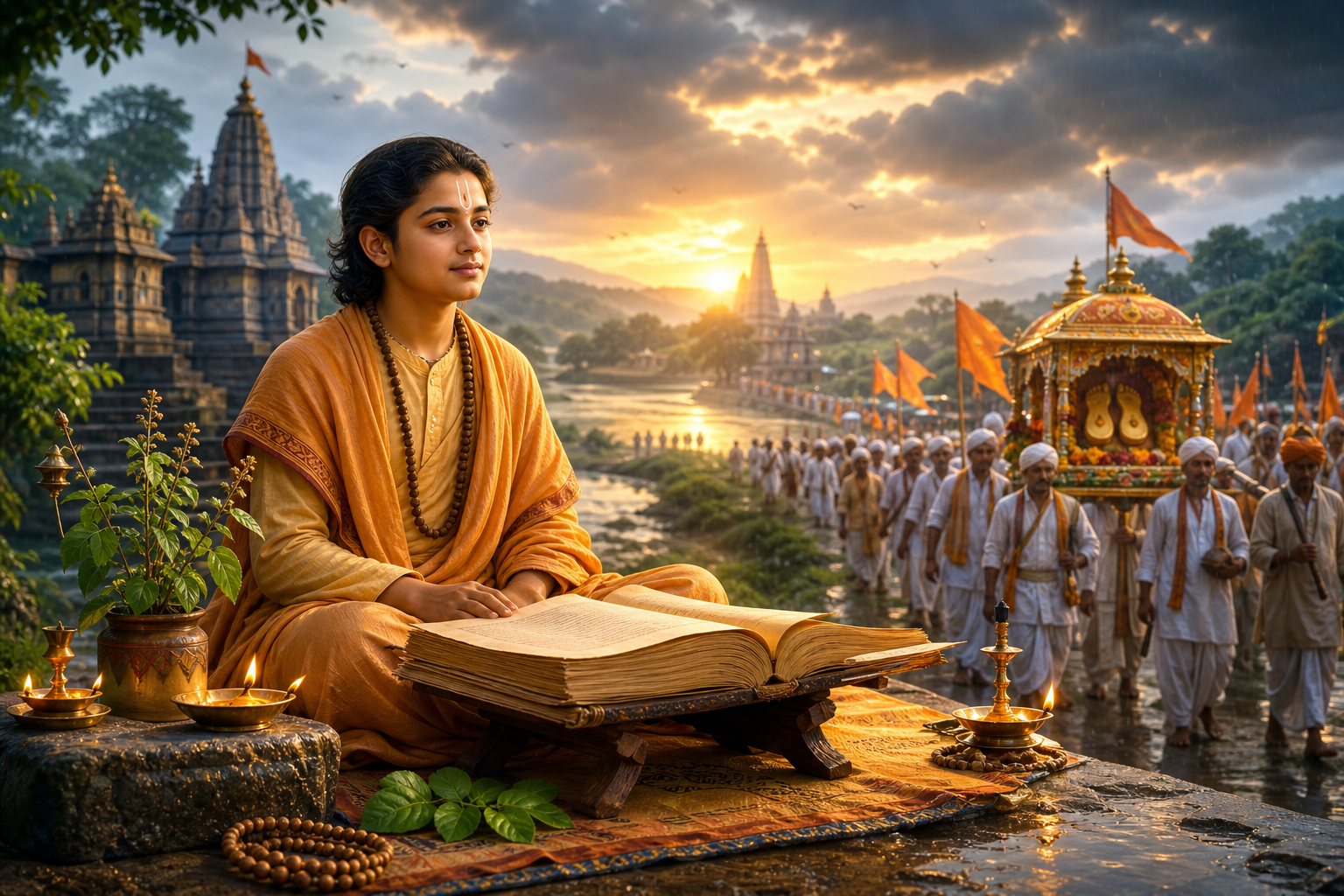
Sant Dnyaneshwar Jayanti 2026 falls on Friday, September 4, and commemorates the birth anniversary of Sant Dnyaneshwar Maharaj, the 13th-century saint, philosopher, yogi, poet, and spiritual teacher whose influence remains central to Maharashtra’s Varkari tradition. The observance is traditionally connected with Krishna Paksha Ashtami in the Shravan month according to the Shaka calendar followed in Maharashtra, a calendrical detail that places the festival within the living rhythm of Hindu panchang, tithi, and regional devotional practice.
The significance of this Jayanti cannot be reduced to a date alone. It is a remembrance of a short but luminous life that shaped Marathi literature, Hindu spirituality, the Bhakti Tradition, and the devotional culture of Pandharpur, Alandi, and countless homes where the name “Mauli” is spoken with affection. Sant Dnyaneshwar is remembered not merely as a historical figure, but as a spiritual presence whose teachings make philosophical wisdom accessible without diminishing its depth.
Most traditional accounts place Sant Dnyaneshwar’s birth in 1275 CE and his Sanjeevan Samadhi in 1296 CE, although scholarly and hagiographical traditions preserve some variation in the details of his life. What remains broadly accepted is the extraordinary scale of his contribution within a life of roughly two decades. His major works, especially the Dnyaneshwari or Bhavarth Deepika, and the Amrutanubhav, continue to stand at the intersection of Sanskritic learning, Marathi expression, Advaita Vedanta, Yoga, and bhakti toward Vithoba.
The historical setting of Sant Dnyaneshwar’s life was medieval Maharashtra under the Yadava period, when devotional, philosophical, and literary currents were interacting in powerful ways. His family background, the struggles surrounding social acceptance, the guidance of his elder brother and guru Nivruttinath, and the companionship of his siblings Sopan and Muktabai form an important part of the sacred memory around him. These accounts are often devotional in tone, yet they preserve a profound social message: spiritual realization is not confined by external status, age, language, or inherited privilege.
Sant Dnyaneshwar’s most celebrated contribution is the Dnyaneshwari, a Marathi commentary on the Bhagavad Gita traditionally dated to 1290 CE. Its importance is literary, philosophical, and civilizational. At one level, it made the Gita’s teaching available in the language of the people. At another level, it demonstrated that a regional language could carry the full weight of metaphysics, ethics, devotion, and subtle yogic insight. For Marathi culture, it became a foundational text; for Hindu thought, it became a bridge between scriptural authority and lived experience.
The technical brilliance of the Dnyaneshwari lies in the way it explains difficult ideas without flattening them. Concepts such as atman, Brahman, karma, jnana, bhakti, yoga, detachment, self-mastery, and divine immanence are interpreted through poetic analogies, everyday images, and devotional warmth. The text does not merely translate the Bhagavad Gita; it opens a contemplative field in which knowledge and love are not rivals. This synthesis is one reason Sant Dnyaneshwar remains relevant to students of Vedanta, practitioners of Yoga, devotees of Vithoba, and readers interested in Indian philosophy.
The Amrutanubhav, often translated as “the experience of immortality,” reveals another dimension of Sant Dnyaneshwar’s thought. If the Dnyaneshwari is a devotional-philosophical illumination of the Gita, the Amrutanubhav is a more direct exploration of spiritual experience. It addresses non-duality, consciousness, the limits of language, the relation between knowledge and realization, and the experiential dimension of truth. In academic terms, it belongs to the highest stream of Indian philosophical literature; in devotional terms, it is a map of inner awakening.
The Jayanti observance invites attention to the panchang basis of the festival. Krishna Paksha refers to the waning half of the lunar month, and Ashtami is the eighth tithi. Shravan, especially in Maharashtra and other Hindu regions, is associated with worship, vrata, pilgrimage, and heightened devotional practice. By locating Sant Dnyaneshwar Jayanti on Shravan Krishna Ashtami, the tradition places his birth within a sacred seasonal atmosphere of rain, renewal, restraint, and remembrance.
In 2026, the September 4 observance provides devotees, scholars, and cultural communities an opportunity to revisit not only the date of birth but the meaning of birth in the spiritual sense. Sant Dnyaneshwar’s life suggests that wisdom is born whenever knowledge becomes compassionate, whenever scripture becomes accessible, and whenever devotion becomes inclusive rather than narrow. This is why his Jayanti continues to feel alive rather than ceremonial.
Alandi holds a special place in this remembrance. The town is associated with Sant Dnyaneshwar’s Sanjeevan Samadhi and remains one of Maharashtra’s important pilgrimage centers. Devotees visit the samadhi shrine with the belief that the saint’s presence is living and accessible. The experience of Alandi is not only architectural or historical; it is devotional, auditory, and communal, shaped by abhangas, Haripath recitation, kirtan, circumambulation, and the quiet discipline of darshan.
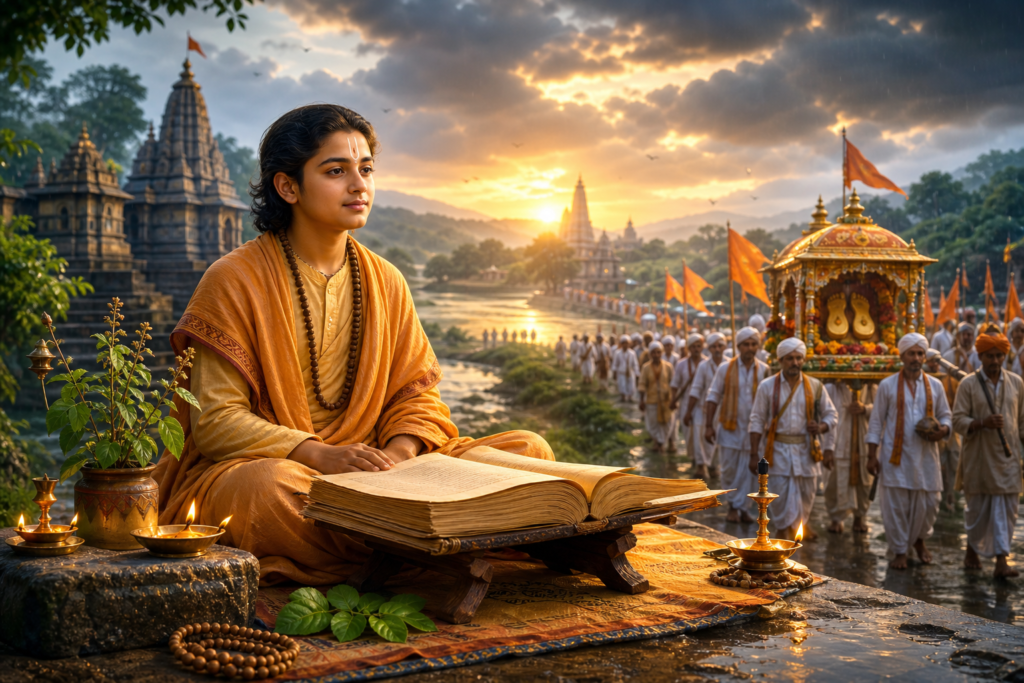
The connection between Alandi and Pandharpur is central to the Varkari tradition. The annual Wari, in which the paduka of Sant Dnyaneshwar are carried in palkhi from Alandi toward Pandharpur, expresses the theology of movement: the devotee walks, sings, serves, remembers, and dissolves ego through collective discipline. This pilgrimage is one of the most visible embodiments of Maharashtra’s devotional culture, and it continues to demonstrate how bhakti can create social cohesion across region, caste, class, and occupation.
Sant Dnyaneshwar’s association with Sant Namdev is another important part of his legacy. Tradition holds that after composing Amrutanubhav, Sant Dnyaneshwar undertook a pilgrimage to northern India with Namdev and other saints. Whether every detail of these accounts is treated historically or devotionally, their cultural meaning is clear: the saintly life is not isolated. It travels, converses, listens, and expands. The companionship of Dnyaneshwar and Namdev symbolizes the unity of knowledge and song, philosophy and surrender, meditation and public devotion.
This spirit of unity is particularly important for the broader dharmic vision. Sant Dnyaneshwar’s work belongs within Hinduism, yet the values he emphasizes—humility, non-injury, inner discipline, reverence for the guru, devotion, self-realization, and compassion—resonate across Hindu, Buddhist, Jain, and Sikh ethical worlds. His approach does not erase differences among dharmic traditions; rather, it shows that multiple paths can share a civilizational commitment to liberation, self-restraint, wisdom, and service.
The Dnyaneshwari also reflects an inclusive devotional imagination within Hindu traditions themselves. It reveres multiple expressions of the sacred and draws from Vaishnava, Shaiva, Shakta, Vedantic, yogic, and bhakti sensibilities. This makes Sant Dnyaneshwar especially valuable in an age that often turns religious identity into argument. His work offers a more disciplined alternative: clarity without hostility, devotion without exclusion, and philosophy without arrogance.
One of the most emotionally powerful dimensions of Sant Dnyaneshwar’s life is the tension between suffering and serenity. Traditional narratives remember the hardship faced by his family, the social complications around his father’s renunciation and return to household life, and the burden carried by the children. Yet the legacy that emerged from this pain was not bitterness. It was literature, bhakti, wisdom, and compassion. This transformation gives his Jayanti a deeply human relevance: inner greatness is often forged not by escaping suffering, but by transmuting it into insight.
His ethical teaching, especially as reflected through the Dnyaneshwari, gives importance to humility, purity of mind, patience, devotion, restraint of the senses, and non-violence in thought, speech, and action. These are not abstract virtues. They are practices for everyday life. A person dealing with family conflict, intellectual pride, social pressure, or spiritual confusion can still find practical guidance in this framework. Sant Dnyaneshwar’s thought insists that realization must refine conduct.
The title “Mauli,” often associated with Sant Dnyaneshwar, carries a tender meaning. It evokes the idea of motherly compassion, spiritual nourishment, and intimate care. This is striking because he is not remembered only as a scholar or yogi, but as one whose knowledge has a maternal quality. The image of Mauli softens the distance between saint and devotee. It suggests that true knowledge does not dominate; it shelters, nourishes, and liberates.
From a literary perspective, Sant Dnyaneshwar helped establish Marathi as a powerful vehicle for sacred thought. Before such vernacular expressions became widespread, philosophical discourse was often mediated through Sanskrit learning. Sant Dnyaneshwar did not reject Sanskritic wisdom; he honored it by making it available through Marathi. This is a crucial point. His work represents continuity, not rupture. It shows how tradition renews itself when knowledge flows into the language of lived communities.
The Varkari movement that reveres Sant Dnyaneshwar places great emphasis on nama-smarana, kirtan, pilgrimage, simplicity, vegetarian discipline for many practitioners, and devotion to Vithoba of Pandharpur. Its devotional culture has historically brought together farmers, artisans, scholars, saints, householders, women, and marginalized communities. Sant Dnyaneshwar’s life and compositions helped create a spiritual grammar in which divine love and social humility could stand together.
For contemporary readers, Sant Dnyaneshwar Jayanti 2026 can be approached at several levels. Devotees may observe it through puja, abhang recitation, reading the Dnyaneshwari, visiting temples, remembering Vithoba, or offering seva. Students may use the day to study Marathi bhakti literature and the development of vernacular theology. Families may treat it as an occasion to introduce younger generations to the lives of Hindu Saints whose teachings combine courage, tenderness, and intellectual depth.
The festival also raises an important question for modern society: what does it mean to make knowledge accessible without making it shallow? Sant Dnyaneshwar’s answer remains instructive. Accessibility does not require oversimplification. It requires compassion for the learner, mastery of the subject, and the ability to speak from realization rather than performance. In this sense, the Dnyaneshwari remains a model for education, commentary, translation, and spiritual communication.
There is also a philosophical lesson in the way Sant Dnyaneshwar integrates jnana and bhakti. In many debates, knowledge and devotion are treated as separate temperaments: one intellectual, the other emotional. Sant Dnyaneshwar refuses such a division. For him, true knowledge ripens into devotion, and true devotion is illumined by knowledge. This integrated model has lasting relevance for Hindu philosophy and for all dharmic seekers who wish to avoid both dry intellectualism and unexamined sentimentality.
Sant Dnyaneshwar’s relationship with the guru principle is equally significant. Nivruttinath, his elder brother and guru, occupies a central role in traditional accounts. The guru-shishya relationship in this context is not merely institutional. It is transformative. It represents the transmission of discipline, insight, restraint, and interior awakening. Sant Dnyaneshwar’s reverence for the guru reminds modern readers that spiritual autonomy and spiritual humility need not contradict one another.
The story of his Sanjeevan Samadhi at Alandi is among the most sacred and moving elements of his life. Tradition holds that, after completing his mission, he entered a deep meditative state and took samadhi at a young age. Historically minded readers may approach this account with critical caution, while devotees experience it as living truth. Both approaches can acknowledge the same fact: the memory of this event has shaped centuries of pilgrimage, poetry, ritual, and spiritual longing.
Sant Dnyaneshwar Jayanti should therefore be understood as more than a biographical anniversary. It is a cultural observance, a literary remembrance, a philosophical invitation, and a devotional renewal. It asks communities to remember a saint who gave language to realization, dignity to common speech, and philosophical depth to public devotion. It also asks whether present-day religious life can retain that same generosity of spirit.
The most enduring message of Sant Dnyaneshwar is that the divine is not distant from life. The field, the road, the river, the home, the temple, the spoken word, and the disciplined mind can all become places of realization. This is why his memory continues to travel from Alandi to Pandharpur, from the pages of the Dnyaneshwari to the voices of kirtankars, and from scholarly study to the quiet faith of devotees.
On September 4, 2026, Sant Dnyaneshwar Jayanti offers a meaningful occasion to honor Maharashtra’s spiritual heritage and the wider dharmic commitment to wisdom, compassion, and liberation. The observance is not only about remembering what Sant Dnyaneshwar achieved in the 13th century. It is about allowing his teachings to question the present: whether knowledge is being shared with humility, whether devotion is widening the heart, and whether spiritual practice is producing kindness in action.
In that sense, Sant Dnyaneshwar remains powerfully contemporary. His life teaches that youth can carry wisdom, suffering can become compassion, language can become scripture-like in its dignity, and devotion can unite communities without erasing diversity. Sant Dnyaneshwar Jayanti 2026 is therefore both a festival and a discipline of remembrance: a day to bow to Mauli, study deeply, serve quietly, and renew the dharmic values of unity, humility, and inner realization.
Research references consulted for factual context include HinduPad’s Sant Dnyaneshwar Jayanti note, background material on Sant Dnyaneshwar, the Dnyaneshwari, Amrutanubhav, Alandi, and the Hindu calendrical context of Shravana month.
Inspired by this post on Hindu Pad.



Leave a Reply
You must be logged in to post a comment.