

Aadi Amavasai 2026 date and time: Aadi Amavasai, also written as Aadi Amavasya, falls on Wednesday, August 12, 2026, for India and Tamil Nadu observance. Standard panchang references for New Delhi list Amavasya Tithi beginning after Krishna Paksha Chaturdashi at 1:52 AM on August 12 and ending at 11:06 PM on August 12, 2026. Local sunrise, temple practice, and regional panchang calculations can vary slightly by location, so families normally confirm the precise muhurta with a local priest or Tamil panchangam before performing Tharpanam.
Aadi Amavasai is the no-moon day of the Tamil month of Aadi, a solar month that generally falls across July and August. In the Tamil calendar, Aadi carries a distinct ritual atmosphere: it is associated with transition, devotion, river worship, feminine divinity, agricultural rhythms, and renewed attention to inherited obligations. Among these observances, Aadi Amavasai is especially significant because it turns attention toward forefathers, departed ancestors, and the continuing moral relationship between the living and those who came before them.
The central religious idea behind Aadi Amavasai is Pitru remembrance. In Hindu tradition, human life is not viewed as an isolated individual project; it is shaped by lineage, family memory, inherited duties, and unseen blessings. The obligation toward ancestors is often discussed through the concept of Pitru Rina, the debt owed to forefathers. This debt is not merely financial or social. It is spiritual, ethical, and civilizational, reminding households that every generation receives language, land, culture, values, ritual knowledge, and family identity from previous generations.
Amavasya itself is considered a powerful Tithi for ancestral rites because the lunar cycle has reached its moment of inward stillness. The absence of the visible moon gives the day a contemplative quality. Traditional Hindu practice often interprets this lunar quietness as suitable for introspection, humility, charity, prayer, and acts performed for departed souls. Aadi Amavasai intensifies this meaning because it occurs in a month already marked by sacred observances in Tamil culture.
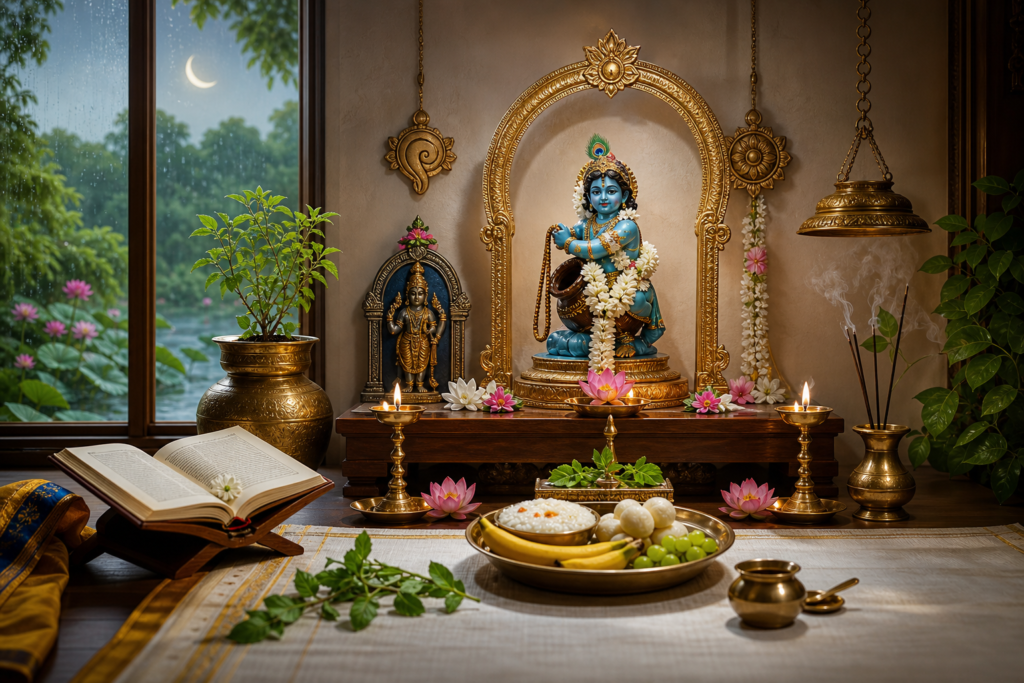
For many Tamil families, Aadi Amavasai is not experienced as an abstract calendar entry. It is remembered through early morning baths, simple clothing, visits to riverbanks or seashores, offerings of sesame, water, rice, darbha grass, and prayers for ancestors whose names may still be spoken with reverence in the home. Even where the ritual is performed with professional guidance, the emotional center remains intimate: gratitude for parents, grandparents, teachers, protectors, and unnamed elders whose lives made the present generation possible.
The most recognized ritual associated with the day is Tharpanam, also spelled Tarpanam. This offering traditionally involves water mixed with black sesame seeds, often performed while remembering ancestors by name and lineage. In some traditions, Pinda offerings made of cooked rice are also used, especially in rites connected with Shraddha and Bali. The intention is not transactional worship, but an act of reverent continuity. The living symbolically nourish the departed through sacred offerings and seek their blessings for peace, clarity, family harmony, and spiritual progress.
Ritual practice differs by family tradition, sampradaya, region, and priestly guidance. Some families perform Amavasya Tharpanam at home; others travel to temples, river ghats, seashores, or traditional pilgrimage centers. In Tamil Nadu, sacred places such as Rameswaram, river confluences, temple tanks, and coastal sites often draw devotees on Aadi Amavasai. The common principle is that water functions as a sacred medium: it carries memory, purification, offering, and surrender.
From a technical calendar perspective, Aadi Amavasai is determined by the occurrence of Amavasya Tithi within the Tamil solar month of Aadi. A Tithi is not identical to a civil date; it is a lunar day based on the angular distance between the Sun and the Moon. Because Tithi timings begin and end at precise astronomical moments rather than midnight, a festival can appear on different civil dates in different regions or time zones. This is why diaspora communities in the USA, UK, Europe, Malaysia, Singapore, Gulf countries, Australia, and New Zealand should use a location-specific panchangam rather than assuming the Indian date automatically applies everywhere.
For 2026, the Indian observance is best understood as August 12, with the Amavasya Tithi active for nearly the whole day. The panchang detail is important because ancestral rites are usually aligned with the Tithi rather than with a generic Gregorian date. Families performing the rite in India can treat August 12 as the primary Aadi Amavasai day, while those outside India should check local sunrise and Tithi alignment for their city.
Aadi Amavasai also sits within a broader Indian framework of regional Amavasya observances. In Kerala, a closely related ancestral rite is observed as Karkidaka Vavu Bali. In North India, the corresponding period may be associated with Hariyali Amavasya or Shravan Amavasya. In parts of Maharashtra, Andhra Pradesh, Karnataka, and Odisha, the day may be known by different regional names and embedded in different ritual calendars. These variations show the strength of Hindu pluralism: the calendar language changes, but the ethical focus on gratitude, memory, and reverence remains shared.
This regional diversity also supports a wider dharmic reading of the day. Aadi Amavasai is specifically a Tamil Hindu observance, yet its deeper values resonate across dharmic traditions: respect for lineage, gratitude to teachers and elders, responsibility toward family, and humility before the continuity of life. Buddhist, Jain, and Sikh traditions do not observe Aadi Amavasai in the same ritual form, but each preserves distinctive practices of remembrance, reverence, ethical inheritance, and community continuity. The unifying principle is not uniformity of ritual, but shared respect for the moral bonds that connect generations.
In contemporary life, Aadi Amavasai has acquired renewed relevance. Many families now live far from ancestral villages, and younger generations may know only fragments of their family history. The day provides an opportunity to recover names, stories, photographs, places of origin, and inherited values. Even when a person cannot perform the complete ritual procedure, the day can still be marked through respectful remembrance, feeding the needy, offering water with devotion, visiting a temple, reading family history, or simply expressing gratitude for the sacrifices of elders.
The observance should be approached with seriousness rather than fear. Some popular descriptions reduce Amavasya to superstition or anxiety, but the traditional emphasis is more disciplined and constructive. It is a day for restraint, remembrance, purification, charity, and prayer. A person observing Aadi Amavasai may avoid unnecessary indulgence, maintain simplicity in food and conduct, and keep the mind directed toward gratitude and self-reflection. Such discipline gives the ritual its ethical depth.
Temple worship on Aadi Amavasai often includes special pujas, prayers for ancestors, and collective participation by devotees. In Tamil Nadu, temples and sacred water bodies may become crowded, particularly in major pilgrimage centers. Devotees planning travel should account for early morning queues, local traffic controls, bathing arrangements, and the availability of priests for Tharpanam. Where crowds are expected, the practical side of devotion matters: arriving early, maintaining cleanliness, avoiding plastic offerings near water, and respecting local temple rules are all part of responsible religious conduct.
For household observance, the essential mood is reverence. Traditional families may wake before sunrise, bathe, wear clean clothes, prepare offerings, and perform Tharpanam under guidance. The names of ancestors may be recited according to lineage, and offerings may be made facing the prescribed direction depending on custom. After the rite, charity, feeding others, offering food to cows or birds where appropriate, and simple meals may follow. These practices vary, but the inner meaning remains stable: the living acknowledge that their existence rests upon the lives and sacrifices of others.
Aadi Amavasai 2026 also coincides astronomically with the new moon associated with the total solar eclipse of August 12, 2026, though visibility and traditional observance rules depend on location. Since most ritual rules around eclipse-related Sutak are applied according to visibility and local panchang guidance, families should consult a trusted regional panchang or priest if they are concerned about eclipse-related restrictions. The ancestral observance itself remains rooted in the Amavasya Tithi and the Tamil month of Aadi.
The enduring strength of Aadi Amavasai lies in its ability to join astronomy, ritual, family memory, and spiritual discipline. A lunar Tithi becomes a day of ethical reflection. A calendar date becomes a bridge between generations. A simple offering of water becomes a statement that the departed are not forgotten. In this sense, Aadi Amavasai is not only about the past; it is also about forming future generations who know how to remember with dignity.
For 2026, devotees can therefore mark Wednesday, August 12, as Aadi Amavasai in India, with Amavasya Tithi running from about 1:52 AM to 11:06 PM IST according to standard panchang calculations for New Delhi. Those observing in Tamil Nadu, elsewhere in India, or abroad should verify local timings. The essential preparation, however, is universal: approach the day with humility, remember the ancestors with gratitude, perform Tharpanam or prayer according to family tradition, and allow the observance to renew the bond between personal life, family duty, and Sanatana Dharma.
Sources consulted: HinduPad source page on Aadi Amavasai date and significance, https://hindupad.com/aadi-amavasai-2011-aadi-amavasya-2011-date/; Drik Panchang day panchang for August 12, 2026, New Delhi, https://www.drikpanchang.com/panchang/day-panchang.html?date=12/08/2026.
Inspired by this post on Hindu Pad.










Leave a Reply
You must be logged in to post a comment.