Across Hindu temple iconography, the four Vedas are not treated as abstract texts but as living, intentional presencesveda-purushaswho embody the eternal, conscious flow of Vedic wisdom. Among these presences, the Yajur Veda occasionally appears with a goat-faced countenance in sculptural programs, a striking image that invites careful interpretation. Rather than a curiosity, this form signals a coherent nexus of ritual practice, linguistic nuance, and iconographic convention that temple artists and theologians have cultivated for centuries.
Vedic personifications typically appear in clusters of four (chatur-veda murtis) near the base moldings (adhisthana), at the corners of the sanctum (garbhagriha), or on narrative friezes, particularly in South Indian temples from the Chola, Hoysala, and later Vijayanagara periods. Guidance for these depictions is drawn from a constellation of sourcesAgamas, Shilpa Shastras, and art-theoretical passages of the Vishnudharmottara Puranawhere the Vedas are assigned attributes, postures, colors, and emblems. Within this shared grammar, the Yajur Veda is most consistently aligned with yajna (sacrifice) and the officiating priestly role of the Adhvaryu, cues that strongly shape how it is visualized in stone and bronze.
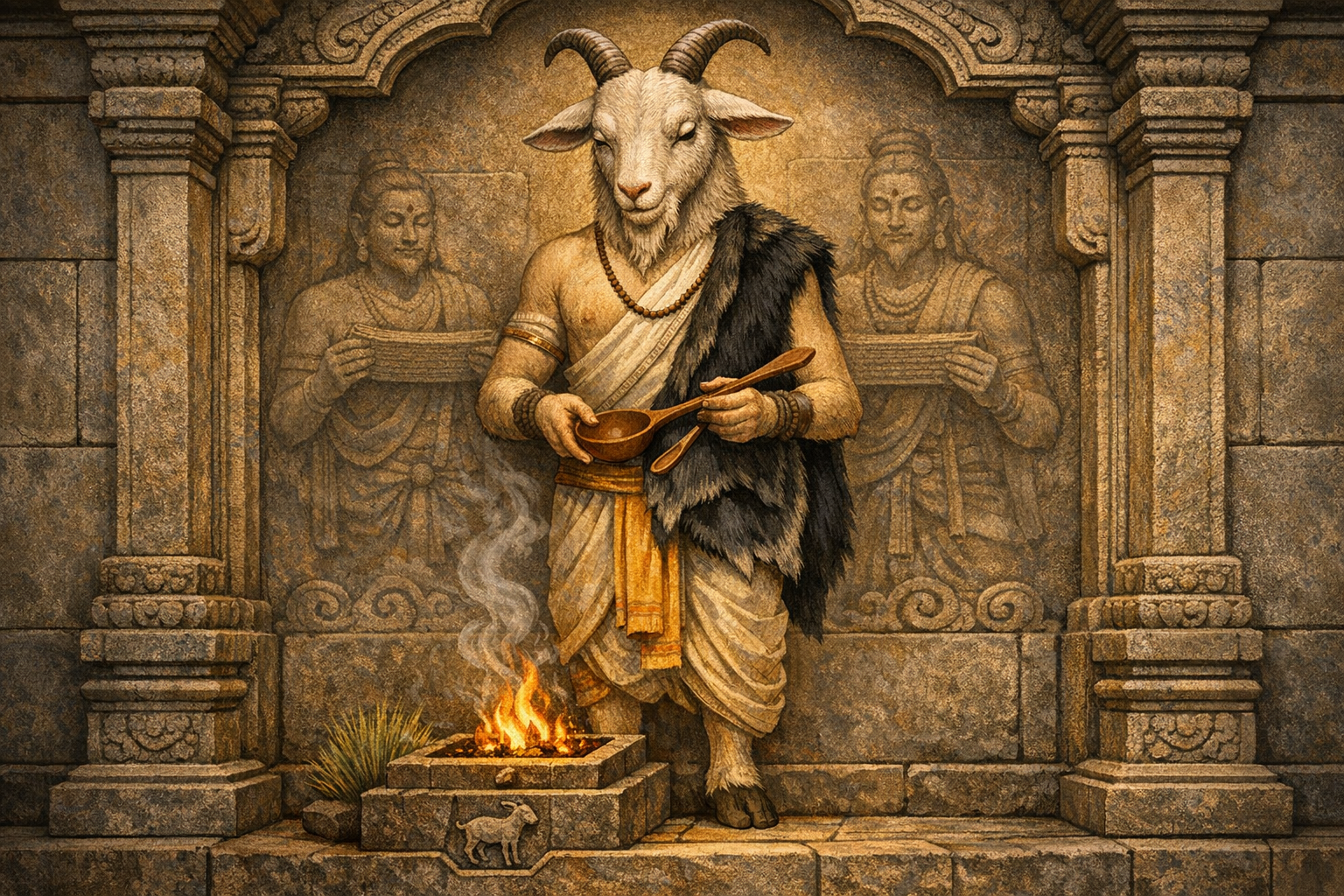
The ritual logic behind a goat signifier is robust. Etymologically, yajur (from yajus) denotes sacrificial formulastexts recited in the precise economy of the fire ritual. In early and classical Vedic performance, the goat (aja) occupies a notable position among sacrificial animals, while the black antelope (krishna-mriga) skin and other ritual substances, such as darbha grass and wooden ladles (sruk and sruva), anchor the Adhvaryu’s practice. In sculpture, these ritual memories often congeal into visual shorthand: a goat motif, the presence of a yajna-kunda, the Adhvaryu’s implements, and a sacred thread (yajnopavita) worn in the upavita style across the chest.
Philology further enriches the cue. The Sanskrit aja can mean “goat,” but also “the unborn,” a layered semantic field that temple art sometimes compresses into a single emblem. The goat may thereby communicate both the outward grammar of sacrifice and an inner metaphysics of the unborn principle, where offering is ultimately returned to the Unborn (Aja) Reality that underwrites all ritual meaning. This double valence makes the goat-faced Yajur Veda plausible within the broader hermeneutics of Hindu temple art.
Iconographic variants range from a fully goat-faced bust to a human-faced veda-purusha attended by a goat at the feet, or by clear sacrificial paraphernalia. In several regional traditions, sculptors prefer to mark Yajur Veda through tools of the Adhvaryusruk, sruva, wooden handle, and bundled darbhawhile leaving the face human. Elsewhere, a discreet goat head, horn, or pelt appears as a decisive emblem when spatial constraints preclude a full narrative context.
Because goat-headed figures occur elsewhere in Hindu art, careful differentiation strengthens accurate reading in the field. A frequent source of confusion is Daksha Prajapati, whose head is replaced with that of a goat in the aftermath of the Daksha Yajna. Daksha is typically framed within a narrative ensembleoften accompanied by Veerabhadra or Satiand appears in a mood of submission or repentance, lacking the crisp ritual implements of the Adhvaryu. Such narrative cues distinguish Daksha from a Yajur Veda personification.
A second point of potential overlap is Ajaikapada (Aja-eka-pada), a Rudra-related form found in Vedic and Puranic lists. Ajaikapada is commonly depicted as one-footed or as an abstracted limbic presence and, in some regional schools, may display caprine associations. Yet its compositional syntaxaustere verticality, yogic stillness, and Rudra markersdiffers from the sacrificial, tool-centric grammar used to denote Yajur Veda. When goat associations do appear with Ajaikapada, they point to Rudra cosmology rather than Adhvaryu liturgy.
Textual and workshop evidence support these distinctions. The Vishnudharmottara Purana’s art sections, alongside later manuals such as Mayamata, Manasara, and regional shilpa compendia, recommend that painters and sculptors encode each Veda with distinctive gestures, emblems, and sometimes animal associations. While prescriptions vary by lineage and locale, the consistent thread for Yajur Veda centers on sacrificial implements, smoke-tinged or earth-toned palettes, and, in some schools, a goat as an identifying emblem when narrative context is minimal.
Color and texture often collaborate with form. Dark, smoke-gray, or earth-brown finishes can be deployed to suggest ash, soot, and the atmosphere of the yajna-kunda. A pelt (ajina) rendered across the shoulder, a tuft of darbha, or the polished curve of a ladle can make the Yajur Veda instantly legible, even if the facial type remains human. Where a goat-headed visage appears, it typically functions as an emphatic iconographic marker that compresses the entire sacrificial ecosystem into a single sign.
The semiotics are not merely external. The goat emblem also encodes an inner discipline: the transmutation of lower impulses through conscious offering. Yajur Veda materials repeatedly pivot from outward rites to inner oblationsprana-agnihotra, self-restraint, truthfulness, and the consecration of action. Read this way, the goat-faced form becomes a contemplative device: it signals the refinement of vitality (prana) into clarity (sattva) through the “fire” of attention and ethical commitment.
Seen through a dharmic-unity lens, this inwardization resonates across Hindu, Buddhist, Jaina, and Sikh traditions. While these paths differ in scripture and soteriology, each emphasizes disciplined transformationahimsa and tapas in Jaina ethics, the Buddha’s path of right action and mindfulness, the Sikh focus on Naam and seva, and the Hindu ideal of yajna as consecrated action. The goat, once a literal element of early Vedic ritual, here becomes a shared metaphor for offering egoic patterns into a higher idealan interpretive bridge that affirms harmony among dharmic traditions without erasing their distinct voices.
For visitors and students of Hindu temple iconography, a field checklist helps anchor confident identification of a Yajur Veda personification: look for (1) proximity to other Veda figures, suggesting a chatur-veda set; (2) ritual implements like sruk, sruva, prastara (darbha), and a yajna-kunda; (3) a goat emblem, pelt, or head when space restricts narrative context; (4) Adhvaryu-coded posturespoised, service-oriented, often in mid-action; and (5) the absence of Daksha’s narrative entourage or Rudra’s austere, one-footed abstraction typical of Ajaikapada.
Regional styles add nuance. In Tamil and Kannada regions, sculptors of the Chola, Hoysala, and Vijayanagara milieus often relied on micro-detailstextures of skin, curve of ladles, and the geometry of the sacrificial hearthto carry meaning. In some Kerala and Andhra contexts, painted or low-relief programs emphasize color, vegetal motifs, and miniature animal attendants to clarify identification. Such diversity reflects the living workshop traditions (sthapati paramparas) through which Vedic personifications were taught and transmitted.
Scholarly cataloging benefits from transparent labels that distinguish a goat-headed Daksha from a goat-emblemed Yajur Veda, and from an Ajaikapada program. Curatorial notes that foreground the Adhvaryu’s toolset, the goat’s semiotics, and the placement among companion Vedas reduce interpretive drift, support pedagogy, and enrich public engagement with Hindu sacred art.
From a conservation perspective, retaining even small adjunct elementsthe faint outline of a goat at a figure’s feet, the chipped tip of a ladle, or the surviving corner of a yajna-kundacan be critical for iconographic reading. Where loss has occurred, documentation of comparable regional exemplars and consultation with living silpa lineages can guide responsible restoration and didactics without overstepping the evidence.
In contemporary spiritual life, the goat-faced Yajur Veda can also be read as an ethic of consecrated action: the invitation to transform work, speech, and attention into offerings. This aligns with the Vedic idea of loka-sangrahasustaining the worldwhile harmonizing with the dharmic emphasis on compassion, truth, and restraint found across Hinduism, Buddhism, Jainism, and Sikhism.
Ultimately, the goat-faced personification of Yajur Veda is a compact grammar of meaning. It weaves ritual history (yajna), linguistic layers (aja as “goat” and “unborn”), and the workshop intelligence of Hindu temple art into a single, memorable sign. Approached with this layered lens, what first arrests the gaze as unusual resolves into a lucid, integrative teaching about sacrifice, service, and the inner fire that refines human life.
Inspired by this post on Hindu Blog.