Among the most emotionally charged and philosophically challenging moments in the Ramayana are Sita’s Agni Pravesha (Agni Parīkṣā) and her later exile from Ayodhya. These episodes continue to shape public imagination because they test the limits of dharma, the duties of kingship (rajadharma), and the fragility of social trust. Read across Hindu, Buddhist, Jain, and Sikh interpretive horizons, they invite a unified reflection on leadership, justice, compassion, and the lived cost of public responsibility.
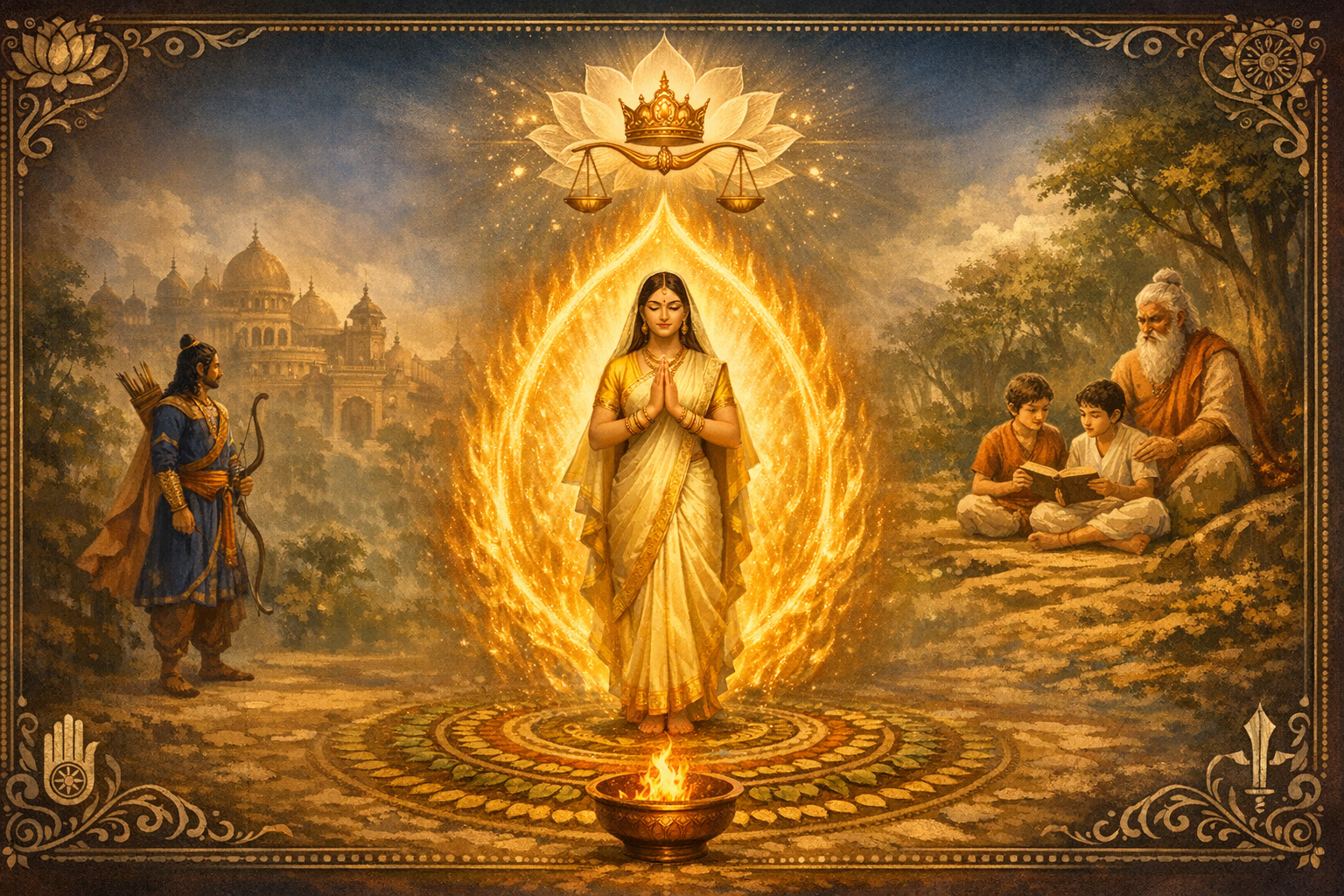
Valmiki’s Ramayana situates Agni Pravesha at the close of the Dharma-Yuddha in Lanka. After Ravana’s defeat, Sita is brought before Sri Rama. Conscious of the trauma his subjects (praja) endured and the public scrutiny that would inevitably arise, Rama speaks in a register of public duty rather than private consolation. The scene, often misunderstood as personal doubt, is presented in the epic as the sovereign’s concern for an unimpeachable restoration of social order. In this tense setting, Sita chooses to enter the sacred fire, invoking Agni as witness (Agni-sākṣī) to her lifelong fidelity.
Valmiki narrates that Agni Deva returns Sita unscathed, publicly affirming her purity. The devas praise her steadfastness, and Rama receives her, declaring the ordeal a demonstration for the world rather than a test for himself. In epic logic, Agni, who sanctifies Vedic rites and witnesses marriage vows, is the most authoritative arbiter of truth within the ritual universe of the Treta Yuga. This is not mere spectacle; it is a juridical sign meant to close the question for a traumatized polity.
Later traditions deepen the theological canvas. Some Puranic and regional retellings (for example, strands in the Padma Purana and Adbhuta Ramayana) speak of a “Maya Sita” or “Chaya Sita,” preserved by Agni during the abduction and exchanged back in the Agni Parīkṣā. Such accounts aim to protect Sita from even symbolic contamination and underline her inviolability. Other classical tellings, including Kamba Ramayanam and Tulsidas’s Ramcharitmanas, retain the core affirmation of Sita’s purity while adapting tone and emphasis for their audiences. Jain and Buddhist Ramayana traditions, too, recast the narrative within their ethical frameworksforegrounding non-violence, exemplary kingship (Dhammarāja), and the primacy of inner virtuedemonstrating a shared Dharmic concern for truth and moral order.
The exile unfolds later in Ayodhya and is especially debated. Valmiki’s Uttara Kāṇḍa describes a social climate unsettled by a washerman’s tauntan emblem of a wider murmur questioning royal conduct. Rama, now firmly in the role of Maryāda Puruṣottama (the exemplar of righteous conduct), confronts a perennial tension: personal dharma as a husband (pati-dharma) versus public duty as a king (rajadharma). Classical statecraft assumes that a ruler must remain beyond suspicion; even false rumor, if left unaddressed, can corrode institutional trust. In this calculustragic but consistent with the era’s normsRama chooses the stability of the realm over personal happiness.
The narrative’s pathos deepens when Sita, pregnant at the time, is escorted by Lakshmana to the forest and received with reverence by Maharishi Valmiki. In the sanctity of the āśrama, she gives birth to Lava and Kusha, whose education includes the very epic that bears their parents’ trials. Years later, at a royal assembly during the Aśvamedha, the twins recite the Ramayana, compelling the court to hear the story’s moral architecture anewfrom innocence toward judgment, and back toward compassion.
The epic offers a second and final resolution in Sita’s own voice. Invoking Bhūmi Devi, Sita asks the Earth to receive her if she has remained pure in thought, word, and deed. The Earth opens; Sita returns to her source. This is not despair but ethical sovereignty: Sita refuses to perform proof repeatedly for the fickle court of public opinion. The Earth’s assent becomes the ultimate seal of truth, beyond juridical theater and rumor alike.
Read philosophically, two axes structure the episode. First is procedural legitimacy: in a monarchy, public confidence is a constitutional force in itself. Second is substantive justice: the unalloyed truth of Sita’s character. Agni Pravesha aims to align these axes; exile shows what happens when they cannot be perfectly reconciled. The epic thereby stages a moral problem still familiar todayhow leaders should act when perception and reality diverge. The lesson is not a mandate to surrender truth to gossip, but a cautionary meditation on the cost of leadership in an imperfect world.
Across Dharmic traditions, the same ethical tensions reappear in cognate idioms. Buddhist discourse on the Dhammarāja emphasizes that a ruler’s legitimacy rests on public trust and compassionate governance. Jain narratives hold up restraint and non-injury while honoring the primacy of personal integrity under social pressure. Sikh reflections on the integration of spiritual and temporal responsibilities (miri-piri) stress truthful living and courage in public life. These perspectives converge on a unifying insight: sustaining justice requires personal sacrifice, institutional prudence, and a deep commitment to compassion.
From a hermeneutic standpoint, scholars debate the textual history of the Uttara Kāṇḍa. Some propose that its language and thematic density suggest a later stratum layered onto an earlier epic core; others defend the unity of Valmiki’s composition. Regardless of verdict, the Uttara Kāṇḍa has functioned for centuries as scripture for practice and reflectionguiding norms of rajadharma, civic responsibility, and ethical leadership across regions from Ayodhya to Southeast Asia.
The symbolism of Agni as witness is integral to Vedic culture. Fire consecrates marriage (with Agni as the divine witness), seals vows, and adjudicates oaths. In this light, Sita’s Agni Parīkṣā is less an ordeal imposed by suspicion than a sacred declaration placed before the highest court available to the age. That the devas and Agni affirm her is a theological claim that no human rumor can overturn.
Equally vital is Sita’s agency. She sets the conditions of her first trial, and she sets the terms of her final vindication. Modern readersespecially those attuned to the harm inflicted by rumor and the vulnerabilities of survivorsoften read these scenes as an indictment of societies that demand proof of innocence from the innocent. The Ramayana accommodates this critique by giving Sita the last irrevocable word.
Contemporary ethical analysis can frame these events as a triad: rajadharma (public duty), svadharma (personal duty), and lokadharma (the expectations of society). Rama’s decisionshis vanvas in youth, the Dharma-Yuddha in Lanka, and the painful choice in Ayodhyaare all inflected by these layers. The epic does not trivialize the human cost; it memorializes it so that future readers, rulers, and citizens can strive toward a society where substantive justice and public trust align without such sacrifice.
Ultimately, Sita’s Agni Pravesha and exile call for a dharmic unity of head and heart. The episodes counsel leaders to prize truth and compassion, citizens to resist the seduction of rumor, and families to honor dignity over display. Read with the shared wisdom of Hinduism, Buddhism, Jainism, and Sikhism, the narrative teaches that legitimate power grows from inner integrity, that social order must be anchored in compassion, and that the highest dharma preserves both truth and tenderness.
Inspired by this post on Hindu Pad.