Vaishakha Masam (also revered as Madhava Masam) is the second month of the traditional Hindu Telugu calendar observed across Andhra Pradesh and Telangana. In 2026, Vaishakha Masam begins on 18 April and concludes on 16 May, as per the amanta lunar convention that runs from Amavasya to Amavasya. Across peninsular India, closely aligned amanta reckoning is followed in Maharashtra and Karnataka; in Gujarat, the Vikram Samvat framework has distinct naming conventions, yet Vaishakh-linked observances remain widely recognized. This shared foundation underscores how regional panchangams preserve unity within India’s diverse calendrical traditions.
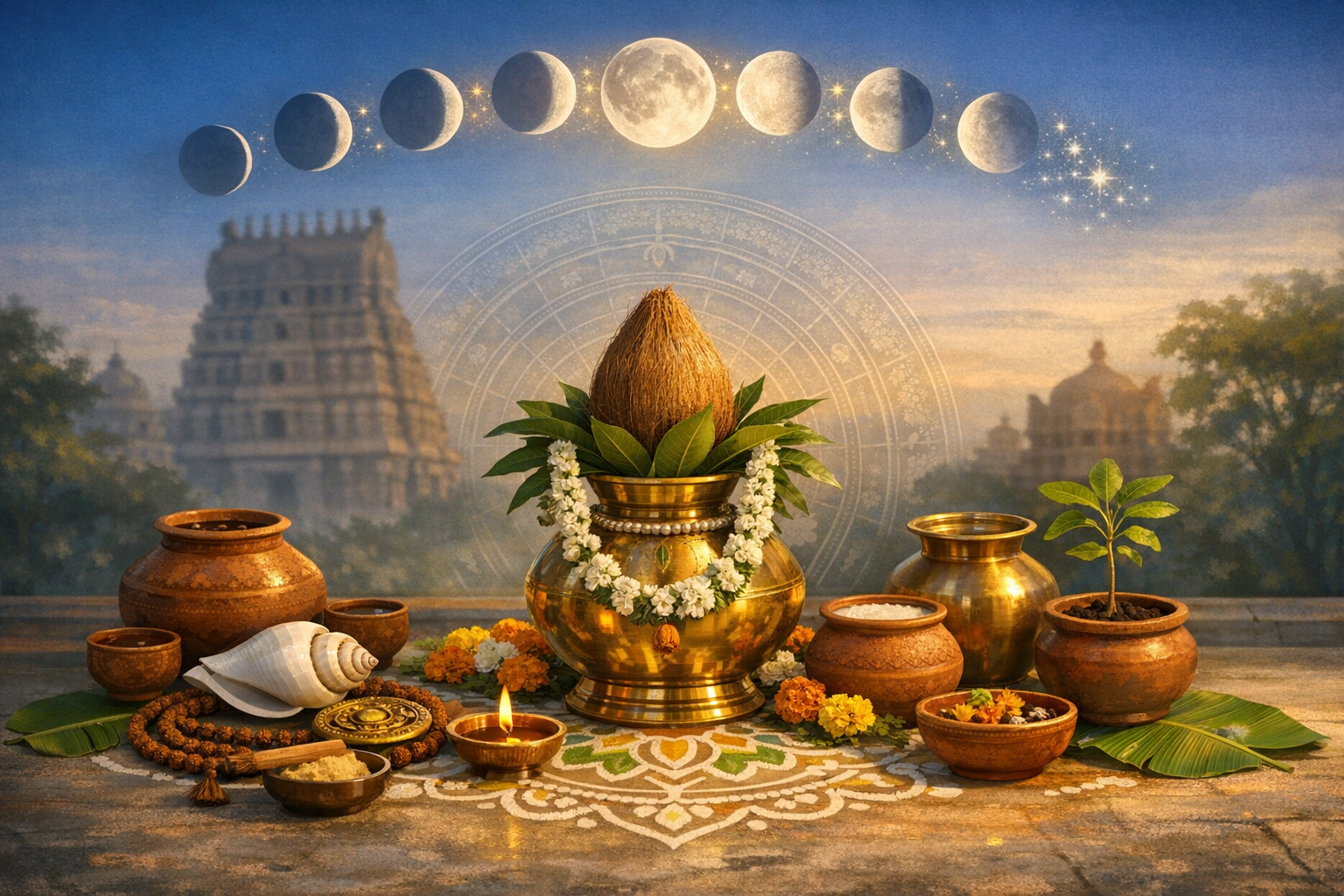
Technically, Vaishakha is identified by the full moon that occurs near the Viśākhā nakshatra. The Telugu calendar employs a lunisolar structure: days are reckoned by sunrise, months are anchored to lunations, and the sequence of tithi, nakshatra, yoga, and karana governs ritual timing. Vaishakha is divided into Śukla Paksha (waxing phase, from day after Amavasya to Purnima) and Kṛṣṇa Paksha (waning phase, from day after Purnima to the next Amavasya). Because tithis are astronomical intervals rather than fixed civil dates, local sunrise and geographical longitude can shift festival dates by a day between almanacs.
Scripturally, Vaishakha holds exceptional merit in the Padma Purana and Skanda Purana (Vaishakha Mahatmya), which extol the triad of snāna (sacred bathing), dāna (charity), and japa (mantra recitation). In the Vaishnava tradition, Vaishakha is celebrated as Madhava Masam, dedicated to Lord Vishnu in the aspect of “Madhava.” Devotees commonly recite the Vishnu Sahasranama, observe vrata on Ekadashi, and offer sandalwood, tulasi, and cool refreshments to deitiespractices that harmonize spiritual discipline with the season’s intense heat in the Deccan.
Within Vaishakha Masam 2026 (18 April–16 May), several pan-Indic observances occur by tithi. Akshaya Tritiya falls on Vaishakha Śukla Tritiya and is widely regarded as a day of unfading merit; Parashurama Jayanti is also associated with this tithi. Mohini Ekadashi arrives in the Śukla phase, while the much-venerated Narasimha Jayanti occurs on Vaishakha Śukla Chaturdashi. Vaishakha Purnima is significant across Dharmic traditions as Buddha Purnima (Vesak) and, in many calendars, Kurma Jayanti; households also perform the Satyanarayana Vrata on Purnima. In the Kṛṣṇa Paksha, Apara Ekadashi is observed, and the month typically includes two Pradosha Vratas (on each Trayodashi).
Across Telugu households, Vaishakha mornings often begin before sunrise with cool snāna, the gentle fragrance of chandan, and unhurried recitation of stotras. The distribution of panakam (a jaggery-and-cardamom sherbet) and buttermilk to travelers and neighbors becomes a cherished act of service that ties devotion to daily life. Such practicessimple yet profoundshape living memories, passing from grandparents to grandchildren as seasonal signatures of Madhava Masam.
Akshaya Tritiya, occurring in the waxing phase of Vaishakha, is central to the month’s ethos of auspicious beginnings. Textual traditions recommend dāna of water, food, and cooling substances; planting and caring for trees; and commencing long-term sādhana commitments. In coastal Andhra, the famed Chandanotsavam of Sri Varaha Lakshmi Narasimha Swamy at Simhachalam typically coincides with Akshaya Tritiya, enveloping the temple in sandal paste and devotion. While commercial customs have grown around this day in modern times, the enduring spiritual focus remains charity, restraint, and steady practice.
Narasimha Jayanti on Vaishakha Śukla Chaturdashi celebrates the fierce compassion of Lord Vishnu as Narasimha. In the Telugu region, communities undertake special abhishekam, pradakshina, and evening āradhana that emphasize courage in the face of adharma and protection of the devoted. The theological arcBhakta Prahlada’s steadfastness culminating in divine interventionresonates deeply with the month’s call to inner strength aligned with dharma.
Vaishakha Purnima weaves a natural unity among Dharmic traditions. Hindus often mark Kurma Jayanti on this full moon, honoring the cosmic churning and the principle of stability (dharā) that supports evolution. The same full moon is Buddha Purnima (Vesak) for Buddhists, celebrating the Buddhatva that illumines compassion, wisdom, and mindful living. Jains revere Akshaya Tritiya within Vaishakha as the day Bhagavān Rishabhanatha broke his prolonged tapas with ikshu-rasa, inspiring the Varshitap Parana for contemporary ascetics and lay practitioners. This confluence highlights a shared civilizational commitment to ahimsa, dāna, and inner transformation.
Regional variations within the Telugu tradition lend additional texture. Many Telugu-speaking communities observe Hanuman Jayanti in Vaishakha Kṛṣṇa Paksha (often on Bahula Dashami), infusing the latter half of the month with collective chanting of the Hanuman Chalisa and recitations from Sundara Kanda. Such calendrical diversitywhile guided by uniform shastric rulesdemonstrates how living practice adapts across geographies without losing philosophical coherence.
Practically, festival timing follows the tithi present at local sunrise for most observances, though certain rituals require the tithi’s presence at specific hours (e.g., Chaturdashi for Narasimha Jayanti close to sunset). Ekadashi fasting is kept on the day Ekadashi prevails at sunrise, with pāraṇa on the following morning after the prescribed time. Because tithis can begin or end between sunrises, authoritative local panchangams may differ by a civil day; observants are best served by cross-checking the local Telugu panchang for muhurta and pāraṇa windows.
Seasonally, Vaishakha aligns with peak summer across the Deccan, shaping the month’s characteristic sevas: annadāna with cooling foods, jalaseva through community water points, and distribution of buttermilk and fresh fruit. Temples emphasize sandalwood paste, shade, and water offerings; households echo these gestures as extensions of dāna and dayā. The devotional mood becomes tactilecooling deities with chandan and the world with compassion.
From a spiritual-discipline perspective, Vaishakha rewards steadiness more than spectacle. Daily japa, regular scriptural reading (such as the Vishnu Sahasranama or passages from the Bhagavad-Gita and Srimad-Bhagavatam), and modest vratas integrated with work and family life embody the classical triad emphasized in the puranas. Many households augment these practices with a Satyanarayana Vrata on Vaishakha Purnima, seeking clarity, gratitude, and ethical resolve for the months ahead.
For calendrical comparison, it helps to note that North and East Indian almanacs frequently use the pūrnimānta system (full-moon to full-moon), so their named months offset by roughly a fortnight from the amanta Telugu reckoning. Despite this, the underlying tithisand thus the core vratasremain synchronized across the subcontinent, illustrating how shared astronomical grammar supports a mosaic of regional expressions. The result is unity in diversity, with the Telugu Vaishakha Masam harmonizing seamlessly with allied practices in other regions.
In summary, Vaishakha Masam 2026 in the Telugu calendar (18 April–16 May) offers an integrated pathway of devotion to Lord Vishnu as Madhava, ethical action through dāna and jalaseva, and contemplative practice via japa and svādhyāya. Its high pointsAkshaya Tritiya, Narasimha Jayanti, and Vaishakha Purnimacreate a shared spiritual season with Buddhism’s Vesak and Jain Varshitap Parana, reaffirming the Dharmic ethos of compassion, self-restraint, and service. Anchored in precise lunar astronomy yet lived with warmth and remembrance in family spaces, Madhava Masam invites renewed commitment to dharma, unity, and inner poise.
Inspired by this post on Hindu Pad.