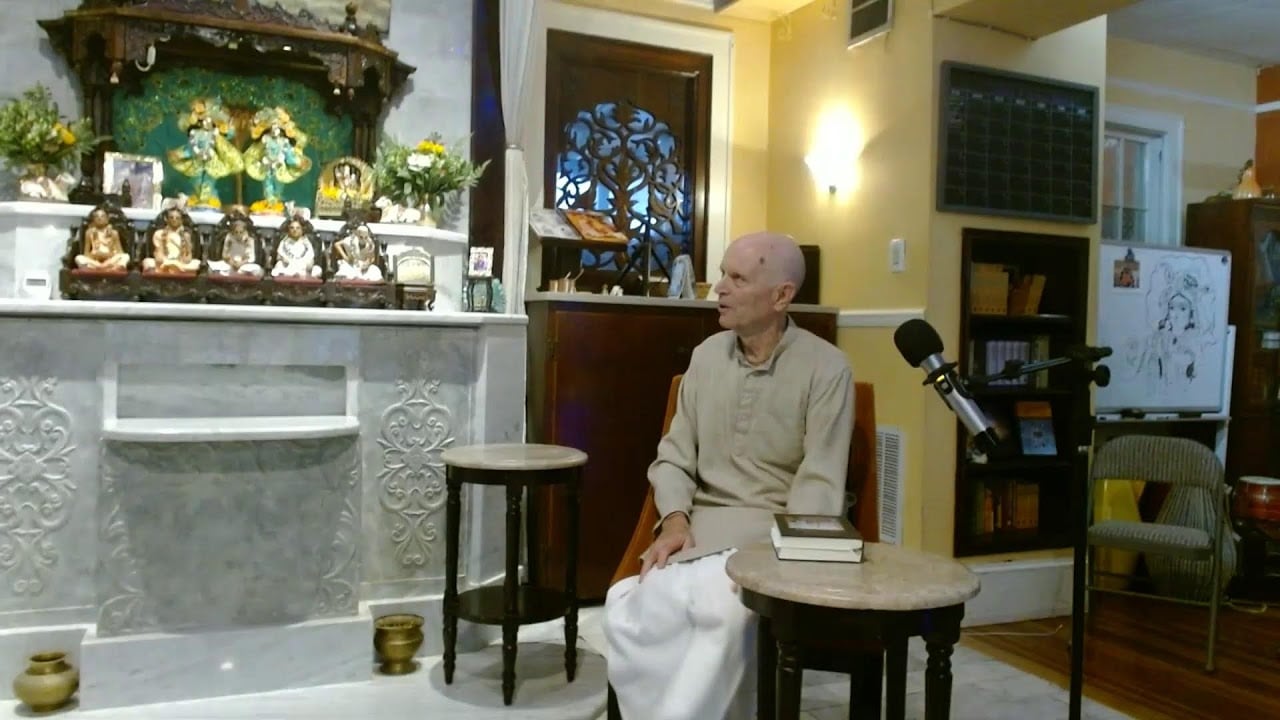
Srimad-Bhagavatam (Bhagavata Purana) Canto 4, Chapter 9, verses 37–53 present the luminous denouement of Dhruva Maharaja’s questwhere uncompromising bhakti, refined by tapasya and guided by divine grace, matures into social responsibility and cosmic appointment. Building on interpretive themes frequently emphasized in Kalakantha Prabhu’s careful readings at Krishna House Gainesville, this analysis approaches these verses as a tightly woven synthesis of personal transformation, Vedic philosophy, and dharma-based kingship that continues to inform spiritual practice and public ethics across dharmic traditions.
Context clarifies the texture of these concluding verses. Dhruva, stung by familial rejection, turned to spiritual discipline under the guidance of Nārada, anchored his mind in the mantra om namo bhagavate vasudevaya, and attained darshan of the Supreme Lord. Earlier in the chapter, his devotion had already pivoted from grievance to gratitude; in the close of the narrative (vv. 37–53), the text records how divine benediction flows into the fabric of communal life as he returns to his family, to his city, and ultimately to the responsibilities of rajadharma, now reframed as service.
The narrative arc from austerity to audience and from audience to assignment is deliberate. In these verses, Dhruva’s interior transformationintensely personal and theologicalreceives its public confirmation. The reunion with King Uttanapada and Queen Suniti, the citizens’ joy, and the restoration of royal order indicate that authentic spiritual attainment in the Bhagavata Purana is never merely private; it becomes a civilizational resource. Vedic philosophy here insists that true leadership follows self-mastery and that sovereignty without sattvic integrity is incomplete.
Theological implications are pronounced. The Srimad-Bhagavatam consistently places bhakti above karma and jnana because devotion integrates knowledge and action under the primacy of relationship with the Divine. Dhruva’s earlier longing for status is transmuted by vision; commentators in the bhakti tradition often note the paradox that he searched for “broken glass” (worldly vindication) but found a “jewel” (direct realization). In verses 37–53, that jewel refracts into social virtue: humility, gratitude, and dutiful governance.
Cosmologically, the text affirms a striking benediction: Dhruva receives a fixed stationDhruvalokaabove the wandering planetary systems, emblematic of the unwavering steadiness his name connotes. Classical Vaishnava exegesis clarifies a twofold culmination: he serves as a righteous ruler in the world while bearing a destiny beyond the cyclic transformations of material time. The grant of Dhruvaloka functions both as poetic theology (devotion’s immovability) and as metaphysical promise (a domain aligned with divine order).
Ethically, the passage underlines that devotion is not an escape from duty but its purification. Dhruva’s reentry into civic life models rajadharma as stewardship: the king’s power is meaningful only as an instrument of loka-sangrahauplifting the commonwealth through justice, restraint, and generosity. Read in this light, the people’s celebration is not mere pageantry; it is a social recognition that spiritual integrity can heal fractures and restore trust.
Emotionally, verses 37–53 recapitulate a profound transvaluation. The anger that once propelled Dhruva into the forest is no longer the governing force; in its place stand dainya (humility) and prasāda (grace). The Srimad-Bhagavatam invites the reader to witness how direct encounter with the Divine reorganizes the psyche: the same intense will that sought retribution is harnessed toward service, forgiveness, and stability. This is devotional psychology in actionkrodha sublimated into compassion.
Philosophically, the passage can be mapped onto the Gaudiya Vaishnava triad of sambandha, abhidheya, and prayojana. Dhruva discovers sambandha (relationship with the Supreme) through revelation; he embodies abhidheya (the practice of devotion) via disciplined remembrance and obedience; and he glimpses prayojana (the goal) as steadfast proximity to the Lord, symbolized by his cosmic station. The verses render these categories narratively: the rejoicing city, the reconciled family, and the crowned ruler become theater for metaphysical truth.
Textually, the denouement balances particularity and universality. Particularity appears in the royal household’s restoration and the precise cosmography of Dhruvaloka; universality appears in the principles that govern the transformation: tapasya leading to clarity, clarity to humility, humility to service. The Bhagavata Purana thus offers both a story and a schema, encouraging readers to see their own interior journey mirrored in Dhruva’s.
A cross-dharmic lens further widens the significance of these verses, aligning with the shared values of Hinduism, Buddhism, Jainism, and Sikhism. Dhruva’s tapasya echoes Jain commitments to disciplined restraint; his stabilized mind resonates with Buddhist emphasis on samadhi and the relinquishing of craving; his surrender and remembrance parallel Sikh devotion to Naam and reliance on the Guru’s nadar (grace). Across these traditions, ethical transformation blossoms from contemplative deptha unifying thread that fosters mutual respect and learning.
Practically, the passage offers a blueprint for contemporary sadhana. Concentrated mantra-japa as attention training counteracts distraction; mindful austerity becomes sustainable simplicity rather than harsh denial; gratitude regulates ambition; and leadership reframed as seva (service) dissolves performative authority in favor of authentic care. In organizational life, these are not abstractions: they translate into transparent decision-making, fair process, and compassion under pressure.
Devotional method and outcome are inseparable in the Bhagavata Purana. Dhruva’s disciplined remembrance (smarana) and continuous orientation to the Divine produce chitta-shuddhi (purity of heart), which in turn yields vision. The ensuing boonscosmic stability and earthly stewardshipare corollaries, not the aim. The text thereby cautions against instrumentalizing spirituality for power or prestige; power is tolerable only when devotion has already redefined its purpose.
Socially, the verses affirm that communities flourish when virtue is admired and imitated. Public rejoicing signals that character is contagious. As often noted in Gaudiya Vaishnava commentaries and echoed in contemporary study circles inspired by teachers like Kalakantha Prabhu, scriptural study is not an antiquarian exercise; it is a catalyst for ethical culture. When study deepens empathy and strengthens self-governance, plural societies gain resilience.
Cosmology, ethics, and devotion converge around a single claim: steadiness of heart creates steadiness of world. The fixity of Dhruvaloka is less about astronomical curiosity than about a metaphysical signaturethe cosmos responds to moral gravity. In verses 37–53, that claim is dramatized in civic harmony, familial reconciliation, and the legitimization of dharmic rule. Such harmony neither erases difference nor enforces uniformity; rather, it invites unity in diversity under the shelter of shared virtues.
Read today, SB 4.9.37–53 offers an integrative message vital to all dharmic communities. Discipline without bitterness, devotion without sectarianism, leadership without dominationthese are the enduring benchmarks the text advances. By honoring this common ground, practitioners of Hinduism, Buddhism, Jainism, and Sikhism can walk distinct paths while recognizing a shared horizon: the transformation of self for the good of all.
Inspired by this post on Dandavats.