
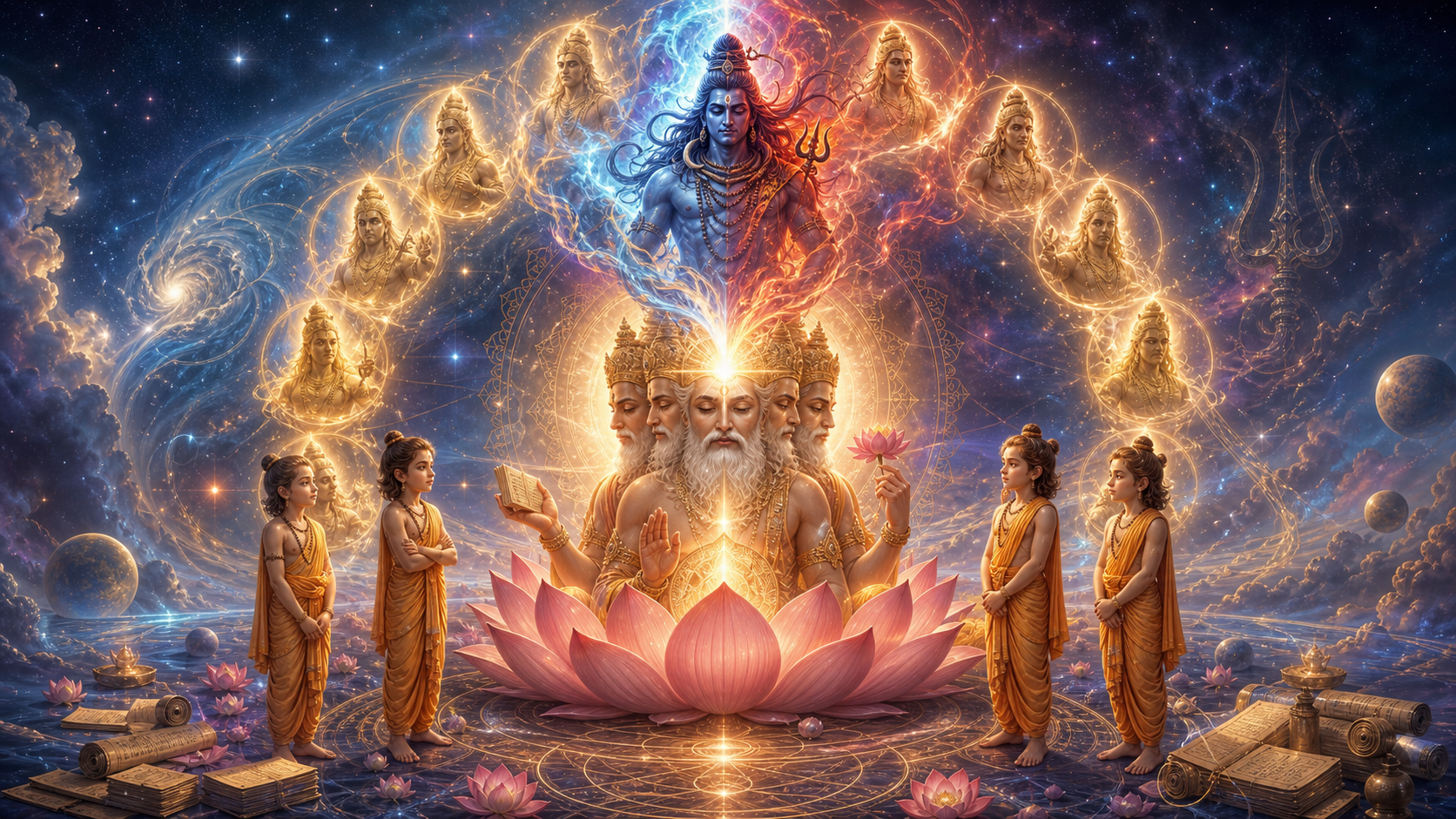
In the sacred literature of Sanatana Dharma, the birth of Rudra is not merely a dramatic myth of anger becoming form. It is a carefully layered account of creation, renunciation, cosmic psychology, and divine balance. The story begins with Brahma, the four-faced creator, seated in the vastness of early creation and charged with bringing forth beings who could populate and structure the universe. Yet the first movement of creation does not unfold through immediate expansion. It begins with refusal, contemplation, and the difficult truth that not every being born from divine will is meant for worldly multiplication.
The four Sanat Kumaras, traditionally named Sanaka, Sanandana, Sanatana, and Sanatkumara, occupy a central place in this episode. They are described in Puranic literature as mind-born sons of Brahma, beings of luminous purity who appear in childlike form yet possess profound spiritual insight. Brahma expects them to assist in creation by entering the path of household life and generating progeny. Instead, they choose brahmacharya, renunciation, knowledge, and the inward path of liberation. Their refusal is not rebellion in the ordinary sense; it is the assertion that creation also requires sages who preserve wisdom, not only progenitors who extend biological life.
This moment reveals a subtle tension within Hindu cosmology. Brahma represents pravritti, the outward movement of manifestation, social order, continuity, and generative activity. The Sanat Kumaras represent nivritti, the inward movement of withdrawal, contemplation, self-knowledge, and liberation from attachment. Hindu scriptures do not present these paths as enemies. They are complementary dimensions of dharma. A civilization requires families, rituals, institutions, and social duties; it also requires renunciants, teachers, philosophers, and contemplatives who remind society that material expansion is not the final purpose of life.
According to the Puranic narrative, Brahma restrains his displeasure when the Kumaras decline his command, but the force of that restrained anger becomes creative power. From this concentrated wrath, Rudra emerges. In several accounts, Rudra appears from Brahma’s forehead or from the space between his brows, a location symbolically associated with intensity, vision, command, and inner fire. The child is described as blue-red or fierce in appearance, already marked by the paradox that defines Rudra: terrible yet healing, destructive yet protective, wild yet deeply auspicious.
The name Rudra is often connected with the Sanskrit root rud, meaning to cry or howl. In the Puranic telling, the newborn cries and Brahma names him Rudra. This cry is not a minor detail. It gives theological depth to the name. Rudra is the divine force associated with the cry of beings, the pain of separation, the terror of dissolution, and also the compassionate power that hears suffering and removes it at the root. The same deity who frightens the ego becomes the healer of the soul. This duality is why Rudra later becomes inseparable from Shiva, the auspicious one.
The emergence of Rudra from Brahma’s anger should not be read as a simple tale of rage producing violence. In the symbolic language of the Puranas, anger is a raw cosmic energy. When ungoverned, it can destroy. When recognized and placed within dharma, it becomes tapas, courage, discipline, and transformation. Rudra embodies this transmutation. He is not anger as chaos; he is anger purified into spiritual force. His birth teaches that even the most difficult emotions can become sacred when they are brought under awareness, restraint, and divine purpose.
The story then expands into the doctrine of the Ekadasa Rudras, the eleven Rudras. In one influential Puranic list, their names are given as Manyu, Manu, Mahinasa, Mahan, Shiva, Rtadhvaja, Ugrareta, Bhava, Kala, Vamadeva, and Dhritavrata. Other scriptures preserve different lists, including names such as Aja, Ekapada, Ahirbudhnya, Tvasta, Hara, Shambhu, Tryambaka, Aparajita, Ishana, and Tribhuvana. These variations are not contradictions in the modern historical sense. They show how Hindu sacred literature preserves multiple theological lineages, ritual contexts, and regional memories within a shared sacred framework.
The number eleven is especially important. In the Bhagavata Purana’s account, Brahma assigns the Rudras eleven abodes connected with the human being: the heart, the senses, the organs of action, the vital functions, and the mind. The Brihadaranyaka Upanishad offers another profound interpretation by identifying the eleven Rudras with the ten vital energies and the atman. When these vital principles depart from the body, the relatives weep; therefore they are called Rudras. This Upanishadic reading transforms the cosmic Rudras into an interior map of embodied life. Rudra is not only in the heavens or the storm; Rudra is also present in breath, sensation, vitality, mind, and the mystery of life leaving the body.
This inner interpretation gives the myth lasting philosophical power. The Ekadasa Rudras are not only eleven divine figures standing outside human experience. They also symbolize forces within the human constitution. Breath, perception, action, thought, vitality, desire, discipline, time, and transformation all belong to the Rudra principle. Every serious spiritual tradition within the Dharmic family recognizes that the human being must confront restlessness, mortality, fear, and attachment. The Rudra narrative gives these experiences a sacred vocabulary and places them within a path toward awakening.
The connection between Rudra and Shiva deepens this meaning. In the Vedic hymns, Rudra is fierce, storm-like, armed, unpredictable, and also a great physician. In later Shaiva traditions, this Rudra is understood as Shiva, the supreme yogi, lord of dissolution, master of beings, and source of grace. The development from Rudra to Shiva is not a replacement but an unfolding. The terrifying deity of the storm becomes the meditating lord of Kailasa; the archer who can strike becomes the healer who can bless; the power of dissolution becomes the gateway to liberation.
The four Sanat Kumaras remain essential to this theological architecture. Their refusal initiates the chain of events, but their role is not negative. They represent the freedom of the soul to seek knowledge over possession, contemplation over compulsion, and moksha over mere continuity. In Vaishnava traditions, they are honored as great devotees and teachers of spiritual knowledge. In Shaiva traditions, they are also linked with Dakshinamurti, Shiva as the silent teacher who communicates the highest truth beyond ordinary speech. Their presence across traditions makes them powerful symbols of Dharmic unity.
The Sanat Kumaras also challenge a narrow view of duty. Brahma’s command is connected to cosmic necessity, yet the Kumaras reveal that dharma cannot be reduced to one social function. For some beings, the highest service is teaching. For others, it is family life. For others, ritual, governance, scholarship, meditation, protection, artistic creation, or service to society may become the path. Hindu philosophy repeatedly affirms this diversity through concepts such as svadharma, adhikara, and ishta. The sacred order is not uniformity; it is harmony among different capacities and callings.
Seen through this lens, the birth of Rudra is not a punishment for the Kumaras’ renunciation. It is the universe making room for another necessary principle. Creation cannot be sustained by generation alone. It needs the power to dissolve what becomes stagnant, to frighten arrogance, to heal suffering, to discipline excess, and to return beings to the truth. Rudra enters the cosmos as that corrective force. He is fierce because reality itself is sometimes fierce. He is compassionate because destruction, when governed by wisdom, can clear the path for renewal.
The emotional depth of this story lies in its realism. Every human life knows Brahma’s frustration, the pain of plans interrupted, the anger that arises when expectations fail. Every life also knows the Kumaras’ inward call, the desire to step away from noise and recover a deeper truth. And every life encounters Rudra, the force that breaks illusions, burns impurities, and makes transformation unavoidable. The story endures because it does not deny these experiences. It sacralizes them and teaches that spiritual maturity comes from integrating them rather than suppressing them.
The Ekadasa Rudras also provide a theological way to understand plurality within unity. Eleven forms arise, but the Rudra principle remains one. This is a recurring pattern in Hindu scriptures: one truth appears through many names, forms, functions, and moods. The same framework helps explain the many devas, devis, avatars, rishis, mantras, and spiritual disciplines across Hindu traditions. Diversity is not a weakness of Dharmic thought. It is one of its central metaphysical strengths. The many are not opposed to the one; they are the one made accessible through relationship, ritual, contemplation, and experience.
This inclusive vision also supports harmony among Dharmic traditions more broadly. Hinduism, Buddhism, Jainism, and Sikhism differ in doctrine, practice, metaphysics, and historical development, yet all give serious attention to self-discipline, liberation from ego, ethical conduct, inner transformation, and the limits of worldly attachment. The Sanat Kumaras’ renunciation, Rudra’s transformative power, the Upanishadic inquiry into the self, the Jain emphasis on restraint, the Buddhist analysis of suffering, and the Sikh discipline of remembrance and service can be understood as distinct yet resonant responses to the human condition. Unity does not require erasing difference. It requires honoring shared spiritual seriousness.
The story also prevents a simplistic reading of anger. In ordinary life, anger often causes harm because it is tied to ego, control, and wounded expectation. In the Rudra narrative, anger becomes sacred only after it is drawn into cosmic order. This distinction matters. The text does not glorify uncontrolled rage. It shows that powerful emotion must be recognized, named, assigned a place, and disciplined. Brahma names Rudra, gives him forms, gives him abodes, and directs his energy. Naming and placement transform danger into function. This is both theology and psychology.
For practitioners, the lesson is practical. Inner Rudra appears whenever life demands truth over comfort. He appears in grief, in the collapse of pride, in the ending of unhealthy attachments, in the discipline of sadhana, and in the courage to face impermanence. The same force can feel severe at first, but it may become healing when approached with humility. This is why Rudra is invoked not merely with fear but with reverence. The Mahamrityunjaya mantra, the Shri Rudram, and Shaiva forms of worship all recognize that the fierce divine is also the compassionate physician of existence.
The four Sanat Kumaras offer the complementary lesson. Their childlike form is not immaturity; it is purity. They remain young because they are not burdened by possessiveness, ambition, and decay of insight. Their wisdom is ancient, but their presence is fresh. This paradox makes them enduring figures in Hindu sacred imagination. They show that true learning requires wonder, humility, restraint, and freedom from compulsive acquisition. In a world that often measures success by production and possession, the Kumaras preserve the dignity of contemplation.
Together, Brahma, the Sanat Kumaras, and Rudra create a complete sacred drama. Brahma shows the necessity of creation. The Kumaras show the necessity of renunciation. Rudra shows the necessity of transformation. None of the three principles can be removed without distorting the whole. A society devoted only to production becomes restless. A society devoted only to withdrawal cannot sustain institutions. A society without Rudra’s corrective force becomes complacent and spiritually fragile. The Puranic narrative therefore presents a balanced vision of life, one that includes action, wisdom, and purification.
The sacred story of Rudra born from Brahma’s wrath is therefore far more than an origin tale. It is a meditation on how the cosmos handles refusal, emotion, multiplicity, and spiritual destiny. It teaches that anger can become tapas, that renunciation can serve creation, that plurality can express unity, and that the fierce face of the divine may ultimately be an expression of grace. The Ekadasa Rudras and the four Sanat Kumaras together illuminate one of the most profound insights of Hindu scriptures: creation is sustained not by one path alone, but by the disciplined harmony of many sacred powers.
Inspired by this post on Hindu Blog.





Leave a Reply
You must be logged in to post a comment.