
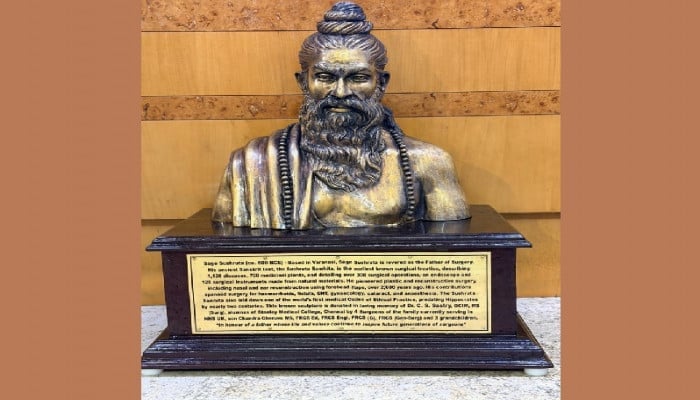
On June 19, 2026, the unveiling of a bronze sculpture of Maharshi Sushruta at the Royal College of Surgeons of Edinburgh created a moment of unusual historical clarity. A leading surgical institution in the United Kingdom publicly honoured an ancient Indian surgeon remembered across medical history as a foundational figure in surgery. The event was not merely ceremonial. It raised a deeper question for Bharat’s medical and educational institutions: why does a civilisational ancestor of such importance remain so faintly visible in the very country whose intellectual soil produced his tradition?
The question is not about sentiment alone. It concerns historical accuracy, institutional memory, medical education, and cultural self-understanding. Maharshi Sushruta is associated with ancient Kashi, today’s Varanasi, and with the Sushruta Samhita, one of the foundational texts of Ayurveda and one of the most significant surviving works in the global history of surgery. Modern scholarship regularly discusses his contribution to surgical training, anatomical observation, wound management, reconstructive procedures, rhinoplasty, surgical instruments, and medical ethics. To remember Sushruta is therefore not an act of nostalgia. It is an act of intellectual honesty.
The irony is sharp. The Royal College of Surgeons of Edinburgh can honour Sushruta with confidence. The Royal Australasian College of Surgeons in Melbourne installed a marble statue of Sushruta in 2018 and noted it in its annual record. Yet across India’s large network of medical colleges, Ayurveda institutions, dental colleges, nursing schools, and public-health campuses, visible recognition remains uneven and limited. This silence is not a minor decorative absence. It reveals how modern Indian education has often failed to integrate Bharatiya knowledge traditions into the mainstream narrative of science, medicine, and professional training.
Indian students are rightly introduced to Hippocrates, Galen, Vesalius, William Harvey, Joseph Lister, Louis Pasteur, Alexander Fleming, and many other figures in the history of medicine. Their contributions deserve study. But a balanced curriculum cannot stop there. Sushruta and Charaka also belong in that global conversation. So do the physicians, mathematicians, astronomers, grammarians, metallurgists, philosophers, and teachers who shaped the intellectual inheritance of Bharat. A medical student who learns only one civilisational genealogy of science receives an incomplete education, even when the clinical training is otherwise modern and rigorous.
The Sushruta Samhita is especially important because it presents medicine as a disciplined field of observation, classification, training, and practice. It is not a casual collection of remedies. It discusses anatomy, pathology, diagnosis, prognosis, surgery, instruments, wound care, obstetrics, ophthalmic concerns, toxicology, therapeutics, and professional conduct. Its surgical sections are particularly renowned because they describe procedures and instruments with a level of systematisation that makes the text central to any serious discussion of ancient medicine and the history of surgery.
One of Sushruta’s most discussed contributions is rhinoplasty, especially nasal reconstruction. The historical importance of this subject is not hard to understand. In ancient and medieval societies, facial injury could result from warfare, accident, disease, or punishment. Reconstructive surgery therefore had both medical and social significance. It sought not only to restore tissue but also to restore dignity, appearance, function, and social participation. The ethical sensitivity behind such work remains relevant even in modern plastic and reconstructive surgery.
The technical descriptions associated with Sushruta include careful attention to incision, excision, scraping, puncturing, probing, extraction, drainage, and suturing. The tradition also discusses the use and maintenance of surgical instruments, including blades, forceps, probes, needles, tubes, and other tools. Such details matter because they show that surgery was not treated as improvisation. It required training, steadiness, preparation, and procedural discipline. In modern language, this points toward a culture of skill acquisition, simulation, supervision, and gradual responsibility.
The educational method attributed to the Sushruta tradition deserves special attention. Students were not expected to begin directly on living patients. They were advised to practise techniques on objects that could simulate tissue, such as gourds, cucumbers, leather bags filled with fluid, and other materials. This resembles, in principle, the modern medical preference for simulation before high-risk clinical practice. The historical comparison should be made carefully, without exaggerating equivalence, but the underlying pedagogical insight is striking: a surgeon must train the hand before testing it on a patient.
This is precisely why honouring Maharshi Sushruta in modern institutions should not be dismissed as a symbolic exercise. A statue, portrait, plaque, or historical panel can become a gateway into a larger educational correction. It can remind students that surgery has a long and plural history. It can introduce them to the fact that medical knowledge emerged in many civilisational contexts. It can help them see that Bharat’s intellectual past includes not only metaphysics and spirituality, but also anatomy, clinical observation, procedure, ethics, and public healing.
The hesitation to honour Sushruta often arises from a false opposition between modern medicine and Ayurveda. Because Sushruta is associated with Ayurveda, some modern medical institutions appear reluctant to recognise him, perhaps fearing that such recognition may be interpreted as a rejection of contemporary evidence-based practice. This concern is unnecessary. A bust of Sushruta in a medical college does not instruct anyone to abandon anaesthesia, antisepsis, antibiotics, imaging, modern pathology, surgical oncology, transplantation, clinical trials, or peer-reviewed research. It simply acknowledges that the search for surgical knowledge includes an Indian chapter of global importance.
Historical recognition is not the same as clinical prescription. This distinction is essential. To study Hippocrates does not mean practising medicine exactly as the Hippocratic corpus described it. To study Galen does not mean accepting all Galenic physiology as modern truth. To study Vesalius does not mean ignoring later anatomy. In the same way, to honour Sushruta does not mean replacing contemporary medical standards with ancient procedures. It means placing Sushruta where he belongs: within the global history of medicine, surgery, medical education, and ethical care.

The deeper issue is civilisational memory. India has often built public memory around political leaders while giving far less visible space to scientists, physicians, philosophers, mathematicians, astronomers, linguists, artists, and teachers. Political history matters, but a civilisation cannot understand itself only through rulers, parties, campaigns, and conflicts. It must also remember the knowledge creators who expanded human capacity. Maharshi Sushruta, Acharya Charaka, Aryabhata, Brahmagupta, Bhaskaracharya, Panini, Patanjali, and many others represent intellectual lineages that deserve institutional presence, not occasional mention.
There are encouraging examples within India. Amrita Institute of Medical Sciences and Research Centre in Kochi unveiled a large statue of Sage Sushruta in 2016. Mysore Medical College and Research Institute unveiled a Maharshi Sushruta statue in 2023. Patanjali Yogpeeth in Haridwar has also been associated with a Sushruta statue. Raj Bhavan, Goa commissioned statues of Charaka and Sushruta in 2025. These examples show that public commemoration is possible. Yet they remain scattered when measured against the size of India’s medical and educational ecosystem.
The need is not for empty nationalism, but for disciplined cultural restoration. Medical institutions should not manufacture myths or make claims that cannot withstand scrutiny. They should present Sushruta through evidence, careful historical framing, and scholarly humility. A good campus display could explain the Sushruta Samhita, its place in Ayurveda, its relevance to the history of surgery, the uncertainty and debate around dates and textual layers, the importance of Kashi, the tradition of surgical training, and the modern scholarly conversation around reconstructive surgery.
Such recognition can also strengthen unity across Dharmic traditions. Bharatiya knowledge systems did not develop in sealed compartments. Hindu, Buddhist, Jain, Sikh, and other Indic communities have interacted for centuries through shared languages, ethical concerns, philosophical debate, medical practice, pilgrimage networks, educational institutions, and social service. The history of medicine in Bharat is therefore best presented as a shared civilisational inheritance, not as a weapon for sectarian division. Sushruta’s legacy can be honoured in a way that deepens respect, not rivalry.
The ethical dimension of Sushruta’s tradition is equally important. Medicine is not merely technical skill. It depends on discipline, compassion, observation, cleanliness, restraint, and responsibility toward the patient. Modern medicine has its own formal structures for ethics, consent, safety, research regulation, and professional accountability. Yet students benefit when they learn that the moral seriousness of healing has deep roots. The physician’s duty to serve with steadiness and care is not a modern invention; it is a recurring theme in many medical civilisations, including Bharat’s.
A practical model for Indian institutions can be simple. Every medical, dental, nursing, Ayurveda, and public-health campus could include a well-researched display on Maharshi Sushruta and Acharya Charaka. Surgical departments could include a short module on the global history of surgery, placing Sushruta alongside other major figures. Ayurveda colleges could present him not only as a revered traditional figure, but also as part of the broader history of medical thought. Public-health institutions could connect Indian medical heritage to questions of sanitation, prevention, community care, and ethical responsibility.
The proposed goal should be visible, measurable, and educational: by 2030, every Indian institution involved in medical, Ayurvedic, dental, nursing, and public-health education should visibly honour Maharshi Sushruta, Acharya Charaka, and other foundational contributors to Indian medical knowledge. This need not require expensive monuments. A plaque, curated wall panel, small bust, digital exhibit, annual lecture, reading module, or student seminar can begin the process. The point is not scale of stone or metal. The point is continuity of memory.
For many students, such recognition could create a powerful emotional and intellectual shift. A young surgeon in training should know that the discipline has many ancestors. Some came from Greece, some from Rome, some from the Islamic world, some from Europe’s anatomical theatres, some from modern laboratories, and some from Bharat. This broader inheritance does not reduce scientific rigour. It deepens it, because science becomes more honest when it acknowledges the diversity of human inquiry.
Maharshi Sushruta does not require institutional recognition to become important. His place in the history of surgery is already established by the depth of the tradition associated with him and by the continuing scholarly attention given to the Sushruta Samhita. The need lies elsewhere. Bharat needs to recognise Sushruta so that its own institutions become more complete, more truthful, and more confident. A civilisation that forgets its healers loses part of its moral memory. A civilisation that remembers them with evidence and humility becomes stronger.
The bronze sculpture in Edinburgh should therefore be read as more than an overseas honour. It is a mirror held before India’s medical establishment. If Edinburgh and Melbourne can honour Sushruta, Indian institutions have even greater reason to do so. The task is not to retreat from modern medicine, but to enrich it with historical depth. Honouring Maharshi Sushruta is a way of telling every student that Bharat’s knowledge traditions belong not at the margins of education, but within the serious story of human advancement.
Inspired by this post on Hindu Post.




Leave a Reply
You must be logged in to post a comment.