
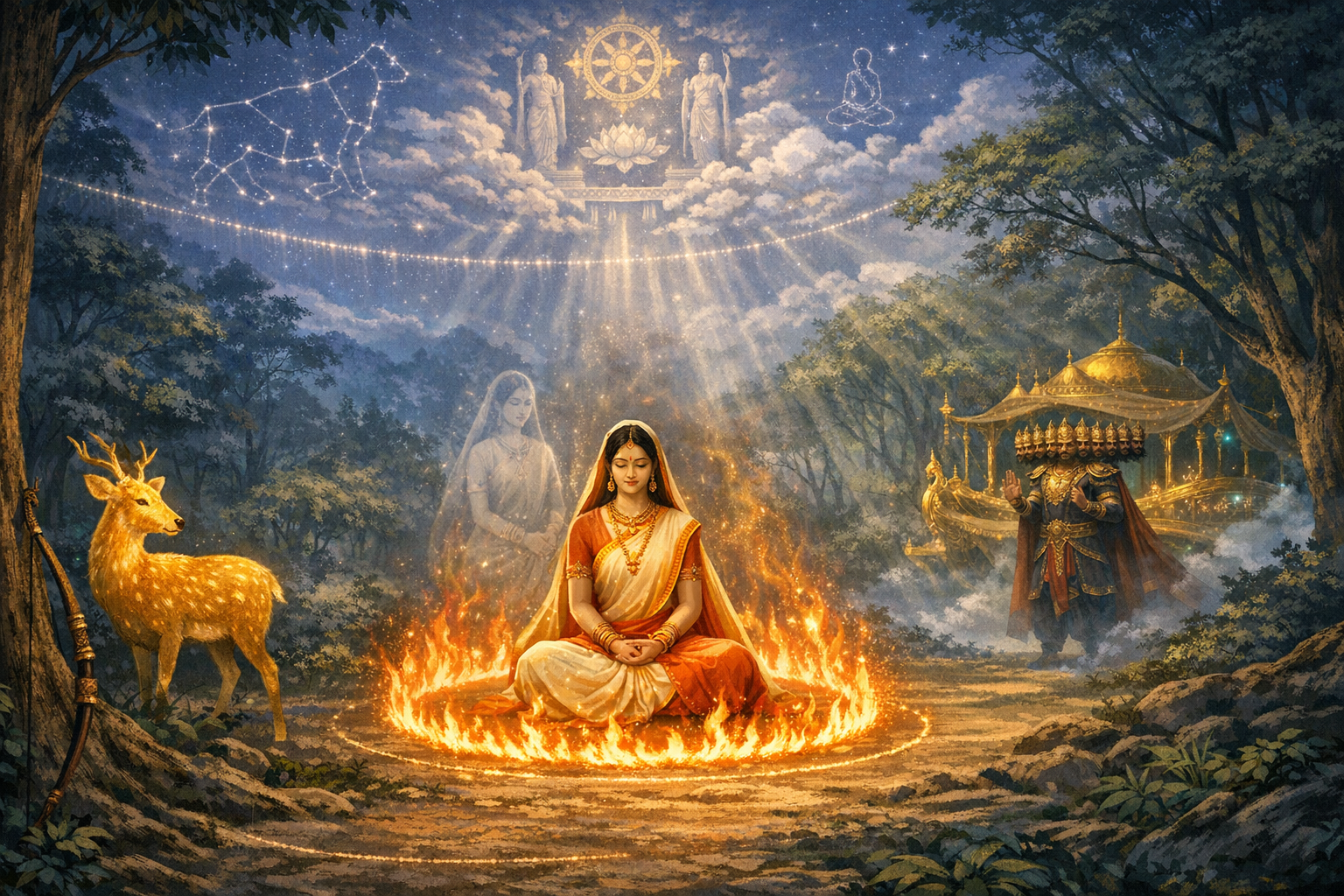
Few questions in Ramayana studies inspire as much fascination as the claim that Ravana abducted Sita in order to be slain by Sri Rama and thereby attain moksha. The possibility unsettles and intrigues in equal measure, because it forces a re-reading of motive, agency, and grace within one of the most emotionally charged episodes of the epic. An academically careful approach shows that this idea emerges not from the Valmiki Ramayana’s surface narrative alone, but from a layered conversation among Puranic motifs, bhakti hermeneutics, regional Ramayanas, and the broader Dharmic philosophy of liberation.
Readers who first encountered the Ramayana as a living storyrecited in homes, staged in Ramlila, sung in kirtanoften remember the abduction of Sita as a moment of grievous adharma. Yet many later devotional traditions refuse to let the villainy be the last word. They suggest a paradox: that profound grace can operate even through enmity to the Divine, and that the cosmic lila of Vishnu’s avatar may enlist an antagonist’s fall as the means to ultimate release. Holding these possibilities together calls for a plural, Dharmic readingone that honors textual rigor while embracing the unity of Hindu, Buddhist, Jain, and Sikh insights on ethical causality, restraint, and liberation.
Within the Valmiki Ramayana, Ravana’s motives appear worldly and transgressive. The text frames the episode through a chain of provocations and choices: Surpanakha’s humiliation, Ravana’s desire, the counsel of Maricha, the golden deer ruse, and the premeditated abduction in Rama’s absence. Nowhere does Valmiki explicitly state that Ravana’s intent was moksha. Instead, the epic emphasizes abhimana (pride), kama (desire), and the steady unraveling of adharma as Ravana defies moral counselfrom Vibhishana and othersand ignores omens that warn of ruin.
At the same time, Valmiki’s narrative architecture hints at cosmic orchestration. Lanka’s fate is repeatedly foreshadowed; the gods seek relief from Ravana’s tyranny; and Vishnu’s avatara as Rama is announced as the means of restoring dharma. Even without an explicit declaration of Ravana’s liberative intent, the poem situates his fall within a sacrificial arc of world-renewal. For readers steeped in Puranic cosmology, such framing invites the question: Could the antagonist’s defeat itself be an instrument of grace?
Later texts and commentarial traditions develop this question more boldly. The Adhyatma Ramayana, for example, reads the epic through a Vedantic and bhakti lens, repeatedly foregrounding Rama as Saguna Brahman and the entire narrative as the sport of the Absolute. In this theological frame, the destruction of adharma becomes inseparable from the bestowal of spiritual benefiteven to the defeated. The Skanda Purana, Padma Purana, and allied traditions often extend the motif: a being slain by the Lord may receive purification, echoing the broader Vaishnava insight that the Divine’s touchwhether in affection or oppositionheals the soul’s estrangement.
Central to this bhakti hermeneutic is the doctrine of Jaya and Vijaya, the gatekeepers of Vaikuntha. Cursed to be born three times as antagonists to Vishnu, they choose enmity over long separation, preferring rapid return through defeat at the Lord’s hands. Their second birth as Ravana and Kumbhakarna culminates in death by Rama; their third as Sisupala and Dantavakra ends in death by Krishnaat which point the Bhagavata tradition records immediate absorption into the Lord’s effulgence. This narrative scaffolding does not prove Ravana’s conscious desire for moksha during the abduction, but it firmly anchors his demise within a cosmic design of return.
Related is the Vaishnava concept sometimes called vaira-bhaktidevotion arising even through enmity. Srimad-Bhagavatam repeatedly teaches that intense, single-pointed absorption in the Lord, though distorted by hostility, can nonetheless draw the hostile soul into the Divine’s transformative orbit. In this theological economy, Ravana’s fierce opposition paradoxically keeps him oriented toward Rama, and his final confrontation becomes the karmic aperture through which grace operates.
Puranic and regional Ramayana traditions also supply a karmic logic of curses that set the stage for Lanka’s downfall. Nandi’s curse after Ravana disturbs Shiva, Vedavati’s vow after being harassed by Ravana, and Nalakuvara’s curse that any violation of a woman’s body would lead to Ravana’s deathall converge to explain both Ravana’s restraint toward Sita in captivity and the inevitability of his doom. These narrative strands reframe the abduction as a juridical and karmic setup: adharma accumulates its own sentence, and Rama, as Vishnu’s avatar, executes that sentence within dharma-yuddha.
The Maya Sita doctrine elaborates the same protective logic. In several later sourcesincluding strands associated with Adbhuta Ramayana and allied Puranic or Tantric tellingsAgni shelters the real Sita while a chaya, or shadow Sita, enters Lanka. The episode of Agni Pariksha then becomes a ritual exchange restoring the true Sita. While contested by some as a post-Valmiki development, this motif defends Sita’s sanctity and keeps Ravana’s transgression within the domain of intention rather than consummation, aligning with Nalakuvara’s curse and reinforcing the karmic and ethical framework of the story.
Comparative perspectives from Jainism and Buddhism enrich this discussion and highlight the unity of Dharmic insights. The Jain Paumacariya (Prakrit Ramayana) of Vimalasuri, for instance, reimagines many events within a rigorous ethic of ahimsa, complicating moral binaries and emphasizing self-mastery and karmic responsibility. Buddhist Jatakas such as the Dasaratha Jataka recast Rama’s story with different relationships and outcomes to teach renunciation and virtue. Across these tellingsHindu, Jain, and Buddhisttwo constants remain: craving and pride steer beings into suffering, and only disciplined virtue, insight, and grace restore equilibrium.
Sikh wisdom resonates with this integrative vision. While the Sikh canon is not a Ramayana commentary, it honors dharma, detachment, and remembrance of the One. Read in this intertradition light, the Ravana-Sita episode becomes less about theological one-upmanship and more about shared ethical grammar: restraint over impulse, duty over dominance, remembrance over pride, and the sovereignty of moral law over power.
From a philosophical standpoint, the moksha-quest thesis touches three pillars of Hindu thought: karma, dharma, and grace. Karma ensures that volitional acts bear fruit; dharma orients action toward the common good and inner integrity; and grace (anugraha) can, at decisive thresholds, cut through accumulated bondage. In the Ramayana’s devotional readings, Rama personifies the meeting point of these forces: he honors dharma, allows karma to ripen, and then, by his presence and compassion, liberates beingseven adversaries.
Two sober cautions remain. First, the Valmiki Ramayana should be read on its own terms: it does not attribute to Ravana a self-aware, spiritual motive in the abduction. Second, the ethical gravity of kidnapping and coercion is not diminished by theological re-readings. A responsible, Dharmic hermeneutic therefore distinguishes between Ravana’s subjective intention as the epic presents it (dominated by kama and abhimana) and the objective, cosmic outcome as later bhakti traditions interpret it (liberation granted by Rama’s touch).
Why, then, has the moksha-quest interpretation flourished? Three reasons stand out. Devotionally, it safeguards the conviction that contact with the Divinehowever fraughtultimately heals. Cosmologically, it harmonizes the Jaya–Vijaya cycle with the Ramayana’s moral universe. Practically, it offers solace: even the most obstinate estrangement can be reversed by grace, a lesson that comforts ordinary readers navigating their own struggles with desire, anger, and pride.
Strong counterarguments deserve equal space. Critics note that retrofitting a soteriological motive onto Ravana risks excusing wrongdoing. Others observe that importing Puranic material into the epic’s core can obscure Valmiki’s literary genius and ethical clarity. A balanced approach therefore reads the layers historically: the epic foregrounds moral psychology and consequence; later Puranas and bhakti texts superimpose metaphysical assurance and theological coherence across the avatar-cycle.
Methodologically, Dharmic pluralismakin to the Jain principle of Anekantavadahelps hold these strands without erasure. Each lens discloses a facet of truth: the epic’s ethical realism, the Puranas’ cosmological design, the bhakti saints’ testimonial confidence in grace, and the regional Ramayanas’ cultural wisdom. Rather than forcing a single answer, a unified Dharmic reading honors the many while seeking harmony among them.
For contemporary seekers, this synthesis is not merely academic. Many readers resonate emotionally with Sita’s steadfastness, Rama’s measured forbearance, Hanuman’s fearless seva, and Vibhishana’s lonely courage to dissent from adharma. The idea that even Ravana’s fall could become a doorway to moksha underscores the epic’s deepest reassurance: no one lies beyond the horizon of the Divine’s compassion, and no defeat is final when oriented toward truth.
A few practical reflections follow from this study. First, fidelity to dutyeven when costlyconserves inner freedom. Second, unchecked desire and pride corrode discernment and isolate the mind. Third, counsel rooted in dharma (as Vibhishana’s was) should be welcomed even when unwelcome to the ego. Finally, remembrance of the Divinethrough Rama-nama, contemplative reading, or ethical actionaligns personal karma with a wider grace that can redeem the past.
In conclusion, the proposition that Ravana abducted Sita to secure liberation through Rama is not the plain statement of the Valmiki Ramayana, yet it is a legitimate and influential thread within the larger tapestry of Puranic and bhakti interpretations. Read together, these traditions do not trivialize wrongdoing; they magnify the reach of grace. Within a unified Dharmic horizon that honors Hindu, Buddhist, Jain, and Sikh pathways, the episode becomes an invitation to responsibility, humility, and trust that the moral law and the merciful Absolute ultimately converge.
Inspired by this post on Hindu Blog.










