Rakta Chamundi, also rendered as Raktha Chamundi, is a fearsome yet compassionate manifestation of the Divine Mother within Hinduism, the Shakti who appears to dismantle adharma and restore cosmic balance. As a Hindu Goddess associated with the liminal and the liberating, she condenses the paradox of the Sacred Feminine: terrible in aspect, protective in intent, and salvific in outcome. The epithet “Rakta” (“blood” or “red”) signals both her blazing radiance and her uncompromising intervention against forces that perpetuate suffering.
Within the Shakta tradition, Rakta Chamundi is closely connected to Parvati as Devi Shakti in her sovereign capacity to uphold dharma. The Devi Mahatmya (Durga Saptashati), a central scripture for understanding the nature and functions of the Divine Mother, narrates how the fierce energy of the Goddess manifests when the cosmic order is threatened. In these accounts, wrath is never wanton; it is a precise and ethical instrument used for protection, clarity, and release from bondage.
The Devi Mahatmya describes the episode in which two asuras, Chanda and Munda, lead a brutal assault upon the Goddess. From the brow of Durga, a dark, lightning-like emanation arisesKaliwho swiftly annihilates them. For this deed, she is venerated as Chamunda, the “slayer of Chanda and Munda.” This narrative illuminates the inseparability of ferocity and compassion in Divine agency: cruelty is met not with cruelty, but with a calibrated force that ends its recurrence.
Another celebrated episode involves the demon Raktabija, whose spilled blood births countless replicas of himself. The Goddess responds by drinking his blood as it flows, thereby preventing further proliferation. The symbolism is pivotal for understanding the “Rakta” dimension: the Goddess dries the very source of limitless repetitionthe seed of compulsive negativityso that genuine transformation becomes possible. In the language of inner sadhana, she halts the self-replicating patterns of ignorance and craving.
Etymologically, “Rakta” conveys both the color red and the life-force quality of blood. It invokes vitality, heat, and the intensity required to confront deeply rooted distortions. “Chamunda,” as a theonym, memorializes the decisive overcoming of Chanda and Munda. Together, Rakta Chamundi becomes the blood-red presence of liberationfiery awareness that refuses to collude with falsehood or fear.
While Chamunda is often identified with Kali and Chandi, iconographic and functional nuances distinguish these forms. Kali is paradigmatically time-transcending and world-dissolving; Chandi is martial and regal; Chamunda leans toward the cremation-ground aesthetic, the ascetic, skeletal, and liminal. Rakta Chamundi accentuates this spectrum with her red-hued ferocity, emphasizing purification through direct confrontation with the roots of suffering.
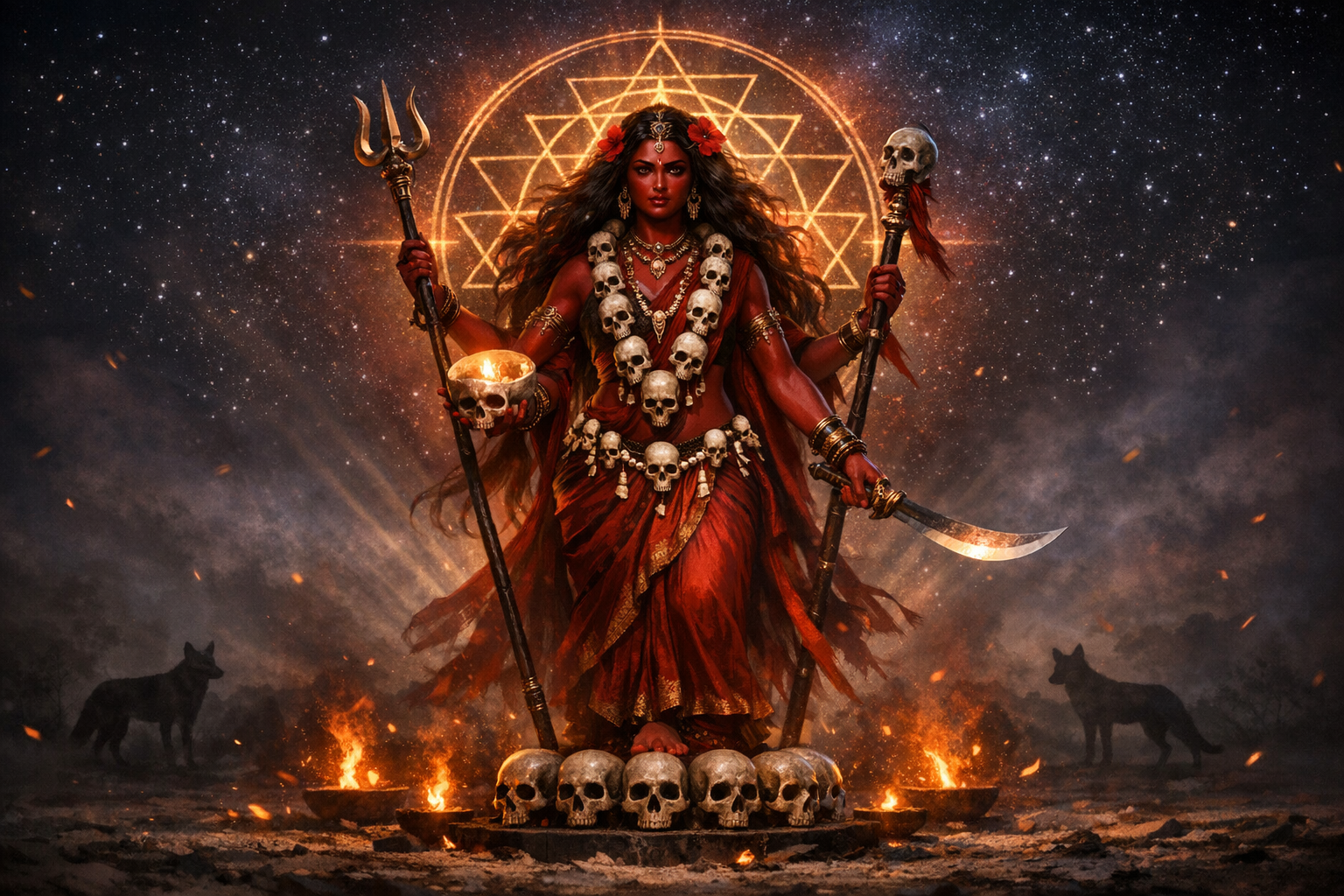
Classical iconography portrays Rakta Chamundi with disheveled hair, a garland of skulls (mundamala), protruding teeth, and a complexion from blood-red to dark crimson. She may carry a trident, sword, skull-cup (kapala), and a staff or khatvanga, standing or dancing upon a corpse to signal victory over egoic inertia. The cremation ground, flames, and bone ornaments invoke an unflinching intimacy with impermanence and truth. Such Symbolism is not morbid; it is didactic, recalling the transience of the body and the urgency of wisdom.
“Goddess Chamunda jackals symbolism” in art and ritual reflects her guardianship at the margins of civilization, where untamed forces roam. Jackals can denote watchfulness, boundary-keeping, and the Goddess’s sovereignty over spaces that polite consciousness prefers to ignore. In many depictions, the presence of these animals emphasizes her refusal to sanitize reality; instead, she integrates it, transforms it, and consecrates it.
The “Panchamundi Asana symbolism” (the seat of five skulls) appears in esoteric traditions associated with Rakta Chamundi and cognate forms of Kali. Philosophically, the asana points to mastery over five sheaths (panchakosha) or five vitalizing principles that can entangle awareness. Seated upon this emblem of transcendence, the Goddess signifies that wisdom is not an escape from embodiment, but its purification and command.
In aesthetics and practice, Rakta Chamundi expresses raudra (fierce) bhava in the service of karuna (compassion). The fusion resolves a common misunderstanding: wrath, in this sacred context, is not hatred. It is the uncompromising light that ends the lifespan of delusion. By embracing the terrible for benevolent ends, Rakta Chamundi models how ethical power dismantles structures that perpetuate harm.
Interpreted inwardly, Chanda and Munda personify the stubborn, proliferating tendencies of the mindanger, envy, fear, and the inertia that cements them. Rakta Chamundi’s sword is viveka (discrimination), and her skull-cup is a reminder that every thought becomes food for awareness or fuel for bondage. When the mind’s “blood”its repeating habitsmeets the presence of vigilant consciousness, the chain of reactivity is cut.
Mainstream worship of Rakta Chamundi is woven into the broader Chandi and Durga traditions. Devotees engage in recitation of the Chandi Path (Durga Saptashati), perform abhishekam, offer red flowers such as hibiscus, and light lamps with deep reverence. The widely venerated Navarna MantraOm Aim Hrim Klim Chamundaye Vicheencapsulates the seed-energies of wisdom, radiance, and transformative force. In settings where esoteric rituals exist, emphasis remains on purity of intention, ethical preparation, and guidance within a legitimate sampradaya.
Festivals like Navaratri and Durga Ashtami highlight her presence. On these occasions, communal worship emphasizes protection of the vulnerable, renewal of personal vows, and collective commitment to dharma. Observances frequently stress ahimsa in offerings, with many regions foregrounding vegetarian naivedya and symbolic substitutes for rites historically associated with sacrifice. The shared principle is clear: genuine devotion seeks the welfare of all beings.
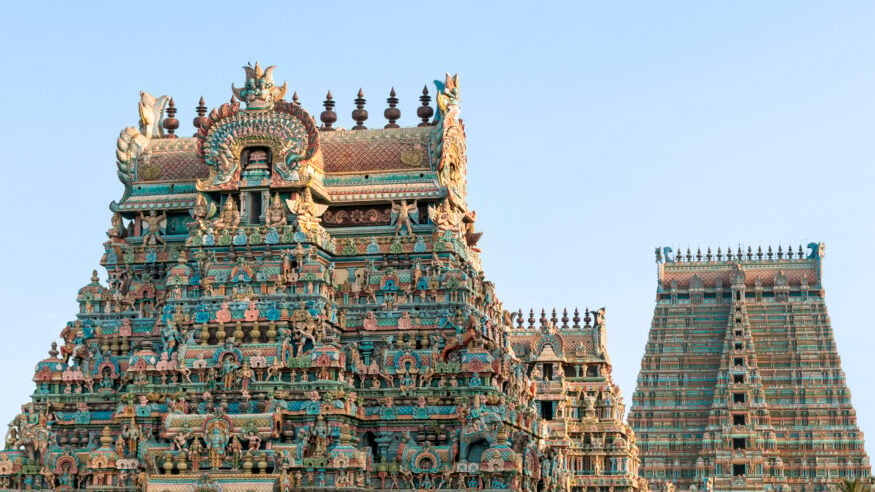
Temple traditions illuminate Rakta Chamundi’s widespread reverence under cognate names. Chamundeshwari on Chamundi Hills (Mysuru) encapsulates the victorious aspect of the Goddess in a royal milieu. In the Himalayan belt, the Chamunda Devi Temple (Himachal Pradesh) enshrines her as a guardian of mountain communities. In the ritual universe of North Malabar, the Theyyam of Raktha Chamundi testifies to a living, performative theology in which the Goddess’s agency is dramatically experienced, blessing villages with protection and moral clarity.
Sculptural and painted forms across India and the Himalayas display regional variations while preserving core attributes: the skull-garland, the fierce visage, and the cemetery iconography. In some Newar contexts of the Kathmandu Valley, the Saptamatrika and Ashta Matrika systems incorporate Chamunda as a liminal protector, often articulated in red tones. These convergences show how regional aesthetics and philosophical emphases adapt while maintaining the essence of the Hindu Goddess as Devi Shakti.
A comparative view across dharmic traditions highlights a shared intuition: fierce compassion is vital for cutting through entrenched harm. In Vajrayana Buddhism, wrathful feminine deities embody enlightened activity that destroys ignorance while protecting sentient beings. In Jain tantric heritage, guardian yakshinis with protective fierceness function within strict ethical parameters of non-violence and restraint. In Sikh tradition, compositions such as Chandi di Vaar in the Dasam Granth poetically honor Divine Power that resists injustice. Together, these perspectives affirm unity in diversityan understanding that transformative courage and compassion are harmonious, not oppositional.
Ethically, Rakta Chamundi invites disciplined engagement with anger. The teaching is not to suppress or glorify it, but to refine it into lucid resolve. This transmutation empowers responsible actiondefending the weak, telling hard truths, and reforming institutionswithout succumbing to bitterness. Protection of dharma in this sense is not sectarian triumphalism; it is the vigilant care of a common moral ecology in which all can flourish.
Psychologically, the Goddess’s red radiance can be read as metabolic heat for inner alchemy. Practices that cultivate attention, discrimination, and compassion furnish the inner “fire” that breaks repetitive patterns. The message aligns with timeless counsel in Indic thought: clarity of mind, steadiness of conduct, and dedication to the welfare of others are the true ornaments of worship.
As a theological motif, Rakta Chamundi ensures that no dimension of realityhowever fearsomeremains outside the scope of liberation. By sanctifying the cremation ground and governing the wilderness at civilization’s edge, she proclaims that enlightenment is not elsewhere; it is precisely where one stands, provided the heart is courageous and the intention pure.
Ultimately, Rakta Chamundi discloses a disciplined, compassionate power that ends cycles of harm and opens pathways to freedom. Her blood-red brilliance does not merely terrify malevolence; it heals communities by anchoring justice in wisdom. In honoring her, practitioners across Hinduismand in fellowship with cognate insights in Buddhism, Jainism, and Sikhismaffirm a shared dharmic aspiration: to cultivate inner and outer conditions in which truth, compassion, and courage prevail together.
Inspired by this post on Hindu Blog.