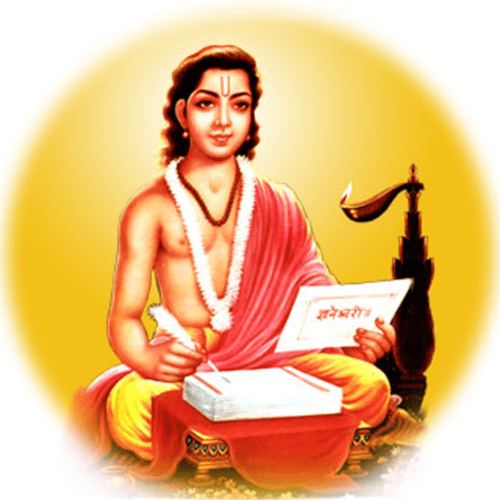
Rajarshi Mudgala (also attested as Mudgal or Mudgala) occupies a distinctive place in Hindu tradition as a Kshatriya sovereign who, through rigorous tapas, attained rishihood. He is traditionally associated with the Mudgala Purana, a Ganesha-focused Upapurana that codifies devotion to Lord Ganesha and outlines puja and homam practices. Celebrated for exemplary kshamā (forbearance), equipoise, and universal goodwill, Mudgala stands as an ethical archetype for householders and ascetics alike.
Textual sources present more than one remembrance of Mudgala. One current identifies him as a Rajarshi of royal lineage whose renunciation exemplifies the permeability between kshatra (sovereign responsibility) and brahmavidyā (spiritual realization). Another strand, preserved in the Mahabharata’s didactic sections, portrays a Brahmin ascetic named Mudgala who lives on gleaned grains, achieves extraordinary merit, and declines even celestial pleasures to remain established in dharma. Within the Purana corpus, “Mudgala” further serves as the seer-narrator associated with the Mudgala Purana. These complementary memories share a thematic core: patience, restraint, and unwavering devotion to the Supreme framed in the benign, wisdom-bestowing form of Ganapati.
The Mudgala Purana belongs to the medieval Ganesha literature alongside the Ganesha Purana. Most scholars place its compilation between roughly the 10th and 14th centuries CE, with later redactional layers likely. Rather than presenting a dynastic or regional history, it offers a theological map of devotion to Vighneshwara, integrating mythic narratives, vrata guidance, mantra-vidhi, and homa outlines into a concise, practice-oriented scripture. Its pedagogical emphasis makes it a practical manual for bhakti anchored in a clear metaphysical vision.
At the heart of the Mudgala Purana is the celebrated teaching on Ganesha’s eight incarnations (ashta-avatara): Vakratunda, Ekadanta, Mahodara, Gajavaktra (often Gajanana), Lambodara, Vikata, Vighnaraja, and Dhumravarna. Each manifestation subdues a distinct asura that allegorically represents a human impediment such as jealousy, pride, delusion, greed, anger, unbridled desire, possessiveness, and self-importance. Read as a soteriological schema, the cycle charts a progressive dismantling of inner obstacles (vighna) so that buddhi (discriminative insight) and shraddhā (deep trust) can ripen. The result is a psychologically nuanced pathway that renders myth an instrument of inner engineering.
Ritual instructions in the Mudgala Purana revolve around regular worship on the Chaturthi tithis, the offering of durva grass, red-hued flowers, and modaka, and the contemplative recitation of the mūlamantra “Om Gam Ganapataye Namaha.” The text valorizes attentive sankalpa (ethical intention) as the seed of every rite, aligning procedural precision with inner clarity. In household settings this translates into simple, steady practicelamp, fragrance, water, naivedyaperformed with serene focus and gratitude, a straightforward Ganapati puja vidhi designed to cultivate presence and purity.
The homam to Ganapati (Ganapati homam) is framed as a sacramental fire that internalizes the remover of obstacles. Agni becomes the conveyor of offerings and resolutions alike; oblations are paired with nama-vidhi and kavacha-like invocations for protection, steadiness, and auspicious beginnings. While regional paddhatis differ on detail, the Purana’s thrust is unmistakable: homa is efficacious when performed with purity of means, ethical livelihood, and a heart oriented toward loka-sangraha (the welfare of all). In practice, this homam procedure complements daily worship by consecrating new undertakings and sanctifying transitions.
As a Rajarshi figure, Mudgala embodies the harmonization of royal stewardship and contemplative depth. He personifies kshamā (patience), maitri (friendliness), and ahimsa (non-harm), virtues that converge across Hindu, Buddhist, Jain, and Sikh wisdom streams. The Rajarshi ideal demonstrates that governance and spiritual realization need not be opposites; rather, righteous power matures through restraint, self-scrutiny, and compassionate service.
The inclusive symbolism of Ganapati strengthens this inter-dharmic resonance. In Vajrayana Buddhism, Mahāgaṇapati appears within tantric mandalas as a fierce yet beneficent guardian of awakened activity. Jain temple iconography in certain regions preserves images of Ganesh as a deity of auspicious beginnings for householders. Within the Sikh tradition’s focus on the One without form, the theme remains ethically continuous: the removal of inner obstacles through remembrance (nam) and right action. Across these lineages, the shared aspiration is unmistakabletransforming impediments into insight and compassionate conduct.
Philosophically, the Mudgala Purana treats Ganesha as both saguna (with attributes) for devotional approach and as nirguna (beyond attributes) when realized as the nondual ground. In this sense, Ganapati is presented as the accessible face of the ineffable Brahman, a bridge between household ritual and contemplative inquiry. The text thereby participates in the broader Vedantic synthesis that holds mythic form and metaphysical formlessness in creative tension, guiding practitioners from ritual correctness to experiential knowledge (anubhava).
From the standpoint of textual transmission, the Mudgala Purana survives in multiple recensions with regional variations. Manuscripts in Devanagari and allied scripts attest to a living tradition of copying, ritual use, and commentary. Modern scholarship tends to read the work as layered, combining older narrative kernels with later devotional expositions and procedural detail. Regardless of redactional history, its voice is consistently pastoralclarifying, encouraging, and oriented to transformative practice.
For contemporary devotees and culturally engaged readers alike, the figure of Mudgala offers a relatable template. Householders begin new ventures by remembering Vighneshwara; students invoke clarity before examinations; communities organize Vinayaka Chaturthi to weave service, art, and devotion into social cohesion. In these moments, a simple mantra and a strand of durva become more than ritualsigns of confidence that obstacles, inner and outer, can be met with wisdom and patience.
In sum, Rishi Mudgala’s legacy unites ethical poise, theological depth, and practical guidance. The Mudgala Purana complements this legacy with a psychologically rich teaching on Ganesha’s eight incarnations and a lucid roadmap for puja and homam. Read within the wider family of dharmic traditions, it encourages unity without uniformitymany approaches, one compassionate intent. That vision, as timely now as in the medieval ashramas where these teachings were first recited, continues to illuminate a path of auspicious beginnings and steadfast progress on the way of dharma.
Inspired by this post on Hindu Pad.