
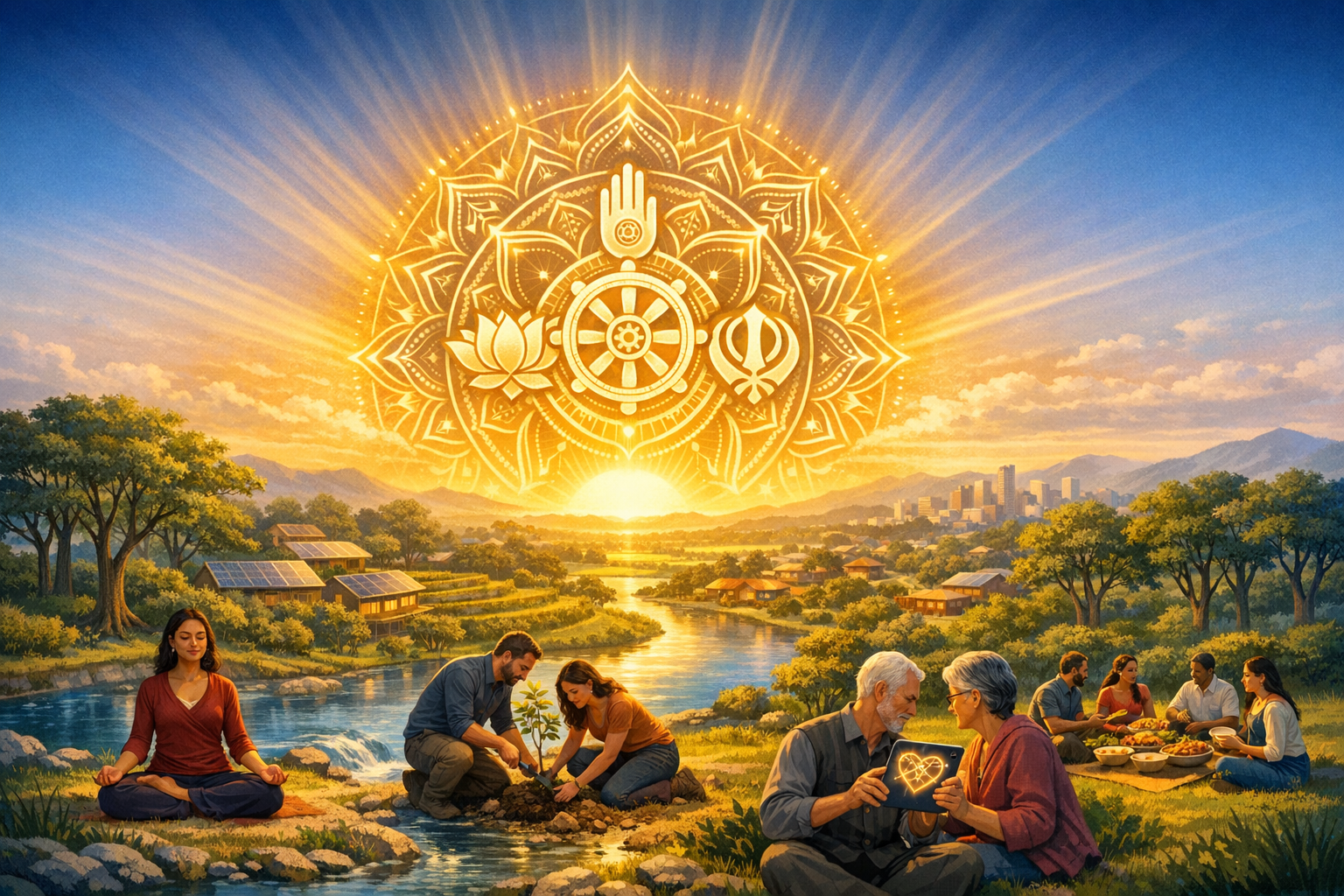
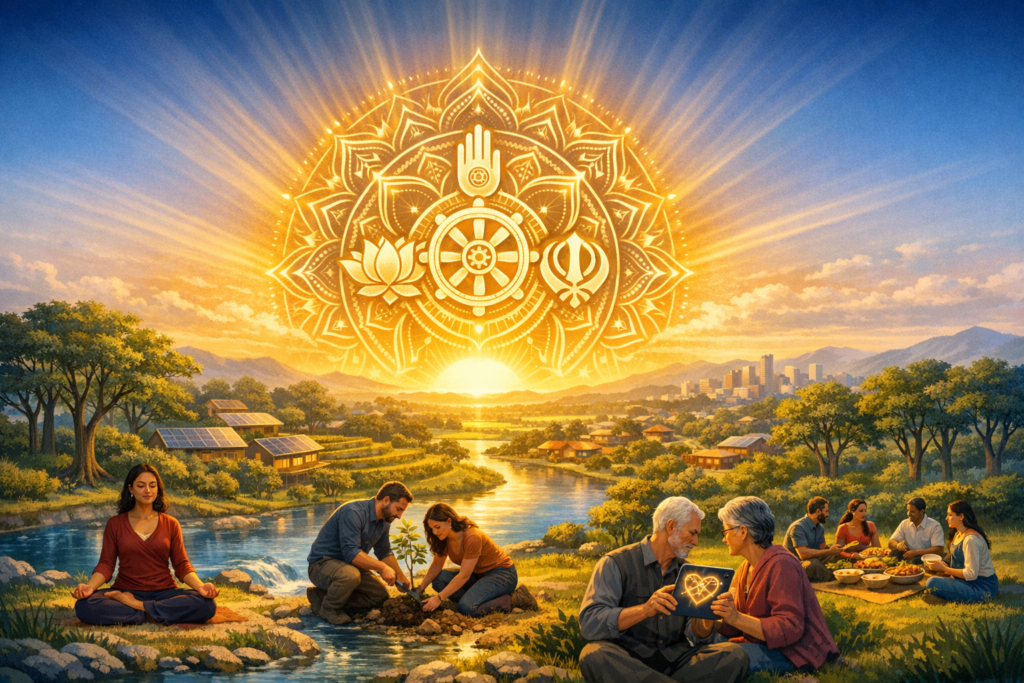
Across South Asian dharmic frameworks, time is understood cyclically, with Kali-yuga marking a period of moral and social turbulence. Purāṇic discussions also point to a luminous interval within Kali-yuga—a Golden Age—during which collective uplift becomes feasible. In that context, the idea of a “new species of humanity” can be understood not as a biological mutation but as a civilizational transformation: a shift in consciousness, conduct, and community structures grounded in dharma and inclusive of Hinduism, Buddhism, Jainism, and Sikhism.
Framed academically, the proposal is a cultural-evolution thesis: societies that align human flourishing with inner cultivation, compassion, ecological responsibility, and ethical technology will outcompete extractive and divisive models. The result is a distinct civilizational type—call it a dharmic humanity—identifiable not by genetics but by observable norms, institutions, and measurable outcomes in well-being, harmony, and resilience.
This dharmic humanity is intrinsically plural. In Hindu thought, dharma, yoga (with yama–niyama), karma-yoga, and the Upanishadic pursuit of truth cultivate an ethics of self-mastery and service. Buddhism contributes the Noble Eightfold Path and the brahmavihāras (maitrī, karuṇā, muditā, upekṣā), offering rigorous methods of mental training and compassion. Jainism grounds social ethics in ahiṁsā, aparigraha, and anekāntavāda, establishing non-harm, non-possessiveness, and perspectival humility as first principles. Sikhism embodies Naam Japna, Kirat Karni, Vand Chhakna, and Sarbat da Bhala, uniting remembrance, honest work, equitable sharing, and the welfare of all. Together, these lineages demonstrate Unity in Diversity without erasing difference.
Shared principles across these traditions converge on a coherent design for social transformation: truthfulness (satya), non-violence (ahiṁsā), generosity (dāna), self-discipline (tapas), pluralism (anekāntavāda), devotion/sacred remembrance (bhakti/simran), contemplative training (dhyāna), and just action (seva/karma-yoga). This constellation supports a practical model for interfaith harmony and institutional design rooted in Sanatan Dharma’s civilizational breadth and fully respectful of Buddhist, Jain, and Sikh standpoints.
Contemporary research perspectives reinforce this program. Neuroplasticity shows that contemplative practice modifies attention, affect regulation, and prosocial tendencies over time. Studies in contemplative science note associations between regular meditation and improvements in stress markers, emotion regulation, and altruistic behavior. Heart–brain dynamics—tracked through heart-rate variability—link breath regulation and mindfulness to parasympathetic tone and resilience. While empirical work must be interpreted carefully and ethically, it provides convergent support for the dharmic claim that inner training cultivates societal benefits.
Viewed through cultural evolution, prosocial norms and cooperative institutions can spread via prestige bias, success bias, and network diffusion. When communities model pluralistic ethics, low-conflict deliberation, and service-oriented leadership, these traits become aspirational and imitated—an evolutionary advantage under complex global stressors. In short, dharma-aligned cultures are poised to be adaptive in the Anthropocene.
This paradigm also addresses the ecological crisis. Dharmic sustainability reframes the human–nature relationship through reverence and restraint, operationalized by conscious consumption (aparigraha), vegetarian or reduced-harm dietary choices where appropriate (ahiṁsā), and community-scale stewardship. The ethic of Vasudhaiva Kutumbakam—“the world is one family”—expands care beyond identity boundaries to all beings and ecosystems.
Design Principle 1: Ahiṁsā-first living. Commit to reducing harm in thought, speech, and action. Practical norms include nonviolent communication, restorative justice, responsible dietary choices, and compassionate economics. Across Hinduism, Buddhism, Jainism, and Sikhism, non-harm is foundational.
Design Principle 2: Satya with viveka (discernment). Truth-seeking requires humility and rigorous examination. Educational and civic programs can institutionalize media literacy, debate etiquette, and inquiry practices analogous to śravaṇa–manana–nididhyāsana, cultivating clarity without polemics.
Design Principle 3: Anekāntavāda as pluralism. Multiple perspectives disclose different facets of truth. Interfaith Dialogue, acceptance of Ishta, and respect for nirguṇa–saguṇa approaches prevent dogmatism. Policy and pedagogy should explicitly teach Unity in spiritual diversity.
Design Principle 4: Seva and dāna as civic infrastructure. Service is formalized through langar/annadāna-inspired food security, community clinics, climate adaptation brigades, and legal-aid cooperatives. Karma-yoga (Gītā 3.19) and Sikh principles of Kirat Karni and Vand Chhakna align service with dignity and equity.
Design Principle 5: Dhyāna and simran as daily hygiene. Contemplative training—breathwork, mantra, mindfulness—stabilizes attention and compassion. Evidence suggests benefits for stress physiology and prosociality when practiced consistently. Accessible, tradition-appropriate modules can be embedded in schools, workplaces, and civic life.
Design Principle 6: Sādhana-centered education. Curricula can integrate texts like the Upanishads, Dhammapada, Ācārāṅga Sūtra, and Guru Granth Sahib with ethics labs, service-learning, and conflict-resolution drills. Pedagogy draws from gurukul, sangha, and sangat models while embracing contemporary rigor.
Design Principle 7: Ecological dharma. Cities and villages adopt circular-economy practices, watershed protection, sacred-grove conservation, and pollution control framed as vows of care. Rituals and festivals become platforms for biodiversity awareness and zero-waste norms.
Design Principle 8: Community institutions—sangha, satsang, sangat. Regular assemblies nurture belonging, dialogue, and shared problem-solving. Deliberation protocols inspired by panchayat traditions and restorative circles reduce polarization while centering sarbat da bhala.
Design Principle 9: Ethical technology. A Digital Dharma Charter can guide product design toward well-being, dignity, privacy, and non-harm. Algorithms should be audited for bias and divisiveness, with incentives for verified knowledge and compassionate discourse.
Design Principle 10: Dharma-guided governance. Subsidiarity, transparency, and accountability align with lokasaṅgraha (collective welfare). Constitutional pluralism safeguards freedom of worship and conscience, embedding unity without uniformity.
Measurement is essential. A Dharma Maturity Index can track five domains: inner cultivation (time in sādhana/simran/dhyāna), compassion-in-action (seva hours and reach), ecological responsibility (footprint and regeneration metrics), harmony (conflict reduction, interfaith cooperation), and integrity (trust, transparency). Cities, schools, and organizations can set targets and publish dashboards, similar to public-health reporting.
Implementation can follow three horizons. In 0–3 years, pilot projects integrate meditation and service in schools, establish interfaith langar–annadāna kitchens, and launch neighborhood dialogue forums. In 3–7 years, regions scale ecological dharma initiatives, adopt ethical-tech standards, and formalize pluralism education. By 7–21 years, interlinked networks consolidate: shared metrics, research–practice consortia, and translocal councils that coordinate resilience and peacebuilding.
Youth engagement is pivotal. Programs that blend Yoga and meditation, ethical entrepreneurship, and climate stewardship channel aspiration into tangible community benefit. Mentorship across Hindu, Buddhist, Jain, and Sikh communities accelerates learning and solidarity.
Families and workplaces can be micro-ecosystems of dharma. Home practices—daily simran, shared meals free of waste, weekend seva—normalize care. Organizational cultures that honor honesty, fair wages, and purposeful work embody Kirat Karni and karma-yoga in professional life.
Urban and rural planning can harness sacred geography as a civic ethic. Temple, vihāra, derāsar, and gurdwara networks already mobilize volunteers and resources; coordinated action multiplies impact in disaster response, food security, and mental-health first aid—without proselytization and with deep respect for autonomy.
Safeguards are necessary. Pluralism must not decay into relativism, and conviction must not harden into sectarianism. Anekāntavāda, compassionate speech norms, and independent ethics boards help prevent coercion, personality cults, or institutional capture.
Common objections can be addressed. First, “new species” here is a metaphor for civilizational type, not biology; it rejects eugenics and affirms equal dignity. Second, claims of pseudoscience are mitigated by transparent, peer-reviewed evaluation of contemplative training, prosocial behavior, and ecological outcomes. Third, exclusivist resistances can be met through dialogue that protects freedom of conscience while modeling cooperative action for shared goods.
Festivals can become engines of inclusion and sustainability. Deepavali, Vesak, Paryuṣaṇa, and Vaisakhi can foreground zero-waste logistics, inter-community service, and education on ahiṁsā and stewardship—where devotion, joy, and responsibility converge.
Global dharmic diasporas offer bridging capital. Their experience with multicultural institutions, philanthropy, and ethical technology can seed transnational collaborations, knowledge commons, and rapid replication of effective models.
In sum, the turbulence of Kali-yuga need not foreclose hope. By aligning inner transformation with social design, dharmic traditions can together inaugurate a practical Golden Age—incremental, measurable, and welcoming to all. The aspiration is neither utopian nor sectarian; it is a disciplined, plural, and humane blueprint. In that cooperative spirit, Vasudhaiva Kutumbakam becomes not a slogan but a daily practice, and a truly dharmic humanity emerges—resilient, compassionate, and united in diversity.
Inspired by this post on Dandavats.






Leave a Reply
You must be logged in to post a comment.