
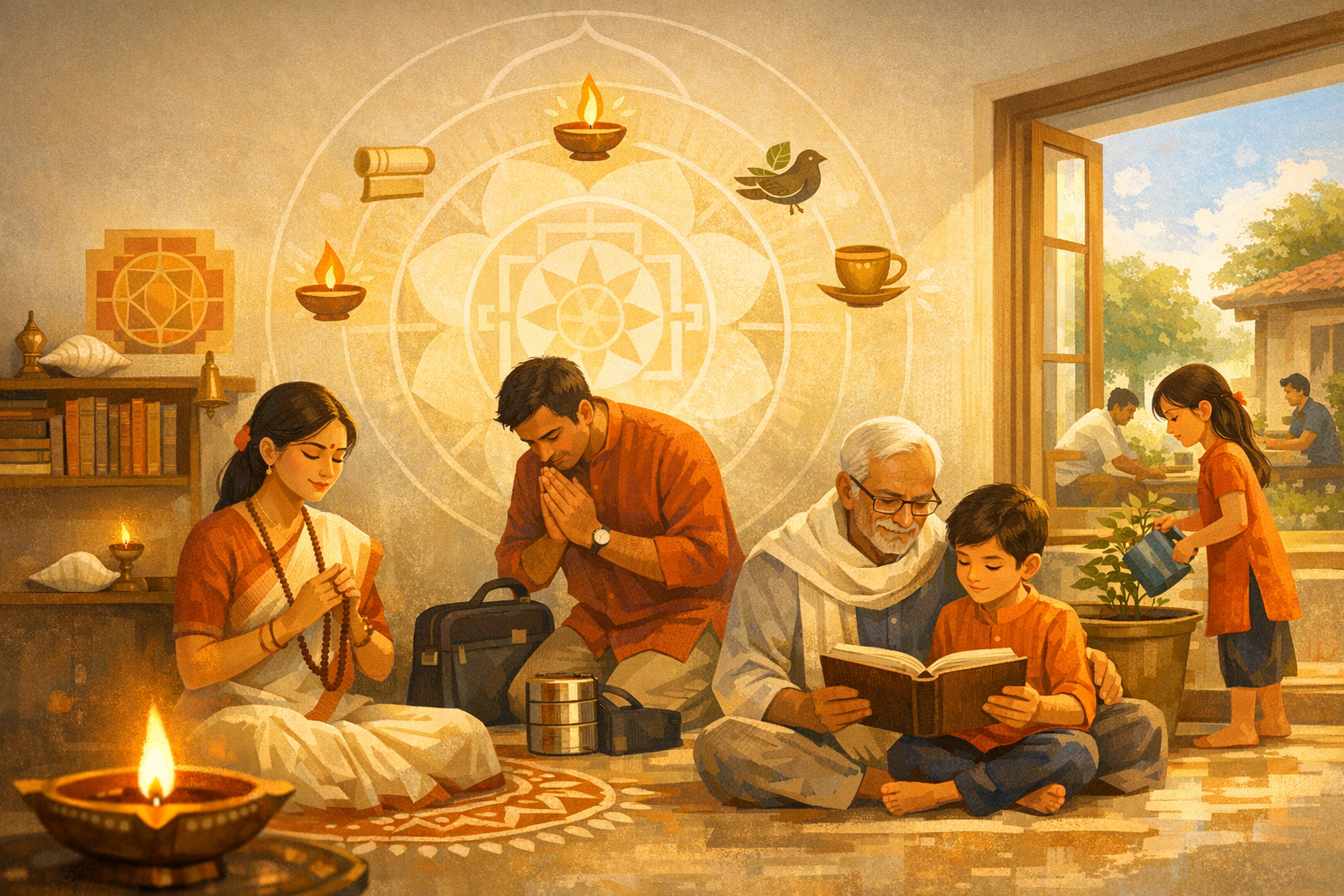
Across many conversations on spiritual life, mukti (moksha) is often equated exclusively with external renunciation—leaving family, relinquishing social roles, and pursuing seclusion. Classical Hinduism, however, presents a more nuanced and comprehensive roadmap in which family life (grihastha) is not an obstacle but a potent vehicle for liberation. This vision finds expression in the ashrama system and in sannyasa-focused texts such as the Narada Parivrajaka Upanishad of the Atharva Veda, which emphasize preparedness, ethical ripeness, and an inward renunciation that can unfold within or beyond domestic responsibilities.
The ashrama framework—brahmacharya (student), grihastha (householder), vanaprastha (forest-dweller), and sannyasa (renunciate)—organizes a human life around the gradual internalization of dharma. Rather than opposing the household phase to spiritual realization, it situates grihastha at the center of social, ethical, and ritual life, enabling the cultivation of discipline, compassion, and non-attachment in the most relationally demanding arena available: family and community. In this model, responsibility is transfigured into sadhana (spiritual practice).
Sannyasa Upanishads such as the Narada Parivrajaka Upanishad underscore that formal renunciation requires maturity of discernment (viveka), dispassion (vairagya), and the erosion of egoic doership (ahamkara). They acknowledge exceptions but generally place sannyasa after the householder’s ethical obligations have been honored. This sequence reflects a pedagogy of ripening: when the heart has been tempered by duty, generosity, and service, its insights can abide stably without recoil or regression.
Dharmashastric literature repeatedly affirms the centrality of grihastha. The householder sustains the other three ashramas by generating the economic, social, and emotional capital that supports study, contemplation, and renunciation. Through the Pancha Mahayajnas—brahma-yajna (reverence for knowledge), deva-yajna (ritual gratitude), pitri-yajna (ancestral remembrance), bhuta-yajna (care for beings and ecology), and atithi-yajna (hospitality)—the householder sacralizes daily life, aligning inner intention with cosmic reciprocity. Such practices purify the mind (chitta-shuddhi), laying the groundwork for higher realization.
The Bhagavad Gita gives this household sadhana precise philosophical articulation. Karma Yoga—selfless action offered without attachment to outcomes—enables spiritual ascent within ordinary duties. Krishna’s assurance, karmanaiva hi samsiddhim asthita Janakadayah (3.20), points to exemplars like King Janaka, who attained perfection through action rightly performed. The Gita’s teaching that svadharma (one’s own duty) enacted with integrity is superior to borrowed ideals (3.35) reframes home, work, and citizenship as sanctified fields of practice. In this light, family obligations are not spiritual detours but the very curriculum of liberation.
Technically, Karma Yoga transforms the mental architecture of action. When acts are consecrated to the Divine (Ishvara-arpana) and results returned to the Divine (prasada-buddhi), raga-dvesha (attraction-repulsion) loosens, the sense of doership attenuates, and sattva (luminosity) increases. This cognitive and moral reconfiguration enables stable meditation (dhyana) and, ultimately, knowledge (jnana) of the Self as atman-brahman identity. Thus, family life, correctly oriented, becomes an accelerator rather than a hindrance to moksha.
The Purusharthas—Dharma, Artha, Kama, Moksha—provide an additional integrative scaffold. In the householder stage, artha (resourcefulness) and kama (harmonious enjoyment) are governed by dharma, so that worldly flourishing does not eclipse ultimate freedom. When navigated with discernment, the Purusharthas form a continuum leading to moksha rather than a competition of ends. This integrated ethics helps prevent spiritual bypassing on one side and material excess on the other.
Family life also demands applied virtues—truthfulness, patience, forbearance, non-harming (ahimsa), and generosity (dana). Parenting, elder care, and partnership continuously test and refine these dispositions. In such relationships, ahamkara is persistently challenged; humility grows; empathy deepens; and the capacity to hold complexity expands. These changes are not merely moral; they are metaphysical preparations that steady the mind for abiding self-knowledge.
Ishta—freedom to relate to the Divine in personally resonant forms—allows householders to tailor sadhana to temperament. Japa, kirtan, puja, seva, and study can be configured around domestic rhythms without loss of depth. This personalization—celebrated across Hindu spirituality—balances rigor with sustainability, ensuring that practice endures through life’s phases. Diversity in spiritual forms here nurtures unity in spiritual essence.
Historical and scriptural narratives illustrate this householder ideal. King Janaka exemplifies equipoise in governance and contemplation. Yajnavalkya engages profound dialogue while embedded in social life before eventual renunciation. Devotee-saints such as Tyagaraja and Tukaram show how bhakti saturates daily responsibilities. These figures collectively testify that spiritual attainment is not hostage to external solitude; it is catalyzed by inner clarity within lived contexts.
Women’s spiritual leadership in the household is equally central. Figures like Gargi and Maitreyi exemplify philosophical brilliance; Arundhati and Anasuya embody steadfast dharma; and Shakti theology illuminates the domestic sphere as a locus of Divine presence. In practice, the emotional labor, ethical discernment, and caregiving skills often enacted by women are profound yogas that expand compassion and wisdom—qualities essential for moksha.
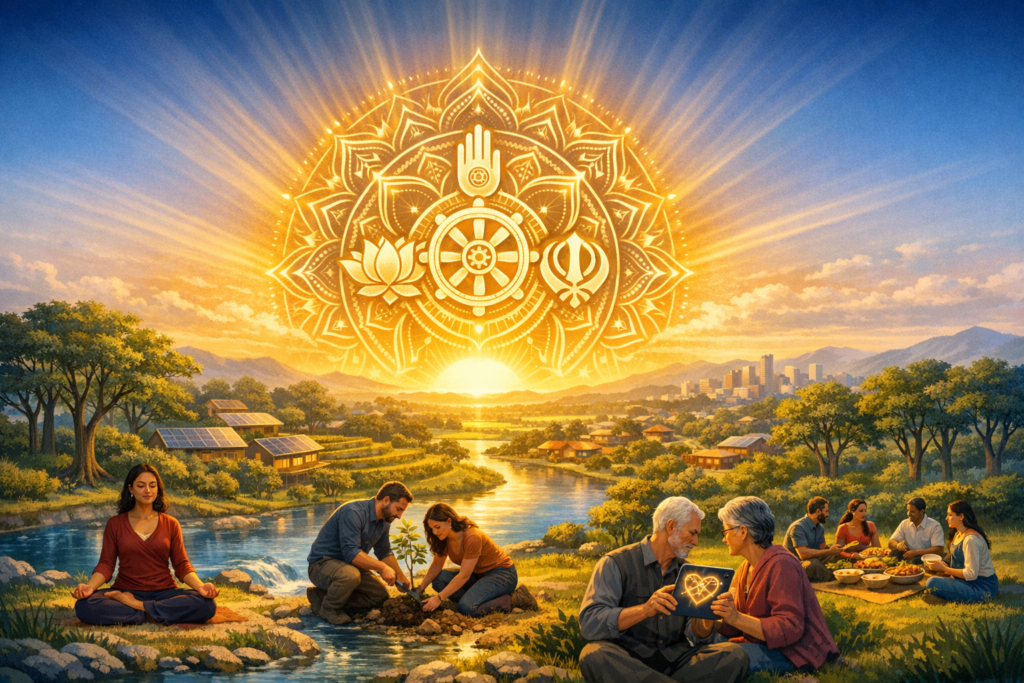
Parallels across dharmic traditions reinforce this inclusive vision. In Buddhism, the upasaka path honors lay realization through dana, sila, and bhavana, with exemplars such as Anathapindika and Visakha. In Jainism, the sravaka follows the eleven anuvratas—tempered vows that align household living with ahimsa and aparigraha. Sikhism explicitly sanctifies grihasth jeevan; the Gurus modeled family life while teaching naam japo, kirt karo, vand chhako and institutionalizing seva through langar. These convergences demonstrate unity in spiritual diversity and affirm that liberation-compatible living flourishes within family and society.
From a practical standpoint, household sadhana benefits from clear architecture. A concise daily liturgy—mantra japa, pranayama, brief meditation, and contemplative reading of the Upanishads or Bhagavad Gita—can anchor mornings. Midday pauses for gratitude or breath awareness recalibrate attention amidst work. Evenings may emphasize family satsanga: shared reflection on dharma, collective kirtan, or acts of seva. Such scaffolding translates lofty teachings into repeatable habits.
Ethical economy is intrinsic to grihastha dharma. Earning and spending under the guidance of dharma transforms artha into stewardship. Dignified work, fair dealing, and dana toward education, healthcare, temples, and community welfare embody yoga-karmasu kaushalam (skill in action). In this sense, livelihoods are not secular digressions but arenas for Karma Yoga, where integrity purifies while usefulness uplifts.
Modern life introduces challenges—time scarcity, digital distraction, and social atomization—but also offers fresh modalities for practice. Mindful technology use, intentional Sabbath-like pauses, and community circles restore relationality. Ecological dharma—reducing waste, protecting biodiversity, and supporting sustainable systems—extends bhuta-yajna to the planetary scale, echoing Vasudhaiva Kutumbakam (the world is one family). Grihastha thus becomes an ecological as well as spiritual vocation.
Philosophically, family life refines inner renunciation (antah-sannyasa): the relinquishment of compulsive cravings, aversions, and self-centered narratives. This interior turn matters more than external form. Whether life culminates in formal sannyasa or in a contemplatively suffused household, the essence of renunciation is the quieting of ahamkara and the recognition of atman.
Texts such as the Narada Parivrajaka Upanishad also describe the qualities required for formal renunciation—fearlessness, steadfastness, and non-attachment grounded in knowledge rather than in fatigue or reaction. When these qualities blossom organically, renunciation—if it comes—is a natural consequence rather than a performative break. Until then, the disciplined practice of grihastha dharma matures the very capacities renunciation presupposes.
For many practitioners, the litmus test of progress is not esoteric experience but measurable shifts in character: reduced reactivity, increased compassion, abiding contentment, and a stable capacity for attention. Yamas and niyamas become less aspirational and more descriptive; sattva predominates more often than rajas or tamas; and integrity holds even under pressure. Such markers signify that Karma Yoga is doing its quiet work.
Consider ordinary yet revealing scenarios. A caregiver navigating a parent’s illness learns a serenity that cannot be engineered in isolation. A professional who refuses unethical gain enacts aparigraha in a context that matters. Partners who choose truth over convenience build inner strength more enduring than any technique alone. In each case, dharma transforms experience; family life becomes the crucible in which freedom is smelted.
This synthesis has inclusive ramifications for interfaith and intrafaith harmony within the dharmic family—Hinduism, Buddhism, Jainism, and Sikhism. Shared commitments to compassion, non-harming, truthfulness, and service produce a common ethical grammar that invites mutual learning. Anekantavada (the Jain doctrine of many-sided truth) and the Hindu principle of Ishta together foster respectful pluralism, enabling communities to affirm different methods while recognizing a convergent aim: liberation from suffering and realization of the highest truth.
Far from being a compromise, grihastha dharma is a sophisticated spiritual technology. It engages the full spectrum of the human condition—love, loss, obligation, creativity, and community—so that wisdom is embodied, not merely conceived. By integrating the Purusharthas under the guidance of dharma, and by transmuting work and relationships through Karma Yoga, householders cultivate the very purity and discernment celebrated by the Upanishads.
In sum, Hinduism does not reserve mukti for cloisters and caves. It invites liberation to unfold in kitchens, offices, schools, and neighborhoods—in the patient tending of children, the honest conduct of enterprise, the care of elders, the honoring of teachers, the protection of nature, and the steadfast practice of remembrance. When dharma, duty, and love permeate family life, the world itself becomes the ashram and every day the field of Yoga.
Inspired by this post on Hindu Blog.




Leave a Reply
You must be logged in to post a comment.