
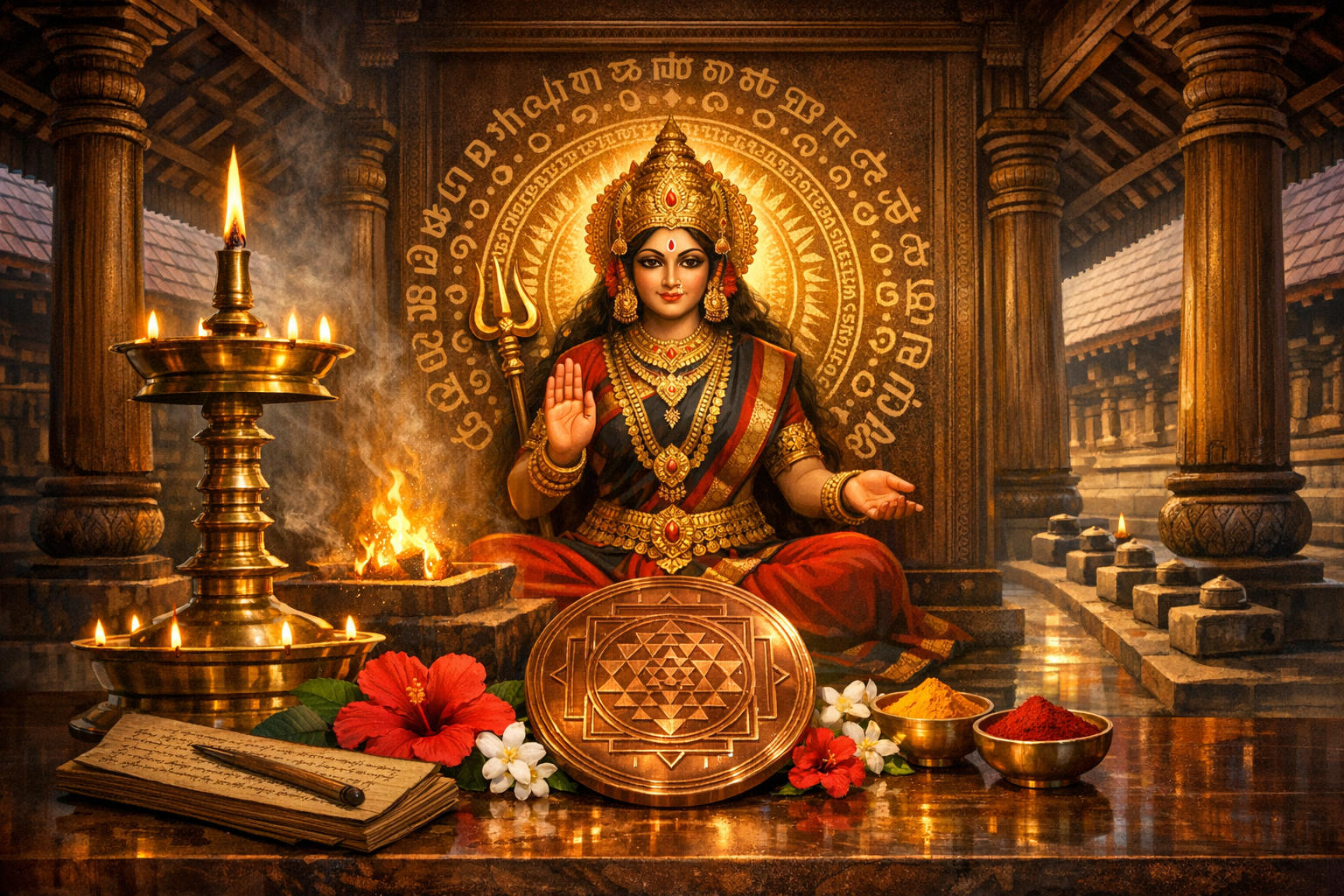
Matrisadbhava is recognized within Hindu scriptures as a pivotal Shakta Tantra associated with Kerala, articulating a rigorous yet compassionate pathway for the sacred worship of the Divine Mothers through the specific focus on Goddess Bhadrakali, also revered in certain lineages as Rurujit. Situated at the confluence of pan-Indian Tantric theory and the lived ritual culture of Kerala temples, the text functions as a bridge between doctrinal subtlety and community-centered practice. Its significance lies not only in liturgical precision but in the way it encodes a plural, patient, and ethically grounded vision of devotion that resonates across Dharmic traditions.
The name Matrisadbhava (Sanskrit: Mātr̥-sadbhāva) can be rendered as the “abiding reality of the Mothers,” evoking the ontological presence of the Matrikas (the Divine Mothers) as the substratum of consciousness and cosmos. In philosophical terms, “sadbhāva” signals an affirmation of being, while “mātr̥” underscores the maternal principle as a primary mode of manifestation and protection. Kerala’s Goddess-centered religiositywhere Bhagavati/Bhadrakali occupies a central roleprovides a receptive ground for such a text, allowing metaphysics, mantra, and material ritual to align in a coherent devotional science.
Historically, Matrisadbhava appears to belong to the wider corpus of medieval Shakta Tantra that took distinctive regional form in Kerala. While precise dating remains debated, the text’s idiom and ritual architecture harmonize with Kerala’s temple paddhatis and the scholastic environment that also produced ritual digests like Tantrasamuccaya. The Kerala milieumarked by rigorous temple routines, Bali (peripheral offering) systems, homa traditions, and carefully regulated daily and festival observancescreates a matrix in which Matrisadbhava’s prescriptions could be enacted with depth and continuity.
In this tradition, Bhadrakali is emphasized as a sovereign embodiment of Śakti, fierce and protective, yet ultimately benevolent. The epithet Rurujit, attested in certain Kerala ritual lineages, signals triumphant subjugation of adverse forces; the name’s connotations are read in a devotional key, not as antagonism toward any spiritual path but as the disciplining of inner obstacles. The text frames Bhadrakali’s worship as a vehicle for courage, ethical clarity, and maternal protection, aligning with Kerala’s enduring reverence for the Goddess as community guardian.
Doctrinally, Matrisadbhava articulates a Shakta nondualism in which Śiva and Śakti are inseparable and the Mothers pervade body, speech, and mind. The maternal metaphor serves as both theology and soteriology: the Divine Mother births, nourishes, and reabsorbs the cosmos, offering refuge and liberation to the practitioner who aligns intention, attention, and action with Her wisdom. This framework supports an inclusive temple culture where the many forms of the Goddess are honored without contradiction.
Ritual eligibility (adhikāra) and initiation (dīkṣā) are presented as foundational. The text places the guru-disciple relationship at the center of transmission, emphasizing humility, study, and ethical steadiness as prerequisites. Observances akin to yama and niyama (restraint and discipline), meticulous purity protocols, and conscientious participation in temple service anchor the practitioner in responsibility and reverencequalities Kerala temple tradition has preserved through exacting daily and festival schedules.
The mantric architecture in Matrisadbhava is both systematic and layered. Seed syllables (bīja), dhyāna verses, and principal mantras of Bhadrakali are embedded within a matrix of subsidiary formulae for protection (kavaca), sanctification, and thanksgiving. Japa is combined with homa and bali in a calibrated manner sometimes termed puraścaraṇaa cycle of recitations and offerings aligned to intention and ethical vow. As is characteristic of Shakta Tantra, mantra is not merely recited but embodied through breath, gesture, and visualization.
Nyāsathe ritual installation of divinity within the bodyis central. Kara-nyāsa and aṅga-nyāsa, along with mātr̥kā-nyāsa (installation of the phonemic Mothers), inscribe the sacred alphabet upon the practitioner. In this vision, the human body is not an obstacle but a liturgical instrument; speech, gesture, and awareness become precise tools for realizing the Mothers’ presence. The Kerala ritual habitus, with its careful cadence, facilitates these internalizations in tandem with external worship.
Purificatory processes such as bhūta-śuddhi (elemental purification) and prāṇa-pratiṣṭhā (vital installation) reshape perception, preparing the altar within and without. By ritually dissolving and reconstituting the senses and their elements, the practitioner anchors a lucid, compassionate attentionan orientation that integrates seamlessly with the polished etiquette of Kerala temple service.
Yantra and maṇḍala craft receive pointed attention. The text encodes geometric and iconographic guidance for Bhadrakali-centered yantras and matrikā arrangements, reflecting a science of sacred space where form educates feeling. Copper-plate yantras, painted maṇḍalas, and auspicious floor designs operate as pedagogic diagrams, contemplative fields, and potent ritual locithree functions fused in disciplined practice.
Deity-circuit worship (āvaraṇa-pūjā) unfolds the Goddess’s retinue in concentric sequences, honoring guardians, attendant Mothers, and localized energies of the shrine. Standard upacārasfrom pañcopacāra to śoḍaśopacāraare offered with Kerala-specific refinements in lamps, fragrant substances, and cooked offerings. The rhythm of deepam, gandha, and naivedya is kept steady and aesthetically attentive, marrying beauty with exactitude.
Homa consolidates mantra, visualization, and offering into fire, while bali distributes sanctified presence throughout the temple’s circumambulatory paths and liminal points. Kerala’s bali systemcarefully sequenced across prakāra routes and threshold nichesenacts the text’s insistence that sacred power must be shared with all beings and directions. Thus, devotion radiates outward as protection, hospitality, and social cohesion.
Protective frameworks such as kavaca recitation, stotra chanting, and mudrā sequences delineate ritual boundaries, guard ethical intent, and stabilize attention. Concluding rites (udvāsa/visarjana) and purifications (mārjana) ensure closure with gratitude. These techniques are pastoral and pedagogic, equipping practitioners to hold intensity with care and to transition gracefully from temple immersion to daily responsibilities.
Rectificatory procedures (prāyaścitta) and śānti rites address errors in pronunciation, sequence, or mental distraction, affirming that the path is compassionate and corrective rather than punitive. In keeping with Kerala’s pastoral ritual sensibility, amends are made through measured offerings, renewed study, and service to community and shrine.
While manuscripts and oral instruction vary, a representative contents arc of Matrisadbhava typically includes: invocatory verses and guru lineage remembrance; eligibility and dīkṣā prerequisites; rules for time, place, and altar; bhūta-śuddhi and nyāsas (kara, aṅga, mātr̥kā); core bīja and principal mantras of Bhadrakali (Rurujit); yantra and maṇḍala protocols; āvaraṇa-pūjā sequences and upacāras; homa and bali methods; kavaca and stotra corpora; festival adaptations; prāyaścitta and śānti; and guidance on the ethical aims of practice.
Kerala’s wider devotional world enriches reception of the text. While the liturgical center is the temple, resonances appear in allied ritual arts such as Theyyam and Mudiyettu, where Bhadrakali’s protective presence is dramatized with community participation. These cultural forms amplify the text’s maternal ethoscourageous, restorative, and locally groundedwhile maintaining the temple canon as the stable axis of formal worship.
Textual transmission has relied on palm-leaf manuscripts, curated temple libraries, and learned families preserving Sanskrit in Kerala-Grantha and Malayalam scripts. Variation across recensions is expected and embraced; Kerala’s scholarship prizes fidelity to core mantras and procedures while allowing careful adaptation to the conditions of each kṣetra (sacred precinct) and community. This living textuality keeps Matrisadbhava relevant without eroding its doctrinal backbone.
Comparatively, Matrisadbhava converses with broader Shakta literature. Its procedural clarity echoes the ritual pragmatics of Tantrasamuccaya, while its metaphysics aligns with classical Shakta nondual syntheses found across foundational tantras and paddhatis. For students of Hindu scriptures, the text exemplifies how doctrinal vision, mantric embodiment, and temple ecology can cohere across centuries.
Equally important is the text’s affirmation of spiritual plurality. By centering the Mothers and honoring multiple forms of the Divine Feminine, Matrisadbhava coheres with a Dharmic vision that welcomes diverse paths. That vision finds kinship across Hinduism, Buddhism, Jainism, and Sikhism in shared values such as compassion, self-discipline, truthfulness, service, and reverence for the sanctity of life. The maternal ethoscare, protection, and moral couragesupplies an inclusive grammar for unity in diversity.
In contemporary practice, Matrisadbhava remains relevant to priests (archakas), scholars of Sanskrit manuscripts, and lay devotees seeking a reliable map of Shakta Tantra grounded in Kerala’s temple heritage. It aids the preservation of intangible cultural heritage by codifying techniques, timings, and ethical safeguards, and it offers a language for intergenerational transmissionequally legible to the scholar in archives and the practitioner before the lamp.
Responsible engagement with the text presumes respect for lineage protocols and mentorship. While study is encouraged, three elements remain vital: learning mantras and nyāsas under qualified guidance, adapting procedures to the norms of one’s temple and community, and prioritizing collective well-being over private experiment. In these ways, Matrisadbhava’s discipline becomes a shared good rather than a solitary ambition.
Ultimately, the importance of Matrisadbhava lies in how it marries philosophical subtlety to ritual exactitude and social care. It invites practitioners and readers to encounter Bhadrakali (Rurujit) not as distant abstraction but as living presencematernal, protective, and wisewhile embedding worship in a culture of ethical responsibility and plural belonging. As Kerala’s temples continue to tend lamps and distribute bali offerings to every corner, the text’s enduring message is clear: sacred power ripens where knowledge, devotion, and community meet.
Inspired by this post on Hindu Blog.
