
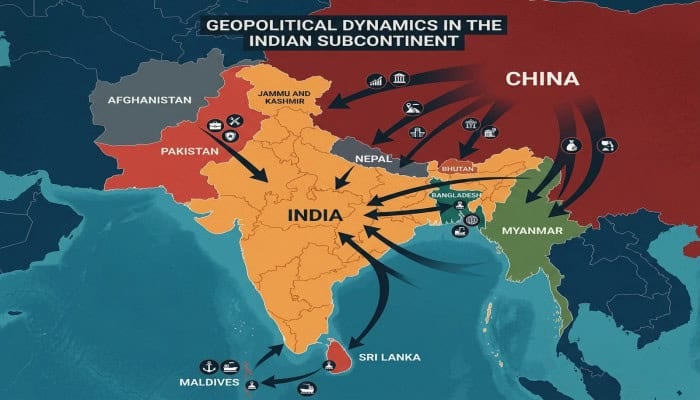
The strategic challenge posed by China to the Bharatiya subcontinent cannot be understood through the narrow image of armies confronting one another across a border. Military power remains central, especially along the Line of Actual Control, but it forms only one layer of a much wider contest. Economic leverage, infrastructure finance, defence cooperation, digital networks, political influence, intelligence collection and access to ports or transport corridors can all alter a country’s choices without a formal act of coercion. The central issue is therefore not simply whether China intends to launch a conventional conflict. It is whether a dense network of asymmetric relationships could gradually reduce the strategic autonomy of states across South Asia.
This expanded assessment develops the concerns raised in the July 2026 MyInd analysis of China’s role in the Indian subcontinent. Its thesis is serious but requires careful qualification. Chinese trade, investment or connectivity is not inherently hostile, and smaller states are not passive pieces on a geopolitical chessboard. Every government retains its own interests, domestic constituencies and capacity to negotiate. The danger emerges when projects are opaque, liabilities become difficult to service, technology suppliers gain privileged access to sensitive systems, or ostensibly civilian facilities acquire military and intelligence utility.
A structural challenge rather than a single threat
A conventional threat assessment usually asks about forces, weapons, intentions and likely avenues of attack. A structural assessment asks a broader set of questions. Who finances essential infrastructure? Who supplies military platforms and replacement parts? Who controls telecommunications equipment, cloud systems, undersea cables, ports, energy corridors and logistical databases? Which creditor can influence a refinancing decision during a fiscal crisis? Which external power maintains relationships with political parties, security agencies, commercial elites and media ecosystems? These relationships matter because national power is exercised not only by destroying assets but also by shaping the conditions under which another state makes decisions.
China possesses unusual advantages in this form of statecraft. Its large manufacturing base, state-linked banks, construction companies, defence industries and diplomatic institutions can operate in a coordinated manner. A port loan can support a construction contract; the contract can establish a long-term commercial presence; that presence can create demand for Chinese communications, surveillance and logistics systems; and those systems can produce political influence or operational knowledge. None of these outcomes is automatic. Together, however, they create pathways through which an economic relationship may acquire strategic consequences.
The appropriate analytical standard is therefore neither complacency nor indiscriminate suspicion. Treating every Chinese-funded road as a military conspiracy would be analytically weak and diplomatically counterproductive. Treating infrastructure as politically neutral would be equally naïve. Risk depends on ownership, financing terms, data access, contractual control, location, technical specifications, security arrangements and the host state’s ability to regulate or replace the facility. The same project can be economically useful in normal conditions and strategically consequential during a crisis.
Why the subcontinent is strategically exposed
The Bharatiya subcontinent sits at the intersection of the Himalayan frontier, the Bay of Bengal, the Arabian Sea and the principal sea routes connecting East Asia with the Gulf, Africa and Europe. India occupies the geographical centre of this space, while Pakistan, Nepal, Bhutan, Bangladesh, Myanmar, Sri Lanka and the Maldives provide access to crucial land corridors, mountain approaches, ports and sea lines of communication. In the strategic usage adopted here, the region extends beyond a strict geological definition of the subcontinent to include the neighbouring states that shape its continental and maritime security environment.
This geography explains why apparently local developments can have regional effects. A road in the high Himalayas can improve civilian mobility while accelerating military reinforcement. A port in the Arabian Sea can facilitate trade while offering replenishment or surveillance opportunities. A telecommunications backbone can support digital development while creating dependence on a foreign vendor for maintenance, software updates and security. A political crisis in a small island state can affect access to sea lanes used by much of Asia’s energy trade. The strategic value of an asset cannot be separated from its location.
These questions may appear abstract on a map, but their human effects are immediate. A prolonged border confrontation becomes anxiety for soldiers’ families and economic disruption for frontier communities. An unsustainable infrastructure project can lead to higher taxes, reduced public services or cancelled development programmes. A cyber intrusion can expose the records of ordinary citizens. Strategic autonomy is therefore not an elite diplomatic slogan; it protects the ability of societies to make public choices without hidden external constraints.
India: the most direct and multidimensional contest
India faces the region’s most overt military challenge from China. The unresolved boundary, competing territorial claims and large deployments on both sides of the Line of Actual Control create a persistent risk of confrontation. The violence in the Galwan Valley in 2020 demonstrated that agreements intended to preserve peace could fail under pressure. Roads, bridges, airfields, surveillance systems and forward logistics on the Tibetan plateau and in the Himalayan borderlands have since become inseparable from assessments of warning time, mobilisation and escalation.
The situation nevertheless requires an accurate account of subsequent diplomacy. According to an Indian Ministry of External Affairs parliamentary answer, India and China agreed on patrolling arrangements in Depsang and Demchok on 21 October 2024, leading to disengagement from the friction points associated with the 2020 crisis. That development reduced immediate tactical friction but did not settle the boundary question, eliminate military infrastructure or restore strategic trust. Disengagement, de-escalation and boundary settlement are distinct processes and should not be treated as interchangeable.
China’s claims concerning Arunachal Pradesh add an eastern territorial dimension. Repeated objections to Indian political activity in the state, the assignment of Chinese names to locations and infrastructure construction near disputed sectors function as forms of legal, diplomatic and psychological pressure. Control of Tibet also gives Beijing a powerful geographical position overlooking the Himalayan frontier. Questions involving Kailash Mansarovar, transboundary rivers and access across the plateau carry religious, environmental and strategic significance, although each issue must be evaluated on evidence rather than merged into a single theory of coercion.
India’s exposure is also economic and technological. Official Indian commerce data show that in 2024–25 India imported approximately US$113.45 billion in merchandise from China while exporting about US$14.25 billion. The Government of India’s trade data also clarify that many imports are capital goods, components, machinery, electronics and active pharmaceutical ingredients used in domestic production. The vulnerability is therefore more complex than a large headline deficit. Abrupt decoupling could damage Indian manufacturing, yet concentrated dependence in pharmaceuticals, electronics, power equipment, telecommunications or clean-energy supply chains could be exploited during a crisis.
India consequently faces a high direct military risk, a substantial cyber and technological risk, and a medium-to-high supply-chain risk. Its larger economy, diversified diplomatic partnerships, democratic institutions and military capacity provide resilience unavailable to many smaller neighbours. Even so, size does not eliminate exposure. The central Indian task is to reduce critical dependencies without abandoning economically rational trade, preserve credible deterrence without allowing every dispute to escalate, and offer neighbouring states development partnerships that respect their sovereignty.
Pakistan, CPEC and the danger of asymmetric partnership
Pakistan’s relationship with China differs fundamentally from India’s. Islamabad views Beijing as a strategic partner, a major defence supplier, a diplomatic supporter and a source of infrastructure finance. The China–Pakistan Economic Corridor connects Xinjiang with transport and energy projects extending toward Gwadar on the Arabian Sea. For Pakistan, CPEC promises connectivity, power generation and investment. For China, it strengthens a long-standing partnership, supports economic access to Pakistan and creates options near the western Indian Ocean.
From India’s perspective, CPEC also presents a direct sovereignty issue because parts of the corridor pass through territory claimed by India and administered by Pakistan. The Government of India has formally stated that these projects impinge on India’s sovereignty and territorial integrity. This objection is not merely an economic criticism of the Belt and Road Initiative. It places China inside an already militarised territorial dispute and deepens the strategic coordination between India’s two principal continental adversaries.
Balochistan exposes another layer of risk. Chinese personnel and CPEC-linked assets have repeatedly been targeted by militant organisations. Local grievances concerning political marginalisation, resource distribution, employment, security practices and the control of Gwadar predate CPEC, but Chinese investment has become incorporated into the conflict. Demands for stronger protection of Chinese workers can expand surveillance, policing and special security arrangements. If external security preferences begin to shape Pakistan’s internal deployments, the boundary between partnership and dependency becomes less clear.
Claims that Pakistan is already a Chinese security client should nevertheless be treated as a scenario rather than an established fact. Pakistan retains powerful armed forces, an independent nuclear deterrent, its own strategic objectives and relationships with other states. The more defensible conclusion is that dependence on Chinese weapons, financing, technology and diplomatic support may increase Beijing’s leverage over time. That leverage will be strongest when Pakistan faces fiscal distress, international isolation or urgent security requirements that few other partners are willing to meet.
CPEC therefore produces simultaneous benefits and vulnerabilities. Successful power or transport projects can strengthen Pakistan’s economy, while opaque contracts, weak local participation and unequal distribution can intensify political resentment. Gwadar can remain a commercial port, yet its location and Chinese involvement give it potential logistical and intelligence value. Sound analysis must examine contractual access, naval visits, storage, communications and security arrangements rather than assuming that commercial construction has already become a permanent military base.
Nepal: influence, connectivity and strategic choice
In Nepal, China’s influence is primarily political, economic and infrastructural rather than military. Kathmandu has long sought to diversify its external relationships and reduce excessive dependence on any single transit route or partner. Chinese roads, border facilities and proposed trans-Himalayan links can therefore answer genuine Nepali development priorities. Nepal’s engagement with China should not automatically be interpreted as hostility toward India; sovereign diversification is a rational objective for a landlocked country situated between two major powers.
The strategic concern lies in the terms and cumulative effect of that engagement. Nepal and China signed a Framework for Belt and Road Cooperation on 4 December 2024. The published framework identifies potential transport, infrastructure and connectivity projects, but it also states that the arrangement is not an international treaty, does not create obligations under international law and does not preclude cooperation with other countries. Those safeguards matter. They demonstrate that dependency is not predetermined and that Nepal retains formal space to diversify partnerships.
Implementation will determine whether that policy space remains real. Large projects require transparent feasibility studies, sustainable financing, open procurement, environmental review and realistic forecasts of traffic or revenue. Political relationships with parties and senior elites should not substitute for institutional scrutiny. Pressure relating to Tibetan refugees, border controls, media narratives or sensitive diplomatic questions can also narrow Nepal’s choices without any visible military presence. For India, the constructive response is not to demand exclusivity but to provide reliable connectivity, respectful diplomacy and competitive development options.
Bhutan: territorial pressure at a sensitive Himalayan junction
Bhutan’s principal exposure arises from its unresolved boundary with China and the strategic location of disputed areas. Changes near the Doklam plateau are particularly sensitive because of their proximity to the Siliguri Corridor, the narrow land connection between India’s northeastern states and the rest of the country. Roads, settlements or permanent facilities in disputed zones could alter facts on the ground even before a final legal settlement is reached.
At the same time, Bhutan must be recognised as an independent actor conducting its own negotiations. The official statement on the twenty-fifth Bhutan–China boundary talks records progress on a three-step roadmap and the creation of a joint technical mechanism for delimitation and demarcation. The statement describes the discussions as constructive. An academic assessment must therefore distinguish India’s legitimate strategic anxieties from unverified assumptions that Bhutanese diplomacy has already been captured or coerced.
The longer-term risk is bargaining asymmetry. China can combine territorial claims, promises of diplomatic normalisation, economic incentives and infrastructure construction in ways that place sustained pressure on a much smaller state. Bhutan’s resilience depends on accurate mapping, transparent public institutions, patient negotiations and continued freedom to maintain close relations with India while developing other ties on terms consistent with its national interest.
Bangladesh: defence dependence and the Bay of Bengal
Bangladesh occupies a pivotal position beside India’s eastern and northeastern regions and at the head of the Bay of Bengal. China has become an important source of military equipment, infrastructure investment, industrial cooperation and development finance. These relationships can support Bangladesh’s modernisation, but long-term dependence on one supplier for complex weapons creates requirements for spare parts, ammunition, software, training and maintenance. Supplier concentration can consequently produce influence that extends well beyond the original purchase.
Infrastructure and technology add another dimension. Ports, power projects, bridges, telecommunications systems and industrial facilities can contribute substantially to growth. Their strategic risk depends on financing terms, cybersecurity, ownership, data access and whether exclusive operational privileges are granted. Maritime facilities near the Bay of Bengal deserve particular scrutiny, but commercial investment should not be labelled a naval base without evidence of military access, command infrastructure or sustained deployments.
Bangladesh’s best protection is a diversified external policy combined with strong domestic institutions. Competitive procurement, parliamentary and audit oversight, local technical capacity and interoperability with multiple suppliers reduce the possibility that any foreign partner can convert commerce into coercion. India’s security is better served by a stable and sovereign Bangladesh than by rhetoric that treats every Dhaka–Beijing agreement as a zero-sum defeat.
Myanmar: conflict, corridors and access to the Indian Ocean
Myanmar gives China its most direct overland approach to the Bay of Bengal. The China–Myanmar Economic Corridor, the Kyaukphyu deep-sea port, pipelines and proposed transport links can connect southwestern China with the coast while reducing dependence on routes through the Strait of Malacca. The World Bank has previously documented plans for a Chinese-majority joint venture in the first phase of the Kyaukphyu port project. The corridor has legitimate commercial purposes, but its geography also gives it potential logistical and strategic value.
Myanmar’s internal conflict magnifies this influence. International isolation, institutional fragmentation and the need for diplomatic protection can make authorities more dependent on Beijing. China also maintains contacts across different political and armed actors to protect border stability and its economic interests. That does not mean Beijing controls every participant in Myanmar’s complex conflict. It does mean that few external powers possess comparable access to both state and non-state networks.
The implications extend across the eastern subcontinent. A durable Chinese logistical position on the Bay of Bengal would affect Indian naval planning, surveillance and the security of the Andaman and Nicobar approaches. Instability around corridor projects can also produce refugee flows, illicit trade and armed spillovers. The policy challenge is therefore not simply to obstruct Chinese construction. It is to support an inclusive political settlement in Myanmar, preserve cross-border stability and ensure that regional connectivity does not become exclusive strategic infrastructure.
Sri Lanka: strategic assets without a simplistic debt-trap narrative
Sri Lanka’s location near major Indian Ocean shipping routes gives its ports exceptional strategic significance. Chinese financing and construction at Hambantota and Colombo have therefore attracted intense scrutiny. The long lease of Hambantota created a durable Chinese commercial position close to vital sea lanes, while visits by Chinese research or surveillance-capable vessels have periodically raised Indian concerns. These developments justify careful monitoring of access, data collection and possible dual-use functions.
Accuracy requires rejecting the claim that Chinese lending alone caused Sri Lanka’s sovereign debt crisis. Fiscal policy failures, tax reductions, depleted reserves, external commercial borrowing, the pandemic, lost tourism income and other shocks all contributed. An IMF study of Sri Lanka’s restructuring describes a diverse creditor landscape in which international sovereign bondholders had become the largest foreign creditor group. China was important, but it was not the only or necessarily dominant cause of the collapse.
The more precise strategic lesson is that severe financial distress can reduce bargaining power over valuable assets and access arrangements, regardless of which creditor caused the crisis. Concentrated lending, opaque project selection and weak revenue forecasts can magnify this vulnerability. Sri Lanka can protect its autonomy through transparent port agreements, equal rules for foreign naval and research vessels, diversified investment, sustainable debt management and credible parliamentary oversight.
The Maldives: fiscal vulnerability beside critical sea lanes
The Maldives combines a small economy, dispersed islands, large infrastructure requirements and an exceptionally important location in the Indian Ocean. Chinese construction, tourism and financing can provide tangible benefits, yet the country’s narrow revenue base and dependence on external flows make major projects difficult to absorb. Political competition can further transform infrastructure choices into symbols of alignment between China and India.
The fiscal problem is broader than exposure to one creditor. The World Bank’s October 2025 assessment estimated public and publicly guaranteed debt at US$9.5 billion, or 126.9 percent of GDP, and classified the Maldives as facing a high risk of debt distress. Such conditions increase sensitivity to refinancing, currency pressure and delayed payments. A creditor capable of supplying emergency liquidity or restructuring could gain influence, but domestic borrowing, global market debt and expenditure policy must also be included in the analysis.
The latent strategic concern is whether commercially presented infrastructure could later support surveillance, logistics or privileged access near major sea lanes. That possibility should be tested through contracts and technical evidence rather than asserted as an accomplished fact. Procurement transparency, limits on exclusive access, national control of data and diversified financing would materially reduce the risk.
The first cross-cutting risk: erosion of strategic autonomy
Strategic autonomy is eroded when a state formally retains sovereignty but finds that major choices carry prohibitive external costs. A government may avoid criticising a powerful partner because it fears delayed financing, disrupted imports, reduced tourism, blocked market access or withdrawn diplomatic support. The pressure need not appear as an explicit ultimatum. Officials may anticipate the likely reaction and alter policy in advance, producing self-deterrence.
Smaller states are especially exposed when several dependencies converge. A country that relies on the same partner for loans, military equipment, telecommunications, infrastructure maintenance and diplomatic protection has fewer credible alternatives during a dispute. Diversification is therefore more important than the nationality of any single investment. Dependence on China can be risky, but replacing it with exclusive dependence on another power would not constitute genuine autonomy.
The second risk: debt, opacity and economic coercion
Debt becomes a strategic vulnerability when repayment schedules are unrealistic, contracts are secret, public guarantees are hidden, projects earn insufficient foreign exchange or refinancing depends on one creditor. The frequently used phrase “debt-trap diplomacy” can obscure more than it explains because it assumes a deliberate plan that is often difficult to prove. Some crises result from poor domestic governance, optimistic forecasts, global shocks and borrowing from many sources. Strategic analysis should focus on observable mechanisms rather than slogans.
Five questions provide a more rigorous test. Was the project selected through a credible cost-benefit process? Were the loan and collateral terms disclosed? Can expected revenue cover foreign-currency obligations? Does the creditor receive control over a strategic asset or policy concession during restructuring? Can the borrower refinance through alternative partners? The risk rises sharply when several answers are unfavourable, regardless of whether a hidden coercive intention can be demonstrated.
The third risk: dual-use infrastructure and military access
Ports, airports, highways, railways, energy pipelines and communications networks are inherently capable of serving more than one purpose. Dual use, however, exists on a spectrum. A commercial port with deep berths may be physically capable of receiving a naval vessel, but sustained military utility also requires secure communications, repair facilities, fuel, ammunition procedures, protected storage, legal access and dependable host-state cooperation. Analysts should evaluate these enabling conditions instead of equating construction with basing.
China can still gain significant advantages short of a formal base. Regular port calls improve operational familiarity. Commercial operators may provide knowledge of shipping patterns and local infrastructure. Survey vessels can collect hydrographic data useful for both scientific and naval purposes. Maintenance contracts and digital port-management platforms may provide access to logistical information. A network of such facilities could expand the endurance and situational awareness of the People’s Liberation Army Navy even when every individual port remains nominally civilian.
The fourth risk: cyber, telecommunications and data dependence
Digital infrastructure can create strategic access more quietly than a port. Telecommunications vendors, surveillance platforms, cloud providers, payment systems, submarine cable operators and smart-city technologies may process sensitive government or personal data. Vulnerabilities can arise from malicious access, insecure software, undisclosed remote maintenance, poor supply-chain security or simple dependence on a vendor that cannot be replaced quickly.
The correct response is a vendor-neutral security regime based on technical standards. Governments should require source and firmware review where feasible, independent penetration testing, data localisation for sensitive systems, strict privileged-access controls, auditable software updates, network segmentation and mandatory disclosure of breaches. Critical networks should avoid single-vendor dependence. These safeguards protect sovereignty without assuming that every Chinese device contains an intelligence capability.
The fifth risk: political influence and information operations
Political influence becomes dangerous when foreign engagement bypasses institutions and concentrates benefits among a narrow group of decision-makers. Party financing, elite business relationships, sponsored travel, media partnerships, academic programmes and preferential contracts can generate constituencies that defend an external power’s interests. Legitimate diplomacy and cultural exchange should not be confused with interference, but secrecy and conflicts of interest create opportunities for elite capture.
Information operations amplify these networks by shaping how citizens interpret events. Coordinated messaging may present dependence as inevitable, dismiss all criticism as hostility or deepen mistrust between neighbouring states. The most effective defence is not censorship. It is transparent ownership of media, disclosure of foreign funding, independent journalism, open public data and strong civic education. Societies able to debate projects on evidence are harder for any external actor to manipulate.
Regional fragmentation as a strategic multiplier
China often gains greater bargaining power through bilateral negotiations than it would face in a coordinated regional framework. South Asian states have their own disputes, historical grievances and concerns about Indian dominance, making collective positions difficult. When governments compete separately for finance or political support, contract standards decline and external powers can play one relationship against another.
This fragmentation should not be answered by demanding that every neighbour align with New Delhi. Such pressure could reproduce the very loss of autonomy that the region seeks to prevent. A more durable approach would establish shared rules for debt disclosure, infrastructure procurement, cybersecurity, port access, environmental assessment and disaster response. Common standards would strengthen every participant’s bargaining position while leaving each state free to choose its partners.
The civilisational bonds of the region can support this institutional cooperation. Hindu, Buddhist, Jain and Sikh traditions have developed through centuries of dialogue, movement and shared sacred geography across the subcontinent. These connections should encourage solidarity without erasing the identities of other communities or turning geopolitical competition into ethnic hostility. The challenge comes from state power and asymmetric systems, not from Chinese people, culture or ordinary commercial exchange.
A technical framework for assessing each project
A credible threat assessment should measure five variables: strategic location, dependency, opacity, convertibility and reversibility. Strategic location asks whether the asset sits near a disputed border, military approach, critical sea lane or communications chokepoint. Dependency measures how difficult it would be to replace the finance, technology, spare parts or market involved. Opacity evaluates whether contracts, ownership and security provisions are publicly reviewable. Convertibility examines how readily a civilian asset could support military or intelligence activity. Reversibility asks whether the host state can terminate access or change suppliers without unacceptable cost.
Intent, capability and exposure must then be analysed separately. Chinese intent is often inferred from official strategy, diplomatic behaviour and patterns across multiple countries, but inference is not proof. Capability can be evaluated more concretely through financing, ownership, technical design, deployments and legal agreements. Exposure belongs to the host state: weak procurement, concentrated debt and poor cybersecurity can produce vulnerability even when immediate hostile intent is absent. This distinction prevents both alarmism and complacency.
On this basis, India faces the highest direct military exposure; Pakistan has the deepest defence and strategic integration; Bhutan faces concentrated territorial pressure; Nepal faces political and connectivity-related leverage; Bangladesh faces defence-supplier and technological concentration; Myanmar combines conflict vulnerability with corridor access; and Sri Lanka and the Maldives face especially important maritime and fiscal risks. These rankings are not permanent. Domestic reform, diversification and changing regional conditions can raise or lower them.
Three plausible regional scenarios
In a managed-competition scenario, China remains a major investor and trading partner while regional states strengthen disclosure, diversify finance and prevent exclusive military access. Border tensions persist but crisis-management mechanisms reduce escalation. This is the most beneficial outcome because development continues without translating automatically into strategic subordination.
In a fragmented-dependency scenario, fiscal stress and domestic political competition lead states to negotiate separately and opaquely. Chinese companies and lenders acquire durable positions in ports, telecommunications, defence supply chains and transport corridors. No formal alliance system emerges, yet governments increasingly avoid policies opposed by Beijing. Sovereignty remains intact in law while practical autonomy narrows.
In an escalatory-bloc scenario, another severe India–China border crisis coincides with expanded Chinese logistical access in Pakistan and the Indian Ocean. Economic restrictions, cyber operations, maritime surveillance and information warfare accompany military mobilisation. Regional states face pressure to choose sides, commercial infrastructure becomes securitised and miscalculation grows more likely. Avoiding this outcome requires preparation before a crisis, because emergency decisions are made under the greatest asymmetry.
A practical strategy for preserving regional autonomy
The first requirement is transparent infrastructure governance. Major foreign-funded projects should disclose beneficial ownership, financing terms, sovereign guarantees, collateral clauses, arbitration provisions, security arrangements and projected revenue. Independent audit institutions and legislatures need access to full contracts. Competitive bidding should be the norm, and emergency exceptions should expire automatically unless reviewed.
The second requirement is debt resilience. Governments should publish consolidated public and publicly guaranteed liabilities, including obligations of state-owned enterprises. Stress tests must account for exchange-rate shocks, construction delays, low utilisation and refinancing risk. Projects that cannot plausibly generate economic or social returns should be redesigned before contracts are signed, not defended after liabilities become irreversible.
The third requirement is technological sovereignty. Critical systems should use segmented architecture, multiple suppliers, open security standards and independently tested equipment. States need domestic expertise capable of inspecting code, managing encryption, responding to incidents and operating essential networks if a foreign vendor withdraws support. Digital public infrastructure should remain under clear national legal control.
The fourth requirement is credible defence and maritime awareness. India must maintain border infrastructure, surveillance, logistics and escalation-control mechanisms while strengthening naval domain awareness across the Indian Ocean. Information-sharing with willing neighbours can help identify unsafe vessel activity, trafficking, illegal fishing and disaster threats without forcing participants into a rigid military bloc. Smaller states benefit when maritime cooperation delivers public goods rather than only great-power competition.
The fifth requirement is diversified development. India, Japan, multilateral banks, European partners, Gulf states and regional private capital can offer alternatives, but they must deliver projects reliably and respect local priorities. Slow implementation and paternalistic diplomacy create openings for competitors. Neighbours are more likely to trust Bharat when consultation, reciprocity and local benefit are visible in practice.
The sixth requirement is renewed regional cooperation. Shared standards for ports, debt, cybersecurity, transboundary water data, disaster relief, health security and energy trade would reduce vulnerability without excluding China. The objective should be an open regional order in which no external or internal power can obtain privileged control through opacity or crisis.
Conclusion: sovereignty is preserved before a crisis begins
China’s challenge to the Bharatiya subcontinent is best understood as a spectrum. At one end lies direct military pressure along the India–China frontier. At the other lie subtler forms of influence created by finance, technology, political relationships, defence supply and commercial infrastructure. The common strategic effect is the possibility of asymmetric dependence, but that outcome is neither universal nor inevitable.
Regional states retain agency. Transparent contracts, sustainable debt, diversified partnerships, secure digital systems and accountable institutions can convert foreign investment into genuine development while limiting coercive leverage. China should be engaged where interests converge and resisted where sovereignty, territorial integrity or security is threatened. This combination of openness and vigilance is more durable than either blanket confrontation or uncritical accommodation.
The deepest lesson is that sovereignty is rarely lost in a single dramatic moment. It is weakened gradually when temporary dependencies become permanent, exceptional access becomes routine and decisions escape public scrutiny. A confident and cooperative subcontinent can prevent that erosion. Its strongest defence will be not fear of engagement, but the institutional capacity to engage every power on transparent, reciprocal and nationally accountable terms.
Inspired by this post on Hindu Post.










Leave a Reply
You must be logged in to post a comment.