
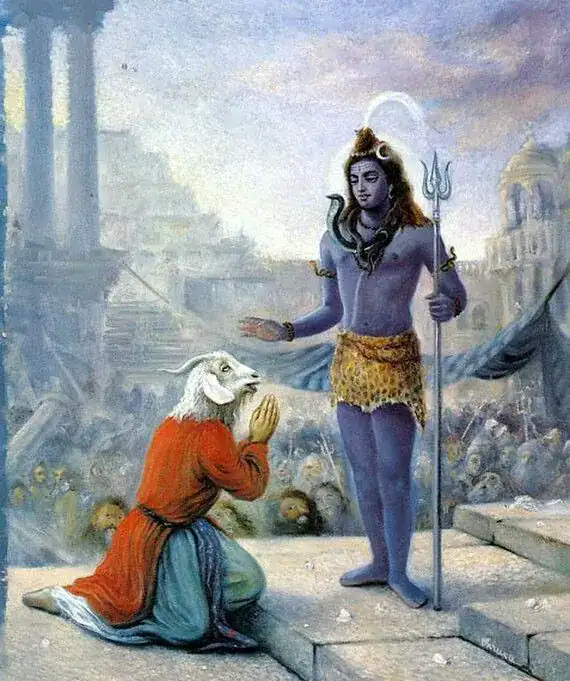
The image of Vīrabhadra offers a powerful way to examine Hindutva, but only when the entire Dakṣa Yajña narrative is kept in view. The fierce warrior does not appear merely to destroy. He emerges after exclusion, humiliation and institutional arrogance have made an apparently sacred order morally incomplete. Yet the ākhyāna does not conclude with devastation: Dakṣa is restored, pride gives way to recognition, Śiva receives his rightful place, and the yajña becomes capable of completion. Read in this fuller form, Vīrabhadra represents corrective energy directed toward cultural renewal, institutional reconstruction and a more confident place for Dharmic civilisation within Bharat.
This interpretation develops the central thesis of the July 5, 2026 essay “Hindutva is a Vīrabhadra Phenomenon”. Its Paurāṇika analogy is illuminating, although several of its political and historical claims require careful qualification. Mythic symbolism can disclose patterns of memory, emotion and public action; it cannot, by itself, establish historical causation or determine constitutional policy. The most productive reading therefore treats the narrative as a disciplined interpretive lens rather than as literal political instruction.
For families that encounter the Purāṇas through a grandparent’s recitation, a temple festival, a regional performance or a pilgrimage, these narratives are not remote literary curiosities. They connect metaphysics with place, ritual with kinship, and ethical reflection with memorable characters. A person may forget an abstract proposition but retain for decades the image of a sacrifice rendered defective by the deliberate exclusion of Śiva. That emotional durability helps explain why Paurāṇika symbols continue to shape Indian cultural identity and political language.
Narrative as a Civilisational Knowledge System
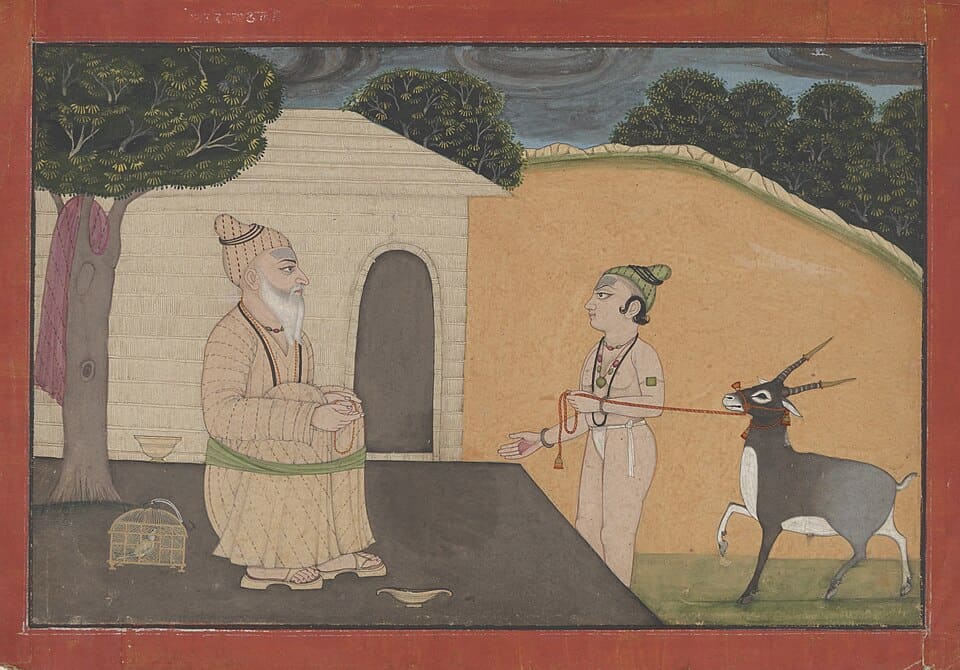
Indian traditions have long used stories about deities, seers, rulers, animals, forests, rivers and transcendent realms to transmit knowledge. Such narration is not simply entertainment added to philosophy. It is often the structure through which philosophical, ritual, ecological and social insights become intelligible to a broad public. The Satyanārāyaṇa Kathā associated with the Revā Khaṅḍa, Skanda Purāṇa is a striking example: its component stories praise the transformative value of hearing and observing a sacred narrative whose significance exceeds any single episode. Dr J. P. Singh describes this communicative architecture in Nāradīya Sañcāra Nīti as a story organised around the praise of a story.
Purāṇa-s literally concern what is ancient or inherited, but the genre is more dynamic than a simple archive of the past. Tradition commonly enumerates 18 major Purāṇa-s alongside numerous secondary and regional works. Their materials include cosmology, genealogies, sacred geography, pilgrimage, ritual instruction, ethics, political memory, medicine, flora, fauna and accounts of divine manifestation. The traditional Pañcalakṣaṇa identifies five characteristic subjects: creation, dissolution and recreation, genealogies of gods and sages, the cycles of the Manus, and royal dynastic history. As the UCLA MANAS overview of the Purāṇas notes, individual texts do not always display all five subjects with equal emphasis.
The Itihāsa-Purāṇa tradition consequently functions as a large civilisational memory system rather than a modern textbook arranged by discipline. A single narrative may connect a cosmic principle to a local shrine, a ritual calendar, a performing art and a moral dilemma. The sacred geography of the Śaktipīṭha-s illustrates this integrative function: textual variation exists concerning their number and location, yet the shared narrative creates a network of remembered places across the subcontinent. Diversity of enumeration does not necessarily invalidate the tradition; it often reveals the historical development of multiple regional communities within a larger sacred map.
Ananda K. Coomaraswamy described myth as “the penultimate truth, of which all experience is the temporal reflection.” This proposition does not require treating every narrative detail as modern empirical history. It suggests that a sacred story may reveal durable structures of experience: order and exclusion, sacrifice and pride, grief and anger, destruction and reconciliation. Political interpretation becomes defensible when these structures are compared carefully with modern institutions, while the differences between sacred narrative and historical evidence remain explicit.
A rigorous reading also recognises textual plurality. The Dakṣa Yajña narrative appears in multiple Sanskrit and regional traditions, and its sequence, emphasis and dramatis personae can vary. No single retelling exhausts its meaning. Philology asks what a particular textual recension says; religious studies examines ritual and reception; art history studies iconography; political theory considers how the story is mobilised in public discourse. Combining these methods is more reliable than extracting one dramatic episode and treating it as a self-sufficient political command.
The Dakṣa Yajña and the Emergence of Vīrabhadra
The narrative’s institutional problem is captured by Dadhīca’s challenge to Dakṣa: “What avails worshipping the gods in the sacrifice if Rudra is not worshipped by you?” Dakṣa’s yajña is magnificent in appearance, populated by distinguished participants and supported by ritual authority. Its flaw is nevertheless foundational. The sacrifice excludes Śiva, not accidentally but as an expression of Dakṣa’s hostility toward a figure who does not conform to his standards of prestige, purity and social decorum.
Dakṣa, a Prajāpatī and the father of Sati, regards Śiva as an improper son-in-law: an ascetic associated with mountains, cremation grounds and beings outside polished courtly society. Sati attends the sacrifice despite the exclusion and encounters contempt directed at both herself and Śiva. In the traditional narrative, she relinquishes her body through yogic fire. This episode concerns the goddess Sati as a specific sacred person and should not be confused with later historical practices that came to be described by the same English spelling.
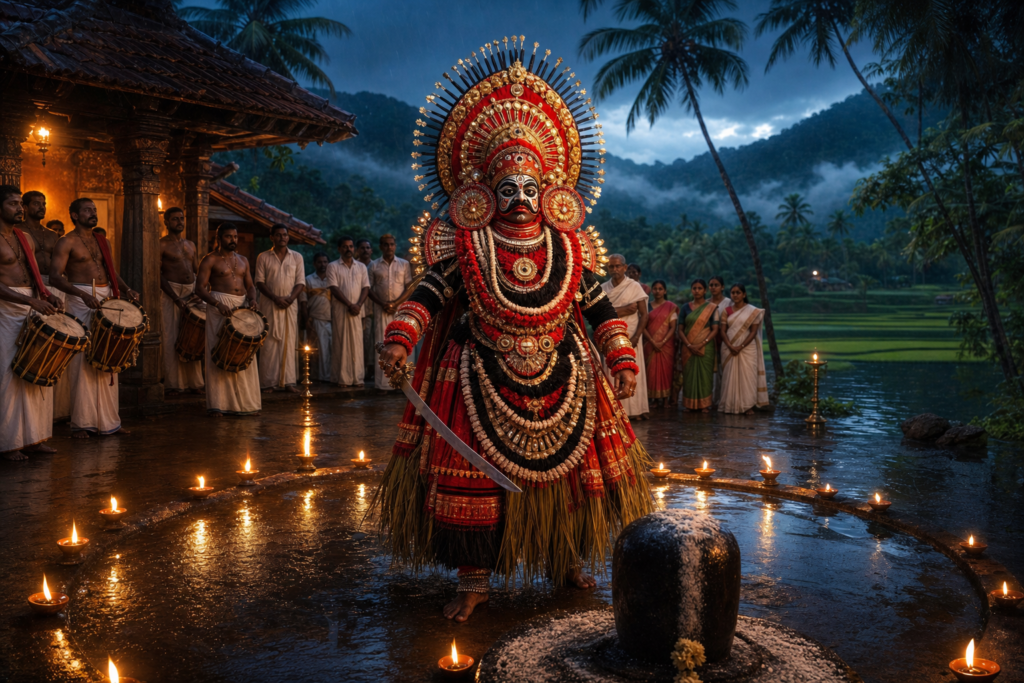
Śiva’s grief then assumes a fierce public form. A lock of his matted hair is cast down, and Vīrabhadra emerges; some traditions also foreground Bhadrakāli. Vīrabhadra enters the sacrificial arena, defeats its defenders, disrupts the ritual and punishes Dakṣa. Iconographically, he is frequently represented as armed, dynamic and formidable. The form communicates controlled ferocity—the capacity of the sacred order to resist an institution that invokes sacred authority while excluding an indispensable dimension of reality.
Stopping at the destruction of the yajña produces an incomplete theology. Śiva ultimately restores Dakṣa with the head of a sacrificial goat. Dakṣa awakens without his former arrogance, acknowledges Śiva and seeks forgiveness. Śiva pardons him, and the sacrifice is completed in a corrected form. The narrative therefore moves through five stages: exclusion, protest, rupture, recognition and reintegration. Its destination is neither permanent chaos nor the extermination of an opponent; it is the restoration of a legitimate order.
This conclusion changes the meaning of Vīrabhadra. He is not an autonomous cult of rage and does not define the whole of Śiva. He is a situational manifestation called forth when ordinary accommodation has failed. His force remains connected to a source that is also contemplative, generative and compassionate. Political movements using Vīrabhadra as a metaphor must therefore be judged not only by the intensity of their resistance but also by whether they can return public life to justice, restraint and durable cooperation.
The tripartite framework of adhyātma, adhibhūta and adhidaiva further clarifies the interpretive possibilities. At the adhyātma level, Dakṣa can represent pride within the person, Sati wounded dignity, Śiva neglected wholeness and Vīrabhadra the energy that breaks a false internal order. At the adhibhūta level, the story concerns embodied relations, ritual institutions and material consequences. At the adhidaiva level, it concerns cosmic powers and the limits of creation when destruction, finitude and transcendence are denied. A political interpretation belongs mainly to the adhibhūta register and should not claim to exhaust the others.
The relationship between Pravrtti Dharma and Nivrtti Dharma is equally important. Pravrtti Dharma concerns engaged life, obligation, institution and participation in the world; Nivrtti Dharma points toward withdrawal, inwardness and liberation. Śiva cannot be reduced to either pole. His presence exposes the incompleteness of an order that celebrates production, status and ceremonial success while suppressing renunciation, mortality and transcendence. The narrative’s political relevance arises precisely because a state or movement also becomes distorted when it treats material power as sufficient and neglects ethical self-limitation.
What Hindutva Means in Modern Indian Politics
Hindutva, formed from Hindu and the suffix -tva, is commonly rendered as Hinduness. It is nevertheless a contested modern political concept rather than an uncontested synonym for every form of Hinduism. Its intellectual history has nineteenth-century antecedents and received an influential formulation in V. D. Savarkar’s 1923 text commonly published as Hindutva: Who Is a Hindu? Later organisations, political parties, religious leaders, scholars and citizens developed competing definitions. Some emphasise civilisational belonging; some foreground cultural nationalism; others treat it as a programme of political consolidation; critics associate particular forms of it with majoritarian power.
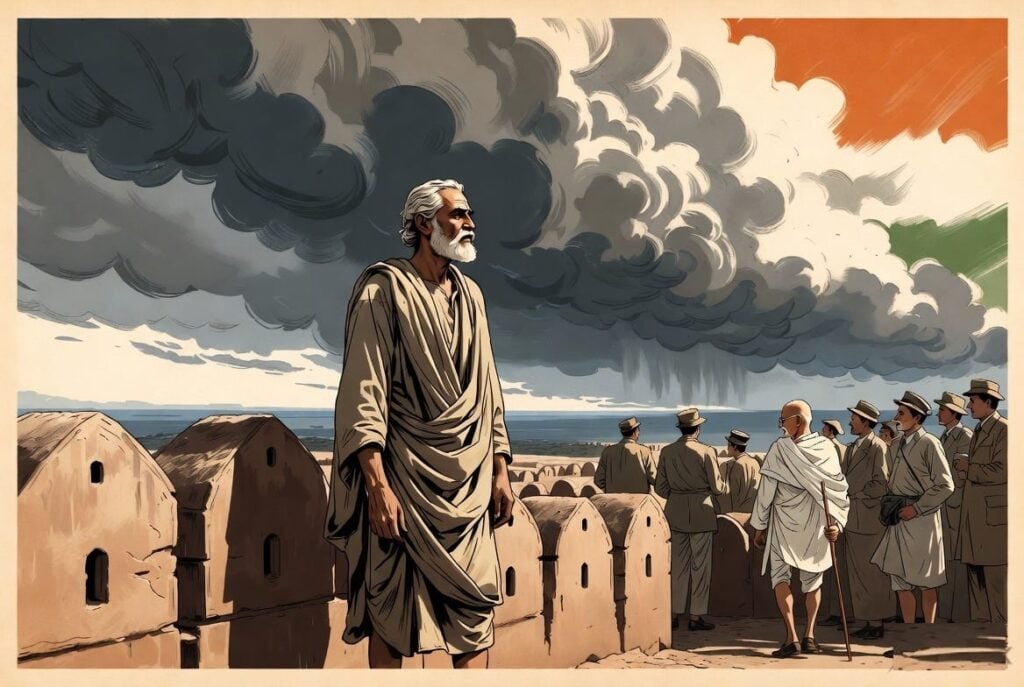
The modernity of the term does not mean that every impulse gathered beneath it began in the twentieth century. Communities have long defended temples, languages, pilgrimage networks, customary law, intellectual traditions and political autonomy. The academically sound distinction is between historical continuity and retroactive labelling. Vijayanagara, the Maratha polity and the Sikh Khalsa may provide analogies for civilisational resistance, but their actors inhabited different political worlds and should not simply be converted into members of a later ideology.
Hindutva is best analysed on at least three levels. As cultural consciousness, it affirms the historical depth and public legitimacy of Hindu civilisation. As social mobilisation, it creates networks of education, service, worship, heritage preservation and political advocacy. As electoral politics, it becomes a language through which parties seek votes, frame policy and distinguish themselves from opponents. These levels overlap, but they are not identical. A temple volunteer, a Sanskrit scholar, a heritage activist and a party campaigner may all affirm cultural continuity while disagreeing sharply about economics, caste, federalism, state power or constitutional reform.
This distinction explains why Hindutva cannot be reduced entirely to the BJP, Shiv Sena, RSS or any other organisation. Organisations provide leadership, discipline, resources and ideological articulation, but they also respond to sentiments already present within society. Families, monastic lineages, local associations, publishers, pilgrimage communities, artists, legal advocates and unaffiliated citizens participate in cultural resurgence through different channels. Conversely, calling a movement organic does not place its organisations beyond scrutiny. Leadership choices, funding, rhetoric and policy outcomes remain legitimate subjects of evidence-based evaluation.
The movement draws emotional strength from experiences of colonial domination, temple destruction, cultural displacement, Partition, the displacement of Kashmiri Hindus, unequal access to institutions and perceptions of bias in education or public policy. These memories deserve documentation rather than dismissal. At the same time, historical suffering does not justify collective blame against present-day religious communities. Academic analysis must distinguish among doctrines, empires, rulers, missionary institutions, political organisations and ordinary citizens. Generalising about every Muslim or Christian from selected episodes reproduces the same flattening of identity that civilisational analysis seeks to correct.
The Vīrabhadra thesis is strongest when it describes a movement ecology rather than a hidden conspiracy. Social movements usually arise through interacting causes: inherited memory, institutional grievances, demographic change, charismatic leadership, communications technology, legal controversies and electoral incentives. Political organisations can amplify these forces without creating all of them. The metaphor captures the transition from latent discontent to visible assertion, but empirical research is still required to explain when, where and why that transition occurs.
Mapping the Vīrabhadra Metaphor
Within this analogy, Śiva represents the depth of Dharmic civilisation that remains socially pervasive even when elite institutions treat it as embarrassing, private or politically inconvenient. This includes temples, festivals, sacred geography, philosophical schools, vernacular literatures, customary practices and memories carried outside formal academia. The comparison does not imply that one political movement possesses Śiva or speaks for every Hindu. It indicates that a state cannot understand Bharat adequately if it excludes the civilisational traditions through which a large part of its population interprets life.
Dakṣa represents institutional arrogance more than any single individual or party. His error is the belief that procedural magnificence can compensate for foundational exclusion. A modern institution may display constitutional language, administrative expertise and ceremonial legitimacy while remaining inattentive to the communities it governs. Yet the metaphor applies in every direction. A Hindutva institution that marginalises Dalits, women, regional traditions, dissenting Hindu schools, Buddhists, Jains or Sikhs would repeat Dakṣa’s mistake rather than correct it.
The yajña represents the state and its public institutions as systems organised toward declared ends. A sacrifice coordinates participants, rules, offerings and anticipated results; a constitutional order coordinates offices, laws, rights, taxation and public goods. The analogy is useful because both require legitimacy as well as procedure. It becomes dangerous if religious ritual is treated as a literal blueprint for coercive state power. Modern citizenship is governed by the Constitution, and citizens do not lose equal status because they interpret the sacred differently.
Vīrabhadra represents corrective assertion: the moment when ignored communities acquire language, organisation and the confidence to challenge established arrangements. In a democratic order, that energy should move through scholarship, elections, litigation, journalism, peaceful assembly, cultural production and institution-building. Violence is not a necessary implication of forceful symbolism. The most durable form of Dharmic resistance is the capacity to expose an unjust structure and replace it with one that protects dignity without creating a new class of excluded people.
Dakṣa’s restoration represents institutional reform. The old arrangement cannot simply continue, because its governing assumptions have been discredited; nor is the entire social field abandoned. Recognition makes completion possible. Applied to Bharat, this suggests that cultural renewal should seek better curricula, fairer governance, protected heritage, transparent administration and equal citizenship. The test of resurgence is not whether an adversary has been humiliated but whether the rebuilt institution serves the public more truthfully.
The phrase creative destruction therefore requires caution. In economics it can describe innovation displacing obsolete structures; in sacred narrative it may describe the rupture of a false ritual order. In constitutional politics, however, literal destruction of property, places of worship or human life remains subject to law. Mythic intensity should be translated into creative construction: archives, universities, museums, accountable temple institutions, language revitalisation, social service and serious policy. Romanticising uncontrolled demolition detaches Vīrabhadra from Śiva’s final act of restoration.
Indian Secularism: Constitutional Principle and Political Dispute
The source essay describes secularism as a vacuous construct associated with Nehruvian politics. That is one influential critique, developed from different premises by thinkers such as Sita Ram Goel, T. N. Madan, Ashis Nandy and Jakob De Roover. A factual account must also state the constitutional position. The word secular was inserted into the Preamble by the Constitution (Forty-second Amendment) Act, 1976, effective in 1977, but the constitutional architecture of religious liberty, equality and non-establishment had existed from the beginning.
The Constitution of India protects freedom of conscience and the right to profess, practise and propagate religion under Article 25, subject to public order, morality, health and other constitutional provisions. Article 26 protects the affairs of religious denominations within similar limits. Articles 14 and 15 establish equality and prohibit specified forms of discrimination, while Articles 29 and 30 protect cultural and educational interests, including those of religious and linguistic minorities. These provisions form an interconnected settlement rather than a single slogan.
In S. R. Bommai v. Union of India (1994), the Supreme Court treated secularism as part of the Constitution’s basic structure. The Court has subsequently described Indian secularism as more than passive tolerance and associated it with equal treatment by the state. This does not settle every policy controversy. It establishes that criticism should distinguish constitutional secularism from selective implementation, electoral appeasement or administrative asymmetry. A government may violate a principle through partisan application; that failure does not logically prove that the principle itself is empty.
A productive Dharmic critique of secularism can therefore ask precise questions. Are comparable religious institutions subject to comparable rules? Are heritage funds allocated transparently? Do citizens receive equal protection from intimidation and violence? Are personal-law distinctions consistent with fundamental rights? Do educational policies represent Indian knowledge traditions accurately? Precise institutional questions are more persuasive than blanket denunciations because they can be tested through statutes, budgets, judgments and administrative data.
Electoral law also places boundaries around religious mobilisation. Section 123(3) of the Representation of the People Act, 1951 addresses appeals for votes on specified religious, racial, caste, community or linguistic grounds. The Election Commission’s Model Code of Conduct directs parties and candidates not to aggravate communal differences or use places of worship as forums for election propaganda. Cultural discussion is not erased by these rules; electoral competition is required to respect civic equality and public peace.
Minority protections should likewise be analysed without caricature. Their constitutional purpose is to preserve conscience, culture and education where numerical vulnerability may create risks of absorption or discrimination. Legitimate debate remains possible about scope, institutional parity and unintended effects. The Vīrabhadra lens recommends correction where asymmetry is demonstrated, but Dakṣa’s restored yajña warns against solving one exclusion by engineering another. Equal citizenship must protect Hindu institutions while also securing the lives, worship and dignity of Muslims, Christians, Buddhists, Jains, Sikhs and others.
Ayodhya, Memory and the Rule of Law
The Ayodhya movement is frequently presented as the clearest modern example of Hindu civilisational assertion. For millions of devotees, the Ram Janmabhoomi claim concerned sacred geography, historical memory and the dignity of Rāma Lalā. That experience cannot be understood solely as an electoral calculation. It mobilised religious organisations, historians, archaeologists, litigants, political parties and ordinary pilgrims across several generations.
Academic accuracy nevertheless requires a distinction between the claim, the 1992 demolition and the legal settlement. In its 2019 Ayodhya judgment, the Supreme Court awarded the disputed land for the construction of a temple through a trust and directed that alternative land be provided for a mosque. The Court also characterised the demolition of the mosque as an egregious violation of the rule of law. Recognising both holdings is essential; selecting only one would turn a complex constitutional judgment into partisan mythology.
The deeper lesson is that civilisational memory and constitutional procedure need not be enemies. Devotees may experience restoration with profound emotion, while the state remains obligated to protect every community and adjudicate claims through evidence and law. A Vīrabhadra interpretation appropriate to a republic should celebrate the recovery of cultural confidence without converting illegal demolition into a general method. Otherwise the metaphor could license endless reciprocal destruction, the opposite of the narrative’s final reconciliation.
Historical Resistance Without Anachronism
Historical examples can enrich the thesis when used comparatively. The Vijayanagara Empire, Chhatrapati Shivaji Maharaj’s state and the Sikh Khalsa each emerged under distinct conditions and combined military power with religious patronage, revenue systems, diplomacy and local alliances. None can be explained by a single civilisational motive. Their relevance lies in demonstrating that cultural survival requires institutions, strategic competence and political imagination—not merely indignation.
Resistance also crossed the boundaries of contemporary party labels. Virbhadra Singh remained a Congress leader while publicly taking positions associated with Hindu cultural advocacy. Under his government, Himachal Pradesh enacted the Himachal Pradesh Freedom of Religion Act, 2006, which prohibited conversion by force, inducement or fraudulent means. Whatever view is taken of such legislation, the example shows that cultural politics has never been contained perfectly within one party or organisational family.
Historical comparison becomes unreliable when rulers are praised or condemned through isolated anecdotes detached from chronology, source criticism and political context. Claims about temple destruction, conversion, patronage or communal policy should be evaluated against inscriptions, court chronicles, administrative records, archaeology and competing scholarship. A confident Hindu resurgence has no need for exaggerated evidence. Cultural memory becomes stronger when it can distinguish documented injury from legend, polemic or retrospective embellishment.
Dharmic Unity Without Erasing Difference
The civilisational language of Bharat can strengthen unity among Hinduism, Buddhism, Jainism and Sikhism only if it respects their distinct identities. These traditions share long histories of philosophical debate, pilgrimage, artistic exchange, monastic and household institutions, vernacular culture and ethical reflection. They also differ on scripture, metaphysics, authority, ritual and community formation. Unity is sustainable when it permits principled disagreement rather than forcing every tradition into a single doctrinal mould.
The Dakṣa Yajña itself supports this plural approach. Its central warning concerns exclusion from an order that claims completeness. A civilisational state inspired by Dharma would therefore make room for Shaiva, Vaishnava, Shakta, Smarta, Buddhist, Jain, Sikh, folk, tribal and other inherited communities without demanding uniformity. The sacred landscape of Bharat has historically been produced by overlapping routes, stories and institutions; its integrity is ecological and relational, not mechanically homogeneous.
Dharmic resistance can draw upon several ethical modes: non-violence, self-discipline, intellectual debate, legal advocacy, seva, artistic creation, economic cooperation and, where law permits, proportionate defence of life. Vīrabhadra symbolises one fierce mode within this broader repertoire; he cannot replace the compassion of the Buddha, the disciplined non-violence associated with Jain traditions, the Sikh commitment to service and protection, or the many Hindu paths of knowledge, devotion, action and meditation. Civilisational strength emerges from their conversation rather than from the domination of one vocabulary.
Kshatra offers a useful companion concept when understood as disciplined protection rather than aggression. Protection requires courage, but it also requires discrimination between an offender and an entire population, between evidence and rumour, and between proportionate action and revenge. Force without Dharma becomes domination; restraint without the capacity to protect can become helplessness. The challenge is to unite moral clarity with institutional accountability.
This framework also avoids treating Islam and Christianity as undifferentiated historical agents. Empires, churches, missionary organisations, reform movements, local communities and individual believers have not acted identically across centuries. Theological disagreement and criticism of coercive practices remain legitimate, but collective suspicion weakens scholarship and social cohesion. A Dharmic public culture demonstrates confidence by defending itself precisely while maintaining ordinary relations of citizenship, neighbourliness and shared responsibility.
Risks Within the Vīrabhadra Interpretation
The first risk is permanent mobilisation. Vīrabhadra is called forth by a crisis; he is not the sole form of normal social life. A movement that continually requires enemies may become unable to recognise success, compromise or changing conditions. Its institutions can then reward outrage more reliably than scholarship and construction. The narrative’s ending insists that fierce correction must eventually yield to a legitimate and functioning order.
The second risk is homogenisation. Hindu civilisation contains numerous philosophies, sects, castes, languages, temple systems and regional practices. Cultural confidence should not impose one liturgy, one historical memory or one model of religious authority upon this plurality. A movement becomes Dakṣa-like when it defines respectable tradition so narrowly that ascetics, local deities, tribal practices, heterodox schools or socially marginal communities are treated as inconvenient.
The third risk is neglect of internal reform. Colonialism and external aggression are important parts of Indian history, but they cannot explain every contemporary inequality. Caste discrimination, exclusion from learning, gendered violence, corruption and poor institutional management also require attention. Cultural resurgence gains credibility when it protects the vulnerable within its own communities. Pride in civilisation and honest self-criticism are not opposites; both are needed for renewal.
The fourth risk is majoritarian instrumentalism. A numerical majority can still experience cultural alienation, but its organised power also creates obligations. The treatment of a vulnerable neighbour is a crucial measure of civilisational confidence. If Hindutva is understood as the public assertion of Hindu civilisation, its strongest expression should make arbitrary discrimination less likely, protect places of worship, punish violence consistently and ensure that citizenship does not depend upon theological conformity.
The fifth risk is confusing symbols with outcomes. Temple ceremonies, slogans, processions and digital imagery can create solidarity, but they do not by themselves improve education, employment, public health, archaeological conservation or judicial capacity. Symbolic recognition matters because people live through meaning. It becomes durable only when linked to measurable public goods. The corrected yajña must actually function.
From Reactive Assertion to Creative Construction
A constructive Hindutva programme would begin with knowledge. Sanskrit, Pali, Prakrit and regional-language manuscripts require cataloguing, conservation, critical editing, translation and open digital access. Universities need rigorous programmes in Indian philosophy, archaeology, art history, legal history and religious studies. Traditional scholars should participate without being insulated from critical methods, while academic researchers should engage living traditions without treating practitioners as merely objects of study.
Heritage policy should connect temples, monasteries, gurdwaras, pilgrimage routes, sacred groves, water systems and performing arts. Conservation is not limited to restoring stone. It includes training artisans, documenting oral histories, protecting ritual ecologies, maintaining archives and creating transparent local institutions. Sacred geography survives when communities can care for it across generations, not when it appears only as an election-season backdrop.
Religious governance requires both autonomy and accountability. Public debate should compare legal regimes carefully, identify genuine asymmetries and propose reforms compatible with fundamental rights. Temple revenue, appointments, conservation and charitable activity should be transparent. Comparable institutions should be governed by principled standards rather than political convenience. Reform framed in this manner can protect Hindu institutions without weakening the constitutional freedom of other communities.
Social service is another measure of civilisational seriousness. Schools, libraries, clinics, disaster-relief networks, food programmes, environmental projects and support for vulnerable families convert identity into shared welfare. Such activity already exists across Hindu, Buddhist, Jain and Sikh institutions, but cooperation can be deepened. Seva creates encounters in which Dharma is recognised through conduct rather than asserted only through rhetoric.
Legal reform should focus on equal protection, due process and clear evidence. Forced or fraudulent conversion, intimidation, vandalism, hate crimes and targeted violence should be addressed consistently, regardless of the identity of the victim or accused. Laws must be precise enough to punish coercion without criminalising voluntary conscience. This balance protects both cultural continuity and individual liberty.
Public communication also needs reform. Digital platforms reward compressed anger, unverified claims and spectacular confrontation. A mature cultural movement would invest in source-based history, translations, documentary archives, careful journalism and accessible explanations of philosophy. The difference between narrative warfare and civilisational education is not a lack of conviction; it is the presence of evidence, proportion and intellectual responsibility.
Intercommunity cooperation should not require the erasure of difficult history. Truthful commemoration can coexist with present-day partnership. Local projects involving heritage protection, environmental restoration, emergency relief and neighbourhood security can build trust while leaving theological differences intact. Reconciliation is not amnesia. In the Dakṣa Yajña, recognition of the wrong precedes completion of the sacrifice.
Political parties invoking Hindutva should consequently be evaluated through ordinary standards of governance: institutional competence, economic opportunity, educational quality, corruption control, public safety, environmental stewardship and equal application of law. Electoral victory can demonstrate mobilisation, but it cannot alone demonstrate civilisational renewal. Vīrabhadra opens a blocked order; administrators, scholars, teachers, judges, artisans and citizens must build what follows.
The Complete Meaning of the Vīrabhadra Phenomenon
Hindutva can plausibly be described as a Vīrabhadra phenomenon when the phrase refers to Hindu society’s movement from suppressed cultural memory toward organised assertion. The analogy explains why a movement may arise beyond party structures, why sacred symbols possess political force and why exclusion can produce a fierce response. It also imposes a demanding standard: resistance must remain connected to Dharma, and rupture must prepare the ground for reconstruction.
The conclusion of the Paurāṇika ākhyāna is therefore more important than its most dramatic scene. Śiva restores rather than annihilates; Dakṣa recognises rather than continues to exclude; the yajña resumes rather than remaining a ruin. Śiva is described as the sacrifice itself, yajño; the Lord of the sacrifice, yajñapatir; the sacrificer, yajvā; and the destroyer of corrupted sacrifices, yajñānāmantakṛd. These roles hold creation, participation, sovereignty and correction within one sacred reality.
For contemporary Bharat, the benefit of this lens lies in its union of confidence and restraint. Civilisational memory should be recovered, Dharmic institutions should be strengthened, historical injuries should be studied honestly and constitutional asymmetries should be debated with evidence. At the same time, every citizen’s dignity must be protected, the differences among Dharmic traditions must remain visible, and political power must submit to law. Vīrabhadra is meaningful not because anger becomes permanent, but because excluded truth becomes impossible to ignore and a more complete order can finally be built.
Research basis: This analysis draws on the source essay, the traditional Dakṣa Yajña cycle, scholarship on Purāṇic narrative, the Constitution of India, S. R. Bommai v. Union of India, the Supreme Court’s 2019 Ayodhya judgment, the Representation of the People Act, Election Commission guidance and the Himachal Pradesh Freedom of Religion Act. Interpretive claims are presented as interpretations; legal and historical propositions are distinguished from theological meaning.
Inspired by this post on Hindu Post.

Leave a Reply
You must be logged in to post a comment.