
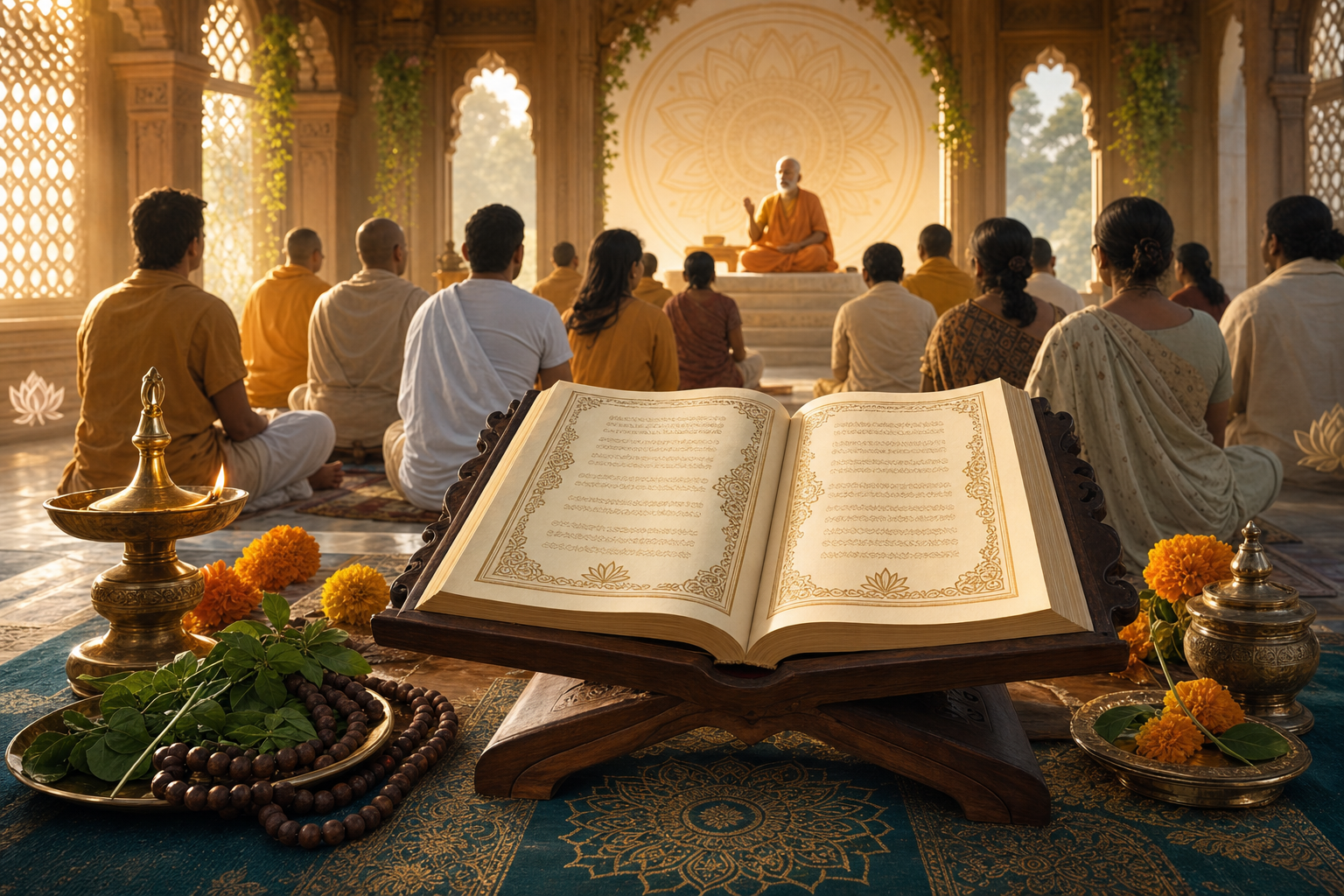

A live morning Srimad Bhagavatam class by HG Prabhavishnu Prabhu belongs to a long and respected tradition of scriptural hearing, reflection, and disciplined spiritual inquiry. Since the source material provides only a video thumbnail and title, no specific verse, date, transcript, or detailed class theme can be verified from the supplied content. For that reason, a faithful transformation must avoid inventing the exact subject of the lecture and instead present the broader spiritual, philosophical, and devotional context in which such a class is understood.
The Srimad Bhagavatam, also known as the Bhagavata Purana, occupies a central place in Vaishnava Hindu scriptures and in the devotional culture of Krishna consciousness. It is studied not merely as literature, theology, or sacred history, but as a living guide to dharma, bhakti, self-discipline, and spiritual transformation. Morning classes on this text are especially significant because they place sacred learning at the beginning of the day, before worldly duties scatter attention and before the mind becomes absorbed in routine concerns.
In the devotional communities shaped by Srila Prabhupada’s teachings, the morning Srimad Bhagavatam class often functions as both study and sadhana. It is a forum where Sanskrit verses, traditional commentaries, philosophical concepts, and practical spiritual questions are brought together. The exercise is not limited to intellectual comprehension. It asks the listener to consider how scriptural wisdom can refine conduct, deepen humility, strengthen compassion, and cultivate a more purposeful relationship with Bhagavan Sri Krishna.
HG Prabhavishnu Prabhu’s presence in such a setting gives the class a devotional and pedagogical character. A teacher in the Vaishnava tradition is expected to do more than explain vocabulary or narrate sacred episodes. The teacher draws attention to sambandha, abhidheya, and prayojana: the soul’s relationship with the Supreme, the process of devotional practice, and the ultimate goal of pure love of God. This framework helps transform the Bhagavatam from a distant text into a practical spiritual map.
The morning setting is not incidental. Across Dharmic traditions, dawn has long been treated as an auspicious time for prayer, meditation, chanting, study, and self-regulation. In Hinduism, Buddhism, Jainism, and Sikhism, early spiritual discipline is associated with clarity, restraint, remembrance, and purification of intention. A Srimad Bhagavatam class in the morning therefore resonates with a broader Dharmic understanding: the day should begin by orienting consciousness toward truth, duty, and transcendence.
The Bhagavatam’s teaching method is layered. It presents cosmology, metaphysics, ethics, devotional narratives, royal duties, renunciation, yogic insight, and the psychology of attachment. Yet its central emphasis remains bhakti. Knowledge without devotion can become pride, ritual without inner transformation can become mechanical, and social duty without spiritual grounding can lose its moral center. The text repeatedly redirects attention toward devotion that is sincere, disciplined, and free from selfish calculation.
This makes the Srimad Bhagavatam especially relevant in modern life. Many people experience mental restlessness, social fragmentation, overwork, loneliness, and spiritual uncertainty. A morning class does not erase these realities, but it can provide a framework for meeting them with steadiness. Hearing sacred teachings regularly develops a different rhythm of attention. Instead of beginning the day with anxiety, comparison, or distraction, the listener begins with remembrance, reflection, and moral orientation.
Academic study of the Bhagavata Purana often highlights its literary sophistication, theological richness, and historical importance within medieval and early modern bhakti traditions. Devotional study, however, adds another dimension: the text is not only analyzed but internalized. The stories of Dhruva Mahārāja, Prahlāda, Ambarisha, the Pandavas, the gopis, and other figures are not treated as remote mythology alone. They become case studies in faith, humility, courage, surrender, and the human struggle between ego and divine dependence.
The technical depth of the Srimad Bhagavatam also deserves careful attention. Its teachings engage with the nature of atman, Paramatma, prakriti, karma, guna, maya, avatara, dharma, and moksha. These concepts require patient explanation because they are often misunderstood when translated too quickly into modern categories. A competent Bhagavatam class helps listeners understand that dharma is not merely religion, karma is not merely fate, and bhakti is not merely emotion. Each term carries philosophical precision and practical consequence.
In Vaishnava interpretation, bhakti is both the means and the goal. It includes hearing, chanting, remembering, serving, worshiping, praying, surrendering, and cultivating loving devotion to Krishna. The act of hearing the Bhagavatam is therefore itself a form of spiritual practice. The listener participates through attention, humility, inquiry, and willingness to be changed. This is why the tradition places such importance on shravanam, the disciplined hearing of sacred sound from realized teachers and sincere practitioners.
The communal aspect of a live class is also important. Spiritual learning is strengthened when it is shared. Listeners may come from different backgrounds, levels of knowledge, languages, and life circumstances, yet they gather around a common sacred text. This shared hearing builds community without demanding uniformity of personal experience. It reflects a broader Dharmic principle: unity is not sameness, but a disciplined respect for truth, practice, and the sincere pursuit of spiritual realization.
Such classes also support inter-Dharmic harmony when presented with maturity. While the Srimad Bhagavatam is a Vaishnava Hindu scripture, its emphasis on self-control, compassion, truthfulness, non-violence, detachment, and reverence for the sacred can be appreciated alongside Buddhist, Jain, and Sikh spiritual ideals. The particular theology remains distinct, but the ethical and contemplative seriousness creates meaningful bridges. This kind of presentation strengthens Dharmic unity without flattening the uniqueness of each tradition.
A responsible reading of the Bhagavatam must also avoid sectarian arrogance. The text praises devotion, humility, and service, not contempt for others. Its deeper purpose is to purify consciousness and awaken divine love. When scriptural study becomes a tool for superiority, the spirit of bhakti is weakened. When it becomes a mirror for self-examination, it becomes transformative. A morning class is therefore most valuable when it encourages listeners to become more truthful, more compassionate, and more steady in service.
The image of a live morning class also evokes the continuity of guru-shishya parampara. Sacred knowledge in Indian civilization has historically been preserved through attentive listening, memorization, commentary, debate, and lived example. Modern digital platforms have changed the medium, but not the fundamental principle. A devotee watching from home, a temple hall, or a distant country still participates in an ancient practice: receiving shastra through the voice of a teacher and reflecting on its application in daily life.
In practical terms, the value of a Srimad Bhagavatam class lies in repetition and regularity. One lecture may inspire, but repeated hearing gradually reshapes perception. The listener begins to notice patterns: the danger of pride, the fragility of worldly success, the importance of saintly association, the limits of material control, and the mercy available through sincere devotion. These lessons become most powerful when they are not treated as abstract doctrine but as guidance for relationships, work, family life, and personal conduct.
The Bhagavatam’s devotional worldview is also deeply personal. It does not reduce the self to a social role, economic function, or psychological profile. It affirms the jiva as spiritual in nature and capable of a loving relationship with the Supreme. This teaching can be profoundly stabilizing in an age where identity is often fragmented by external pressure. The text invites the listener to locate dignity not in status or consumption, but in spiritual identity and service.
At the same time, the Bhagavatam is not escapist. Its narratives address kingship, family conflict, moral failure, social duty, suffering, death, and the consequences of desire. It does not deny the complexity of life. Instead, it teaches that worldly life becomes meaningful when aligned with dharma and devotion. This makes the text especially suitable for householders, students, professionals, renunciants, and seekers who must balance spiritual aspiration with practical responsibility.
A live class by a respected speaker such as HG Prabhavishnu Prabhu can help make these teachings accessible. The best scriptural teaching does not merely repeat inherited phrases. It clarifies, contextualizes, and applies them without diluting their seriousness. It helps listeners understand why the Bhagavatam remains relevant: because the human condition has not changed as much as modern culture assumes. Desire, fear, pride, grief, longing, and the search for meaning remain constant.
For many devotees, the experience of hearing Srimad Bhagavatam in the morning carries an emotional quietness that is difficult to describe in purely academic language. The atmosphere of sacred sound, the discipline of attentive listening, and the memory of Krishna’s pastimes can create a sense of inner alignment. This emotional dimension is not opposed to scholarship. In the bhakti tradition, disciplined understanding and softened heart are meant to develop together.
The supplied post, though minimal in original form, points toward a meaningful spiritual event: a live opportunity to hear Srimad Bhagavatam from HG Prabhavishnu Prabhu. Its expanded significance lies in the enduring place of Bhagavata study within Hindu spirituality, Vaishnava practice, and the wider Dharmic commitment to wisdom, devotion, and ethical living. Such a class is best understood not as passive content consumption, but as an invitation to begin the day with shastra, humility, and remembrance of Sri Krishna.
Inspired by this post on Dandavats.









Leave a Reply
You must be logged in to post a comment.