Goddess Trikala is best understood as a theologically integrative manifestation of Shakti that unites the three modalities of timepast, present, and futurewith the cosmic functions of creation, preservation, and dissolution identified with the Trimurti. In Hindu spiritual traditions, such synthesis clarifies how the Sacred Feminine not only energizes the deities but also binds the universe across time, ethics, and experience. The very term trikāla (three-times) signals a doctrinal emphasis on continuity: what was (bhūta), what is (vartamāna), and what will be (bhaviṣya) are brought into one illuminating presence.
Purāṇic retellings situate Trikala Devi within a lineage of integrative theophanies. According to strands of Varāha Purāṇa exegesis and later regional narratives, she is described as arising from the unified gaze (ekadṛṣṭi) and conjoined essences (tejas) of Brahmā, Viṣṇu, and Śivaan event meant to signal a harmonized cosmic intent. While the specific epithet “Trikala” is not standardized across all manuscripts or regions, the pattern of a goddess emerging from aggregated divine energies is thematically consistent with widely accepted texts such as the Devī Māhātmya, where the Goddess manifests from the combined powers of the devas. Trikala Devi, in this interpretive frame, functions as a theological shorthand for time-conscious divine unity.
Doctrinally, Trikala aligns two classical triads: the tri-temporal vision (trikāla) and the threefold activity of the Trimurtisṛṣṭi (creation), sthiti (preservation), and saṁhāra (dissolution). This mapping underscores a sophisticated cosmology in which time is not a passive background but an active, sacred dimension that structures becoming. Within this vision, time and agency co-implicate one another: no act of creation, sustenance, or transformation can be understood outside the flow of kala, and no apprehension of kala is complete without recognizing its divine purposiveness.
Trikala Devi can also be hermeneutically related to the TrideviSarasvatī, Lakṣmī, and Pārvatī (or Durgā)whose spheres of knowledge (vidyā), prosperity (śrī), and power (śakti) permeate all three times. Knowledge preserves memory of the past and interprets the present; prosperity sustains life in the present and secures futures; and power transforms what is into what might be. In this comparative lens, Trikala is not a rival to the Tridevi but a conceptual horizon that enfolds their distinct modalities into a single, time-spanning form of the Sacred Feminine.
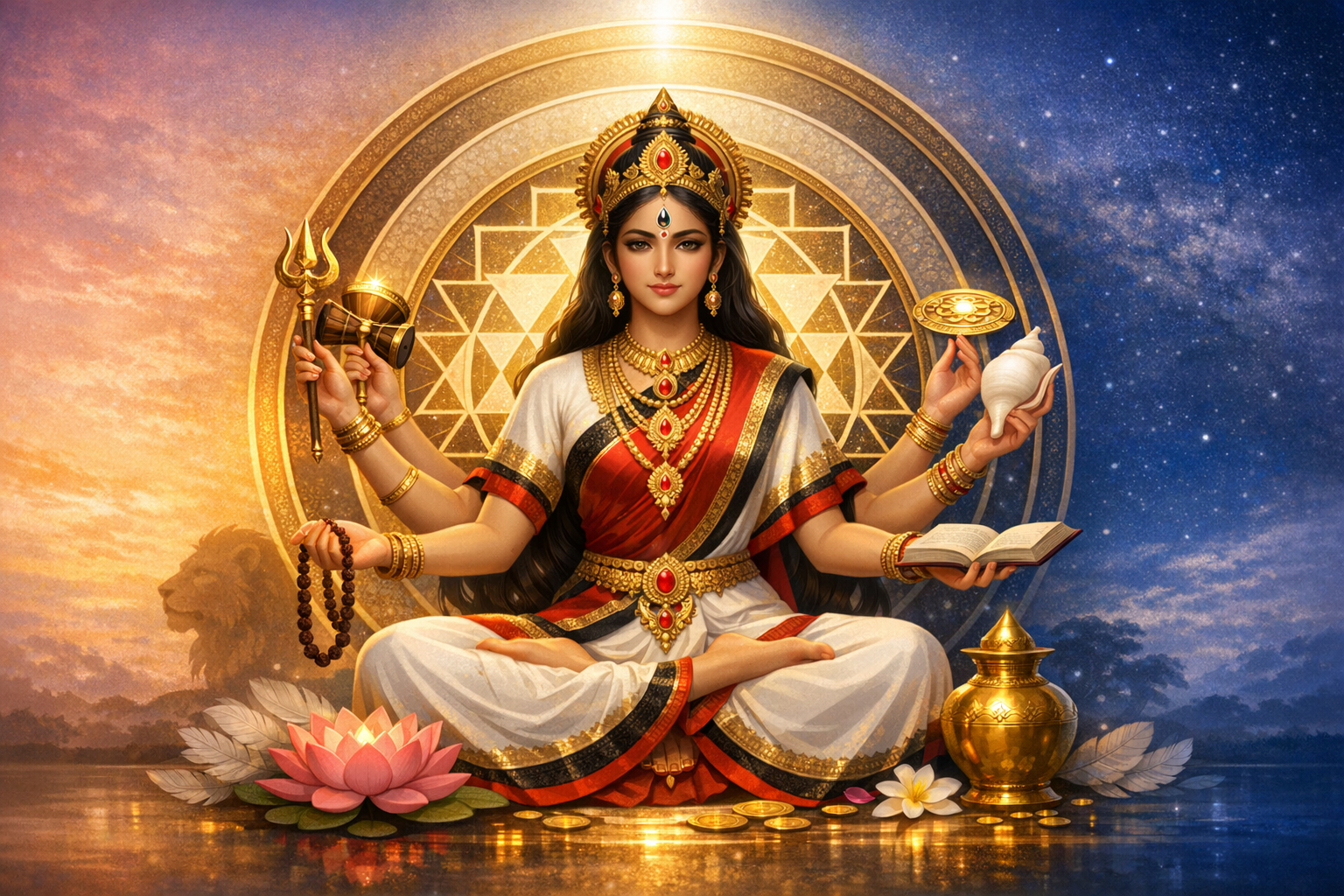
Iconographically, depictions of a time-enfolding goddess often privilege integrative symbols rather than a single canonical form. Interpreters sometimes evoke a tri-netra (three-eyed) visage to suggest omnitemporal awareness; color triads such as white-red-black to echo knowledge, activity, and profound depth; and composite emblemstrident (tri-śūla), discus (cakra), rosary and book (akṣamālā–pustaka), lotus and pot (padma–kalaśa)to signal that her sovereignty gathers attributes otherwise distributed across multiple deities. In Śrīvidyā practice, the intersecting triangles of the Śrī Cakra and the name Tripurasundarī (“Beauty of the Three Cities/Worlds”) offer additional semiotic anchors for a Sacred Feminine who holds multiple domains and times in equipoise.
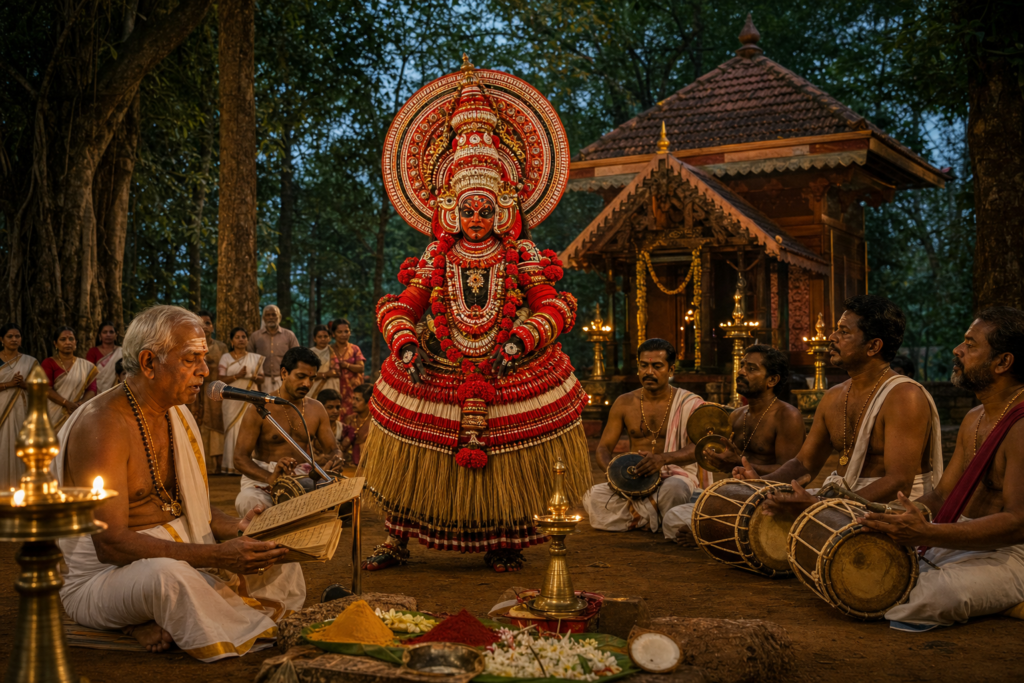
Ritually, Hindu practice already encodes a trikāla sensibility. Trikāla sandhyāthrice-daily worshipaligns devotion with the day’s temporal thresholds. Many temples structure pūjā cycles in morning, noon, and evening segments, concretizing a time-conscious sacrality. Festivals such as Navarātri, spanning nine nights, enact staged transformation across time, inviting devotees to witness how worship matures from invocation to culmination. Within such a ritual ecology, Trikala Devi can be contemplated as the devotional horizon that sanctifies remembrance (smṛti), presence (sākṣātkāra), and foresight (pratipatti).
Philosophically, kala is a foundational category across Hindu darśanas. In the Bhagavad Gītā’s theophany (11.32), the Supreme is revealed as Time, the great transformer. In Śaiva traditions, Maheśvara is Mahākāla, while in Śākta traditions, Kālī embodies the sovereign intensity of time. Vedānta treats time as a dependent reality illumined by consciousness (cit), and Sāṁkhya identifies cyclicality through prakṛti’s guṇas (sattva, rajas, tamas). Trikala Devi, viewed through these lenses, communicates that time is not a negation to be escaped but a sacred field in which knowledge, virtue, and liberation are cultivated.
Parallels across dharmic traditions deepen this integrative reading and support unity in spiritual diversity. In Buddhist scholasticism, trikāla-jñāna (knowledge of the three times) names a perfected cognition of temporal continuity; in Jaina traditions, trikalika-pūjā and the ideal of kevala-jñāna (absolute knowledge) emphasize awareness that spans past, present, and future; in Sikh tradition, Akal Purakh (the Timeless One) establishes a devotional grammar in which God is beyond, yet intimately present to, time. These cognate insights affirm a shared civilizational intuition: time is both sacred and transparent to the Real. Trikala Devi, as theological motif, can therefore serve as a bridge concept for dharmic concord.
Historically and philologically, it is important to note that “Trikala” more commonly appears as a philosophical epithet (e.g., trikāla-jñāna) than as the name of a universally standardized, pan-Indic goddess cult. Regional liturgies and oral narratives may exalt a form of the Goddess under this title, and contemporary practitioners may invoke Trikala Devi in meditative or devotional contexts that emphasize temporal wholeness. Such variability is typical of the Purāṇic and Tantric landscape, where fluidity, localization, and thematic analogy are as central as fixed iconographic canons.
The ethical and contemplative implications of Trikala are immediate. A past-aware spirituality cultivates gratitude and discernment (what was learned), a present-aware spirituality fosters responsibility and compassion (what must be done), and a future-aware spirituality nurtures prudence and hope (what ought to be prepared). This triadic discipline can guide decisions in family life, social service (seva), ecological stewardship, and knowledge-seeking, aligning personal action with Sanātana Dharma’s call to harmonize being, becoming, and belonging.
In lived practice, devotees and communities often describe a felt continuity when engaging dawn, midday, and dusk rites; when reciting hymns that recollect divine deeds; or when planning acts of generosity whose fruits are intended to outlast a single moment. Such testimonies are not merely emotive; they are phenomenological confirmations that ritual time can educate perception. In this sense, Trikala Devi functions as an experiential grammar of devotion: memory is sanctified, presence is illumined, and aspiration is anchored in dharma.
Viewed in total, Goddess Trikala offers a compelling, integrative lens for the Sacred Feminine in Hinduismone that harmonizes Trimurti and Tridevi, situates kala as a sacred dimension of life, and invites concord with cognate insights in Buddhism, Jainism, and Sikhism. This unifying vision preserves the diversity of images, rites, and philosophies while clarifying their shared trajectory: to see time as transparent to truth, and truth as the living heart of time.
Inspired by this post on Hindu Blog.