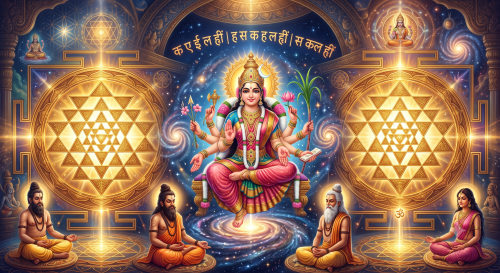
“Gagan Mai Thaal” reimagines worship as a cosmic liturgy, where the sky itself becomes the ceremonial platter and celestial bodies serve as luminous lamps. In this vision, creation is not merely observed but celebrated as the Aarti, affirming that the divine pervades every element of existence. The hymn invites contemplative attention to the harmony of the universe and to a profound sense of awe that transcends ritual formality.
Within Sikhism, the Aarti attributed to Guru Nanak reframes devotion around the formless One (Nirankar), emphasizing direct interior reverence over external display. By presenting the cosmos as the altar of worship, the shabad cultivates humility, ethical living, and seva, aligning devotion with everyday conduct. This approach offers a clear, accessible path to spiritual insight without negating the value of sacred tradition.
The theological current in “Gagan Mai Thaal” resonates across dharmic traditions. The Vedic intuition of cosmic order (ṛta), the Bhagavad Gita’s vision of the Viśvarūpa, Buddhist reflections on interdependence (pratītyasamutpāda), and the Jain ethic of ahiṃsā each converge on reverence for all life. This shared sensibility strengthens Religious Pluralism and demonstrates Unity in Diversity, affirming that Hinduism, Buddhism, Jainism, and Sikhism articulate complementary pathways to the same transcendent truth.
As a lived practice within the Bhakti Tradition, the hymn nurtures devotion through contemplative song and quiet reflection. Many find that simply contemplating the evening sky as the “thaal” instills equanimity and gratitude. Such moments of attentive presence deepen inner stillness and transform ordinary perception into a form of worship, anchoring devotion in experience rather than in spectacle.
The hymn also carries an eco-spiritual insight. By framing nature as the sacred setting of Aarti, it encourages stewardship of the environment and reverence for the elements. This aligns with dharmic ethics that regard the earth as a living home and echo expressions such as “Vasudhaiva Kutumbakam,” fostering compassionate responsibility toward all beings.
Preserved in the Guru Granth Sahib, “Gagan Mai Thaal” exemplifies Guru Nanak’s ability to render complex metaphysics in lucid, experiential language. The imagery is poetic yet rigorous, offering a theological vocabulary that is both accessible to devotees and compelling to scholars of scripture. Its clarity supports careful study while allowing for personal devotional immersion.
In intercommunal settings, the hymn serves as a bridge for Interfaith Dialogue among dharmic communities. By centering the shared intuition that the sacred suffuses creation, it encourages mutual respect and reduces friction rooted in ritual differences. This shared ground nurtures a plural ethos, strengthening bonds without erasing distinct identities.
Ultimately, “Gagan Mai Thaal” celebrates creation as worship and worship as creation’s attentive embrace. It presents a contemplative method that is at once academically coherent and spiritually transformative, guiding seekers to perceive unity amid diversity. Through this cosmic Aarti, dharmic traditions find a living convergence: many paths, one radiant light.
Inspired by this post on SikhNet – News.