Kalaratri stands in the Mahabharata tradition as the fierce brilliance of the Divine Femininean awe-inspiring presence that scholars and devotees associate with the dark, purifying night of Time itself. Within the eighteen-day Kurukshetra War, descriptions of carnage, destiny, and the inexorable advance of kāla (time) evoke the figure of Goddess Kalaratrioften equated with Kalias a cosmic witness whose very being frames the conflict as a vast moral and metaphysical rite.
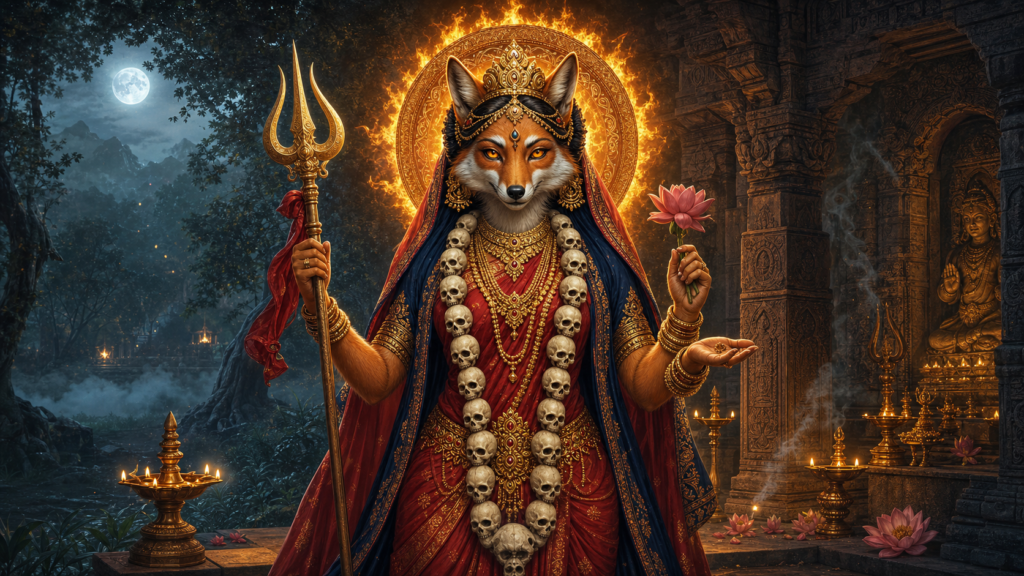
Philologically and theologically, the name “Kalaratri” signifies the “Night of Time” or “Night of Death,” a form of Devi inseparable from Shakti. Iconographic memory portrays her with unbound hair, a dark radiance, three eyes, and a garland of severed headssymbols not of gratuitous terror, but of dissolution (pralaya) that clears the ground for renewal. As a Hindu Goddess deeply woven into Shakta understanding, Kalaratri represents the power that ends cycles so that dharma may be reborn.
In the epic’s war books, narrative images of night descending upon the ranks, omens that foretell irreversible loss, and the relentless presence of fate together suggest a personified principle moving through the battlefield. Many traditional readings interpret these passages as the stride of KalaratriTime’s own goddesstraversing Kurukshetra. Her role, in this view, is not to favor cruelty but to delimit adharma and make visible the moral law that undergirds a Dharma-Yuddha.
Across regional retellings and devotional commentaries, Kalaratri frequently appears as a soul-carrier or psychopomp, guiding the fallen toward their destined realms in accordance with their karma. This “divine soul-carrier” motif transforms the war from a chronicle of violence into a cosmic passage. The fallen are not abandoned to oblivion; they are seen, held, and escorted by a power that acknowledges both their courage and their choices.
Ethically, Kalaratri is the boundary-keeper of dharma. Her fearsome compassion severs the clinging that perpetuates conflict and invites a reckoning with truth. The blackness she embodies is not mere absence; it is the fertile matrix in which grief, responsibility, and moral clarity converge. In the Mahabharata, this reading situates Kalaratri as the measure of consequence and the midwife of renewal.
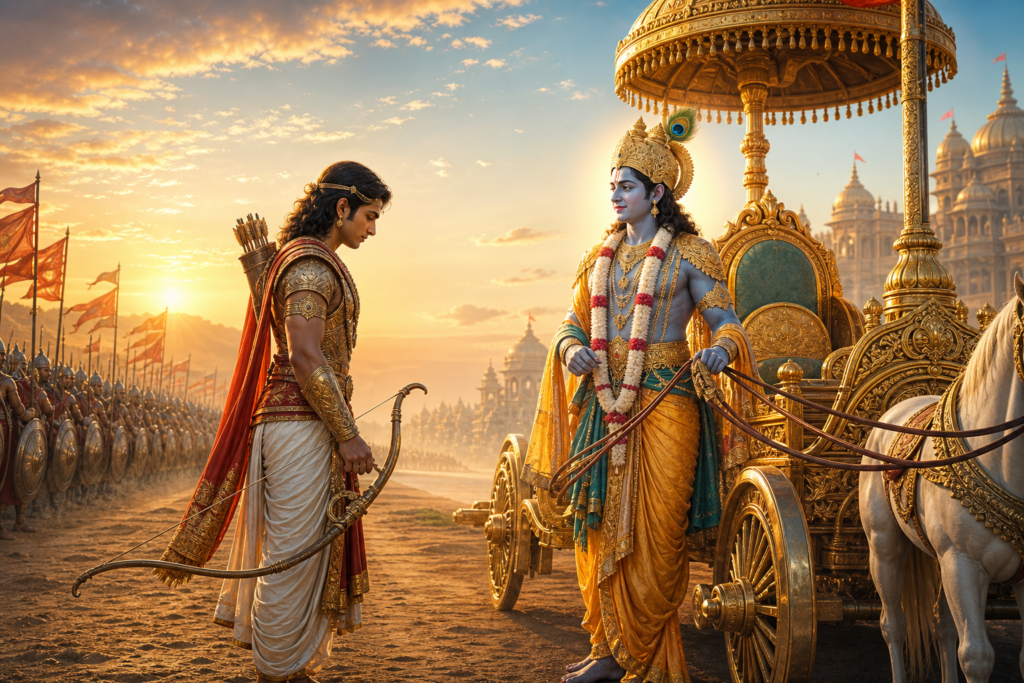
The Bhagavad Gita’s revelation“Time, the destroyer of worlds”resonates profoundly with Kalaratri’s symbolism. The theophany contextualizes destruction within a cosmic order, where endings are instruments of restoration. Through this lens, Kalaratri becomes the long night through which the dawn of justice breaks, aligning the Kurukshetra War with a wider metaphysics of duty, consequence, and compassion.
A dharmic, plural perspective enriches this symbolism further. Buddhist thought on impermanence (anicca) and compassionate wisdom, Jain emphasis on karma and non-violence (ahimsa) moderated by responsibility, and Sikh insights on hukam and righteous courage all converge in the figure of a fierce-yet-compassionate safeguard of truth. Read together, these traditions affirm that Kalaratri’s “fierce grace” is a call to inner transformation, ethical restraint, and serviceunifying threads rather than sectarian boundaries.
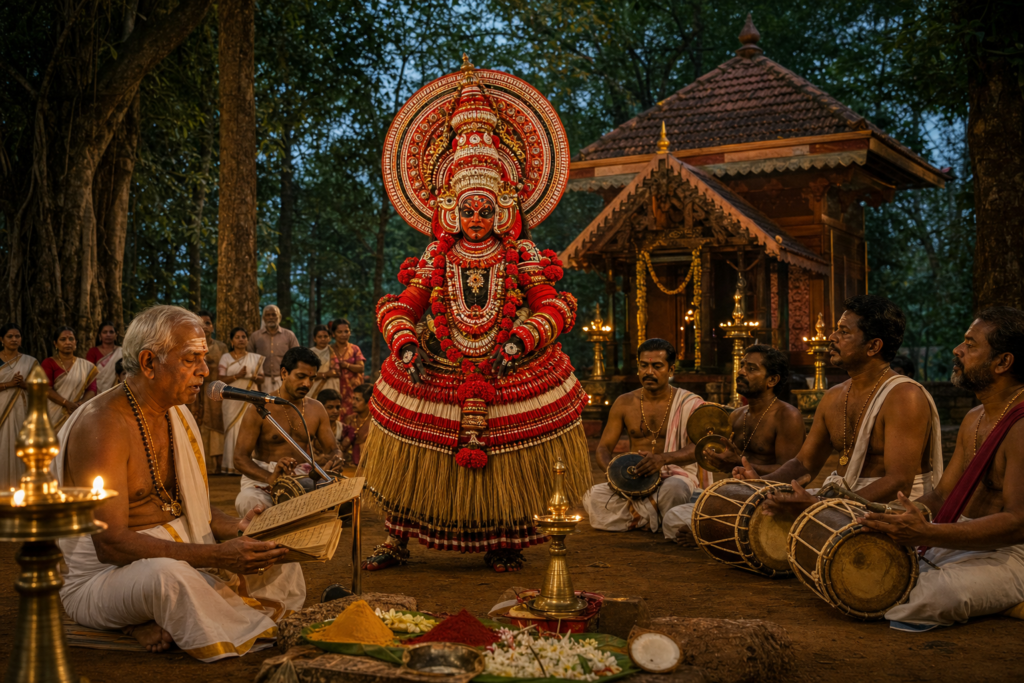
In lived practice, contemplation of Kalaratri cultivates fearlessness and sobriety of mind. Devotees encounter this energy during Navaratri and in meditative remembrance on loss, duty, and renewal. On the battlefield of Kurukshetraand in the battlefields of everyday lifeKalaratri signifies the courage to uphold dharma while honoring grief, the strength to conclude what must end, and the humility to begin again with compassion.
Symbolically distilled, Kalaratri in the Mahabharata War functions as witness, measure, and guide: witness to the truth of actions, measure of their moral weight, and guide for souls crossing thresholds. She does not glorify violence; she transfigures it by exposing its costs and exhausting its momentum. In that exposure lies the possibility of a society anchored in justice, empathy, and shared responsibility across all dharmic paths.
Understanding this sacred role sharpens engagement with the Mahabharata, deepens appreciation of Hindu Goddess traditions, and clarifies the Shakti philosophy that unites devotion and ethics. It also affirms a broader civilizational insight: diverse dharmic traditions can meet in the recognition that fierce compassionKalaratri’s signatureis essential for healing, renewal, and unity.
Inspired by this post on Hindu Blog.