
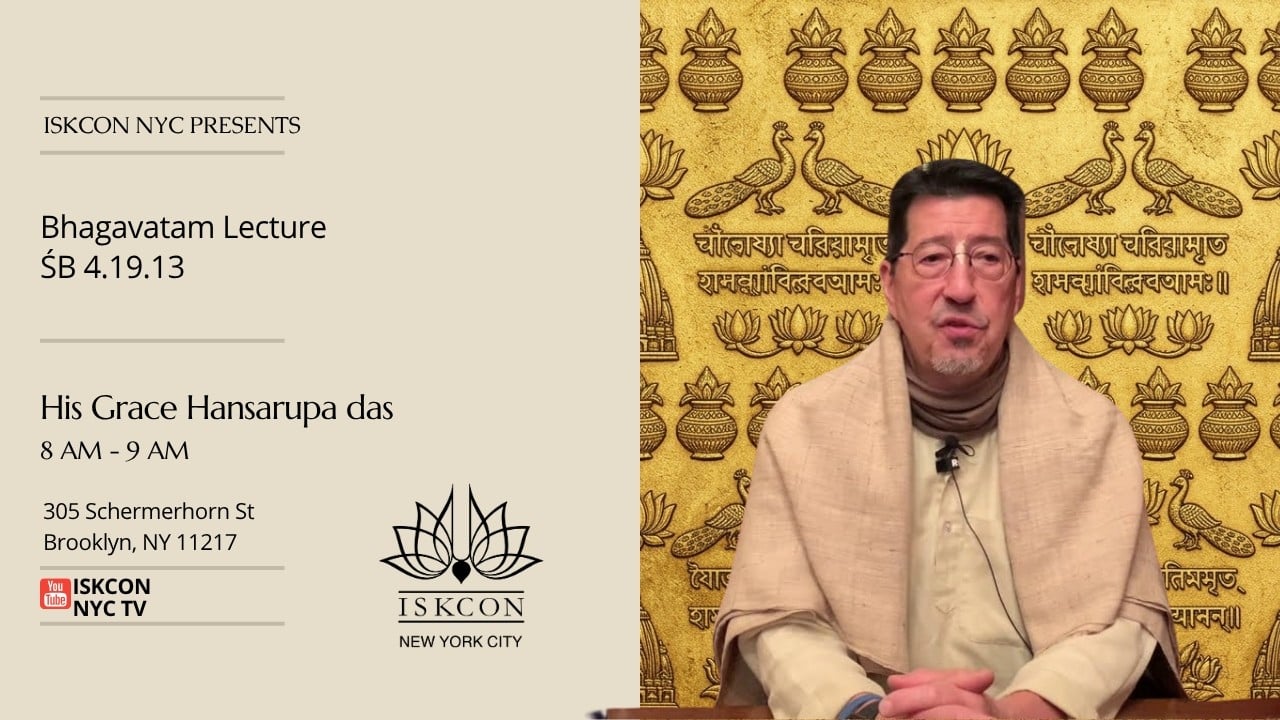
ŚB 4.19.13 stands at a pivotal moment in the Srimad Bhagavatham’s narration of King Prithu’s reign, where exemplary governance intersects with the inner science of Dharma. A recent NYC satsanga by HG Hansarupa das, circulated by ISKCON NYC TV, foregrounds this verse within the broader arc of the Bhagavata Purana’s Canto 4, inviting careful reflection on the relationship between Vedic ritual, ethical leadership, and the cultivation of devotion. The scene around this text situates the sacrificial arena—meticulously organized under Vedic injunctions—with learned brāhmaṇas, r̥tviks, and citizens gathered in dignified harmony, not merely to complete external rites but to align social order with transcendental purpose.
Contextually, the narrative follows the restoration of justice after King Vena’s misrule and the emergence of Prithu as an ideal rājārṣi. Chapter 19 centers on Prithu’s series of aśvamedha-yajñas, conducted to establish both rightful sovereignty and inner rectitude. Within this chapter, the thirteenth verse functions as a textual waypoint that highlights the sanctity, precision, and ethical seriousness of the sacrifice. Read as a whole, the chapter cautions that when ritual prestige outpaces inner transformation, envy arises—even among the powerful, as shown through Indra’s interventions. Hence, the verse frames yajña as a disciplined vehicle of social uplift and spiritual offering rather than spectacle.
From the standpoint of Vedic philosophy, yajña is not reducible to fire oblations; it is the architecture of responsibility. The rigors of vidhi (injunction) and niṣedha (prohibition), the balance between aṅga (subsidiary components) and pradhāna (primary purpose), and the expectation of apūrva (subtle merit) all direct the practitioner toward integrity. In the Bhagavata Purana’s bhakti-centered hermeneutic, these instruments point beyond ritual reward (phala) to enduring God-centered living. King Prithu’s sacrifices thereby model rāja-dharma as service to citizens, stewardship of resources, and humility before the Absolute, turning statecraft into sādhanā.
The episode’s dramatic tension—Indra’s envy and reactive disruption—illuminates a perennial hazard: spiritual opportunism. The text critiques the tendency to innovate external signs for social advantage when inner substance wanes. Crucially, this critique is not a rejection of authentic sampradāyas; rather, it is a call for sincerity across all genuine paths. By reading ŚB 4.19.13 through that lens, the focus returns to character formation, truthfulness, and compassion as the essence of Dharma in Hinduism, with ritual serving realization rather than replacing it.
Gaudiya Vaishnava commentators consistently emphasize that bhakti is the telos of sacrifice. The aśvamedha attains its highest meaning when devotion saturates every limb of the rite; otherwise, form remains an empty shell. In the contemporary Hare Krishna Movement (ISKCON), this trajectory finds expression in the saṅkīrtana-yajña, the congregational chanting of the holy names—Hare Krishna—understood as the Vedic sacrifice most suited to a complex, global age. Far from sectarian narrowing, this insight opens an inclusive horizon: wherever devotion, ethical discipline, and compassion flourish, Dharma is alive.
Read comparatively across dharmic traditions, the teaching resonates with remarkable clarity. Buddhism’s emphasis on dāna, sīla, and bhāvanā warns against attachment to mere rite; Jainism’s Anekantavada invites humility about truth-claims and complements the vow of Ahimsa as the measure of genuine spirituality; Sikhism’s sevā and simran integrate social responsibility with remembrance of the Divine. ŚB 4.19.13 thereby encourages unity in spiritual diversity: a shared moral grammar, many valid methods. Such synthesis honors the Sanatana Dharma principle of Vasudhaiva Kutumbakam—the world as one family—without diluting distinctive practices.
The ecological substratum of Prithu’s story also carries pressing relevance. Earlier in Canto 4, the Earth is approached as a nurturing mother whose resources respond to the integrity of human conduct. When governance and society align with Dharma—truthfulness, restraint, gratitude—prosperity arises without exploitation. In modern terms, this suggests a template for ethical economies, mindful consumption, and community resilience where yajña becomes a living ethic: offering time, talent, and resources for the common good.
For diaspora communities, including those gathering in New York City, the narrative offers practical orientation. It reframes success as character-driven leadership, encourages disciplined study of Hindu scriptures, and invites steady practice—daily japa or simran, service to neighbors, honest work, and non-harming choices. Listeners often report a quiet uplift as these teachings transform stress into one-pointedness, and competition into collaboration. In heterogeneous urban settings, such inner alignment fosters interfaith goodwill while deepening one’s roots.
Three guiding applications flow naturally from ŚB 4.19.13. First, prioritize intention over impression: let humility and truth guide every observance. Second, translate yajña into everyday service: feed, educate, and protect—especially where it most relieves suffering. Third, cultivate unity across dharmic families: respect different upāsanā methods, learn across traditions, and let Ahimsa shape both speech and policy. In this way, the verse becomes a praxis manual for ethical leadership and inclusive spirituality.
In sum, ŚB 4.19.13—as illuminated in the NYC exposition by HG Hansarupa das—presents sacrifice as a science of responsibility, a pedagogy of virtue, and an instrument of social harmony. It cautions against the diversions of prestige, centers devotion as the heart of Vedic wisdom, and affirms that Dharma thrives when communities honor sincerity over show. Read alongside Buddhism, Jainism, and Sikhism, the verse fosters a shared civic-spiritual imagination poised to meet contemporary challenges with compassion, clarity, and courage.
Inspired by this post on Dandavats.









Leave a Reply
You must be logged in to post a comment.