
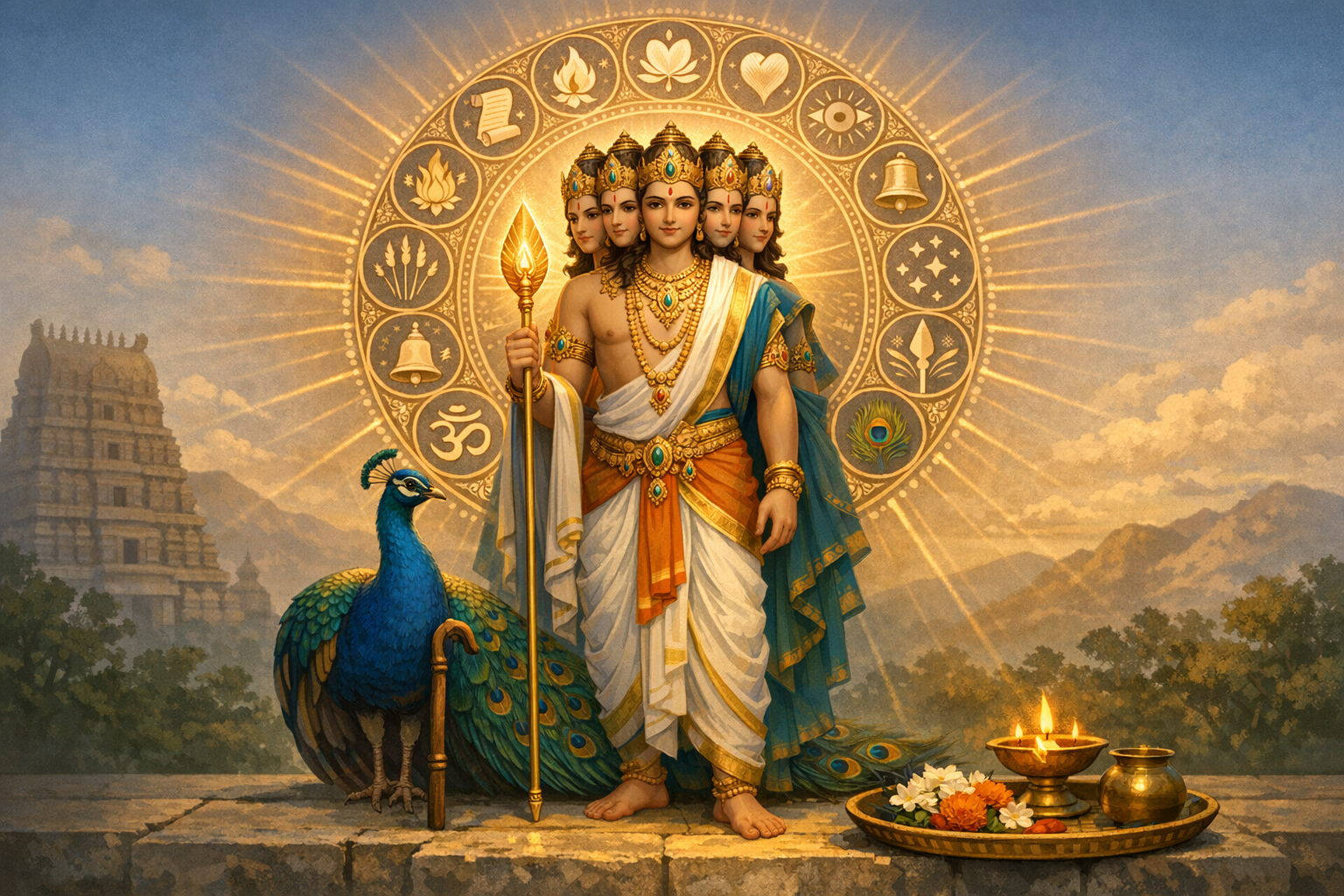
Within the Shaiva Agamic corpus, the Kumara Tantra occupies a distinctive place in articulating the theology, iconography, and liturgical practice of Lord Subrahmanya—also known across regions as Murugan, Skanda, Kartikeya, Kumara, and Swaminatha. The tradition presents a Shodasha-nama (sixteen-name) litany that functions as both a concise theology and a complete meditative map of the deity’s attributes—wisdom, youthful vitality, martial prowess, and compassionate guidance. These sixteen names are widely employed in archana, homa, and temple paddhatis across South Asia, particularly in Tamil Nadu and Karnataka, and resonate with the broader Shaiva Agamas as well as the Skanda Purana’s narrative universe.
Agamic manuals and temple traditions preserve more than one recension of Subrahmanya’s sixteen names; regional paddhatis at Palani (Dandayudhapani), Swamimalai (Swaminatha), Tiruttani, Thiruchendur, Pazhamudircholai, and at the Kukke Subramanya temple reflect local theological emphases while remaining aligned with shared Agamic principles. In practice, priests and householders often recite a conservative, pan-Indic sequence that harmonizes with stotra literature and the ritual grammar of Shaiva worship. The sequence below follows a mainstream liturgical pattern while indicating interpretive notes that appear in Agamic commentaries and temple usage.
The sixteen names are far more than honorifics; they frame a full sadhana. Each epithet implies a visualization, a mantra-syllabic mood (bhava), an ethical disposition (such as courage tempered by compassion), and a concrete ritual gesture (mudra, flower offering, or nyasa). In this way, Shodasha-nama archana condenses cosmology into devotion—an essential feature of the Shaiva Agamas—while remaining accessible to householders and monastics alike.
For many devotees, these names are lived realities: lighting a deepam during Skanda Sashti, taking kavadi during Thaipoosam, or meditating on the peacock vahana during Karthigai kindles a felt sense of protection, clarity, and disciplined joy. The Shodasha-nama sequence thus supports both temple-based yajna and intimate home worship, with a shared aspiration: inner victory over confusion (avidya) and outer service to dharma.
1) Subrahmanya — Commonly glossed as “the One who brings auspicious knowledge of Brahman” or “the propounder of sacred wisdom,” Subrahmanya places jnana at the heart of valor. In archana, Om Subrahmanyaya namah is often the seed from which the full litany unfolds. The name signals that martial energy (kshatra) must be guided by insight and ethics, a recurrent Agamic motif.
2) Skanda — Derived from the verbal root skand (to leap, to surge), Skanda evokes an outpouring of tejas and the courageous leap into righteous action. The Skanda Purana’s narrative cycles situate this epithet in the drama of restoring cosmic order without cruelty, aligning heroism with restraint and justice.
3) Kumara — “The Eternal Youth.” Kumara represents purity, possibility, and an ever-fresh resolve to pursue truth. In ritual psychology, this name restores beginner’s mind—vital for scholars, seekers, and leaders seeking clarity before complex decisions.
4) Guha — “The Hidden One,” the indwelling teacher who abides in the cave (guha) of the heart. Meditatively, Guha invites turning attention inward, recognizing that the ultimate commander of the senses is the witness within. Devotees often pair this name with quiet pranayama to sense subtle presence.
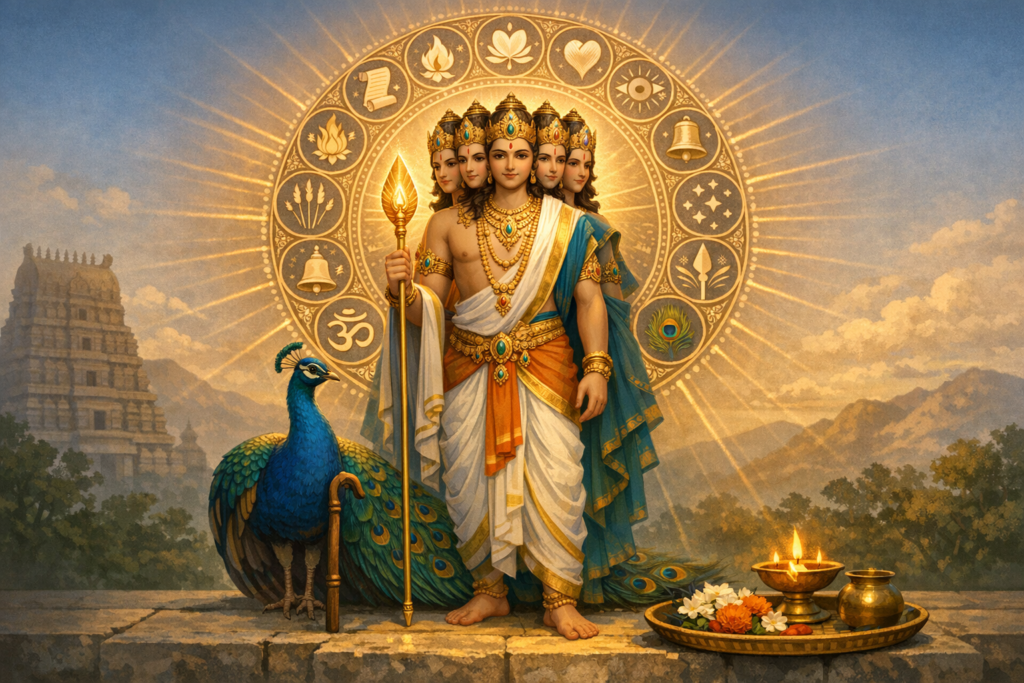
5) Shanmukha — “Six-faced,” indicating comprehensive awareness. Traditional exegesis links the six faces with complete vision of directions and with mastery over the six inner enemies (arishadvarga). In iconography, Shanmukha holds multiple weapons yet stands serene—an instruction to unite capacity with composure.
6) Shadanana — Another six-faced epithet, complementing Shanmukha with emphasis on knowledge rays (shad-anshu) that illumine diverse vidyas. In practice, priests may intone this name when offering sandal paste, aligning fragrance with the diffusion of wisdom.
7) Saravanabhava — “Born in the reed-bed (saravana),” recalling the birth narrative where divine sparks congeal into a compassionate leader. This name ritualizes remembrance: from subtle fire to embodied grace, the cosmic becomes personal. It is a favorite in Tamil liturgy and festival hymns.
8) Swaminatha — “Teacher of the Lord (Shiva),” centered at Swamimalai. The name asserts a paradox of Agamic theology: the son instructs the father in the meaning of Om, affirming that ultimate truth transcends hierarchy. In worship, it anchors humility: even the greatest must learn.
9) Devasenapati (Mahasena) — “Commander of the divine host,” where leadership is service. The liturgical mood turns strategic: protection of the vulnerable, restoration of order, and responsibility without triumphalism. This name is often linked with bell-ringing, signaling alert guardianship.
10) Kartikeya (Krittika-sunuh) — “Son of the Krittikas,” connecting Subrahmanya to stellar rites and the Vaikasi Visakam birth festival. The epithet binds heavens and earth, calendar and ethics, inviting devotees to align personal vows with the rhythms of the cosmos.
11) Vishakha (Visakam) — Commemorating the natal star. As an epithet, Vishakha encodes auspicious timing (muhurta) into identity. In temple praxis, archakas may accent this name during Vaikasi Visakam, guiding the community to synchronize sadhana with sacred time.
12) Velayudha (Shaktidhara) — “Bearer of the Vel (spear),” the power (shakti) that pierces ignorance. Devotees contemplate the Vel not as aggression, but as discerning intellect that cuts through confusion. Offerings to the Vel icon affirm disciplined energy directed toward compassion.
13) Tarakari (Tarakasura-samhari) — “Subduer of Tarakasura,” the conquest of chaos rather than of beings. Agamic hermeneutics treat Taraka as a cipher for inner disarray; this name focuses worship on self-mastery, ensuring that outer victories mirror inner ethics.
14) Mayuravahana — “He whose vahana is the peacock,” a symbol of beauty transmuting poison. The peacock’s iridescence becomes a meditation on resilience: adversity metabolized into wisdom. This epithet is prominent in temple processions and household iconography across South India.
15) Dandayudhapani — “Bearer of the staff,” linked especially to Palani. The staff signifies disciplined renunciation and guidance. In home worship, this name is often intoned to seek steadiness during transitions—study, career, family responsibilities, or vows.
16) Guruguha — “The guru who is Guha,” the indwelling preceptor. Celebrated in classical music and liturgy, this epithet fuses devotion with pedagogy; the Lord is simultaneously the intimate guide and the universal principle of teaching. It is an invitation to make life itself the classroom of dharma.
While presented discretely, these sixteen names form an integral mandala: Subrahmanya as teacher (Subrahmanya, Swaminatha, Guruguha), hero (Skanda, Devasenapati, Tarakari), contemplative presence (Guha), cosmic citizen (Kartikeya, Vishakha), and ethical force (Velayudha, Dandayudhapani), grounded in birth-myth and iconography (Saravanabhava, Shanmukha, Shadanana, Mayuravahana). Recited as a whole, they align knowledge, courage, and compassion—three pillars of Agamic spirituality.
Ritually, a simple home archana may proceed by lighting a lamp, offering water and flowers, and reciting the sixteen names with Om [Name]aya namah, allowing the mind to dwell on each epithet’s teaching. The practice harmonizes with temple observances such as Skanda Sashti, Thaipoosam, Vaikasi Visakam, and Karthigai, and supports vows like kavadi with an interior grammar: discipline without harshness, zeal without intolerance, and devotion without sectarianism.
Across the broader dharmic family, these values travel well. In Buddhist traditions of East and Southeast Asia, Skanda appears as a protector of the Dharma (for example, in forms cognate with Wei Tuo), exemplifying guardianship yoked to wisdom. In Jain and Sikh ethical horizons, the same triad—clarity, courage, compassion—remains central to righteous conduct. Celebrating Subrahmanya through the Shodasha-nama therefore nurtures a spirit of unity-in-diversity among Hindu, Buddhist, Jain, and Sikh communities, affirming shared commitments to truth and non-harm.
Temple geography reinforces the theological map. Swamimalai teaches humility, Palani disciplines will, Thiruchendur frames victory as service, and Kukke Subramanya embodies guardianship of nature and community well-being. Processions with the Vel, the peacock vahana, and the six-faced alankara instantiate the Shodasha-nama in motion, turning doctrine into lived culture.
Scholarly readers may note that Agamic and Puranic layers interpenetrate throughout the sequence. The Kumara Tantra gives the liturgical scaffolding; the Skanda Purana, the narrative backbone; regional stotras, the affective color. Variants in sequencing or diction found in paddhatis do not undermine coherence; rather, they attest to a living tradition that balances fidelity with contextual relevance.
In contemporary practice, these sixteen names offer a complete spiritual technology: a way to train attention, regulate emotion, align action with conscience, and serve society with steadiness. Whether intoned in a crowded festival or whispered in a quiet room, the Shodasha-nama of Subrahmanya invites a life where insight leads, strength follows, and kindness completes the work.
Inspired by this post on Hindu Blog.








Leave a Reply
You must be logged in to post a comment.