Tag: Dharma in Hinduism

  • Why NLSIU’s Dharma Motto Deserves Serious, Humane, and Scholarly Defense

    Why NLSIU’s Dharma Motto Deserves Serious, Humane, and Scholarly Defense

    This article examines the debate over NLSIU’s motto, “Dharma Rakshati Rakshataha,” in the context of public commentary following the tragic Twisha Sharma case. It argues that a criminal case involving serious allegations should be approached first with empathy, due process, and concern for justice rather than used to indict an entire civilizational concept. The discussion…

  • Own the Present: Hindu Dharma’s Powerful Path from Regret to Responsible Action

    Own the Present: Hindu Dharma’s Powerful Path from Regret to Responsible Action

    This article explores how Hindu Dharma transforms regret into responsible action through the living practice of present dharma. It explains that while past choices, inherited conditions, and social influences may partly shape a person, the present moment remains the true field of ethical freedom. The discussion clarifies karma as moral continuity rather than fatalistic punishment,…

  • Mumbai Hindu Rashtra Adhiveshan: Powerful Resolve for Dharma and Social Unity

    Mumbai Hindu Rashtra Adhiveshan: Powerful Resolve for Dharma and Social Unity

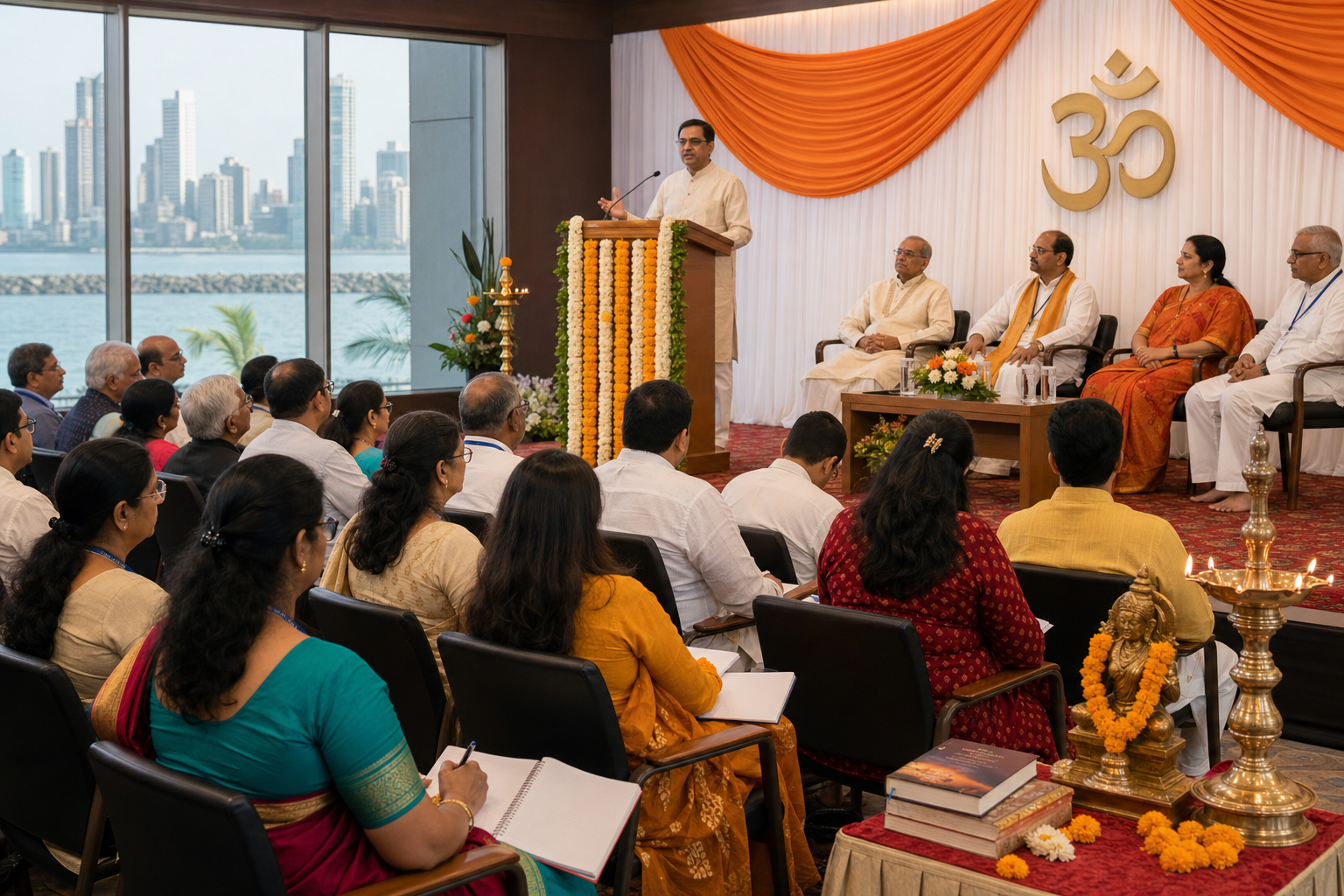
    The Mumbai Regional Hindu Rashtra Adhiveshan brought together more than 100 devout Hindus who resolved to work collectively for Hindu Rashtra, Dharma-rakshan, and Hindu interests. The gathering highlighted organisation, preparedness, and cultural responsibility as essential priorities for contemporary Hindu society. It also reflected the need to transform devotion into disciplined civic action rooted in Sanatan…

  • Dharma as the Powerful Key to an Integrated, Ethical and Meaningful Life

    Dharma as the Powerful Key to an Integrated, Ethical and Meaningful Life

    Dharma offers a comprehensive framework for living an integrated, ethical, and meaningful life. It connects personal conduct, social responsibility, spiritual discipline, and inner growth into one coherent path. Rather than treating life as a cycle of desires and necessities, Dharma sees human progress as a movement from ignorance to wisdom and from fragmentation to wholeness.…

  • ŚB 4.19.14–22 decoded: Pṛthu’s Aśvamedha, Indra’s Envy, and the Ethics of Dharma

    ŚB 4.19.14–22 decoded: Pṛthu’s Aśvamedha, Indra’s Envy, and the Ethics of Dharma

    Śrīmad-Bhāgavatam (ŚB) 4.19.14–22 examines how power and piety interact when public ritual becomes a theater for rivalry. Set during King Pṛthu’s aśvamedha-yajñas, these verses depict Indra weaponizing ascetic symbols to mask sabotage, thereby illustrating the danger of kūṭa-dharmacounterfeit religiosity. The passage distinguishes authentic renunciation from its costume, urging institutions to anchor trust in conduct, not…

  • Gorakhpur’s Hindu Rashtra Adhiveshan: 160+ Groups Unite for Dharmic Unity and Legal Safeguards

    Gorakhpur’s Hindu Rashtra Adhiveshan: 160+ Groups Unite for Dharmic Unity and Legal Safeguards

    Representatives from over 160 Hindu organisations met in Gorakhpur for the Hindu Rashtra Adhiveshan and agreed on a practical agenda: deepen Hindu unity across sampradāyas, expand temple-based outreach, and build lawful self-defence capacity. The analysis reframes contested terms into a rights-based, behaviour-specific, and religion-neutral policy blueprint aligned with India’s Constitution and Supreme Court precedent. It…

  • Decoding ŚB 4.19.13: Prithu’s Sacrifices, Indra’s Envy, and the Power of Dharmic Unity

    Decoding ŚB 4.19.13: Prithu’s Sacrifices, Indra’s Envy, and the Power of Dharmic Unity

    ŚB 4.19.13, discussed in a thoughtful NYC satsanga by HG Hansarupa das, anchors King Prithu’s sacrifices in the Srimad Bhagavatham as a model of ethical leadership and devotion-centered ritual. The verse sits within a chapter that warns against spiritual opportunism and reaffirms that yajña is meaningful only when guided by humility, integrity, and compassion. Framed…

  • Ayyappa as Indilayappan: Kerala’s Compassionate Guardian and the Ritual Science of Relief

    Ayyappa as Indilayappan: Kerala’s Compassionate Guardian and the Ritual Science of Relief

    Ayyappa as Indilayappan highlights Kerala’s living synthesis of devotion, ethics, and healing. The article explains how the name Indilayappan foregrounds Ayyappa’s role as remover of distress within the wider identity of Dharma Sastha and Hariharaputra. It traces historical currents that shaped the Sabarimala pilgrimage, unpacks key rituals such as vratham, Irumudi Kettu, neyyabhishekam, and Aravana…

  • Why We Suffer: Tiruvalluvar on Raga, Dvesha, Avidyaand a Dharmic Path Beyond Sorrow

    Why We Suffer: Tiruvalluvar on Raga, Dvesha, Avidyaand a Dharmic Path Beyond Sorrow

    Human suffering, Dharmic traditions teach, begins within. Tiruvalluvar’s Tirukkural aligns with a shared analysis across Hinduism, Buddhism, Jainism, and Sikhism: three inner blemishesraga (clinging likes), dvesha (aversive dislikes), and avidya (mis-knowing)distort perception and seed fresh sorrow. Read alongside Patanjali’s kleshas and the Bhagavad Gita’s cascade from attachment to downfall, the Kural’s ethics map a precise…

  • Kolhapur, Maharashtra: Sadguru Swati Khadye on Dharma-led safeguards against coercive grooming

    Kolhapur, Maharashtra: Sadguru Swati Khadye on Dharma-led safeguards against coercive grooming

    A special discourse in Kolhapur, Maharashtra examined coercive grooming risks in intimate relationships and outlined constructive, lawful responses that strengthen safety and unity. Centering Sadguru Swati Khadye’s emphasis on Dharma and Hindu culture as protective factors, the analysis reframes the discussion through an evidence-based, rights-respecting lens. It clarifies the difference between manipulation and genuine interfaith…

  • Devotion as Calling and Choice: A Transformative Cross-Dharmic Framework for Daily Sadhana

    Devotion as Calling and Choice: A Transformative Cross-Dharmic Framework for Daily Sadhana

    This article reframes devotion as both a calling and a deliberate, daily choice, drawing on the Bhagavad Gita, Yoga philosophy, and the living disciplines of Buddhism, Jainism, and Sikhism. It explains how steady abhyasa, supported by nairantarya abhyase, transforms fleeting inspiration into reliable sadhana. Readers gain a practical framework that integrates aspiration, repetition, and accountability,…

  • The Floating Chariot of Yudhishthira: Dharma’s Power, a Necessary Lie, and a Profound Fall

    The Floating Chariot of Yudhishthira: Dharma’s Power, a Necessary Lie, and a Profound Fall

    This essay revisits the Mahabharata’s striking image of Yudhishthira’s chariot floating four finger-breadths above the earthand its sudden descent when he consents to the Ashvatthāma stratagem. It analyzes the episode through the lenses of rajadharma, kshatra-dharma, and apaddharma to show how Dharma in Hinduism balances deontological truth with harm-minimizing prudence. The discussion incorporates cross-traditional insights…

  • Decoding King Shibi’s Paradox: When Compassion Transcends Nature and Defines Dharma

    Decoding King Shibi’s Paradox: When Compassion Transcends Nature and Defines Dharma

    The Shibi episode from the Mahabharatamirrored in the Śibi Jātakalooks paradoxical if read as ecology, but it is rigorous when read as Dharma. The dove’s refuge and the eagle’s hunger dramatize a conflict between necessity and obligation, which King Shibi resolves by internalizing the cost of compassion. Hindu, Buddhist, Jain, and Sikh frameworks converge hererājadharma…

  • Dharma Decoded: The Profound Mimamsa–Vaisheshika Map of Duty, Ritual Power, and Liberation

    Dharma Decoded: The Profound Mimamsa–Vaisheshika Map of Duty, Ritual Power, and Liberation

    This in-depth exploration clarifies how Mimamsa and Vaisheshikatwo classical Hindu darshanasdefine and operationalize dharma in distinct yet complementary ways. Mimamsa establishes the scriptural authority and hermeneutics of duty, introducing apūrva as the unseen link between rite and result. Vaisheshika supplies the ontological grammar and moral causality through adṛṣṭa, defining dharma as the cause of both…

  • Why Hegemony Persists: A Dharmic Guide to Ethical Power, Rajadharma, and Pluralism

    Why Hegemony Persists: A Dharmic Guide to Ethical Power, Rajadharma, and Pluralism

    Hegemony persists because human societies require coordination, security, and shared meaning; the Dharmic lens accepts this reality and seeks to civilize it. Drawing on Rajadharma, the Bhagavad Gita, and Kautilya’s Arthasastra, the article reframes power as service bounded by Dharma and directed toward Lokasangraha (social cohesion). It integrates Buddhist Dhamma-raja ideals, Jain Anekantavada and Ahimsa,…

  • When Outsiders Rule a Marriage: Manthara–Kaikeyi’s Lesson on Counsel, Dharma, and Power

    When Outsiders Rule a Marriage: Manthara–Kaikeyi’s Lesson on Counsel, Dharma, and Power

    The Manthara–Kaikeyi episode in the Ramayana is a rigorous case study in the dangers of third-party influence over marital decisions. Through the lenses of dharma, psychology, and governance, it shows how secrecy, urgency, and divisive counsel can derail household harmony and public order. The analysis identifies red flags of manipulative advice and green flags of…

  • Resolute Mind, Unstoppable Path: Dharmic Science of Determination from Gita to Guru Granth

    Resolute Mind, Unstoppable Path: Dharmic Science of Determination from Gita to Guru Granth

    This essay examines the dharmic science of determination across Hinduism, Buddhism, Jainism, and Sikhism, showing how unwavering resolve yields reliable results when aligned with ethics and sustained practice. It grounds the teaching in the Bhagavad Gita’s vyavasāyātmikā buddhi, the Yoga Sutras’ abhyāsa–vairāgya, Buddhism’s adhiṭṭhāna pāramī, Jainism’s vīrya and Anekantavada, and Sikhism’s Chardi Kala and sevā.…

  • Lead with Devotion, Live Unattached: Dhruva Maharaja’s Lessons in Bhagavatam 4.12 (10–16)

    Lead with Devotion, Live Unattached: Dhruva Maharaja’s Lessons in Bhagavatam 4.12 (10–16)

    Bhagavatam 4.12 (10–16) presents Dhruva Maharaja as a saint-king who unites devotion with rāja-dharma, demonstrating how to lead decisively while remaining inwardly detached. The passage operationalizes the Bhagavad-Gita’s counsel to act and remember simultaneously, turning smaraṇaṁ into a discipline that purifies action at its source. Readers gain a practical, stepwise protocolestablish attention with śravaṇa-kīrtana, return…

  • Beyond the Hype: Dharma’s Clear‑Eyed Guide to the Illusion of Permanent Followers

    Beyond the Hype: Dharma’s Clear‑Eyed Guide to the Illusion of Permanent Followers

    Chasing fans and followers often masks an unexamined attachment to impermanent signals of worth. This essay reframes that chase through a dharmic lensHindu, Buddhist, Jain, and Sikhshowing why audiences are structurally volatile and why identity need not be. It draws on the Bhagavad Gita’s Karma Yoga, Buddhism’s anicca and anattā, Jainism’s Anekantavada and aparigraha, and…

  • Mahabharata Wisdom on the True Gift: Markandeya’s Guide to Nishkama Dāna and Seva

    Mahabharata Wisdom on the True Gift: Markandeya’s Guide to Nishkama Dāna and Seva

    This long-form exploration distills Sage Markandeya’s Mahabharata teaching on the nature of the true gift (dāna) and explains why intention, not magnitude, confers ethical value. It maps dāna to the Bhagavad-Gita’s guṇa framework, clarifying the difference between sāttvika, rājasa, and tāmasa giving. Through the exemplar of King Śibi, it highlights abhayadāna (the gift of fearlessness)…