
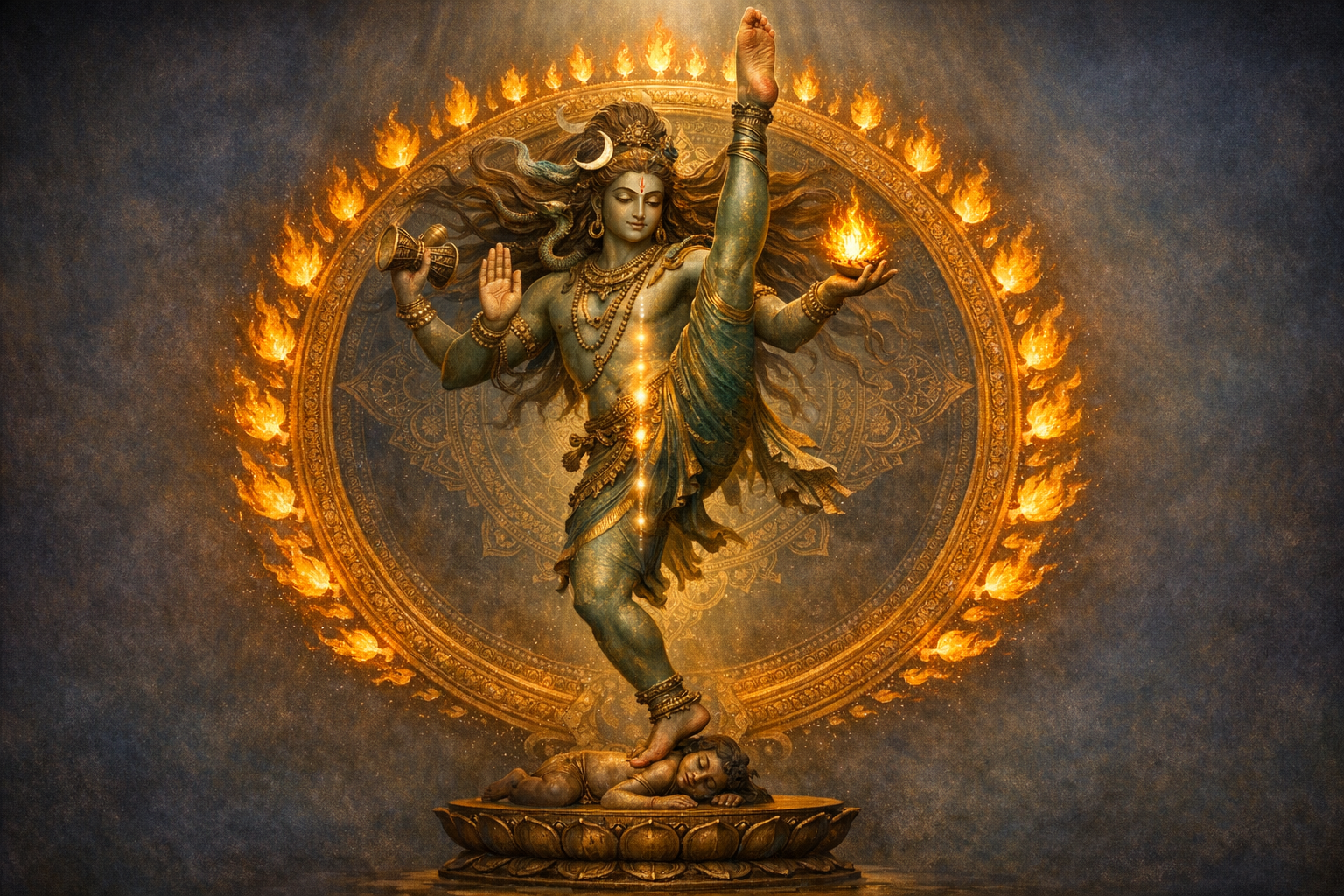
Urdhva Tandava—often translated as the Supreme Ascending Dance of Shiva—stands among the most evocative expressions of Nataraja’s cosmic movement. It conveys mastery over ego and ignorance while directing consciousness upward toward liberation. As a visual theology and a kinetic philosophy, this form integrates metaphysics, aesthetics, and sadhana into a single, ascending current of grace.
Etymologically, urdhva means upward or raised, while tandava denotes Shiva’s dynamic, forceful dance. Read together, Urdhva Tandava articulates the vertical surge of awareness that transcends inertia (tamas), restlessness (rajas), and the bindings of ahamkara. It is frequently discussed in Shaiva traditions alongside Ananda Tandava, the blissful dance, to emphasize that ascent and bliss are not separate, but two interlocking dimensions of the same awakening.
Within Shaiva Siddhanta and related Agamic streams, Nataraja’s choreography embodies the five cosmic acts (panchakritya): srishti (emanation), sthiti (sustenance), samhara (withdrawal), tirobhava (veiling), and anugraha (grace). Urdhva Tandava is especially associated with anugraha, where the divine initiative lifts the jiva above limiting tendencies, reorienting life upward (urdhva-gamana) toward freedom.
Classical lore situates Urdhva Tandava within the sacred landscape of Chidambaram. In several South Indian narrative traditions, Shiva performs an urdhva leg-raise in a dance encounter historically associated with Kali—an episode best read not as a triumph over Shakti but as an allegory for transcending duality. Here, Shiva and Kali are complementary principles; their interplay dramatizes the union of consciousness (Shiva) and energy (Shakti), and the urdhva gesture signifies the ascent beyond egoic contest into non-dual harmony.
Iconographically, Urdhva Tandava presents Shiva with one foot firmly anchored upon Apasmara (the dwarf of forgetfulness/ignorance), while the other leg is lifted high in a vertical arc. The torso often exhibits a graceful tribhanga curve, and the flying jatas (matted locks) extend outward to indicate unfettered cosmic vitality. The visage is serene, affirming composure amid vigorous motion.
The attributes vary by regional silpa traditions, yet a consistent grammar appears. The damaru in one hand symbolizes the primal spanda (vibration) that births and measures time; agni in another represents transformative dissolution. Additional hands may hold the trishula, a deer (symbolic of the restless mind), or other Shaiva emblems. Gesture (hasta) vocabulary commonly includes abhaya (fearlessness), and a pointing or sweeping indication toward the lifted foot, directing the devotee’s gaze to the path of ascent.
In some images, the circle of flames (prabhamandala) encircles the dance as the fiery cycle of samsara transmuted by wisdom. The crushed Apasmara (also called Muyalaka in Tamil sources) indicates conquered inadvertence and spiritual amnesia, not the destruction of life but the subduing of ignorance. The crescent moon, the descent of Ganga, and serpents woven into the locks convey time, purification, and awakened energy flowing through consciousness.
The symbolism of Urdhva Tandava is internally coherent and profoundly integrative. The raised leg signifies the liberating ascent; the grounded foot upon Apasmara marks the stabilizing of awareness beyond forgetfulness; damaru and agni express creation and dissolution as two halves of a single beat; and the radiant circle encodes cyclicality consumed and clarified by insight. The overall composition functions as a mandala that teaches at a glance what texts elaborate in chapters.
Yogically, Urdhva Tandava can be read as an allegory of kundalini rising through the sushumna nadi. The upward gesture corresponds to sublimation of prana (sometimes expressed as urdhva-retas), the refinement of attention through dharana and dhyana, and the harmonization of the chakras from muladhara toward sahasrara. In this frame, the dance becomes embodied sadhana: an instructional diagram for inner alchemy rather than an external spectacle alone.
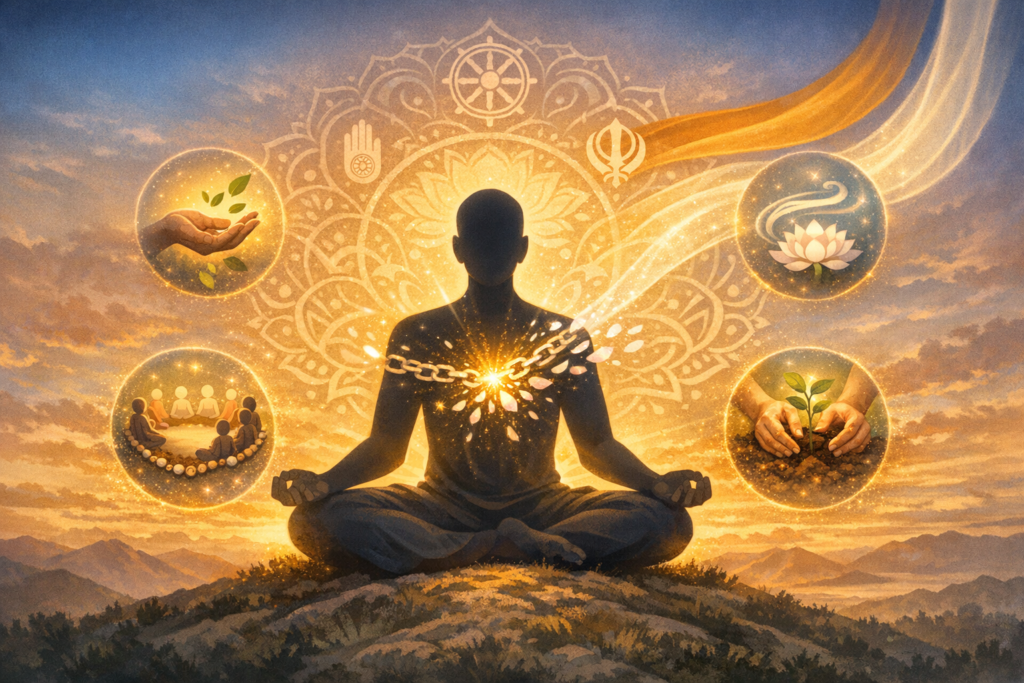
Beyond Hindu streams, the dance’s core insight—the overcoming of egoic contraction—resonates across Dharmic traditions. The subduing of Apasmara mirrors the Buddhist critique of clinging and ignorance, aligns with Jain emphasis on self-restraint (aparigraha) and right knowledge, and parallels the Sikh challenge to haumai (ego). Interpreted in this inclusive light, Urdhva Tandava celebrates unity-in-diversity across Hinduism, Buddhism, Jainism, and Sikhism by affirming a shared destination: freedom from narrowing self-identity toward compassionate wisdom.
In Indian performing arts, especially Bharatanatyam, the Natyashastra’s 108 karanas provide the grammar that underlies Shiva’s dance iconography. Urdhva-oriented karanas and adavu sequences echo the upward vector of the form. When a dancer lifts the leg with balance and grace, controlling breath and drishti, the physical vocabulary serves as sadhana, translating metaphysical ascent into lived kinaesthetic experience.
Art-historically, the Chola bronzes of Tamilakam offer celebrated renderings of Nataraja and related nrtta-murtis, including Urdhva Tandava. Chidambaram, Thanjavur, Kumbakonam, and other centers preserve stone and metal images where variations in hand positions, attributes, and the angle of the lifted leg attest to distinct silpa traditions. These works communicate theology through proportion, rhythm (tala), and dynamic balance captured in metal and stone.
Ritually, the experience of Urdhva Tandava is intensified during Arudra Darshan (Tiruvathirai) when Shiva’s cosmic dance is venerated across South India. Alankaras may emphasize the lifted leg and the pointing hand of grace, while mantra recitation, deepa, and abhishekam reinforce the doctrine that grace both descends and lifts upward. The temple experience—sound of bells, damaru-like percussion, and the fragrance of vibhuti—immerses the senses in the dance’s teaching.
Many devotees and practitioners report that a first encounter with an Urdhva Tandava murti can be unexpectedly moving: the poised serenity of Shiva’s face amidst the intensity of motion invites a felt recognition that inner stillness and outer action need not oppose each other. In daily life, this often translates into a renewed capacity to respond (not react), to lift attention when circumstances press downward, and to embody composure while engaging the world.
As contemplative practice, meditating on Urdhva Tandava may include visualizing the lifted foot as the invitation to rise above habitual patterns, aligning breath with the imagined beat of the damaru, and allowing inner heat (tapas) to refine intention like agni purifies metal. Simple japa of Om Namah Shivaya, steady posture, and relaxed focus on the heart region (anahata) can anchor the contemplative arc in accessible daily routines.
Read as philosophy, art, and practice, Urdhva Tandava integrates cosmos and consciousness, ritual and ethics, aesthetics and liberation. It teaches that ascent is not escape but transformation: ignorance is steadied, energy is refined, and vision is lifted. In honoring this form, communities across the Dharmic family affirm a shared aspiration—to rise together toward clarity, compassion, and fearless joy.
Inspired by this post on Hindu Blog.


Leave a Reply
You must be logged in to post a comment.