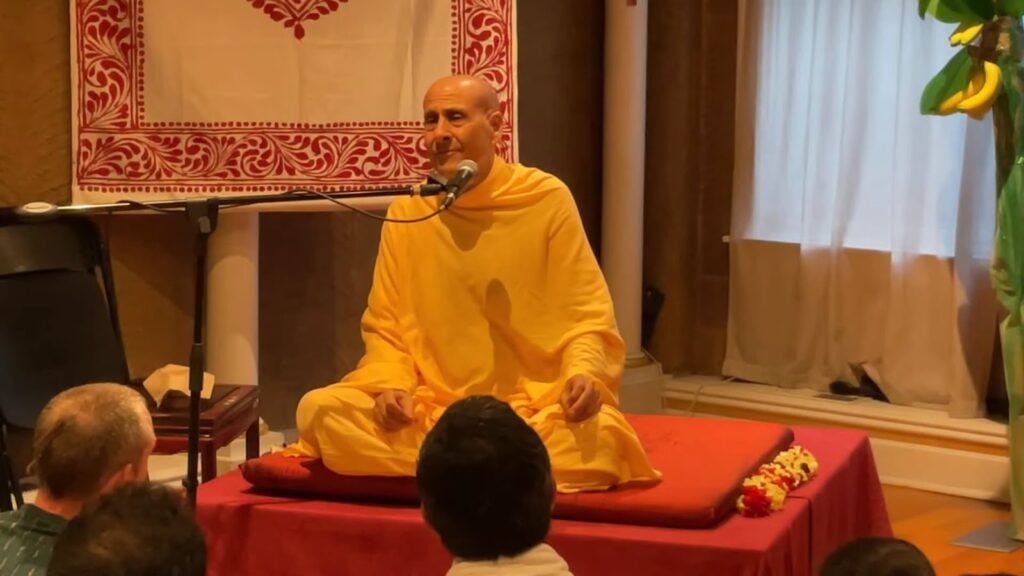
Her Grace Daivi Shakti Mataji’s exposition on SB-11.02.23-26 (10-05-2026) illuminates a pivotal passage of the Bhagavata Purana that concisely describes how devotion matures from inner sentiment to observable character. Situated in Canto 11, Chapter 2within the celebrated Nimi–Nava-yogendra dialoguethese verses serve as an exacting guide to the lived ethics, psychology, and social implications of bhakti in the Hindu philosophy tradition.
Textually, Canto 11 integrates theology and practice with unusual density. The dialogue form between King Nimi and the nine Yogendras presents layered answers that move from metaphysical premises to practical sādhanā. Verses 23–26 function as a compact primer on sādhu-lakṣaṇa (hallmarks of saintliness), showing how devotion to Bhagavan becomes verifiable through qualities that transform conduct, relationships, and social responsibility.
Read as a thematic cluster, the verses delineate a progression: devotion refines affect, affect stabilizes conduct, and conduct reinforces realization. Compassion unaccompanied by self-restraint remains fragile; restraint without compassion risks aridity. By yoking inner devotion with outward virtuesequanimity, kindness, truthfulness, forbearance, non-injury, and simplicitythe text sets a standard whereby bhakti is authenticated not by mere ritual performance but by steady, prosocial change.
This segment of Chapter 2 anticipates a broader triad classically associated with the Bhagavata Purana: bhakti (devotion), pareśānubhava (realization of the Supreme), and vairāgya (detachment). While articulated elsewhere in the chapter with unmistakable clarity, the logic already operates here: devotion flowers into direct spiritual experience, and that experience naturally loosens binding attachments. The synergy offers a rigorous, testable framework for self-assessment without recourse to sectarian gatekeeping.
Commentarial traditionsŚrīdhara Svāmī, Jīva Gosvāmī, and Viśvanātha Cakravartī among otherstreat these qualities not as optional ideals but as emergent properties of genuine sādhana. The verses also prefigure the well-known taxonomy of aspirants in this chapter, where the maturing practitioner learns to balance reverence for the Divine with friendship toward devotees, mercy toward the spiritually unacquainted, and principled non-engagement with entrenched hostility. In this way, individual transformation is inseparable from communal ethics.
For many practitioners, the practical arc is recognizable. Early enthusiasm often brings alternating surges of zeal and doubt; with disciplined śravaṇa (hearing), kīrtana (chanting), and smaraṇa (remembrance), the affective life steadies. Over time, reactive anger gives way to forbearance (titikṣā), suspicion yields to trust tempered by discernment (viveka), and acquisitive impulses soften into generosity (dāna and sevā). The consistency of these shiftsacross settings and stressorsbecomes an empirical index of devotional depth.
SB 11.02.23–26 also scales naturally into a dharmic social vision. The qualities it extols reduce interpersonal friction, curb factionalism, and foster solidarity. In the Bhagavata Purana’s idiom, private piety matures into public responsibility: compassionate speech, ethical livelihood, hospitality, and protection of the vulnerable. Such traits constitute the lived “Hindu way of life,” in which spiritual advancement is measured by the well-being it radiates to family, community, and the broader ecosystem.
Strikingly, the virtues mapped in these verses resonate across the broader family of dharmic traditions. Buddhism’s Brahmavihāras (mettā, karuṇā, muditā, upekkhā), Jainism’s ahiṁsā and anukampā framed by anekāntavāda, and Sikhism’s sevā and nām-simran converge with the Bhagavata’s emphasis on compassion, restraint, and service. Read in this intertextual light, SB 11.02.23–26 becomes a charter for unity in spiritual diversity rather than a boundary marker of exclusion.
Practice recommendations align with the classical ninefold bhakti program celebrated in the traditionśravaṇa, kīrtana, smaraṇa, pāda-sevana, arcana, vandana, dāsya, sakhya, and ātma-nivedanawhile acknowledging that different temperaments emphasize different limbs. A householder might cultivate hospitality and truth in commerce; a monastic might stress contemplation and simplicity; a civic leader might translate forbearance and fearlessness into just governance. The verses endorse plurality of method while preserving unity of telos.
From a philosophical perspective, the passage offers a coherent soteriology: it reframes liberation as relational flourishingloving alignment with the Divine (īśvara), ethical care for beings (sarva-bhūta), and freedom from compulsions that fracture attention and community. The text’s axiological claim is clear: what is spiritually true must be ethically beautiful and socially good.
Contemporary research in moral psychology and contemplative science incidentally echoes these insights. Repetitive sacred sound and breath-regulated practices support attentional stability and emotional regulation; compassion training correlates with prosocial behavior and reduced aggression. While the Bhagavata Purana does not rely on laboratory validation, its integrated modelcognition, affect, conduct, and communityremains methodologically robust and practically verifiable.
For application, a simple periodic audit derived from SB 11.02.23–26 proves useful: Is compassion widening beyond one’s circle of affinity. Is restraint present when provoked. Is truthfulness consistent under cost. Is service undertaken without expectation of reciprocation. Is sectarian antagonism giving way to respectful dialogue. Such diagnostics keep devotion accountable to outcomes the text explicitly valorizes.
Her Grace Daivi Shakti Mataji’s presentation underscores that these verses are not merely descriptive; they are prescriptive, inviting embodied practice that heals estrangementfrom the Divine, from others, and from one’s better self. By drawing out their convergences with Buddhism, Jainism, and Sikhism, the exposition honors the blog’s guiding objective: to strengthen unity among dharmic traditions through shared virtues and mutually intelligible practices. In this spirit, SB 11.02.23–26 stands as a luminous guide for cultivating bhakti that is experientially deep, ethically exacting, and socially unifying.
Inspired by this post on Dandavats.