
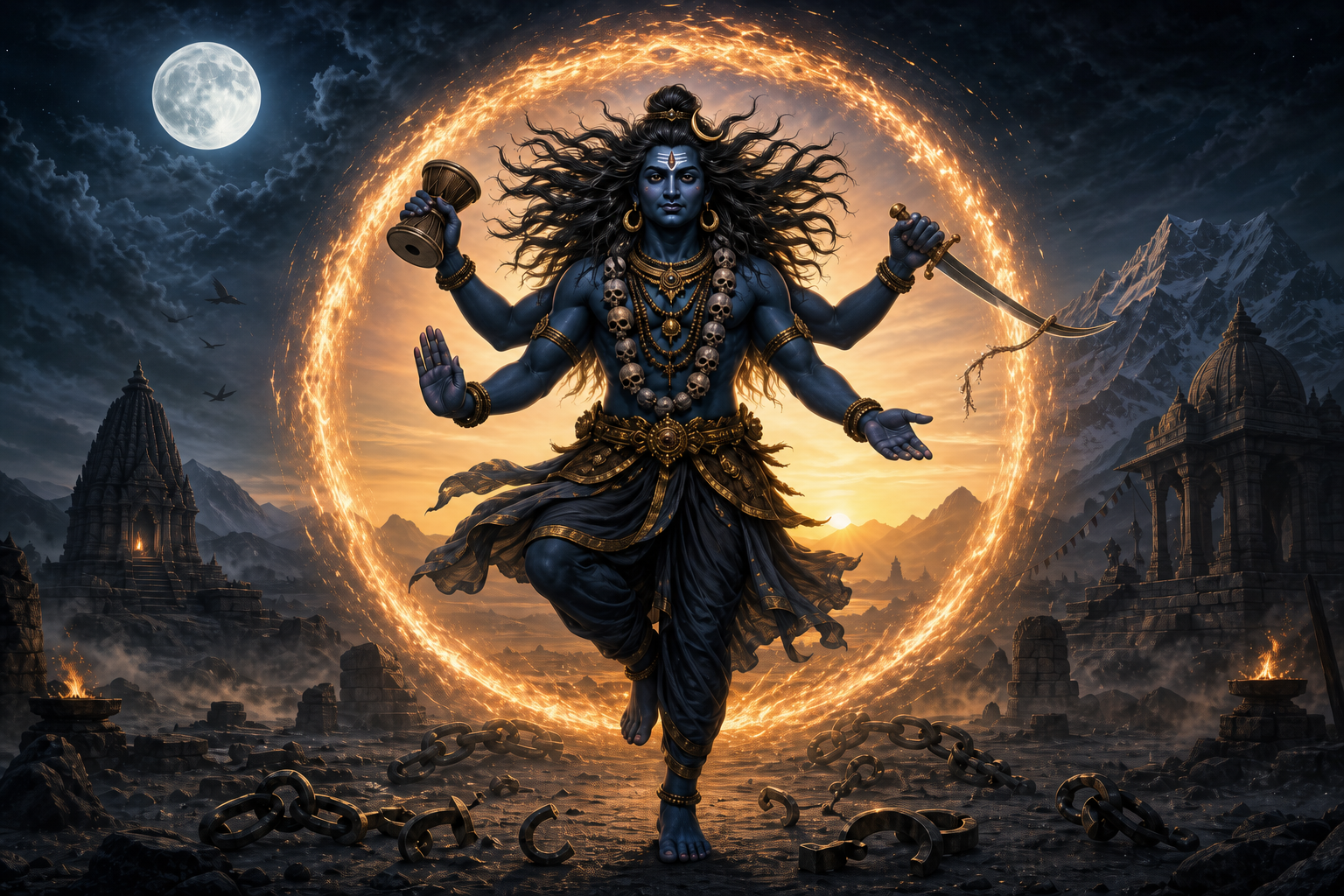
You may have encountered Unmatta Bhairava as a disturbing name or fierce image and wondered whether Damara Tantra celebrates madness, anger, or ritual transgression. You won’t understand it by softening those features. You have to ask what they are meant to transform.
The practical task is to separate four things that are often collapsed: the visible image, the ritual function, the inner pattern being confronted, and the ethical result. Once you make those distinctions, Bhairava’s fierceness stops looking like aggression dressed as spirituality and becomes a disciplined test of how you meet fear, anger, impermanence, and attachment.
Read Unmatta as freedom from constraint, not loss of control
Within Damara Tantra, Shiva appears as Unmatta Bhairava and instructs Parvati as Unmatta Bhairavi. The setting matters. This is an intimate transmission of knowledge, not a spectacle of divine rage.
Unmatta is often glossed as ecstatic or beyond ordinary mental constraint. That does not mean irrational, intoxicated by impulse, or exempt from discernment. It points toward awareness no longer confined by the mind’s habitual divisions. Reason is not discarded; it is refined until it can recognize the assumptions that keep experience fragmented.
This gives you a precise question to bring to every fierce image: Which limiting division is being exposed here? The relevant oppositions include pure and impure, self and other, fear and fearlessness. In a Vamachara setting, unconventional symbols can unsettle these divisions, but disturbance is a method rather than the goal.
Use the ethical result as your first interpretive safeguard. A reading that produces theatrical taboo-breaking, contempt for others, uncontrolled anger, or spiritual superiority has mistaken deconditioning for permission. Fierce wisdom should make conduct clearer and less reactive. If it merely makes the practitioner feel exceptional, something essential has been missed.
Let the six-part architecture slow down your interpretation

Before interpreting an isolated verse or image, establish where it sits. Readers encounter a Mangalacharana, six paricchedas, and a mapping of eight Unmatta Bhairavas. That architecture tells you not to treat the most dramatic fragment as a self-contained command.
The Mangalacharana is more than a formal ornament. An auspicious opening aligns study with clarity, steadiness, and compassionate conduct. It establishes the direction in which later material should be read. If an interpretation contradicts that orientation, return to the beginning and test it again.
The six divisions also imply sequence and context. You can use the following questions as a study map without pretending they reproduce an exact chapter-by-chapter table of contents:
- What first principle or spiritual problem is being established?
- Which divine function is being represented, and what does that function do?
- How do visualization, concentrated recitation, or contemplative stillness organize attention?
- What is being protected, dissolved, or redirected?
- What change in perception is expected?
- What kind of conduct would demonstrate that the change is genuine?
This method prevents a common mistake: extracting a ritual element while ignoring the metaphysical and ethical frame that gives it meaning. Orientation, practice, dissolution, and realization belong to one arc. They should not be treated as independent techniques.
Edition awareness is equally important. Sanskrit transmission, regional paraphrases, interpretive glosses, and recensional variation can change how a term or instruction is understood. When you study a passage, record the edition and language in front of you, distinguish the base wording from commentary, and mark where a translation has made an interpretive choice. If variant wording would change a practice instruction, do not improvise a resolution.
Use the named Bhairavas as maps of transformation
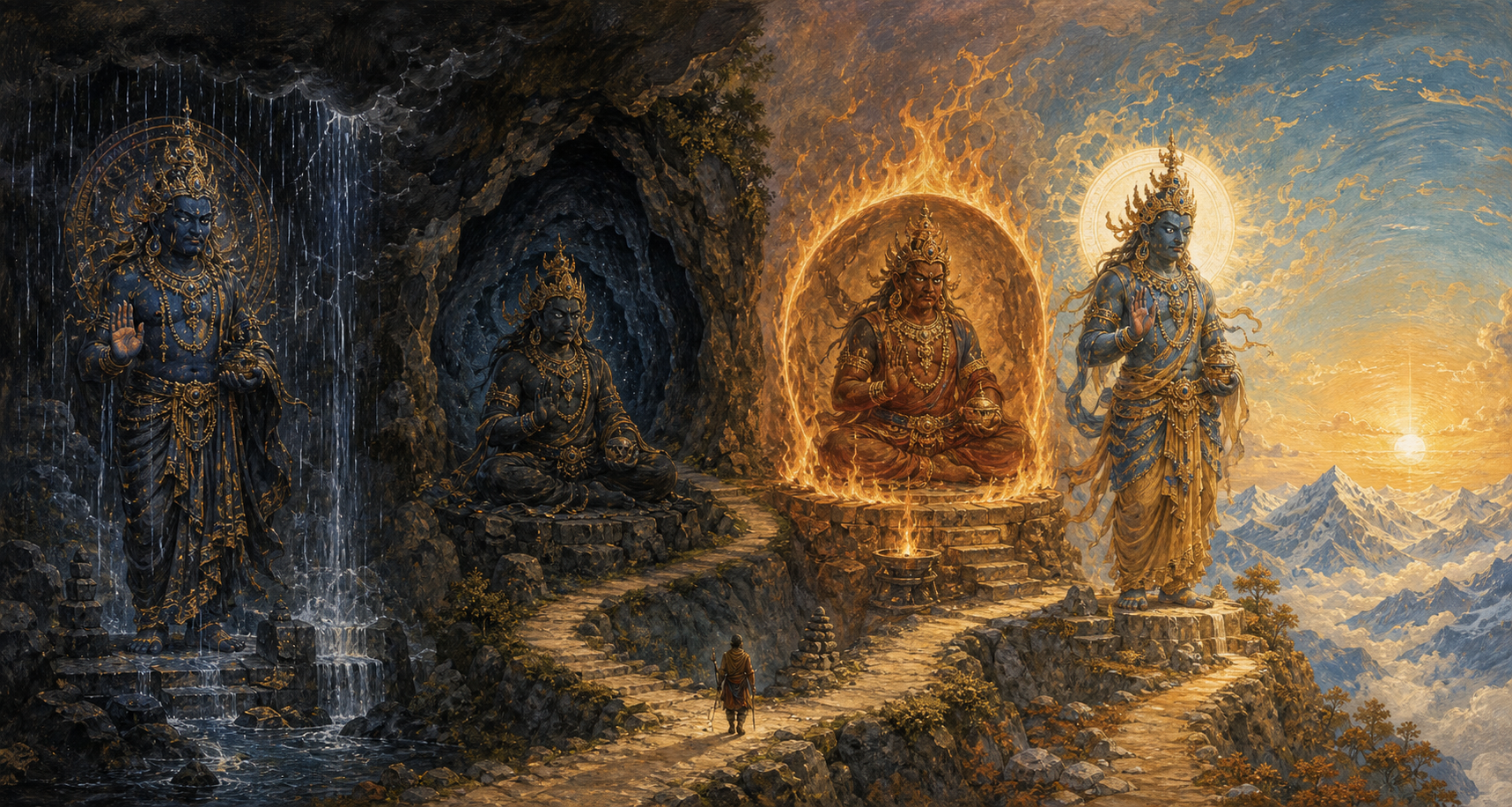
The eight Unmatta Bhairavas are best approached as a taxonomy of transformative functions. Three named forms make the method especially clear: Kapali Bhairava, Samhara Bhairava, and Krodha Bhairava. Each takes an experience that ordinarily binds the mind and turns it into a field of insight.
| Form | Transformative function | What you should notice | Misreading to avoid |
|---|---|---|---|
| Kapali Bhairava | Radical insight into impermanence and the removal of false identity | Which identity are you treating as permanent, sufficient, or ultimately yours? | Reducing the skull-bearing form to morbidity or visual shock |
| Samhara Bhairava | Recognition of dissolution, cyclic becoming, and release from clinging | What are you trying to preserve after its conditions have already changed? | Confusing dissolution with nihilism or indiscriminate destruction |
| Krodha Bhairava | Redirection of anger’s distorted vitality into lucid courage and protective compassion | Can force remain available after blame, blindness, and the urge to injure are removed? | Treating sacred wrath as permission for personal rage |
Kapali asks you to see what cannot be secured by identity. Samhara asks whether clinging is being mistaken for fidelity. Krodha asks whether anger can surrender its confusion without surrendering its energy. These are practical contemplative questions, not invitations to imitate a deity’s outward appearance.
Krodha provides the clearest ethical test. Feeling forceful is not evidence of transformation. Look instead for less blindness, more precision, and a stronger capacity to protect without hatred. Protective compassion is not passive, but neither does it use sacred language to conceal retaliation.
The full scheme contains eight forms, while these three establish only part of the map. When an excerpt does not identify the remaining forms or their functions, leave the gap open. Verify the relevant Sanskrit, edition, and lineage explanation rather than assigning meanings from generic Bhairava symbolism.
Apply a four-layer reading to every fierce passage

A single-level reading creates predictable errors. Literalism turns wrathful imagery into horror or aggression. Pure psychologizing erases ritual and theological meaning. Abstract non-dual language can become a way to avoid the actual fear or anger that the image exposes. A four-layer method keeps the dimensions connected without confusing them.
- Literal layer: Record what is actually present. Identify the named form, action, emblem, speaker, and setting before explaining any of them. This keeps later interpretation anchored.
- Ritual layer: Ask how visualization, recitation, or contemplative stillness directs attention. At this stage, determine the function of the practice rather than assuming that reading an instruction authorizes you to perform it.
- Contemplative layer: Name the reactive pattern under examination. Is the passage confronting fear, clinging, false identity, anger, or a rigid pure-impure division? Then identify what a less reactive response would look like in conduct.
- Non-dual layer: Ask how the passage loosens the apparent separation between the one who fears and the feared object, or between awareness and the experience appearing within it. Do not use this layer to deny ordinary ethical distinctions.
After working through the four layers, test the result in three ways:
- Textual test: Does the interpretation fit the actual wording and its place in the larger sequence?
- Ethical test: Does it remain compatible with ahimsa, satya, self-discipline, and responsibility?
- Transformative test: Does it reduce fear-driven reaction, clinging, or delusion, or does it merely give those patterns a sacred vocabulary?
Comparisons with other Dharmic traditions can clarify this method if you preserve doctrinal boundaries. Vajrayana Buddhism can employ fierce imagery for compassionate, obstacle-clearing wisdom; Jain traditions honor protective yaksha-yakshi figures within an ethic of non-harm; and Sikh teachings join fearlessness to just conduct. These are resonances, not proof that the deities, doctrines, or ritual systems are interchangeable.
Key takeaways for responsible study and practice

- Unmatta points beyond constricted mental categories; it does not authorize irrational or uncontrolled behavior.
- Bhairava’s fierce appearance is a method for confronting fear and ignorance, not a model for aggression.
- The Mangalacharana, six paricchedas, and eightfold Bhairava scheme supply context that an isolated image cannot provide.
- Kapali, Samhara, and Krodha represent distinct transformations involving impermanence, dissolution, and anger.
- Every interpretation should be checked at literal, ritual, contemplative, and non-dual levels.
- Ahimsa, satya, self-discipline, humility, and compassionate conduct are tests of realization, not optional additions to it.
Your next reading session
Take one passage or one Bhairava form and make four notes: what is depicted, what function it performs, which reactive pattern it exposes, and what ethical change should follow. Keep explicit wording separate from your interpretation. This takes only one page, but it will show you where understanding is grounded and where you are filling a gap with assumption.
If a passage moves from contemplation into an esoteric ritual instruction, pause there. Seek guidance from someone who can identify the Sanskrit wording, the edition or recension, the lineage context, and the ethical boundaries of the practice. Curiosity is enough for careful study; it is not, by itself, ritual authorization.
Begin with Kapali, Samhara, or Krodha and follow one question into daily conduct. Notice the identity you defend, the ending you resist, or the anger you mistake for clarity. Bhairava’s fierceness becomes useful when it leaves you less governed by that reaction and more capable of courage without cruelty.