
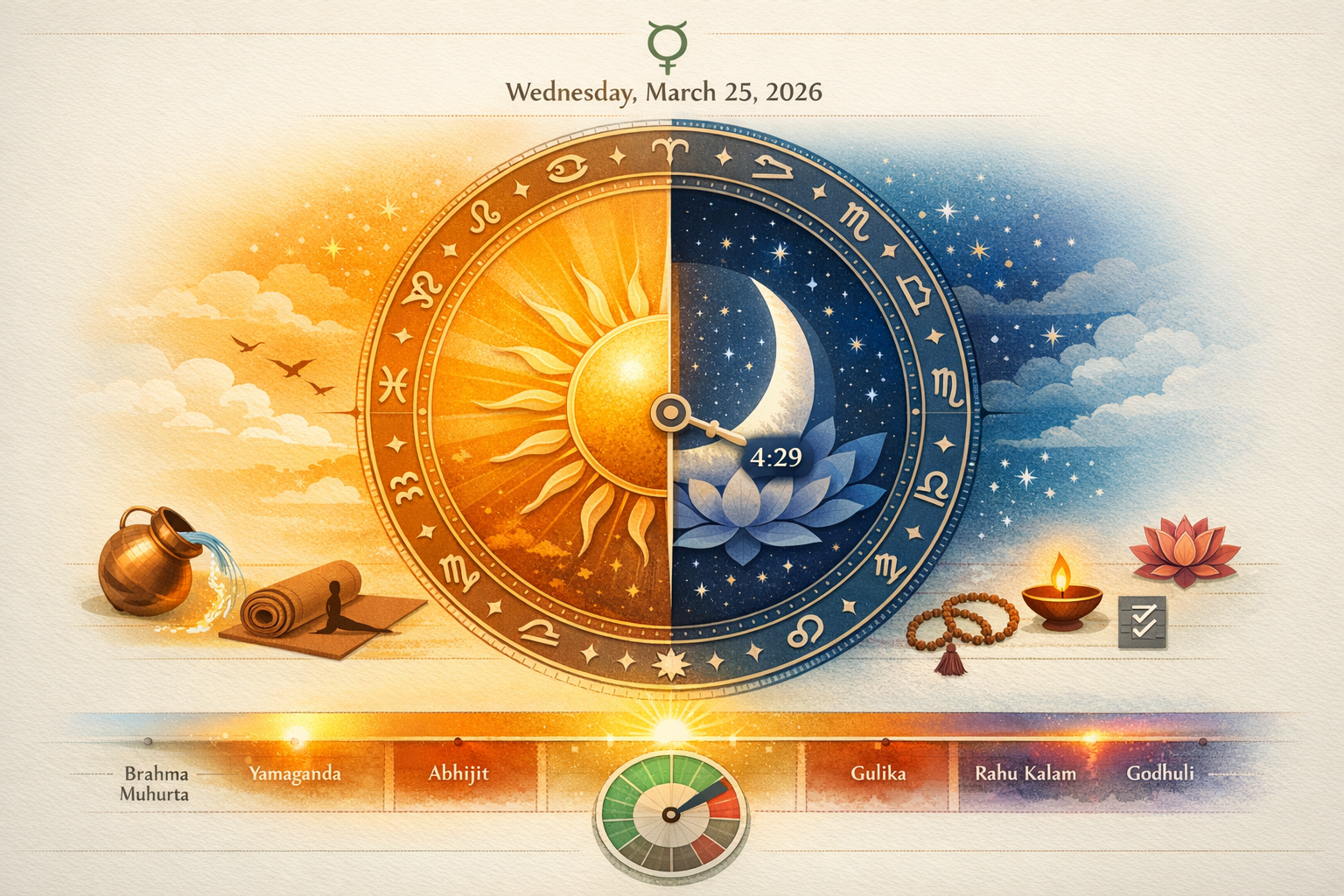
Wednesday, March 25, 2026, in the Hindu calendar (Panchang) observes Shukla Paksha Saptamithe seventh lunar day of the waxing phaseuntil 4:29 PM in most regions. From 4:29 PM onward, Shukla Paksha Ashtami begins, continuing the bright fortnight. As a Budhavara (Wednesday), the day is traditionally associated with Budha (Mercury), emphasizing clarity in learning, communication, accounts, and practical organization.
In Panchang computation, a tithi is defined by the angular distance between the Moon and the Sun. Each tithi spans a 12-degree advancement of the Moon relative to the Sun. Thus, Saptami corresponds to a solar–lunar elongation of 72°–84°, and Ashtami to 84°–96°. Because the Moon’s apparent motion varies, tithi boundaries rarely align with civil midnight and instead can terminate at any clock timehence the observed transition at 4:29 PM on this date.
Technical convention matters for observance: many day-based rituals adopt the tithi present at sunrise (nitya-karmas and numerous vratas), while event-specific muhurta often uses the tithi that prevails at the chosen start time. When a tithi spans sunrise and ends during the day, practices sensitive to the precise boundary (e.g., upavas termination, certain sankalpas) should be aligned to the exact tithi end-time recorded locally.
Shukla Paksha Saptami carries a long-standing association with Surya-upasana. While Ratha Saptami is the best-known exemplar, any Saptami in the bright fortnight is seen as favorable for offering arghya to the Sun at sunrise, reciting Aditya Hridayam, and practicing Surya Namaskar. These observances harmonize with ayurvedic circadian wisdom by invigorating agni (metabolic fire) and supporting ocular and cardiovascular vitality. Many practitioners report that even a brief sunrise salutation enhances mental brightness and emotional steadiness throughout the day.
As the day advances to Shukla Paksha Ashtami from 4:29 PM, the energetic tone traditionally turns inward toward shakti-centered sadhana. Ashtami is renowned for Devi-upasana; practitioners often choose focused japa, brief homa, or meditative reading from texts celebrating the Divine Feminine. In a practical sense, Ashtami encourages conscientious boundary-setting, purification of intention, and disciplined follow-throughvirtues valuable in both household and professional life.
Good time guidance (shubha muhurta) on any weekday draws from both universal and weekday-specific principles. Three broadly beneficial windows are commonly prioritized: Brahma Muhurta (approximately 96 minutes before local sunrise; classically a 48-minute span) for meditation and study; Abhijit Muhurat (centered on local solar noon, roughly ±24 minutes) for urgent undertakings when no other muhurta is available; and the soft twilight of Godhuli for brief prayers and reconciliatory conversations. On Wednesday, these universal auspicious periods are considered especially supportive of learning, writing, negotiations, and analytical tasks.
Rahu Kalam, Yamaganda, and Gulika are avoided windows for initiating important activities. To compute them accurately for any location, divide the daylight interval (sunrise to sunset) into eight equal parts. On Wednesday, Yamaganda falls in the 2nd segment of daylight, Gulika in the 4th segment, and Rahu Kalam in the 5th segment. This segment-based method preserves accuracy across seasons and latitudes. When planning key actions (e.g., signing agreements, setting course milestones, or beginning a journey), select a shubha period and steer clear of these three dosha windows.
Nakshatra and Rashi are location- and time-sensitive. Nakshatra is determined by the Moon’s ecliptic longitude projected onto the 27 divisions of 13°20′ each, while the Moon’s Rashi (Moon sign) reflects which 30° zodiacal sector the Moon occupies. Because the tithi transition occurs at 4:29 PM, the day can straddle a nakshatra or even (less commonly) a rashi boundary. For the most reliable result, consult the local Panchang for the precise Moon longitude at the relevant activity time. This attention to lunar precision is vital when choosing muhurta for samskaras, house-entering rites, and temple seva commitments.
Practical scheduling for March 25, 2026 benefits from honoring the tithi boundary. Initiatives aligned with Suryahealth routines, vision care, gratitude practices, solar mantra-japaare best completed before 4:29 PM under Shukla Paksha Saptami. Activities invoking Devi’s graceinner cleansing, boundary-setting, and transformative studyharmonize well with the Shukla Paksha Ashtami that begins at 4:29 PM. For work or study plans emblematic of Budhavara, reserve Abhijit Muhurat for milestone decisions and use Brahma Muhurta for high-focus reading and reflection.
Shared dharmic sensibility across Hinduism, Buddhism, Jainism, and Sikhism values lunar rhythm and mindful timekeeping. Buddhist uposatha, Jain observances framed by lunar fortnights, and historic Sikh calendrical practice tied to regional lunisolar reckoning all reflect a civilizational intuition: aligning with natural cycles nurtures inner steadiness and social harmony. Approaching the Panchang through this inclusive lens encourages respect for diverse paths while highlighting a unifying commitment to time-conscious ethical living.
For Choghadiya-based planning, the uplifting choghadiyasAmrit, Shubh, and Labhare generally preferred, while Kaal, Rog, and Udveg are avoided. Because Choghadiya rotates from sunrise, timings vary by location and season; a locally computed table ensures precision for travel, business appointments, and medical visits. Used together with tithi and weekday considerations, Choghadiya offers a practical, easy-to-apply heuristic for daily scheduling.
In summary, March 25, 2026 brings a meaningful mid-fortnight cadence: Shukla Paksha Saptami until 4:29 PM fosters solar clarity and vitality, while Shukla Paksha Ashtami from 4:29 PM invites disciplined inner work and devotion to shakti. Honoring Brahma Muhurta and Abhijit Muhurat, while sidestepping Wednesday’s Yamaganda (2nd segment), Gulika (4th), and Rahu Kalam (5th), provides a resilient framework for both spiritual practice and worldly action. Grounded in Panchang science yet open to the diverse expressions of dharmic traditions, this approach helps each practitioner move through the day with wisdom, balance, and reverence.
Inspired by this post on Hindu Blog.
