
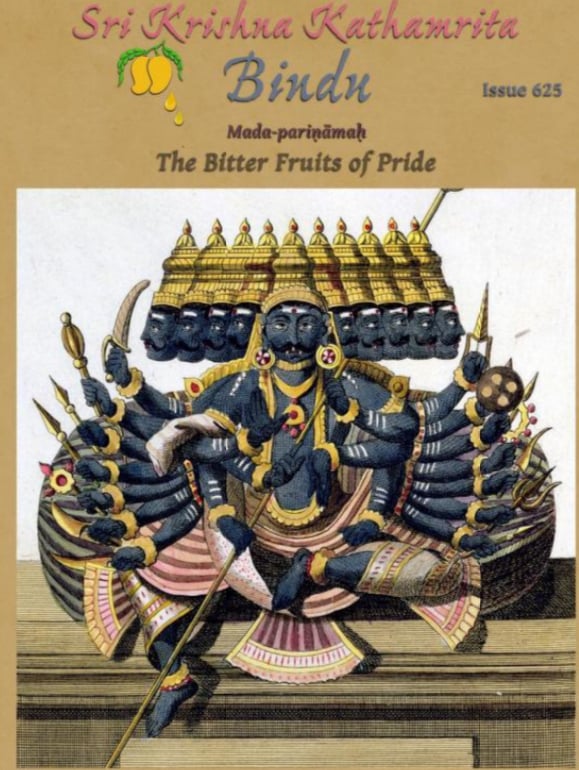
Sri Krishna Kathamrita Bindu, issue 625, published for Sri Pandava Ekadasi on 26 June 2026, gathers a compact but profound set of teachings on one of the most persistent obstacles in spiritual life: pride. Its central theme is not merely moral caution, but a technical analysis of how pride distorts perception, weakens surrender, damages relationships, and prevents genuine advancement in bhakti. The issue draws from the words of A. C. Bhaktivedanta Swami Prabhupada, Sri Srimad Gour Govinda Swami Maharaja, Srila Thakur Bhaktivinode, the Mahabharata, Manu-samhita, Chanakya-niti, and the devotional poetry of Premananda Das.
The title, The Bitter Fruits of Pride, is especially apt because pride rarely appears bitter at first. It often begins as confidence, reputation, seniority, learning, or spiritual identity. Yet the dharmic tradition repeatedly warns that when these become instruments of self-display, they produce inner agitation rather than freedom. The issue therefore presents humility not as social weakness, but as a disciplined spiritual intelligence that protects the mind from delusion.
A major teaching highlighted in the issue is that unnecessary pride is harmful even when it arises in a religious setting. The thought, “I have become very advanced,” is treated as spiritually dangerous because it subtly replaces dependence on Krishna with dependence on personal achievement. In the Bhagavad Gita tradition, surrender begins when the practitioner recognizes that the living being is not the independent controller of material nature. Pride persuades the conditioned mind that it owns, controls, and deserves; humility restores a more accurate understanding of reality.
This point has deep practical relevance. In ordinary life, people may become proud of education, wealth, status, family lineage, age, institutional rank, ritual knowledge, or public influence. In spiritual communities, the same tendency can appear in subtler forms: pride in austerity, pride in scriptural learning, pride in seniority, pride in renunciation, pride in being recognized as a teacher, or pride in belonging to a respected lineage. The issue insists that these forms of self-importance are not harmless decorations of personality; they are obstacles to clear perception.
The discussion from Sri Srimad Gour Govinda Swami Maharaja gives special attention to seniority. When asked how Vaishnavas should understand seniority, the answer is direct: spiritual respect is not determined by age alone. Dhruva Maharaja was a child, Prahlad Maharaja was very young, and Sukadev Goswami was only sixteen when elder sages heard Srimad Bhagavatam from him. The deciding factor is advancement in devotion, not material calculation. This principle carries an important lesson for dharmic communities: reverence must be guided by spiritual substance, not merely by chronology, office, or self-promotion.
The Sanskrit and Bengali devotional sources used in the issue give this teaching a sharper form. Srila Thakur Bhaktivinode states: krsnaika-saranata-i sadhura laksana apanake sadhu baliyà paricaya de-oya dambhikata. The meaning is that taking shelter of Krishna is the principal symptom of a sadhu, while claiming to be a sadhu is arrogance. This distinction is psychologically precise. True holiness does not need constant self-advertisement. It becomes known through conduct, steadiness, compassion, and Krishna’s grace.
Another verse from the same section says: krsna-bhakta vyatita nahika sadhu ara ami sadhu bali haya dambha avatàra. The teaching is uncompromising: a devotee of Krishna is truly worthy of the name sadhu, but one who announces “I am a sadhu” becomes an embodiment of arrogance. The point is not sectarian superiority; it is an ethical warning against spiritual branding. Across Hinduism, Buddhism, Jainism, and Sikhism, the sincere seeker is repeatedly asked to examine ego, soften self-importance, and let practice become visible through character rather than proclamation.
The issue also draws on Manu-samhita 2.162-163, where material prestige is compared to poison and dishonor to nectar. The comparison is deliberately unsettling. Prestige feels sweet because it confirms the ego, while dishonor feels painful because it exposes dependency on external approval. Yet the dharmic insight is that one who learns to tolerate dishonor becomes inwardly peaceful. Such a person can sleep peacefully, wake peacefully, and move through the world with less agitation. This is not an invitation to accept injustice passively; it is a discipline for freeing consciousness from the tyranny of praise and blame.
The Mahabharata section presents a technical catalogue of the faults born from pride. The Udyoga Parva identifies eighteen defects associated with proud persons: being disliked by people, acting negatively, fault-finding, false speech, lust, anger, dependency on flatterers, slander, malicious gossip, wasteful expenditure, quarrel, envy, harming others, burning jealousy, delusion, violation of proper conduct, loss of discrimination, and arrogance itself. This list is valuable because it shows pride not as a single emotion but as a root condition that branches into social, ethical, intellectual, and spiritual disorders.
In this framework, pride is not merely “feeling too good about oneself.” It is a breakdown of right relationship. It damages the relationship with truth because the proud person resists correction. It damages the relationship with others because the proud person needs comparison and superiority. It damages the relationship with wealth because resources become tools of display. It damages the relationship with knowledge because learning becomes a platform for domination. Most importantly, it damages the relationship with the Divine because surrender becomes impossible where self-importance reigns.
The issue’s use of Ravana, Kamsa, and other classical imagery strengthens the argument. Ravana is presented as an embodiment of pride because his brilliance, power, and learning did not save him from ruin. Kamsa’s violence emerges from fear, insecurity, and domination. These figures are not simply mythic villains; they are psychological mirrors. Their downfall illustrates a recurring dharmic principle: power without humility becomes self-destructive, and knowledge without surrender becomes dangerous.
Premananda Das’ Manah Siksa adds a more intimate layer by addressing the mind directly. The poem exposes the hypocrisy of claiming transcendence while remaining attached to forbidden conduct, wealth, comfort, praise, and sensual attraction. Its voice is devotional, but its diagnosis is universal. Human beings often speak the language of detachment while arranging life around recognition and comfort. The poem therefore functions like a mirror held before the practitioner: the problem is not lack of vocabulary, but lack of purification.
The line ore mana! ki tomara bujhibara bhula! captures this confrontation with the mind. The poem does not attack another person; it interrogates one’s own inner contradictions. That is why it remains spiritually useful. Pride prefers to diagnose others, while humility begins by examining the self. In devotional practice, this self-examination is not meant to create despair. It is meant to create sincerity, the condition in which chanting, service, study, and association can bear real fruit.
Chanakya-niti offers a complementary social insight. A person who honors himself with his own garland, sandalwood paste, or self-written praise loses dignity, while even a person of limited virtue may become respected when praised by others. The principle is simple and enduring: self-praise diminishes credibility. In academic, professional, political, and religious contexts alike, character is more persuasive when it is recognized by conduct rather than asserted by speech.
For contemporary readers, the issue’s relevance is immediate. Modern life often rewards visibility, self-promotion, personal branding, and public assertion. Social media intensifies the desire to be seen as wise, righteous, successful, spiritual, or influential. Yet the dharmic teachings gathered here ask a quieter question: has recognition made the heart softer, or harder? Has knowledge increased service, or only argument? Has practice deepened compassion, or only identity? These questions make the theme of pride deeply practical rather than merely theological.
The path suggested by the issue is not self-hatred. Dharmic humility does not mean denying one’s gifts, abandoning responsibility, or pretending to be incompetent. It means understanding that ability is entrusted for service. A scholar may study deeply, a leader may guide firmly, a householder may manage resources, and a renunciant may practice austerity; yet all of these become spiritually healthy only when separated from the craving for domination and applause.
This is where bhakti gives humility its positive center. The devotee does not become humble merely by thinking less of the self in an abstract sense. The devotee becomes humble by recognizing Krishna as the ultimate shelter, source, and enjoyer. When the center shifts from ego to service, respect is no longer something to seize. It becomes something naturally offered to others. This principle supports unity across dharmic traditions because it encourages reverence, restraint, mutual respect, and a shared commitment to inner purification.
The strongest lesson of The Bitter Fruits of Pride is that pride must be detected early. Once it matures, it becomes anger when challenged, envy when others prosper, quarrel when contradicted, and delusion when corrected. Humility, by contrast, keeps the intellect teachable and the heart available for grace. The issue therefore presents humility not as an ornament of saintly life, but as a foundational discipline for anyone who seeks genuine spiritual progress.
In the end, the teachings converge on a single practical conclusion: spiritual advancement is measured less by what one claims and more by what one can tolerate, relinquish, and serve. The proud mind seeks honor; the purified mind seeks truth. The proud person advertises status; the sincere practitioner deepens shelter. The bitter fruits of pride are conflict, delusion, and isolation, while the sweet fruit of humility is a heart capable of devotion, wisdom, and unity.
Inspired by this post on Dandavats.











Leave a Reply
You must be logged in to post a comment.