
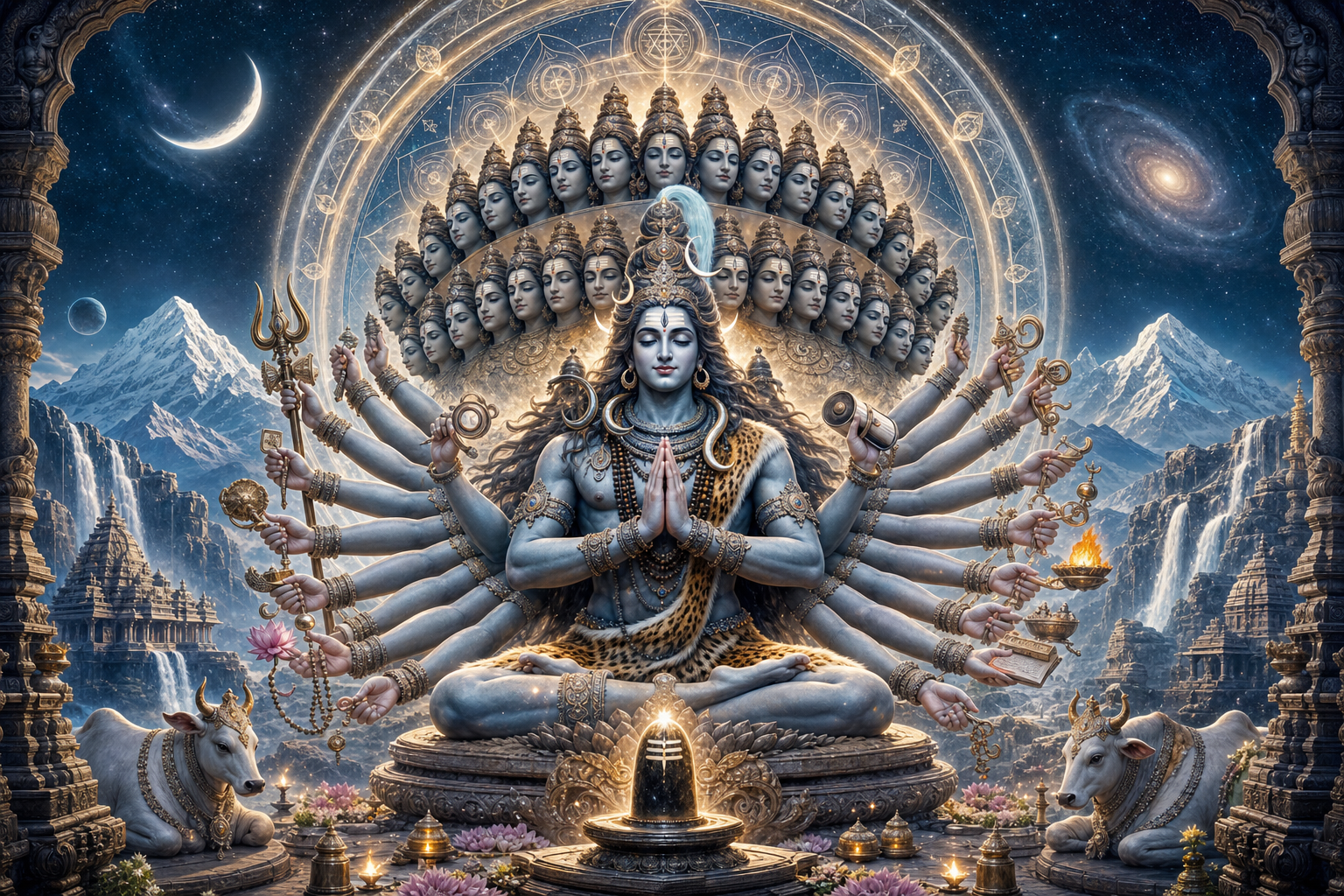
Beyond Form and Formlessness: The Iconographic Majesty of Maha Sadashiva
Maha Sadashiva occupies one of the most profound places in Shaiva iconography. The form is described with twenty-five faces and fifty hands, a vision so vast that it is not meant to be approached merely as an image. It is a theological map, a meditation diagram, and a disciplined attempt to express the inexpressible. In the Shaiva imagination, Shiva is both beyond form and capable of assuming form for the sake of spiritual understanding. Maha Sadashiva brings that paradox into visible form.
The Shaiva traditions have long held together two truths that seem, at first, to oppose each other. Shiva is nirguna, beyond qualities, names, forms, color, direction, and measurement. Yet Shiva is also saguna, available to devotion through name, mantra, murti, temple ritual, sacred ash, linga worship, dance, and cosmic symbolism. Maha Sadashiva stands at this meeting point. The form does not reduce the infinite into an idol; rather, it allows the human mind to contemplate infinity through sacred structure.
In ordinary perception, a face gives identity. It allows recognition, memory, and relationship. In the iconography of Maha Sadashiva, the multiplication of faces does the opposite. It prevents the mind from treating Shiva as a limited personality. The twenty-five faces suggest omnidirectional awareness, total sovereignty, and a consciousness that sees all planes of reality at once. Devotees may stand before such a form with awe, but the icon is also a lesson in humility: the human intellect can gesture toward the divine, but it cannot contain it.
The number twenty-five has deep philosophical resonance in Indian thought. In Samkhya, twenty-five tattvas are used to explain the principles of manifested reality, from prakriti and purusha to the senses, elements, mind, and ego. Shaiva systems develop their own more expansive tattva frameworks, especially in Kashmir Shaivism and Shaiva Siddhanta, yet the symbolism of twenty-five remains meaningful because it evokes the layered architecture of existence. Maha Sadashiva may therefore be read as the Lord who pervades and transcends the categories through which the universe becomes intelligible.
The fifty hands of Maha Sadashiva intensify this theological vision. Hands represent power, action, blessing, protection, knowledge, discipline, destruction, and grace. In Hindu iconography, a deity with many hands is not an exaggeration for spectacle. It is a visual grammar that communicates many simultaneous functions. A human being acts through two hands and experiences one sequence at a time. The divine acts through countless channels, sustaining worlds, dissolving bondage, granting refuge, and guiding spiritual ascent without contradiction.
This is why the form should not be interpreted only as artistic complexity. It is a sacred technology of contemplation. Every face and every hand can be treated as a doorway into a particular aspect of Shiva: creator, preserver, dissolver, concealer, revealer, teacher, ascetic, dancer, healer, lord of mantra, and inner Self. The iconography asks the devotee to move from visual astonishment toward philosophical inquiry. What appears overwhelming at first gradually becomes a disciplined meditation on cosmic order.
The term Sadashiva itself is significant. Sada means eternal or ever-present, and Shiva means auspicious, gracious, and liberating. Sadashiva is not merely a name among many names; it refers to a high metaphysical state in several Shaiva traditions. It is associated with the level at which divine awareness begins to express the universe while remaining established in pure consciousness. Maha Sadashiva, the great form of Sadashiva, magnifies this idea into a cosmic vision that exceeds ordinary devotional portraiture.
The fivefold structure of Shiva is central to understanding the twenty-five-faced form. In many Shaiva traditions, Shiva is contemplated through five faces: Sadyojata, Vamadeva, Aghora, Tatpurusha, and Ishana. These faces are associated with directions, mantras, elements, powers, and divine functions. They express creation, preservation, dissolution, concealment, and grace. If the five-faced Shiva already represents cosmic completeness, the twenty-five-faced Maha Sadashiva may be understood as a grand expansion of that fivefold theology.
Sadyojata is often linked with manifestation and the creative emergence of form. Vamadeva is associated with preservation, beauty, and sustaining grace. Aghora points to dissolution, transformation, and the fearless passage beyond decay. Tatpurusha evokes inwardness, meditation, and the disciplined life of yoga. Ishana represents transcendence, pure knowledge, and the highest spiritual ascent. In Maha Sadashiva, these principles are not isolated. They interpenetrate, multiply, and become a vast mandala of divine consciousness.
Such an image requires a different way of seeing. Modern viewers may be trained to ask whether an image is realistic, historically literal, or psychologically familiar. Sacred Indian iconography often asks a different question: does the form reveal a metaphysical truth? Maha Sadashiva is not realistic in the ordinary sense, but it is precise in the symbolic sense. It uses proportion, multiplication, gesture, and orientation to make visible an understanding of reality that cannot be captured by naturalistic art alone.
The emotional force of this form comes from its refusal to make the divine comfortable. Many devotional images invite tenderness, intimacy, and immediate affection. Maha Sadashiva invites reverence first. It confronts the viewer with scale. It suggests that consciousness is not a private mental event but the ground of the cosmos. For many devotees, this produces a feeling that is difficult to name: fear without terror, love without possessiveness, and wonder without sentimental reduction.
This balance between intimacy and vastness is one of the great strengths of Hindu spirituality. Lord Shiva may be worshipped as the simple aniconic Shivalinga, as the meditating yogi of Kailasa, as Nataraja dancing in the circle of fire, as Ardhanarishvara uniting Shiva and Shakti, as Dakshinamurthy teaching in silence, and as Maha Sadashiva radiating cosmic totality. The variety of forms does not fragment Shiva. It acknowledges that different seekers approach the same truth through different temperaments, disciplines, and stages of understanding.
This principle also supports unity among dharmic traditions. Hinduism, Buddhism, Jainism, and Sikhism each preserve distinct theological languages, practices, and histories, yet they share a civilizational respect for discipline, self-transformation, ethical conduct, and liberation from ignorance. The study of Maha Sadashiva should therefore not become sectarian pride. It is better understood as part of a larger dharmic inheritance in which symbolic forms train the mind to look beyond ego, fear, and narrow identity.
In temple art and ritual culture, complex forms such as Maha Sadashiva are never merely decorative. The sculptor, ritual specialist, and devotee participate in a shared world of meaning. Measurements, gestures, weapons, ornaments, crowns, expressions, and postures all carry significance. The more elaborate the form, the more carefully it must be read. A casual glance sees abundance; trained attention sees theology. This is why Hindu temple architecture and iconography remain indispensable sources for understanding Indian philosophy.
The weapons and emblems held in the many hands of such forms often indicate divine capacities rather than violence in a crude sense. A trident may represent mastery over the three gunas, the three times, or the triad of creation, preservation, and dissolution. A drum may signify the vibration from which sound, language, and manifestation arise. A fire may signify dissolution and purification. A gesture of protection assures the devotee that cosmic power is not hostile to sincere spiritual effort.
The repeated faces also invite reflection on knowledge. Human knowledge is partial because it is perspectival. A person sees from one position, remembers selectively, acts under limitation, and interprets through personal history. Maha Sadashiva symbolizes awareness beyond this fragmentation. The many faces are not many egos; they are the many-sided luminosity of one consciousness. This makes the image philosophically rich, especially when studied alongside the Upanishads, Shaiva Agamas, and later traditions of Hindu philosophy.
The Upanishadic background is essential. The Upanishads repeatedly direct attention away from external multiplicity toward the reality that underlies all experience. Yet they do not dismiss sacred forms as meaningless. Rather, they teach that the highest truth exceeds every limited formulation. When Shaiva iconography presents the infinite through an overwhelming form, it is not contradicting the Upanishadic insight. It is allowing the mind to move from form to formlessness, from symbol to silence.
There is also a practical spiritual lesson here. The mind often wants the divine to be manageable. It prefers a form that answers one need: protection, prosperity, healing, knowledge, or emotional comfort. Maha Sadashiva resists that simplification. The form reminds devotees that reality is not built around personal convenience. Creation and dissolution, grace and discipline, beauty and austerity, silence and cosmic activity are all held together in Shiva. Spiritual maturity begins when these apparent opposites are no longer treated as enemies.
The iconography also deepens the meaning of darshan. Darshan is not only seeing the deity; it is being seen by the deity. In the presence of Maha Sadashiva, this idea becomes especially powerful. Twenty-five faces suggest that there is no hidden corner of the self outside divine awareness. This can be unsettling, but it can also be deeply consoling. The same consciousness that sees human weakness also sees the longing for liberation, the effort to improve, and the quiet sincerity that often remains invisible to the world.
In this sense, Maha Sadashiva is not only cosmic but ethical. The form silently asks what kind of life becomes possible when one remembers that consciousness is sacred. Speech, action, thought, memory, and desire become fields of discipline. The many hands of Shiva symbolize divine action, but they also challenge human beings to refine their own actions. Spirituality is not an escape from responsibility. It is the purification of responsibility through awareness, restraint, courage, and compassion.
The fifty hands may also be understood through the rhythm of abundance and control. The divine has limitless capacity, yet every gesture in sacred iconography is ordered. Nothing is random. This teaches an important principle of dharmic life: power must be governed by wisdom. Energy without alignment becomes chaos; knowledge without humility becomes pride; ritual without inner refinement becomes habit. Maha Sadashiva integrates power and wisdom in one disciplined visual field.
The form is especially important in an age that often separates spirituality from intellectual seriousness. Maha Sadashiva demonstrates that devotion and metaphysics need not be opposed. A devotee may offer flowers, chant mantras, and bow before the murti. A scholar may analyze the symbolic structure, textual background, and philosophical implications. A practitioner may meditate on the form as a mandala of consciousness. These approaches can coexist, enriching rather than weakening one another.
Iconography of this kind also corrects the common misunderstanding that Hindu deities are merely polytheistic figures competing for attention. The many forms of Shiva, Vishnu, Devi, Ganesha, Surya, and other deities often express different approaches to the same ultimate reality, depending on the theological school. Maha Sadashiva is a clear example of this sophistication. It is not a multiplication of gods in a simplistic sense, but a representation of the infinite capacities of divine consciousness.
The distinction between symbol and superstition is important. A symbol opens the mind toward deeper meaning; superstition closes inquiry and reduces practice to fear. Maha Sadashiva, properly understood, is a symbol of extraordinary philosophical density. It asks the viewer to contemplate consciousness, manifestation, divine agency, cosmic order, and liberation. It is therefore best approached with both reverence and study. Devotion gives warmth to understanding; study gives clarity to devotion.
From an aesthetic standpoint, the twenty-five-faced form also reveals the ambition of Indian sacred art. The goal is not minimalism or mere elegance. The goal is adequacy to vision. When the subject is cosmic consciousness, artistic abundance becomes appropriate. The sculptural or painted form must stretch perception. It must make the viewer pause, return, notice, and reconsider. In that repeated looking, the image becomes a teacher.
The form also carries a subtle teaching about the limits of language. Any description of Maha Sadashiva is necessarily incomplete. Words can explain the number of faces, the symbolism of hands, the relation to Shaiva theology, and the role of the form in meditation. Yet the icon remains greater than its explanation. This is not a failure of language alone; it is part of the spiritual point. The highest realities can be approached through language, but they must finally be realized beyond language.
For contemporary seekers, Maha Sadashiva offers a valuable corrective to fragmented living. Modern life often divides the self into professional, social, emotional, digital, and spiritual compartments. The form of Maha Sadashiva suggests integration at a cosmic scale. Every direction, every function, every power, and every plane of being is gathered into one sacred center. The lesson is not that human beings become cosmic rulers, but that life becomes more coherent when anchored in a higher principle.
The image also speaks to the experience of uncertainty. Human beings frequently face situations that cannot be solved by linear reasoning alone: grief, moral conflict, illness, impermanence, and the search for meaning. Maha Sadashiva does not offer a shallow answer. Instead, it presents a vision in which creation and destruction are held within a larger intelligence. This does not remove suffering, but it can give suffering a wider metaphysical horizon.
Within Shaiva practice, Shiva is not only the destroyer but the liberator. Destruction, in its sacred sense, is the removal of bondage, ignorance, egoism, and false identification. The terrifying or overwhelming aspects of Shiva are therefore not opposed to compassion. They are compassion working at a deeper level. Maha Sadashiva, with its immense multiplicity, can be seen as the totality of all divine processes that move the soul from limitation toward freedom.
This interpretation also prevents the form from being reduced to mythology alone. Mythology in Hindu traditions is not merely fictional storytelling; it is a symbolic language for metaphysical, ethical, and psychological truths. When a form seems to defy ordinary possibility, that impossibility is often the clue. The image is not asking to be measured by mundane anatomy. It is asking to be read as sacred philosophy embodied in visual form.
Maha Sadashiva therefore belongs to the larger Hindu understanding that truth can be approached through multiple valid modes: mantra, meditation, ritual, philosophy, temple worship, pilgrimage, music, dance, silence, and service. This plurality is not confusion. It is an acknowledgment that human beings differ in temperament and capacity. The dharmic world has historically preserved many paths because reality itself is rich, layered, and compassionate enough to meet seekers where they stand.
The form also invites intergenerational reflection. A child may first encounter Maha Sadashiva with wonder at the many faces and hands. A devotee may encounter the same image through reverence. A scholar may approach it through textual and artistic traditions. A meditator may internalize it as a symbol of consciousness. Across these levels, the form continues to give. This layered accessibility is one reason Hindu iconography has endured across centuries.
In public discourse, sacred images are sometimes flattened by outsiders into exotic art or dismissed by skeptics as irrational excess. A more careful approach recognizes that Maha Sadashiva belongs to a sophisticated philosophical culture. Its complexity reflects a disciplined attempt to think about the relation between the absolute and the manifest world. The form is not an escape from reason; it is a challenge to narrow reason to expand itself.
The relationship between Shiva and Shakti should also be remembered. No Shaiva understanding of cosmic activity is complete without recognizing the inseparability of consciousness and power. Shiva without Shakti is often described as stillness; Shakti is the dynamic energy through which manifestation unfolds. Maha Sadashiva, though visually centered on Shiva, implies this union of awareness and power. The many hands are meaningful because consciousness is not inert. It acts through divine energy.
This insight has practical relevance for spiritual life. Awareness must express itself through conduct. A person may speak of consciousness, dharma, and liberation, but the truth of these ideals becomes visible in action. Compassion, restraint, courage, truthfulness, reverence for knowledge, and respect for different paths are the human equivalents of sacred gesture. The icon inspires not only contemplation but transformation.
Maha Sadashiva also deepens the understanding of moksha. Liberation is not merely escape from the world; it is freedom from ignorance about the nature of the Self. The cosmic form shows that the world is not outside divine consciousness. The seeker does not reject reality but learns to see reality correctly. This is why Shaiva spirituality can hold together renunciation and participation, temple ritual and inner meditation, personal devotion and nondual insight.
The form is therefore a bridge between bhakti, jnana, and yoga. Bhakti sees the beloved Lord. Jnana recognizes the ground of consciousness. Yoga disciplines the body, senses, breath, and mind so that this recognition becomes stable. Maha Sadashiva can speak to all three. It can be adored, studied, and meditated upon. Its greatness lies in its ability to gather multiple spiritual disciplines without reducing them to one narrow method.
The academic study of such imagery should remain sensitive to living devotion. It is possible to analyze the icon without draining it of sacred presence. In fact, rigorous study can increase reverence when it reveals the depth of the tradition. The more carefully Maha Sadashiva is examined, the more evident it becomes that the form is not arbitrary. It is a profound synthesis of theology, metaphysics, art, ritual, and spiritual psychology.
At the same time, devotion benefits from intellectual honesty. Not every detail of every iconographic tradition is preserved uniformly across regions, texts, and artistic lineages. Sacred forms develop through temple traditions, Agamic prescriptions, regional styles, and inherited practice. This diversity should not be treated as inconsistency. It reflects the living nature of Hindu culture, where continuity and adaptation often exist together.
The most important point remains clear: Maha Sadashiva is a visual declaration that the divine exceeds the mind while still graciously meeting the mind. The twenty-five faces do not trap Shiva in form; they break the narrowness of ordinary form. The fifty hands do not make Shiva merely powerful; they show that divine action is multidimensional, ordered, and compassionate. The entire image is an invitation to rise from surface perception into contemplative insight.
In a world often impatient with subtlety, Maha Sadashiva demands patience. It asks to be looked at slowly, studied carefully, and approached with humility. Its grandeur is not only in the number of faces and hands, but in the philosophical courage behind the form. It dares to show that the infinite can appear without becoming finite, that form can point beyond form, and that beauty can become a path to liberation.
Maha Sadashiva ultimately teaches that the human mind is not humiliated by what it cannot fully grasp; it is elevated by learning to contemplate what exceeds it. The form does not ask for passive amazement alone. It asks for disciplined wonder, ethical refinement, spiritual inquiry, and reverence for the vast dharmic traditions that preserved such a vision. In that sense, Maha Sadashiva remains one of the most powerful symbols of Lord Shiva: infinite, auspicious, terrifyingly beautiful, and eternally liberating.
Inspired by this post on Hindu Blog.
