
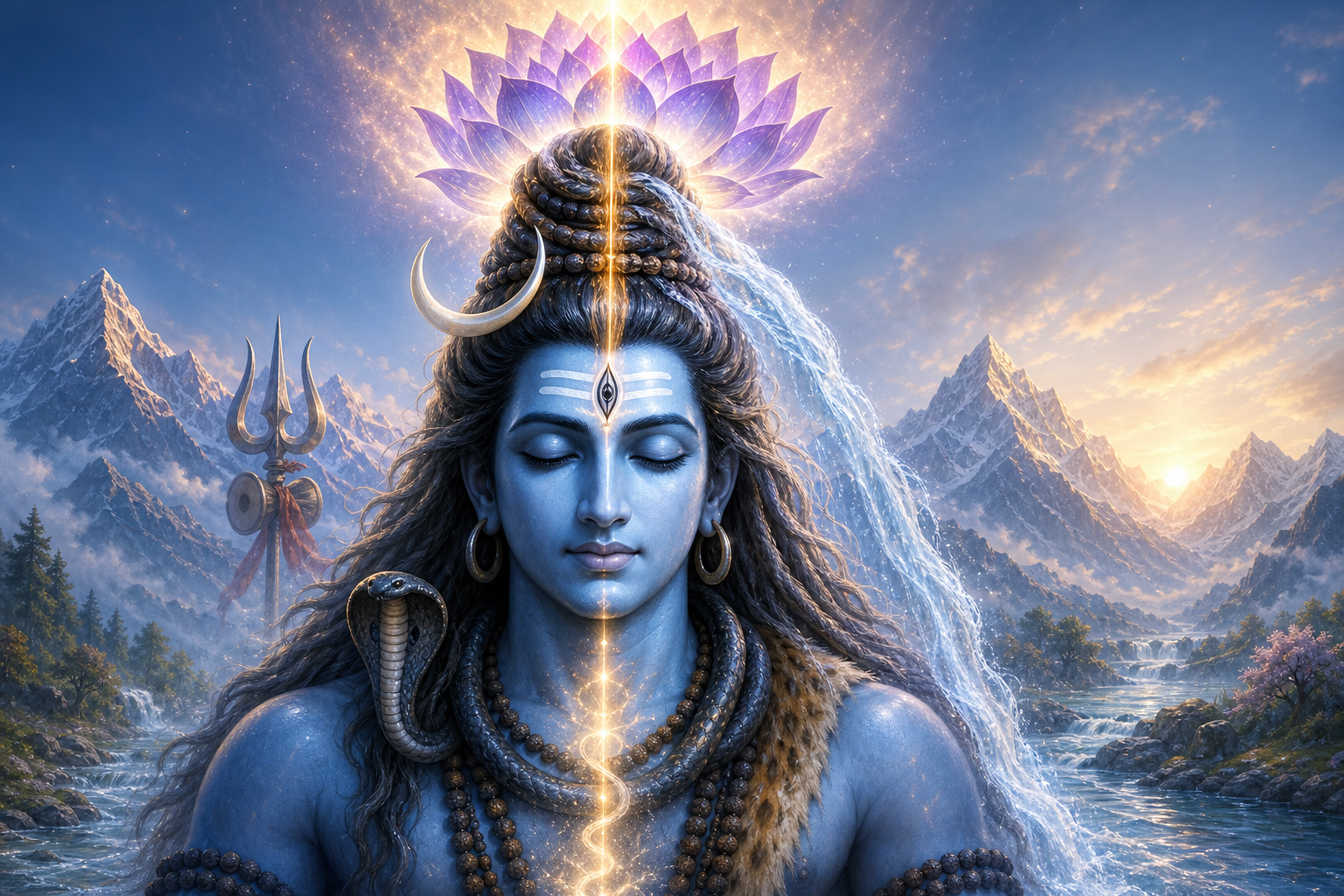
Shiva, Ganga, and the Crown of Consciousness
Among the most evocative images in Shaiva traditions is Shiva bearing the sacred Ganga upon his matted locks. This image is not merely decorative religious art. It is a concentrated spiritual teaching, where mythology, yogic anatomy, sacred geography, devotion, and metaphysics converge into one luminous symbol. The form of Shiva as Gangadhara, the bearer of Ganga, presents the descent of divine grace into the world and the awakening of consciousness at its highest center, often associated in Yoga and Tantra with the Sahasrara Chakra, the thousand-petalled lotus at the crown.
The image is powerful because it joins two great movements of spiritual life. Ganga descends from the celestial realm toward the earth, while the seeker’s awareness ascends from ordinary perception toward the highest realization. In Shiva’s crown, these two movements meet. The river that purifies the world and the lotus that opens into supreme consciousness become part of a single contemplative vision.
In the Puranic imagination, Ganga is no ordinary river. She is revered as a goddess, a purifier, a liberating current, and a sacred presence that connects heaven, earth, and the ancestral realms. In yogic symbolism, the crown of the head is not merely a physical location but a subtle threshold where limited individuality is said to open toward universal awareness. When Ganga rests upon Shiva’s head, the image suggests that divine force must be received by awakened consciousness before it can transform the world without overwhelming it.
The Puranic Story of Ganga’s Descent
The traditional story of Ganga’s descent is closely associated with King Bhagiratha, whose intense tapas was undertaken for the liberation of his ancestors. According to the sacred narrative, the sons of King Sagara had been reduced to ashes, and only the descent of Ganga could bring them release. Bhagiratha’s austerity moved the divine powers, and Ganga agreed to descend from the celestial realm to earth.
Yet her descent carried immense force. If the full power of the celestial river had fallen directly upon the earth, it would have shattered the world. Bhagiratha therefore turned to Shiva, whose yogic stillness alone could receive and regulate that tremendous current. Shiva caught Ganga in his jata, his matted locks, and allowed her to flow gently toward the earth. Through this act, cosmic energy became life-giving rather than destructive.
This episode gives the image of Gangadhara its philosophical depth. Ganga represents grace, purification, knowledge, and the flow of liberation. Shiva represents stillness, awareness, discipline, and the supreme yogic consciousness capable of holding infinite power without agitation. Bhagiratha represents determined spiritual effort. The earth represents embodied life. Together, the story teaches that liberation requires grace, discipline, humility, and sustained effort.
Why Shiva’s Head Matters
The placement of Ganga on Shiva’s head is central to the meaning of the symbol. In Hindu iconography, the head often indicates sovereignty, consciousness, mastery, and the highest principle of being. Shiva does not merely touch Ganga or stand beside her. He bears her upon his crown, showing that the divine current is held in the field of supreme awareness.
Shiva’s jata carries additional meaning. Matted locks are associated with tapas, renunciation, meditative absorption, and mastery over sensory life. They indicate that Shiva is not scattered by the world’s movements. He contains them. The rushing force of Ganga becomes ordered through his stillness. In contemplative terms, the mind that has become steady through dhyana can receive subtle insight without being destabilized by it.
This is one reason the image remains deeply relatable for spiritual practitioners. Many people experience life as a flood of impressions, duties, emotions, memories, and desires. The symbol of Shiva holding Ganga teaches that the answer is not suppression of life’s current but conscious containment. Awareness does not destroy the river; it gives the river a sacred channel.
Ganga as River, Goddess, and Inner Current
Ganga is revered in Hindu tradition as both a physical river and a divine mother. As sacred geography, the Ganga river nourishes civilization, pilgrimage, ritual life, memory, and devotion. As goddess, she embodies compassion, purification, and the possibility that even deeply bound beings can move toward freedom. As spiritual symbol, she represents the descending current of grace that washes the limited self and restores it to its deeper nature.
The river’s movement also offers a profound spiritual metaphor. Water flows from height to depth, from subtle source to manifest world. It adapts to every terrain without losing its nature. It cleanses, nourishes, and carries. In the same way, spiritual wisdom must move from abstraction into lived conduct. It must become compassion, self-discipline, service, and clarity in daily life.
For this reason, Ganga’s presence on Shiva’s crown cannot be reduced to mythology alone. It expresses a psychology of transformation. The sacred current descends into the human field only when consciousness is prepared to receive it. Without inner steadiness, power becomes disturbance. With awareness, the same power becomes purification.
Sahasrara Chakra and the Thousand-Petalled Lotus
In yogic anatomy, the Sahasrara Chakra is commonly described as the thousand-petalled lotus at the crown of the head. It is associated with the culmination of spiritual ascent, the dissolution of narrow ego-identification, and the realization of unity with the supreme reality. Although descriptions vary across yogic and Tantric traditions, Sahasrara is widely treated as the symbolic seat of highest consciousness.
The language of the thousand petals suggests infinity, fullness, and the flowering of awareness beyond ordinary mental categories. A lotus grows from mud and water yet opens toward light. This makes it an ideal symbol for spiritual life. Human experience may begin in limitation, confusion, and attachment, but disciplined practice can transform the same life into a vehicle of realization.
When the image of Ganga on Shiva’s head is read through the lens of Sahasrara, the symbolism becomes especially rich. Shiva’s crown corresponds to the region of highest awakening. Ganga’s descent into that space suggests the arrival of divine knowledge and liberating grace into the awakened center of consciousness. The river and the lotus together express both movement and stillness, descent and ascent, grace and realization.
Kundalini, Sushumna Nadi, and Inner Ascent
In many yogic and Tantric traditions, spiritual ascent is described through the awakening of Kundalini and her movement through the sushumna nadi, the central subtle channel. This ascent is not simply a mechanical process but a disciplined transformation of body, breath, mind, emotion, and awareness. The movement from muladhara toward Sahasrara represents the refinement of consciousness from survival-bound identity toward liberated insight.
Within this framework, Shiva at the crown is often interpreted as pure consciousness, while Shakti is the dynamic power that rises toward union with him. Ganga’s descent offers a complementary image. The divine current comes down, while the seeker’s consciousness rises upward. The meeting point is the crown, where duality is transcended in spiritual realization.
This interpretation should be approached with care. Yogic anatomy is a subtle and symbolic language, not a modern anatomical map. Its purpose is contemplative and transformative. It helps practitioners understand inner life through disciplined symbols. The value of the symbolism lies not in forcing a literal reading but in allowing the image to guide meditation, ethical refinement, and self-knowledge.
Shiva as the Stillness That Receives the Infinite
Shiva’s role in the descent of Ganga reveals a profound principle of spiritual practice: the highest energy requires the deepest stillness. Ganga’s force is immense, but Shiva does not resist it with aggression. He receives it through perfect steadiness. This makes him the archetype of the meditative consciousness that can hold intensity without fragmentation.
In ordinary life, powerful experiences often overwhelm the unprepared mind. Grief, love, insight, success, loss, and devotion can all become destabilizing when there is no inner discipline. Shiva’s bearing of Ganga teaches that consciousness must become spacious enough to receive life’s force without being carried away by it. This is not emotional coldness. It is sacred composure.
The image therefore speaks to seekers across time. It suggests that meditation is not an escape from the river of life. It is the cultivation of a center from which the river can be honored, guided, and offered for the welfare of the world. The yogin does not reject movement; the yogin roots movement in awareness.
Liberation, Purification, and the Ancestral Dimension
The descent of Ganga is also a story of liberation across generations. Bhagiratha’s tapas is performed not for personal gain but for the release of his ancestors. This gives the narrative a moral and familial depth. Spiritual practice is not presented as isolated self-improvement. It is connected to lineage, memory, responsibility, and the healing of inherited burdens.
In this sense, Ganga’s flow represents the possibility that purification can move backward and forward through time. One person’s disciplined effort can bring dignity to the past and clarity to the future. The story honors the dharmic understanding that the individual is woven into family, society, nature, and cosmic order.
This insight remains relevant in modern life. Many people carry ancestral memories, cultural dislocation, emotional wounds, and inherited patterns. The story of Bhagiratha, Shiva, and Ganga offers a language for transformation: sincere effort invokes grace, grace requires steadiness, and steadiness allows healing to flow into the world.
The Crown as a Meeting Place of Grace and Discipline
The relationship between Ganga and Sahasrara clarifies a central principle of Hindu spirituality: realization is neither purely self-generated nor passively received. Bhagiratha practices tapas. Shiva embodies yogic mastery. Ganga descends as divine grace. Liberation unfolds through the meeting of effort, receptivity, and blessing.
This balance is important. A path based only on personal will can become harsh and ego-driven. A path based only on waiting for grace can become passive. The image of Ganga on Shiva’s crown harmonizes both. It affirms that the seeker must prepare the vessel, but the highest realization is not manufactured by ego. It is received when consciousness becomes transparent enough to reflect the supreme.
Sahasrara, in this reading, is not an achievement to be possessed. It is the opening of awareness beyond possession itself. The thousand-petalled lotus does not symbolize personal superiority. It symbolizes surrender into a consciousness that is wider than the personal self.
Iconography as Compressed Philosophy
Hindu iconography often operates as compressed philosophy. The crescent moon, the third eye, the serpent, the damaru, the trishula, the ash-covered body, and the flowing Ganga are not random ornaments. They are symbolic teachings. Each element opens a field of reflection on time, death, knowledge, sound, energy, renunciation, and liberation.
Ganga on Shiva’s head specifically teaches that the highest consciousness does not hoard grace. Shiva receives Ganga, but he releases her for the welfare of the world. The river does not remain trapped in the crown. It flows outward. This is a crucial ethical point. Genuine realization expresses itself as compassion, not self-absorption.
The image also corrects a common misunderstanding of spiritual awakening. Awakening is not merely an extraordinary inner experience. It must become a beneficial flow. The awakened crown must nourish the earth. Wisdom must become conduct. Meditation must become service. Insight must become purification in the world of relationships, duties, and social life.
Dharmic Harmony and Shared Spiritual Aspirations
Although the image of Gangadhara belongs especially to Shaiva traditions, its deeper themes resonate across dharmic traditions. Hindu, Buddhist, Jain, and Sikh streams each emphasize purification, discipline, compassion, self-mastery, and liberation from narrow egoism in their own distinctive ways. The shared concern is the transformation of human consciousness and the cultivation of a life aligned with truth.
Ganga’s symbolism can therefore be appreciated without reducing the uniqueness of any tradition. In Hindu practice, she is a goddess and sacred river. In a broader dharmic reflection, her flow can also evoke the movement from impurity to clarity, from bondage to freedom, and from fragmented identity to a more expansive awareness. Such an inclusive reading strengthens unity while respecting difference.
This approach is especially necessary in contemporary discussions of spirituality. Symbols should not become tools of division. They should open deeper understanding. Shiva bearing Ganga invites reverence for the Shaiva vision while also encouraging dialogue with the wider dharmic quest for wisdom, compassion, restraint, and liberation.
Ecological Reverence and the Sacred River
Any reflection on Ganga must also acknowledge the ecological dimension. A river revered as divine cannot be treated merely as a resource. Sacred geography carries ethical responsibility. To honor Ganga ritually while neglecting her physical health would be a contradiction of the very symbolism she carries.
The image of Ganga descending through Shiva’s locks teaches regulation, restraint, and reverent channeling of power. In ecological terms, this can inspire a culture of river protection, pollution reduction, responsible pilgrimage, and sustainable living. Spirituality becomes complete only when devotion shapes conduct toward nature.
Ganga’s holiness is not separate from her waters, banks, biodiversity, and communities. The river of liberation is also the river of life. Protecting her is not merely environmental activism; it is dharma expressed through ecological care.
A Contemplative Reading for Modern Seekers
For modern seekers, the symbolism of Shiva, Ganga, and Sahasrara offers a practical contemplative map. Bhagiratha represents aspiration and disciplined effort. Ganga represents grace, purification, and the sacred flow of wisdom. Shiva represents meditative steadiness and the supreme consciousness that can receive infinite force. Sahasrara represents the flowering of awareness beyond the limits of ego.
When life feels overwhelming, the image advises steadiness. When practice feels dry, it reminds the seeker of grace. When knowledge becomes abstract, it returns attention to purification and service. When devotion becomes emotional but ungrounded, it points toward discipline. When discipline becomes rigid, it restores the living flow of the sacred river.
This is why the image continues to move devotees, artists, scholars, and practitioners. It speaks simultaneously to the heart, the intellect, and the inner life. It is a theological statement, a yogic diagram, a poetic vision, and a practical teaching on how to receive power without losing balance.
The Union of River and Lotus
The sacred river and the thousand-petalled lotus may appear to be different symbols, yet they complete one another. The river moves; the lotus opens. The river descends; the lotus rises. The river purifies; the lotus reveals. In Shiva’s crown, movement and stillness meet in the mystery of supreme consciousness.
Ganga on Shiva’s head therefore symbolizes more than divine beauty. It reveals a complete spiritual vision: grace descends, consciousness awakens, energy is disciplined, life is purified, and liberation becomes possible. The image teaches that the highest realization is not separate from the world but flows into it, just as Ganga flows from the crown of Shiva toward the earth.
To contemplate Gangadhara is to contemplate the disciplined reception of grace. To meditate on Sahasrara is to reflect on the opening of consciousness beyond narrow identity. Together, they offer one of the most profound symbols in Hindu spirituality: the awakened crown through which the river of liberation enters the world.
Inspired by this post on Hindu Blog.
