
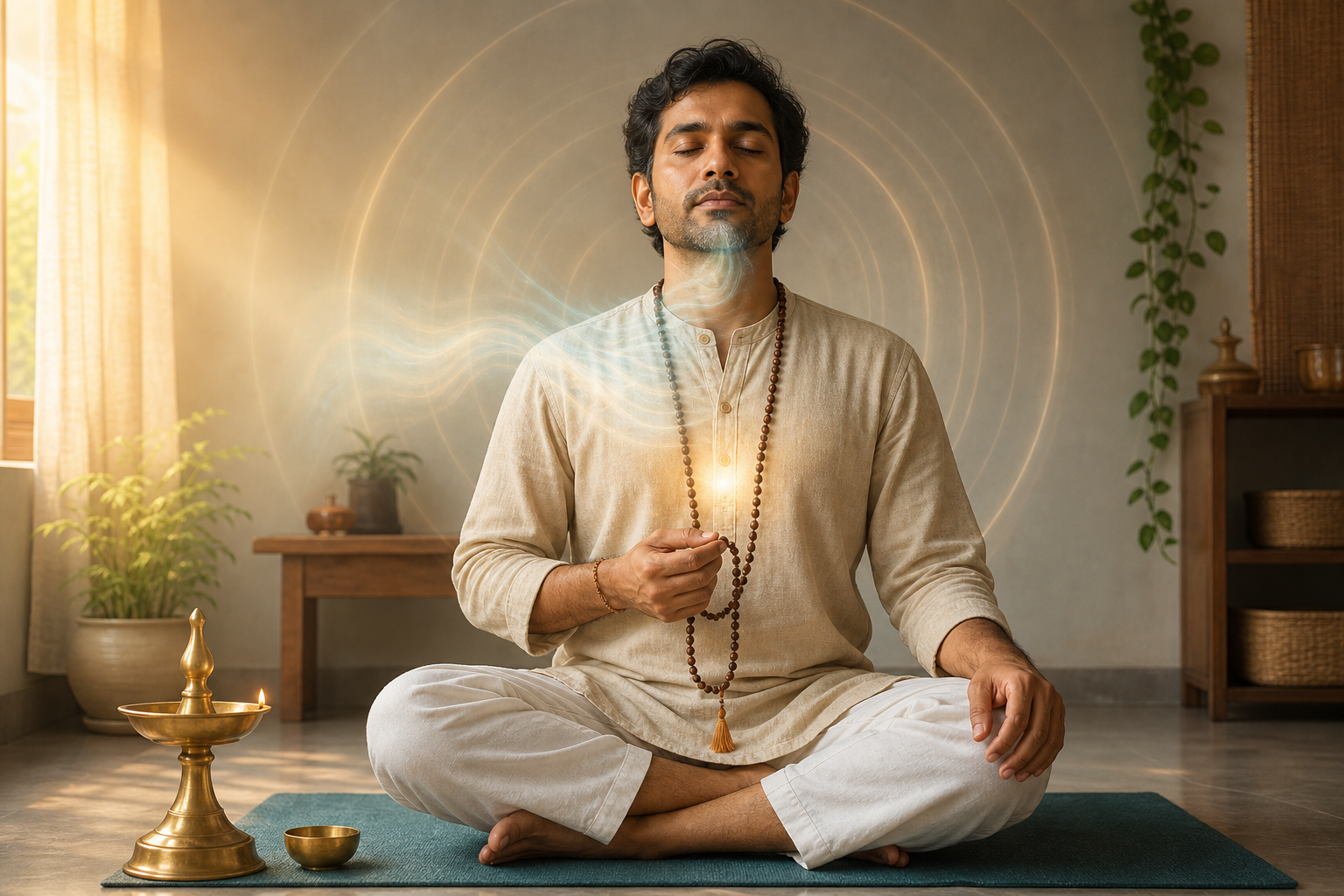
The question of whether continuous mantra chanting affects the body and life deserves a careful answer. In dharmic traditions, the reply is generally affirmative: mantra practice can influence attention, breath, emotional tone, habits, and spiritual orientation. Yet the traditional answer is not that one should chant without interruption at every moment of the day. A disciplined practice is different from uncontrolled repetition. Just as bathing purifies the body but is not performed continuously, mantra japa purifies and steadies the mind when practiced with rhythm, moderation, and understanding.
Mantra is often described as a sacred sound, phrase, or formula used to guide consciousness. In Hindu spirituality, Buddhist practice, Jain discipline, and Sikh remembrance, sound and repetition are not treated as ordinary speech alone. They are used as instruments for training attention, refining intention, and bringing the practitioner closer to dharma. The physical voice, the breath, the nervous system, and the mind all participate in the act of chanting. For this reason, mantra chanting is not merely a religious custom; it is also a disciplined psycho-physical practice.
The first visible effect of mantra chanting is often mental steadiness. Ordinary thought moves restlessly from memory to desire, from worry to planning, and from judgment to fear. Repetition gives the mind a single point of return. This one-pointedness, known in yogic language as concentration, gradually reduces mental scattering. When the same sacred sound is repeated with awareness, the mind learns to return from distraction without aggression. This is why even a short period of sincere japa can make a person feel more composed, less reactive, and more inwardly organized.
The original teaching that one should not chant continuously is important because spiritual discipline is not mechanical excess. A mantra is not strengthened by anxiety, compulsion, or neglect of daily duties. If chanting becomes an escape from responsibility, sleep, food, work, family, or ethical conduct, the practice has lost balance. Dharmic traditions repeatedly emphasize integration: sadhana should support life, not weaken it. The stronger mind developed through mantra should help a person act with clarity, compassion, courage, and self-control in ordinary circumstances.
From a technical perspective, mantra chanting affects the body through breath regulation. Many forms of japa naturally slow the breathing pattern. When a phrase is repeated steadily, exhalation often becomes longer and smoother. This may support relaxation by reducing the tendency toward shallow, rapid breathing associated with stress. Yogic breathing, pranayama, and mantra are therefore closely related. The mantra gives structure to the breath, while the breath gives stability to the mantra.
The nervous system is also involved. Slow, rhythmic vocalization can influence the body through sound vibration, breath pacing, and attention. Chanting aloud engages the diaphragm, chest, throat, mouth, tongue, and hearing. The practitioner produces the sound and receives it at the same time. This feedback loop can create a stabilizing effect, especially when the chanting is neither forced nor hurried. In modern language, such practices may support a shift away from agitation toward a calmer physiological state, although they should not be described as a substitute for medical treatment.
The role of vibration is central in traditional explanations. Sacred sound is understood to carry a subtle force that shapes consciousness. In a more observational sense, every chant has rhythm, pitch, resonance, and duration. A deep and steady chant may be felt in the chest, throat, skull, or abdomen. These sensations are not imaginary; they are part of the body’s response to vocal sound. However, the spiritual value of mantra does not depend only on physical vibration. Intention, reverence, attention, and ethical living are equally important.
Mantra chanting can also influence emotional life. Repetition creates familiarity, and familiarity creates refuge. A person facing grief, fear, uncertainty, or loneliness may find that returning to a mantra provides a stable inner companion. This does not remove the realities of life, but it may change the manner in which those realities are met. Instead of being carried away by every wave of emotion, the practitioner develops a habit of pausing, breathing, remembering, and responding. This is one of the most practical benefits of japa.
The effect on life is therefore indirect but meaningful. Mantra chanting does not magically replace effort, wisdom, or karma. It can, however, change the quality of one’s effort. A calmer mind may speak less harshly, decide more carefully, and recover from setbacks more quickly. A disciplined practitioner may become less dominated by anger, jealousy, fear, and impulsive desire. In this way, the mantra affects life by transforming the inner instrument through which life is interpreted and lived.
Traditional Hindu practice often distinguishes between loud chanting, soft chanting, and silent japa. Loud japa can be useful when the mind is dull, distracted, or sleepy because the audible sound gives the senses a clear focus. Soft japa is more inward and refined. Silent japa, performed mentally, requires greater concentration because the mind must hold the mantra without external support. Each method has a place. The best method depends on temperament, stage of practice, environment, and guidance from a competent teacher or tradition.
Continuous chanting becomes problematic when it is misunderstood as constant vocal repetition without rest. Dharmic traditions also speak of remembrance that continues inwardly while one performs duties. This is not the same as neglecting the world. A person may cook, work, study, serve, or care for family while maintaining a subtle orientation toward the divine. Such remembrance is cultivated gradually. It cannot be forced by strain. It matures when formal practice purifies the mind and daily conduct becomes aligned with dharma.
The bathing analogy is especially useful. Bathing cleanses the body, but excessive bathing can harm the skin and waste time. Food nourishes, but overeating creates heaviness. Sleep restores, but oversleeping can produce dullness. In the same way, mantra strengthens the mind when practiced properly, but mechanical excess can produce fatigue, pride, avoidance, or imbalance. Moderation is not a lack of devotion; it is a sign of maturity.
A balanced mantra routine usually includes a chosen time, a chosen place, a clear number of repetitions, and a respectful attitude. Morning practice is valued because the mind is relatively fresh. Evening practice can settle the impressions of the day. Some practitioners use a mala to count repetitions, commonly 108 beads in many Hindu and Buddhist settings, while others use a shorter count suited to their capacity. What matters most is consistency. A small daily practice performed with sincerity is often more transformative than occasional excess performed with excitement and then abandoned.
Mantra practice also requires attention to pronunciation and meaning. Some mantras are bija mantras, where sound itself is central. Others are names of the divine, verses from scripture, or devotional formulas. Knowing the meaning can deepen the practice because the mind is not merely repeating syllables; it is entering a field of reverence, memory, and philosophy. At the same time, traditions often hold that a mantra received through proper initiation has value beyond intellectual translation. Sound, meaning, lineage, and devotion work together.
In Hindu dharma, mantra japa is associated with bhakti, yoga, tantra, Vedanta, and temple worship. Names of Shiva, Vishnu, Devi, Ganesha, Rama, Krishna, and many other forms of the divine are repeated with devotion. In Buddhism, sacred recitation supports mindfulness, compassion, refuge, and insight. In Jainism, mantras such as reverential formulas direct the mind toward the liberated ones and the path of purification. In Sikh tradition, naam simran emphasizes remembrance of the Divine Name as a way to live in humility, service, and truth. These traditions differ in theology and method, yet they share a deep confidence that disciplined remembrance can refine human life.
This shared dharmic respect for sacred sound supports unity rather than division. Mantra should not become a basis for sectarian superiority. Different communities preserve different forms of chanting because human temperaments, languages, lineages, and devotional relationships are diverse. One person may be moved by Vedic mantras, another by the name of Rama, another by Buddhist recitation, another by Jain reverence, and another by Sikh naam simran. The underlying principle is that sound, attention, and ethical remembrance can lift consciousness when practiced with humility.
The psychological discipline of mantra is closely related to habit formation. The mind becomes what it repeatedly attends to. If it repeatedly attends to fear, it becomes fearful. If it repeatedly attends to resentment, it becomes resentful. If it repeatedly attends to sacred sound with reverence, it gradually becomes more capable of reverence. This is not blind belief; it is a practical observation about attention. Mantra gives the mind a noble object, and the repeated return to that object reshapes mental tendencies over time.
There is also an ethical dimension. Chanting a mantra while continuing to act with dishonesty, cruelty, arrogance, or exploitation creates contradiction. Traditional practice does not separate sound from conduct. Satya, ahimsa, self-control, compassion, purity, and service give strength to mantra. Without ethical alignment, chanting may remain superficial. With ethical alignment, the mantra becomes part of a larger transformation of character.
The body can experience both benefits and strain depending on how chanting is done. Gentle chanting may relax the throat and deepen breathing, while forceful chanting for long periods may irritate the voice, dry the throat, or create fatigue. Sitting posture also matters. A stable and comfortable posture helps the breath flow freely, but rigid sitting can create pain. Those with medical, respiratory, vocal, neurological, or mental health concerns should practice moderately and seek appropriate professional guidance when needed. Spiritual practice should be life-supporting, not harmful.
For beginners, the safest approach is modest and regular. Five to fifteen minutes of attentive chanting may be enough to begin. Over time, the duration can increase naturally. A practitioner may observe the effects: Is the mind becoming calmer? Is daily conduct improving? Is there more patience, clarity, and compassion? Or is there pride, agitation, or avoidance? These observations are essential because the purpose of mantra is transformation, not performance.
One common mistake is to treat mantra as a transaction. Repetition is sometimes approached as though a fixed number of chants automatically guarantees a desired result. Dharmic traditions do recognize the importance of sankalpa, vrata, discipline, and count, but the deeper purpose is not bargaining with the divine. The deeper purpose is purification of intention. A mantra practiced with greed may reinforce greed. A mantra practiced with surrender, devotion, and wisdom gradually softens the ego.
Another mistake is to confuse intensity with sincerity. A person may chant loudly for hours and remain inwardly restless, while another may chant quietly for ten minutes with full attention and receive profound steadiness. The measure of practice is not noise, display, or external drama. The measure is whether the mind becomes stronger, clearer, humbler, and more aligned with dharma.
The question of whether mantra affects destiny must be approached carefully. In dharmic thought, life is shaped by karma, effort, environment, relationships, health, social conditions, and divine grace. Mantra does not erase all complexity. It can change the practitioner, and a changed practitioner meets karma differently. When the mind is strengthened, even difficult circumstances may be faced with greater courage. When speech is purified, relationships may become less reactive. When attention is disciplined, choices may become wiser. These changes can alter the practical direction of life.
Mantra chanting also brings the practitioner into a lineage of memory. Many sacred sounds have been repeated for centuries in homes, temples, monasteries, ashrams, pilgrimage routes, and private spaces of grief and hope. To chant is to participate in a living tradition. This continuity can create a sense of belonging that modern life often lacks. The individual is no longer isolated inside personal worry; the voice joins a larger current of devotion and discipline.
At the same time, mantra is not limited to external identity. Its deepest work is interior. Whether a person is learned or unlearned, wealthy or poor, socially powerful or unnoticed, the mind still needs training. Anger, fear, attachment, pride, and confusion arise in every social class. Mantra addresses this universal human condition. It offers a practical method for returning to the sacred center again and again.
The most balanced conclusion is therefore simple: continuous mantra chanting can affect the body and life, but the practice should be disciplined rather than excessive. Chanting for a meaningful period can strengthen the mind, regulate breath, soothe emotion, refine speech, and deepen spiritual awareness. Chanting without balance can become strain or avoidance. The dharmic ideal is not compulsive repetition but steady remembrance, ethical living, and inner transformation.
When practiced with moderation, mantra becomes a bridge between body and consciousness. The breath becomes calmer, the voice becomes sacred, the mind becomes focused, and daily life becomes more deliberate. The mantra does not remove the need for action; it improves the quality of the one who acts. In that sense, its effect on life can be profound. It teaches the practitioner to return, again and again, from distraction to presence, from agitation to steadiness, and from ego-centered living to a more dharmic way of being.
Inspired by this post on Hindu Pad.
