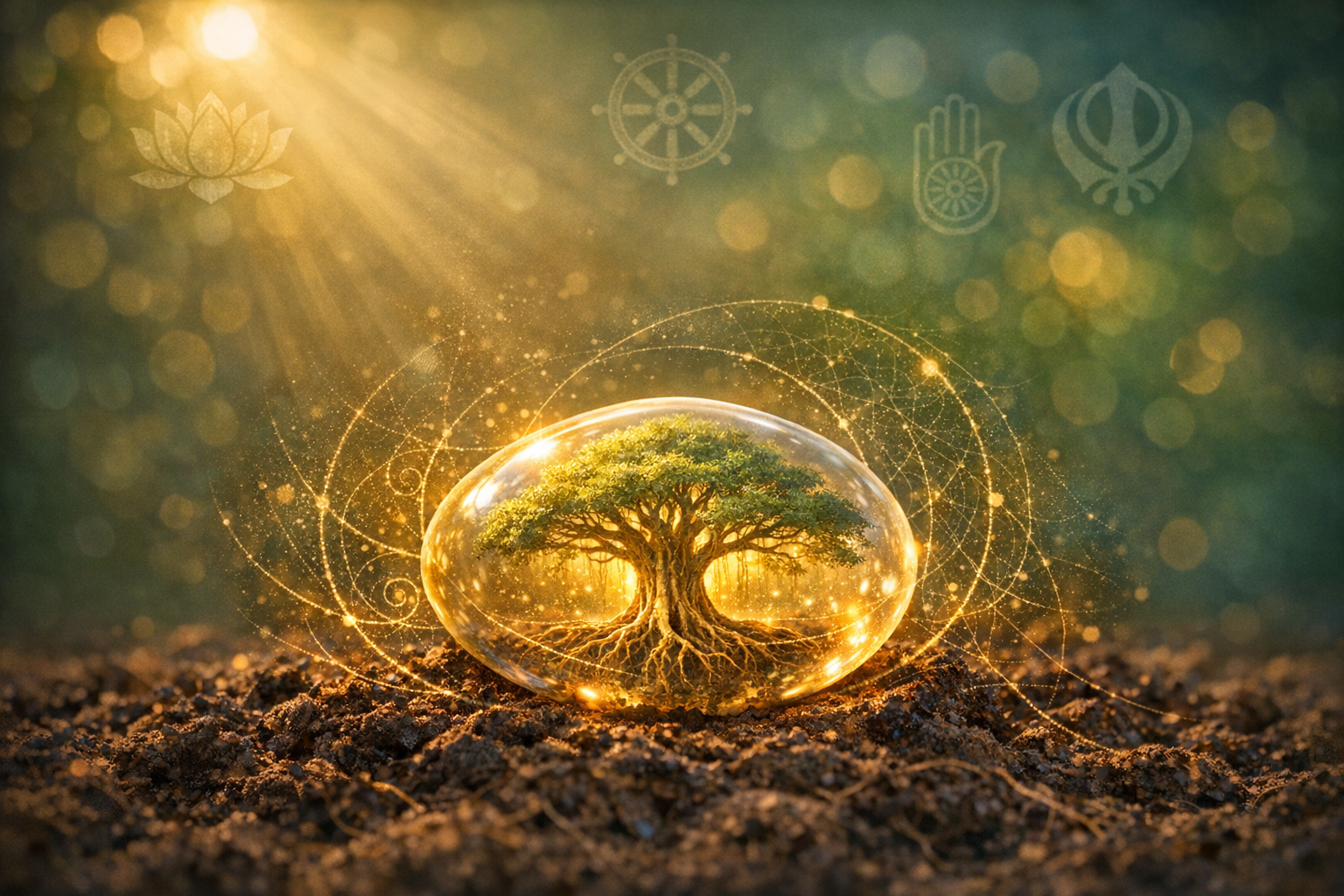
Hindu philosophy often describes spiritual vision as the capacity to perceive wholeness within the smallest fragment of reality. The emblematic image is a seed that, to ordinary sight, appears as a mere speck of matter, yet to trained insight discloses a complete, flowering, fruiting tree. This way of seeing is not poetic excess but a disciplined perception that integrates metaphysics, embodied practice, and an ethic of reverence for life.
The Chandogya Upanishad presents a paradigmatic teaching through the banyan fruit. A student is asked to split the tiny seed and say what is seen. “Nothing,” comes the reply. Yet from that subtle essence arises the vast banyan. The instruction culminates in the mahavakya tat tvam asi, affirming that the subtle essence pervading all is not elsewhere but at the heart of selfhood. Seeing the tree in the seed thus becomes a contemplative exercise in recognizing the unity of the macrocosm and microcosm.
Another classical image comes from the Mundaka Upanishad, which declares, yathornanabhih srijate grhnate cajust as a spider projects and withdraws its web, so does the world arise from and return to the imperishable. Seeds, webs, sparks, and hair from a living body are metaphors for emergence from an unexhausted source. They illuminate a key Vedantic intuition: potentiality is not emptiness but plenitude, and manifestation is patterned by intelligence rather than accident.
Advaita Vedanta sharpens this insight with its analysis of sat-chit-ananda as the ground of being. The seed is not imagined to contain a miniature tree; rather, it bears the ordered conditions by which the tree becomes. The relation is not of physical inclusion but of ontological dependence and lawful unfolding. To perceive the whole in the part, therefore, is to grasp the continuity between being and becomingthe indivisible thread connecting all forms to Brahman.
Sankhya and Yoga complement this account through the language of guna dynamics and samskara-bija. Potentials reside as seedsbijawithin the subtle body, sprouting as tendencies under conducive conditions. Practice (abhyasa) and dispassion (vairagya) are described as methods for attenuating or transforming these seeds, indicating that spiritual growth follows intelligible principles, much like botanical growth responds to soil, moisture, and light.
Buddhist thought, especially in the Yogacara tradition, deploys the notion of bija within alayavijnana (storehouse consciousness) to explain how latent dispositions ripen into experience. This account of causal continuity converges with Hindu reflections on samskara while preserving a distinctive analysis of dependent origination (pratityasamutpada). The convergence illustrates a broader dharmic kinship: transformation is lawful, cumulative, and trainable across lifetimes of practice.
Jain philosophy contributes the doctrine of Anekantavada, the many-sided nature of truth. Seeing the tree in the seed is, in this light, an invitation to integrate multiple valid perspectives: botanical, ethical, contemplative, and metaphysical. Syadvada refines this by teaching that statements about reality are conditionally true, depending on standpoint. The comprehensive vision is not a single gaze but a harmonization of angleseach a facet of a greater whole.
Sikh teachings further deepen the shared dharmic vision through Ik Onkar and hukam. The law that sustains the cosmos also animates the smallest seed. Gurbani frequently deploys agricultural imageryjaisā bījai taisā phal pāvaito highlight moral and spiritual causality. The principle is universal and humane: cultivation shapes destiny. In this sense, to perceive the banyan in the seed is also to recognize the sacred in every beginning and to honor the responsibility inherent in sowing.
Contemporary botany substantiates the metaphor with rich detail. A seed comprises an embryo with meristematic tissues, nutritive endosperm or cotyledons, and a protective coat. Within its genetic and epigenetic architecture lies a dynamic regulatory networktranscription factors, signaling pathways, and hormonal gradients (auxins, cytokinins, gibberellins)that will orchestrate differentiation, vascularization, and fractal branching. Nothing inside is a ready-made tree; everything inside is a blueprint for becoming.
Systems science adds further clarity. From compact encodings, complex forms arise through iterative rules and feedback loops. Phyllotaxis patterns, logistic growth, and allometric scaling exhibit lawful regularities expressible in mathematics. The seed-to-tree arc is a case study in emergent order: initial conditions, constraints, and environmental affordances co-produce a stable yet adaptive organism. This mirrors classical Indian intuitions about rtacosmic orderwhere pattern and possibility coinhere.
Philosophically, the seed metaphor invites reflection on potentiality and actuality. Aristotle’s framework of dunamis and energeia resonates with Nyaya-Vaisheshika analyses of inherence (samavaya) and universals (samanya), and with Vedantic accounts of maya and vivarta. Across these lenses, potential is not unreal; it is the prefiguration of form awaiting suitable conditions. To call spiritual insight the art of seeing a tree in a seed is to affirm that wisdom apprehends powers, relations, and trajectories, not merely surfaces.
Indian thought often expresses this as pinda-brahmandathe individual as a reflection of the cosmos. The banyan seed becomes an experiential pointer: within the heart, subtle and unseen, dwells the capacity for boundless flowering. Ethical conduct and contemplative steadiness supply the sunlight, water, and soil for this flowering; community provides the forest within which individual trees mature without isolation.
This vision is cultivated through practice. In many Hindu lineages, bija-mantra japa refines attention and harmonizes internal rhythms. In Buddhist training, shamatha-vipashyana stabilizes and then clarifies awareness so causal textures can be discerned. Jain samayik builds equanimity, reducing the turbulence that scatters perception. Sikh simran attunes the heart to Naam, aligning action with hukam. The methods differ in form yet converge in function: they train perception to detect depth within the ordinary.
A simple contemplative exercise can exemplify this shared principle. Sit quietly with a seed, a leaf, or a single breath. Attend to its textures, origins, and dependencies: soil and rain, sunlight and microbial life, farmers’ labor and ancestral lineages of cultivation. Then sense the patterns mirrored withinhabit loops, latent aptitudes, aspirations. In time, the mind learns to register continuities between inner and outer ecosystems. This is practical Vedanta and living Dharma.
Ethically, the seed metaphor grounds ahimsa and stewardship. If a seed silently carries forests, then everyday choices carry futures. Aparigraha (non-hoarding) becomes ecological sanity; satya (truthfulness) becomes fidelity to interdependence. Jain vows, Buddhist precepts, Sikh seva, and the Hindu yamas and niyamas articulate a convergent ethic: nurture conditions that allow all beings to unfold their innate promise.
Socially, this outlook fosters unity in diversity. Different dharmic traditions may emphasize distinct methodsdevotion, inquiry, discipline, or serviceyet all tend the same garden of awakening. Diversity of practice is not a defect but a design feature of a plural civilization. The banyan’s canopy shelters many birds; likewise, a dharmic society shelters many authentic paths without coercion, trusting that lawful growth needs encouragement, not uniformity.
Educationally and creatively, seed-vision reframes talent and innovation. Rather than demanding immediate outcomes, it privileges careful sowing: foundational study, ethical formation, mentorship, and iterative practice. Over time, such cultivation yields resilience and originalityqualities prized in both spiritual life and civic leadership.
Misconceptions should be addressed. Seeing a tree in a seed is not naïve mysticism nor mere optimism. It is disciplined realism about causality and emergence. It acknowledges constraintsclimate, soil, diseasewhile insisting that wise intervention can reconfigure outcomes. In spiritual terms, karmic seeds may be strong, but practice and insight can redirect their ripening; in civic terms, structural limits are real, yet humane policy and shared effort can alter trajectories.
In the end, the seed teaches patience, confidence, and reverence. Patience, because growth has tempos that cannot be rushed. Confidence, because potential is expansive when conditions are rightly tended. Reverence, because every beginning holds a world. The ancient instruction to behold the whole in the part remains a living invitation to cultivate unity, depth perception, and compassionate action across all dharmic traditionsHinduism, Buddhism, Jainism, and Sikhismso that a flourishing forest may arise from the smallest of starts.
Inspired by this post on Hindu Blog.