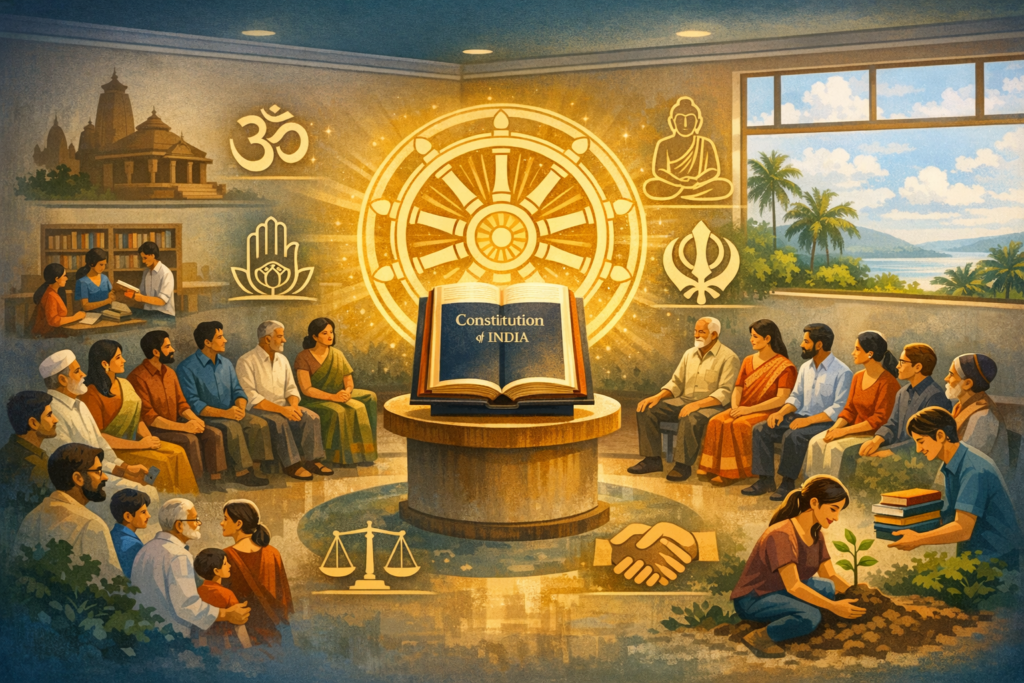
Relativity, interconnectedness, and impermanence are frequently discussed in global philosophy, yet in Sikh philosophy they appear not as abstractions but as rigorously integrated principles guiding how to know reality, how to live ethically, and how to realize liberation. Approached together through Gurmat (the Sikh way), these principles generate a coherent metaphysics rooted in the One, advanced by the discipline of the Shabad Guru, and directed toward sarbat da bhala—the welfare of all. This synthesis also resonates with kindred strands in Hinduism, Buddhism, and Jainism, strengthening unity across dharmic traditions while preserving the distinctiveness of Sikh teachings.
The foundational point of departure is the Mool Mantar, stated in Guru Granth Sahib: ੴ ਸਤਿ ਨਾਮੁ ਕਰਤਾ ਪੁਰਖੁ ਨਿਰਭਉ ਨਿਰਵੈਰੁ ਅਕਾਲ ਮੂਰਤਿ ਅਜੂਨੀ ਸੈਭੰ ਗੁਰ ਪ੍ਰਸਾਦਿ. Each term compresses a metaphysical claim. The One (ੴ) is the sole, unfragmented reality; Truth is Its Name (ਸਤਿ ਨਾਮੁ); the One is the creative agent (ਕਰਤਾ ਪੁਰਖੁ), beyond fear (ਨਿਰਭਉ) and enmity (ਨਿਰਵੈਰੁ), timeless (ਅਕਾਲ ਮੂਰਤਿ), unborn (ਅਜੂਨੀ), self-existent (ਸੈਭੰ), and knowable only through grace (ਗੁਰ ਪ੍ਰਸਾਦਿ). These claims set the horizon for all Sikh reflection on change, relation, and perspective.
Two complementary modalities of the Divine—nirgun (without attributes) and sargun (with attributes)—structure Sikh metaphysics. The nirgun mode safeguards transcendence and absoluteness; the sargun mode discloses immanence in the manifold world. Sikh philosophy thus avoids reduction: it neither collapses the Absolute into phenomena nor dismisses phenomena as mere illusion. Instead, it affirms a real, value-saturated cosmos pervaded by the One.
Hukam is the ordering principle that renders the cosmos intelligible and livable. Through hukam, causes flow into effects, moral life acquires accountability, and the rhythms of nature bear meaning. Japji Sahib urges alignment with this order—ਹੁਕਮਿ ਰਜਾਈ ਚਲਣਾ—so that cognition, action, and devotion harmonize with the law that is simultaneously metaphysical, moral, and spiritual.
Relativity, in Sikh thought, is not moral laxity; it is perspective-awareness within an absolute frame. Human positions are finite, language is indexical, and contexts shape perception. Recognizing the relativity of standpoint disciplines the tendency toward dogmatism while directing the mind toward the non-relative center: Ik Oankar. This is an epistemic humility that sharpens, rather than blunts, commitment to Truth.
This Sikh account of relativity fruitfully converses with Jainism’s anekāntavāda (many-sidedness) and syādvāda (qualified predication). Where Jain logic analyzes how statements may be true from particular standpoints, Sikh practice ties standpoint-awareness to the transforming presence of the Shabad Guru. The outcome in both is a principled restraint against absolutizing partial views, even as Sikh philosophy anchors all perspectives in the singular Real disclosed through grace.
Relativity also dialogs with strands of Vedānta that distinguish paramārthika (ultimate) from vyāvahārika (empirical) truth. Sikh metaphysics, however, maintains the world’s dignity as sargun revelation rather than dismissing it as a sheer negation. The empirical is not a mistake; it is the arena for seva (selfless service), simran (remembrance of the Divine Name), and ethical responsibility under hukam.
Interconnectedness follows from the Oneness of reality: if the same Light pervades all, then self, society, and nature form one living fabric. In practice, this is experienced through sangat (community), where shared devotion, kirtan, and service generate a palpable sense of mutual arising. Metaphysically, it means that relations are not accidental add-ons but constitutive of how the One is manifest in the many.
This Sikh emphasis meets Buddhism’s pratītyasamutpāda (dependent co-arising) at a profound point: beings are networked processes rather than sealed substances. Yet Sikh philosophy completes the picture with the positive claim that the One transcendent source—Waheguru—pervades and sustains the network. Interconnectedness thus becomes not only an ontological fact but a devotional and ethical summons.
Ecological and social ethics follow naturally. If the same Consciousness suffuses all life, exploitation appears as a metaphysical error as much as a moral one. The Sikh orientation to sarbat da bhala broadens compassion to the planetary scale, motivating stewardship, distributive justice, and restorative action. A dharmic consensus emerges here: Hindu care for dharma and ṛta, Buddhist compassion and non-harm, Jain ahiṃsā and restraint, and Sikh seva converge upon a shared ethos.
Impermanence is the third pillar. All conditioned forms pass; change marks every phenomenon. Sikh scripture repeatedly highlights transience to free the mind from clinging and to prioritize the Real. Where grasping binds, relinquishment liberates. Yet impermanence does not entail nihilism; it orients the seeker toward the Akal, the Timeless One, whose remembrance stabilizes life amid flux.
Compared with Buddhism’s anicca, Sikhism emphasizes that while forms decay, the Divine pervasiveness does not. Hence, engagement with the world—family, craft, governance, arts—is not abandoned but purified. Detachment (vairāg) in Sikh praxis is compatibility with renunciation-in-action: living fully without possessiveness, serving without self-display, remembering without anxiety.
Māyā in Sikh philosophy names not a second reality but a cognitive and volitional distortion: the appearance of separateness through haumai (ego). Māyā becomes intoxicating where identity narrows to self-centeredness. Impermanence exposes the fragility of such ego-structures; interconnectedness discloses their falsity; and relativity prevents reifying one’s own perspective into an idol.
Haumai is, therefore, the central spiritual problem. Under its sway, relativity degrades into cynicism, interconnectedness is ignored in favor of competition, and impermanence births fear rather than freedom. By contrast, under Naam—Divine remembrance—relativity becomes humility, interconnectedness becomes compassion, and impermanence becomes serenity. The transformation is catalyzed by the Shabad Guru, not by willpower alone.
Epistemologically, Sikh philosophy gives primacy to revealed hearing (śravaṇ) of the Shabad within the living sangat of practice. Reason, moral intuition, and experience retain real roles, yet Shabad governs, integrates, and corrects them. Knowledge is thus relational: knowing arises in attunement to hukam, not in sovereign isolation.
Ontologically, the nirgun–sargun polarity protects two truths at once: the Absolute exceeds all predicates, and the Absolute self-communicates through all predicates. This polarity interprets impermanence without despair and interconnectedness without pantheistic flattening. It also explains why Sikh devotion is both contemplative (simran) and active (seva), personal and universal.
In soteriological terms, liberation (mukti) is not flight from the world but freedom within it—ego-thinning through Naam, ethical ripening through seva, and aesthetic refinement through kirtan and remembrance. Time’s flow (kāl) remains, yet its tyranny lifts under the shelter of the Akal. The fruit is chardī kalā—ever-ascending resilience, unshaken by loss or success.
Consider a practical triad of disciplines. For relativity: cultivate perspective-taking in dialogue, consciously restating the strongest form of another’s view before presenting one’s own, while returning repeatedly to Ik Oankar as the non-relative reference. For interconnectedness: embed service in daily routine—feeding, healing, teaching—so that relationship becomes the teacher. For impermanence: maintain a death-awareness practice that prioritizes what endures—Naam, character, and contribution.
A dharmic synthesis highlights common ground without erasing differences. Jain anekāntavāda supports Sikh perspective-discipline; Buddhist anicca clarifies Sikh counsel to let go; Vedāntic attentiveness to the nondual points toward Sikh insistence on the One. The Sikh insistence that the world is the field of Divine play, however, guards against world-denial and orients all three principles toward compassionate engagement.
Interfaith dialogue gains traction from this framework. A humility-suffused relativity softens polemic. A metaphysics of interconnectedness nurtures solidarity across communities. A contemplative embrace of impermanence lowers the temperature of identity anxieties. Together, they yield a durable basis for coexistence and cooperation among Hindu, Buddhist, Jain, and Sikh practitioners.
In ethical life, the triad disciplines three distortions: certainty without humility (dogmatism), agency without empathy (exploitation), and attachment without wisdom (anxiety). Policies, institutions, and educational curricula shaped by these correctives move societies toward justice and sustainability. Sikh philosophy contributes both a metaphysical grammar and practices that scale from the individual to the collective.
In science-and-spirit conversations, it is important not to conflate philosophical relativity with physical relativity. Yet the intellectual habit of situating frames of reference—central to modern science—rhymes with the Sikh caution against absolutizing limited views. Similarly, ecological network thinking echoes metaphysical interconnectedness, and studies of life-course change resonate with impermanence. Sikh thought, however, keeps these observations oriented by hukam and illuminated by the Shabad.
Pedagogically, teaching these principles benefits from a spiral method. Begin with Mool Mantar as axiomatic vision; introduce hukam as the integrative law; then unfold relativity, interconnectedness, and impermanence with case studies in community service, conflict resolution, and end-of-life care. Throughout, keep simran and seva as the living laboratories where concepts become dispositions.
Spiritually, three touchstones sustain alignment. First, remembrance: steady recitation and contemplation of Naam quiets the self’s craving for certainty and control. Second, service: concrete acts of care translate metaphysics into neighbor-love. Third, sangat: the community mirrors back blind spots and supports growth in humility, compassion, and courage.
The result is a life that thinks clearly, feels deeply, and serves steadfastly. Relativity educates the mind to be exact without being harsh. Interconnectedness educates the heart to be wide without becoming vague. Impermanence educates the will to be free without becoming indifferent. Under hukam and by ਗੁਰ ਪ੍ਰਸਾਦਿ, these become habits of being.
For dharmic unity, this Sikh articulation offers a shared platform: one reality everywhere present; a world genuinely worthy of care; perspective-discipline as an ethical duty; compassion as the outflow of metaphysics; and freedom as the fruit of non-clinging. Traditions can meet here without erasure, exchanging gifts that strengthen all.
In sum, Sikh philosophy holds relativity, interconnectedness, and impermanence in a higher synthesis under Ik Oankar and hukam. This synthesis honors all partial truths while orienting them to the One; it affirms community and cosmos as sacred disclosures; and it liberates the seeker for fearless service in a transient world. Such clarity, shaped by Shabad and sealed by grace, is not only intellectually satisfying; it is civilizationally healing.
Inspired by this post on SikhNet – News.