The meaning of Panchamukhi Ganapati rests on a foundational idea in Hindu philosophy and practice: the five-faced manifestation of Ganesha symbolizes conscious mastery over the five elements and the five senses, aligning the microcosm of the individual with the macrocosm of creation. In this form, Ganesha is not only Vighneshwara, remover of obstacles, but also the integrator of perception, action, and awareness across fivefold realities that pervade Vedic and yogic thought.
Classical texts provide a clear doctrinal basis for this symbolism. The Ganapati Atharvashirsha identifies Ganesha with the very fabric of existence through the declaration tvam bhūmir āpo tejo vāyur ākāśaḥ, affirming his identity with Earth, Water, Fire, Air, and Ether. This affirmation places Panchamukhi Ganapati within an unmistakable framework of the pancha mahabhutas, where divinity is the ground and goal of elemental reality.
This fivefold schema extends naturally to the senses. Human life is mediated by five jnanendriyas—sight, smell, touch, taste, and hearing—whose refinement is central to sadhana. In the Panchamukhi Ganapati meaning, each face is traditionally contemplated as presiding over one sense, suggesting balanced perception, restraint, and clarity in engagement with the world. By implication, the five karmendriyas—speech, hands, feet, generative organ, and excretory organ—also come under his governance, internalizing self-mastery in thought, word, and deed.
Iconographically, Panchamukhi or Panchamukha Ganapati is commonly depicted with four faces oriented to the cardinal directions and a fifth face directed upward. Many iconographers relate these to the Shaiva Panchabrahma functions—creation, preservation, dissolution, concealment, and grace—mapped respectively to Sadyojata, Vamadeva, Aghora, Tatpurusha, and Ishana. Though developed in Shaiva theology, this mapping is widely adopted in Ganesha symbolism to express total guardianship over the spatial and subtle dimensions of life.
The correspondence to yogic physiology deepens the meaning. Five primary pranas—prana, apana, samana, udana, and vyana—govern respiration, elimination, assimilation, ascent, and circulation. In contemplative practice, Panchamukhi Ganapati is visualized as harmonizing these pranic flows, stabilizing attention and facilitating pratyahara, the inward turning of the senses described in classical Yoga. The five faces thus become a mandala of breath, energy, and awareness.
Similarly, the five sheaths or pancha koshas—annamaya, pranamaya, manomaya, vijnanamaya, and anandamaya—offer another technical lens. Devotional meditation situates Ganesha as the witness-consciousness permeating and sanctifying body, vitality, mind, discernment, and bliss. Contemplation of the five faces across the five koshas supports integrative sadhana: nourishment becomes sacred, breathing becomes prayer, thought becomes lucid, insight becomes ethical, and contentment becomes steady.
Within the broader corpus on Ganesha forms, it is useful to note that texts such as the Mudgala Purana enumerate multiple iconographic variants, including Heramba Ganapati, who is five-faced, ten-armed, and lion-mounted. Many devotional lineages treat Panchamukhi Ganapati as a generic epithet for five-faced forms, while others preserve a distinction between Heramba (a specific tantric form) and a more general Panchamukhi icon. Both approaches agree on the core import: fivefold completeness and protection in all directions.
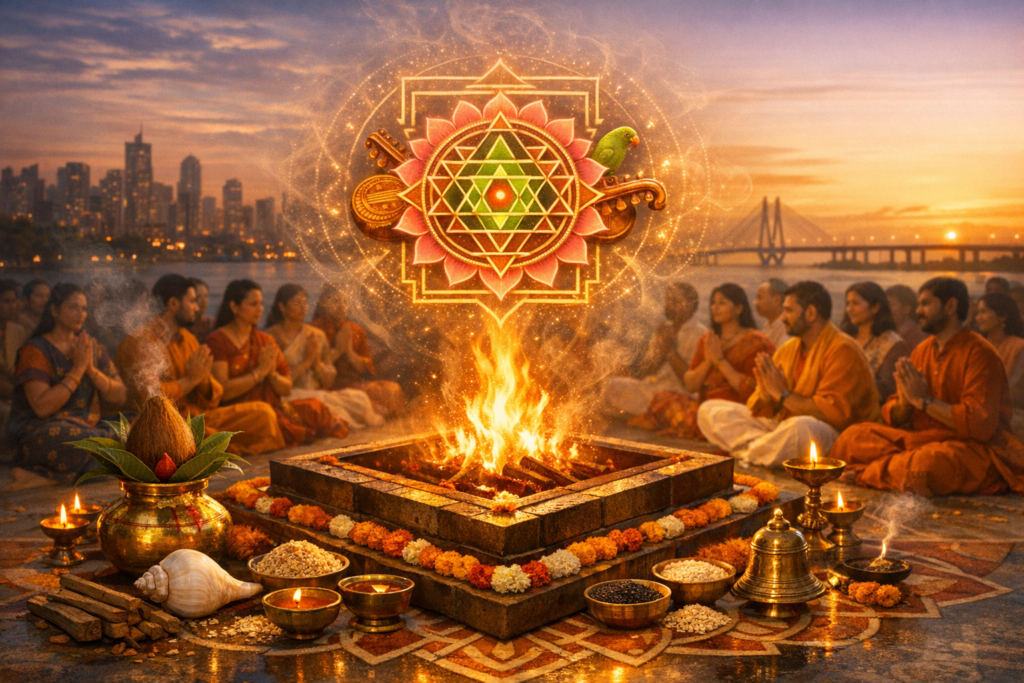
Ritual practice reflects this fivefold grammar. Panchopachara—offering of fragrance, flower, light, incense, and food—beautifully echoes the five-element matrix when worshiping Panchamukhi Ganapati, though Shodashopachara is also common in many homes and temples. Auspicious observances such as Vinayaka Chaturthi and Sankashti Chaturthi often include recitation of the Ganapati Atharvashirsha, whose elemental declarations strengthen the theological continuity between mantra and murti.
For meditation, practitioners frequently adopt a structured approach. Beginning with Om Gam Ganapataye Namaha, attention is directed to the five senses one by one: sight is offered to clarity, smell to purity, touch to compassion, taste to moderation, and hearing to truthfulness. In parallel, the breath is gently aligned with the five pranas. The visualization of five faces—radiant, serene, and encompassing—anchors pratyahara and deepens dharana, preparing the mind for sustained insight.
Householders often report a palpable steadiness when beginning the day with such contemplation. In the overstimulation of digital life, this fivefold orientation trains attention to remain spacious yet discerning. Over time, devotees describe fewer impulsive reactions, more mindful speech, and a grounded sense of inner abundance—concrete signs that the five senses serve wisdom rather than habit.
Placement of a Panchamukhi Ganapati murti at home generally follows the dharma of local sampradaya and family tradition. Common guidelines emphasize a respectful, clean, and calm space facing a devotional axis such as east or north. More important than directional minutiae, however, is consistent practice—mantra recitation, simple offerings, and a short daily meditation that ties sense-restraint to ethical action in family and community life.
Interpreting Panchamukhi Ganapati in a wider dharmic frame also fosters unity across traditions. Fivefold structures pervade Indic spirituality: the pancha mahabhutas and indriyas in Hindu philosophy, the five skandhas in Buddhism as an analysis of experience, the five mahavratas or foundational vows in Jainism that stabilize conduct, and the formative role of the Panj Piare in Sikh tradition as exemplars of disciplined devotion. While each tradition is distinct, this shared grammar of five speaks to a common quest for ethical clarity, spiritual balance, and compassionate community.
From a scholarly perspective, the robustness of Panchamukhi symbolism lies in its multi-layered coherence—elemental, sensory, pranic, cognitive, and soteriological. The form becomes a pedagogical device that unites metaphysics with practice, encouraging aspirants to test ideas in lived experience. Whether approached through bhakti, yoga, or a contemplative synthesis, the five faces invite integrative growth rather than fragmented effort.
It is also helpful to clarify two common questions. First, the terms Panchamukhi Ganapati and Heramba Ganapati sometimes overlap in devotional usage; iconographic manuals may distinguish them, but the spiritual purpose—comprehensive protection and empowerment—remains aligned. Second, the directional mapping of faces varies regionally; any schema that keeps the upward face as the transcendent axis while distributing the other four to the cardinal directions is consistent with the underlying doctrine.
Ultimately, the meaning of Panchamukhi Ganapati can be summarized as mastery infused with mercy. As lord of thresholds, Ganesha teaches that the world’s fivefold beauty need not entangle awareness; rightly approached, it refines character and widens compassion. The five faces thus stand as an invitation to harmonize the senses, align with the elements, and participate consciously in the sacred fabric of life.
Inspired by this post on Hindu Pad.