
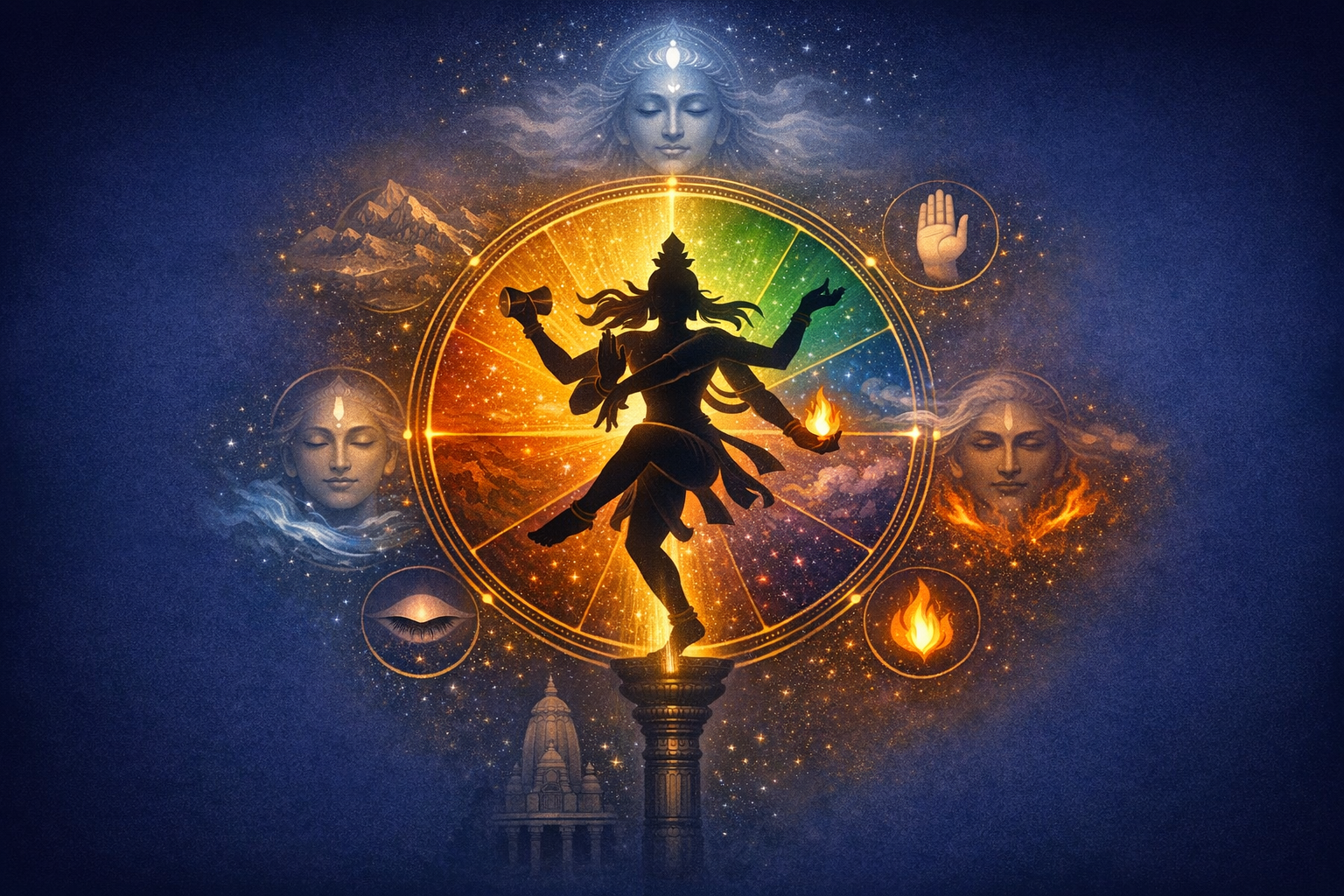
At the heart of Shaiva philosophy stands a precise and transformative intuition: the universe is not something Shiva fabricates and rules from beyond; rather, the universe is Shiva’s own being in ceaseless expression. Within this vision, two interlocking doctrines provide the clearest lens for understanding cosmic process and human liberation—Panchakritya, the fivefold activity of Shiva, and Panchabrahma, the five faces or modes through which those activities are manifested. Together, they ground a theology that is metaphysically rigorous, ritually embodied, and spiritually inclusive.
Panchakritya delineates five continuous functions through which reality unfolds: srishti (emanation or creation), sthiti (sustenance or preservation), samhara (reabsorption or dissolution), tirobhava/tirodhana (concealment or veiling), and anugraha (grace or liberation). These are not episodic events in distant time but concurrent dynamics present in every moment of experience. In Shaiva Siddhanta, Kashmir Shaivism, and the Agamic tradition, they describe both the architecture of the cosmos and the interior movements of consciousness, establishing a bridge between cosmology and soteriology.
Panchabrahma articulates the five faces or modalities of Shiva—Sadyojata, Vamadeva, Aghora, Tatpurusha, and Ishana—each associated with one of the five acts. A common traditional mapping (noting that schools sometimes vary) aligns Sadyojata with srishti (often facing west and linked with the earth element), Vamadeva with sthiti (north; water), Aghora with samhara (south; fire), Tatpurusha with tirobhava (east; air), and Ishana with anugraha (zenith; ether). The philosophical intent is consistent across lineages: these are not separate deities but five functional faces of the one undivided Shiva.
The iconic image of Shiva Nataraja distills Panchakritya into a single luminous form. The damaru (drum) in the upper right hand signifies srishti, the beat of manifestation; the abhaya-mudra in the lower right reassures and preserves, embodying sthiti; the flame in the upper left dissolves forms in samhara; the dwarf Apasmara under the right foot represents the concealment of knowledge through forgetfulness, a vivid symbol of tirobhava; and the uplifted left foot, paired with the gesture of grace, bestows anugraha. The circular prabhamandala encasing the dance names the perpetual rhythm of emergence, duration, withdrawal, veiling, and illumination.
Textual foundations for these doctrines are broad and deep. Vedic strata (notably the Satarudriya/Sri Rudram within the Taittiriya tradition) revere Rudra-Shiva as the pervasive principle in all forms. Later Aranyaka and Upanishadic materials, as well as the Panchabrahma-related recitations preserved in ritual lineages, amplify the fivefold schema. Shaiva Agamas (for example, Kamikagama and allied manuals) and Purana literature (including the Shiva Purana, Linga Purana, and sections of the Skanda Purana) normalize these teachings liturgically and iconographically, ensuring that metaphysics, worship, and ethics are integrated.
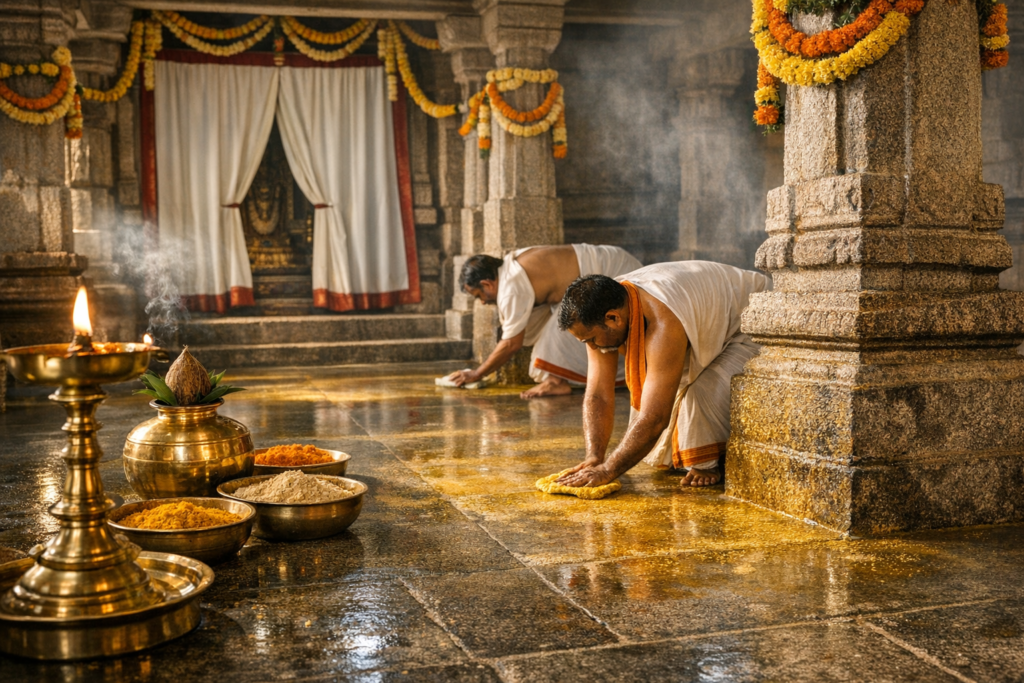
Ritual praxis encodes Panchabrahma and Panchakritya at multiple levels. In daily puja, mantric invocations linked to the five faces sanctify space, body, and intention through nyasa and visualization; in temple consecration (prana-pratishtha), the five functions are ritually invoked to “install” presence in ways that mirror the cosmic acts themselves. The Panchamukha linga and five-faced depictions in sculpture communicate the same unity-in-diversity to congregations through form, gesture, and directionality.
Temple architecture further witnesses to the doctrine. Orientation of sancta, directional guardianship, and the vertical axis culminating in the shikhara evoke the five-directional spread of the faces, with Ishana at the apex symbolizing the ever-free dimension of grace. The Lingodbhava motif, prevalent in South Indian art, teaches that even the search for Shiva’s “beginning” or “end” dissolves into recognition of the boundless, which is at once immanent and transcendent.
Philosophically, Panchakritya clarifies how bondage and liberation are two sides of one continuum. Concealment (tirobhava) is not a cosmic error but a pedagogical device within consciousness that makes individuality, learning, and relationship possible. Anugraha, in turn, is not an external intervention but a revealing of what has always been true—Shiva as the ground of awareness. In Shaiva hermeneutics, the five acts constantly resolve dualities: they explain change without denying permanence, and they affirm permanence without freezing the living pulse of creation.
Practitioners consistently find that the five acts mirror inner life. New ideas arise (srishti), gain stability through discipline (sthiti), old habits fall away (samhara), blind spots obscure clarity (tirobhava), and insight returns with unexpected tenderness (anugraha). In meditation and yoga, aligning breath and attention with these phases becomes a contemplative grammar for self-understanding—scholars sometimes correlate these to the five elements, five sheaths (pancha kosha), and five vital winds (pancha prana) to illustrate how metaphysics, physiology, and psychology converge in a single integrative framework.
Resonances across dharmic traditions affirm the plural yet unified spirit of this doctrine. In Buddhism, the cycle of arising, abiding, and passing away (uppada, thiti, bhanga) echoes the first three acts, while the unveiling of insight parallels the move from concealment to grace without positing a creator separate from phenomena. Jain philosophy’s reflections on karmic obscurations and the path to kevala jnana mirror tirobhava and anugraha as moral-epistemic processes. Sikh thought situates creation, preservation, and dissolution within Hukam, with grace experienced through remembrance of the One (Ik Onkar). Such convergences underscore a shared civilizational intuition: diversity of expression can harmonize around a single compassionate truth.
Historically, the fivefold schema matured as Vedic, Agamic, and regional devotional currents interacted. South Indian temples developed particularly sophisticated Nataraja iconography, while philosophical schools elaborated mappings between the five acts and tattvas, mantras, and yogic practices. Across Southeast Asia, artistic citations of Shiva’s dance further disseminated these ideas, demonstrating how metaphysical grammar travels with art, law, and ritual.
Relations with the Trimurti can be read pedagogically rather than polemically. Many teachers reconcile popular intuition by associating srishti with Brahma, sthiti with Vishnu, and samhara with Rudra, while retaining tirobhava and anugraha as distinctively Shaiva. This integrative approach invites unity-in-diversity: different languages for the same mercy of being, each emphasizing ethical action, contemplative depth, and reverence for life.
For householders and monastics alike, Panchakritya becomes practical when lived as a cycle of wise engagement. Creating responsibly (srishti), maintaining what is just (sthiti), relinquishing what is harmful (samhara), acknowledging limits and biases (tirobhava), and opening to compassionate clarity (anugraha) collectively nurture character, community, and ecological care. Many testify that contemplating the five acts daily—sometimes by dedicating five mindful breaths to each phase—yields steadiness in adversity and humility in success.
Two misunderstandings warrant clarification. First, the five faces are not separate gods competing for authority; they are functional names for one reality. Second, dissolution and concealment are not “negative”; without endings, renewal would stall, and without veiling, individuality would never discover freedom. In all trustworthy Shaiva sources, the five acts culminate in anugraha—an assurance that the cosmos tilts toward awakening.
In sum, Panchabrahma and Panchakritya present a robust, testable metaphysics: elegant enough to model galaxies and subtle enough to read the human heart. They expound a universe where creation is compassion, maintenance is responsibility, dissolution is release, concealment is pedagogy, and grace is recognition. Read through Nataraja’s dance and the scriptures of the Veda, Agama, and Purana, the five acts invite seekers across Hinduism, Buddhism, Jainism, and Sikhism into a shared grammar of wisdom—many paths, one radiance, and a single, ever-dancing truth.
Inspired by this post on Hindu Blog.







Leave a Reply
You must be logged in to post a comment.