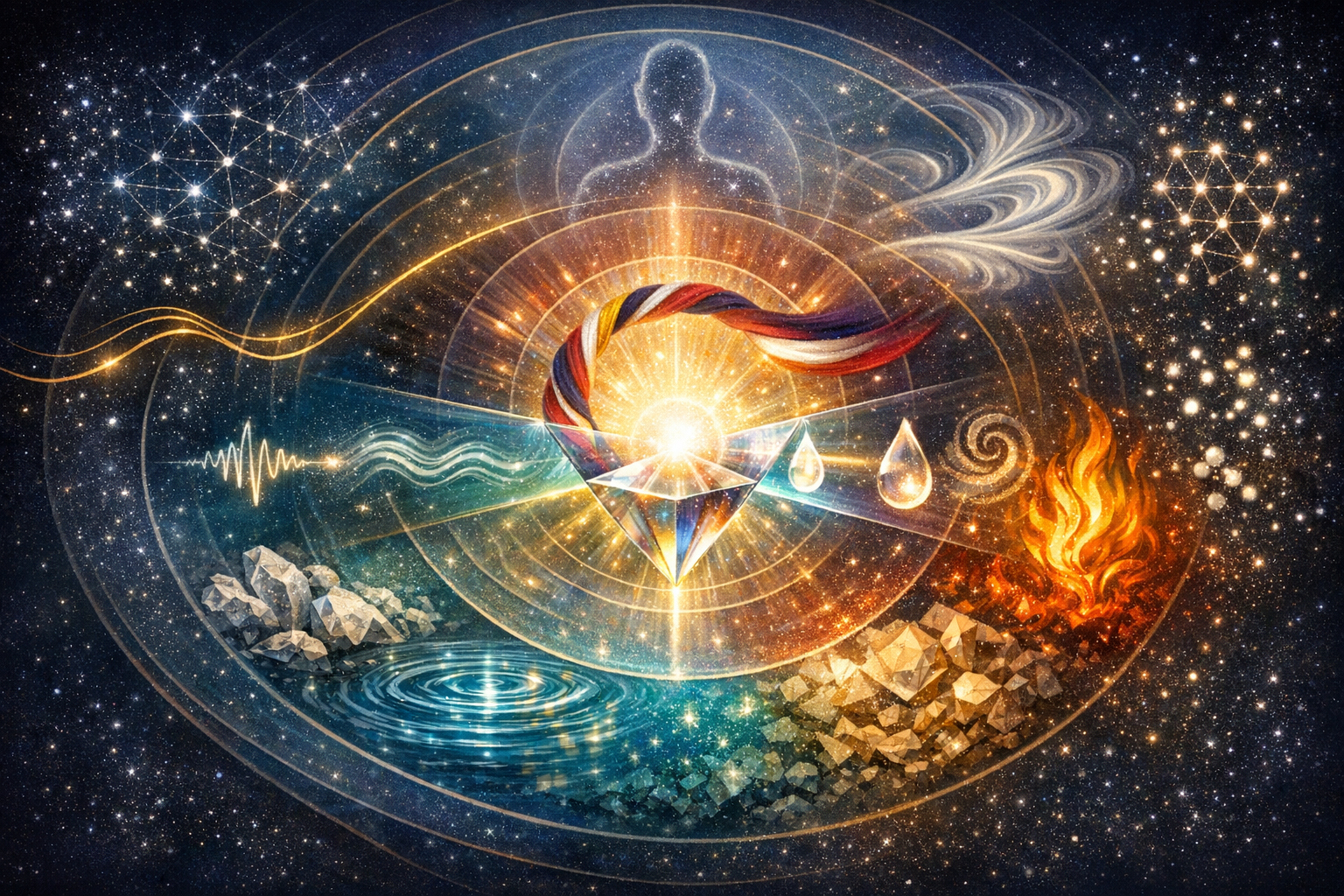
Mahatparinama, literally the transformation of the Great (mahat), names a profound insight in Hindu philosophy: reality continuously unfolds from the subtle (sukshma) into the manifest (sthula). This idea threads through the Hindu darshanas, offering both a cosmological map and a contemplative lens. Read as a unifying theme rather than a sectarian doctrine, Mahatparinama highlights how order, intelligibility, and experience emerge from latent potential across the spectrum of beingphysical, psychological, and spiritual.
In classical Samkhya, mahat or mahattattva denotes cosmic intelligence, the first manifest principle to arise when Prakriti (primordial nature) is perturbed by the mere proximity of Purusha (witness-consciousness). From mahat evolves ahamkara (the principle of individuation), and from its modalities proceed the senses, mind, subtle elements (tanmatras), and the gross elements (mahabhutas). Within this system, Mahatparinama identifies the cascade by which the unmanifest potential of Prakriti articulates into a structured, knowable universe without invoking creation ex nihilo.
Vaisheshika Darshana, by contrast, approaches the subtle-to-manifest arc through an atomistic and categorical analysis. Its early atomic theory posits indivisible paramanus whose intrinsic motion (parispanda) and lawful combinations (dyads, triads, and higher aggregates) yield the fabric of the physical world. While Vaisheshika does not employ the term mahat, it nevertheless explains manifestation as a rule-governed transformation of subtle constituents into gross bodies, thereby engaging the same philosophical concern: how does the seen world arise from the unseen?
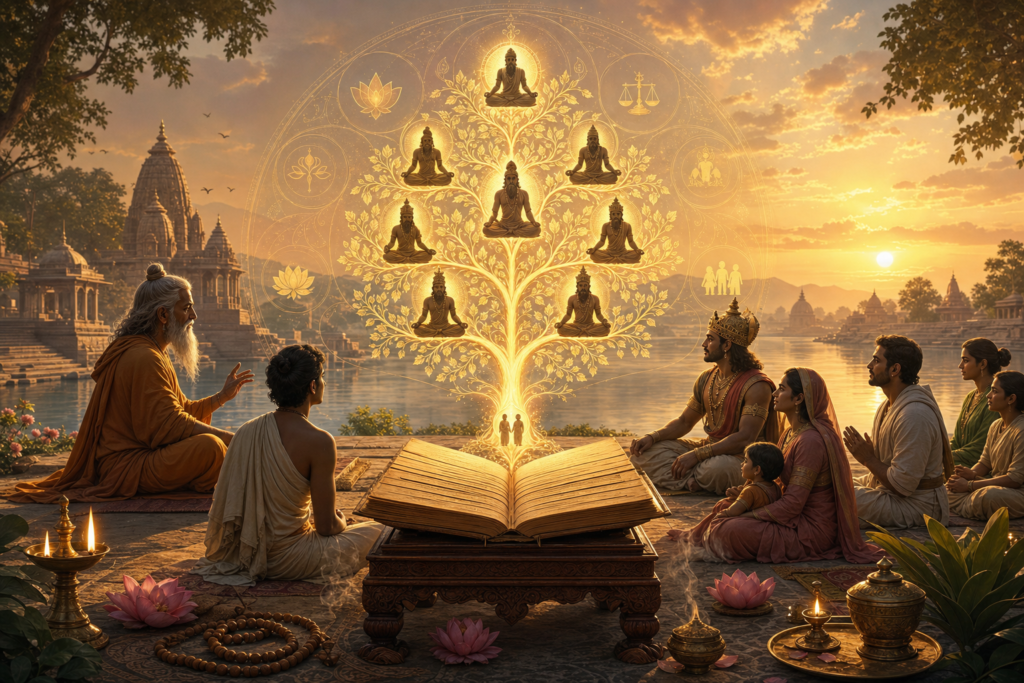
To situate Mahatparinama precisely, Samkhya’s sequence can be outlined conceptually. In the equilibrium of Prakriti’s three gunas (sattva, rajas, tamas), no manifestation occurs. Disturbance of this balance births mahat (cosmic buddhi), which imparts luminosity, determinative knowledge, and the capacity for order. Ahamkara then individuates this intelligence into the sense of “I,” becoming the seedbed for both experiential subjectivity and the diversified cosmos.
From ahamkara, three streams flow in Samkhya’s subtle-to-gross logic. The sattvika stream yields the mind (manas) and the cognitive and conative faculties (jnanendriyas and karmendriyas), enabling knowledge and action. The tamasika stream gives rise to the tanmatrassound, touch, form, taste, and smell as subtle potentialswhich further condense into the five mahabhutas: akasha, vayu, agni, ap, and prithvi. The rajasika stream energizes the process, mediating motion and transformation. Mahatparinama, so understood, is the intelligible rhythm through which latent potential differentiates into experienceable reality.
The sukshma-sthula distinction frames this rhythm. Subtle entitiesmental functions, impressions (samskaras), and tanmatrasmediate the passage from formless potentials to tangible forms. In lived experience, this dynamic is mirrored whenever thought precipitates speech and action, or when intention solidifies into habit and character. The human microcosm thereby recapitulates the cosmological movement: subtle determines gross, even as the gross conditions the subtle.
Vaisheshika complements this account with rigorous ontological categories (padarthas): substance (dravya), quality (guna), motion (karma), universal (samanya), particularity (vishesha), inherence (samavaya), and later, absence (abhava). Physical manifestation proceeds through the conjunction and disjunction of atoms, governed by time (kala), adrishta (unseen causal residues or merits), and natural motion. The theory remains empirical in spirit, inviting inference from perceptible effects to imperceptible causesa hallmark of Nyaya-Vaisheshika epistemology.
These two frameworks also illuminate a classical causality debate. Samkhya’s satkaryavada holds that the effect pre-exists in its material cause; manifestation is transformation (parinama), not origination from nothing. Nyaya-Vaisheshika’s asatkaryavada and arambhavada maintain that the effect is a new beginning, not merely a rearrangement disclosed in the cause. Mahatparinama can be read as the Samkhya-prioritized contour of this debate, yet the Vaisheshika lens still clarifies the stepwise emergence of gross composites from ultrafine substrates.
In Vedanta, parinama becomes a philosophical pivot. Vishishtadvaita embraces real transformation in the relation between Brahman and the world, while Advaita Vedanta construes the world’s appearance as vivarta (apparent transformation) upon the nondual substratum, Brahman. Dvaita underscores difference, and Achintya Bhedabheda affirms inconceivable simultaneous difference-and-non-difference. Across these positions, Mahatparinama remains a hermeneutic key: what is truly transformed, and what only appears so?
Yoga philosophy interiorizes parinama as citta-parinamathe transformation of the mind-stuff. Nirodha-parinama (stilling), samadhi-parinama (integration), and ekagrata-parinama (one-pointedness) describe refined shifts in attention and disposition through abhyasa (practice) and vairagya (dispassion). This inner Mahatparinama traces how the subtle scaffolding of experience can be methodically stabilized, revealing the knower beyond the flux of mental modes.
Upanishadic insights triangulate these themes. Taittiriya maps the person through the five koshas from annamaya (gross) to anandamaya (subtle-delight), articulating a graded interiorization that mirrors Mahatparinama’s arc. The Katha and Mundaka Upanishads intimate how the subtle ground (Brahman/Atman) gives rise to manifested multiplicity without forfeiting unity, a view that nourishes the interpretive range of Vedanta.
Epistemologically, the darshanas deploy pramanas to responsibly infer the subtle. Samkhya prizes perception (pratyaksha), inference (anumana), and reliable testimony (shabda); Nyaya-Vaisheshika elaborates four pramanas, adding comparison (upamana). These methods restrain speculation while legitimizing warranted conclusions about the unobservedfrom latent dispositions to atomsanchoring Mahatparinama in disciplined reasoning rather than unbounded conjecture.
In Buddhism, especially Abhidharma, momentariness (ksanikavada) and dependent origination (pratityasamutpada) illuminate how complex, gross phenomena arise from rapid, subtle successions of conditioned events without positing a permanent self (anatman). While differing from Samkhya’s Purusha-Prakriti dualism, the shared attention to lawful emergence bridges a conceptual kinship: manifest experience rests uponand can be traced back tofiner causal matrices.
Jain philosophy centrally features parinama (modification) as an intrinsic property of dravya (substance), articulated through the dravya–guna–paryaya schema and enriched by anekantavada (many-sidedness). The interplay of karmic matter (pudgala) with jiva is framed through graded transformationssubtle to gross and backrendering liberation (kevala) a process of attenuating and finally shedding karmic obscurations. This deepens Mahatparinama by emphasizing that transformation pervades all substances without annihilating their core identities.
Sikh thought evokes a luminous synthesis through the interplay of nirgun (formless) and sargun (manifest) under Hukam (cosmic order). The world arises, abides, and dissolves in consonance with the Divine Will, with the Shabad (sacred sound) as the sustaining current. The subtle-to-manifest movement is thus devotional and ontological, fostering a way of life in which inward attunement and outward action harmonize.
Read together, these dharmic perspectives underscore unity-in-diversity. Whether speaking of mahat, paramanu, dharmas, or dravya–paryaya, each tradition converges on a shared intuition: reality unfolds through intelligible, layered transformations. Mahatparinama, therefore, becomes a bridge-concepthonoring distinct doctrines while illuminating their common quest to understand emergence, meaning, and liberation.
The soteriological import is decisive. In Samkhya-Yoga, discerning the distinction between Purusha and Prakriti culminates in kaivalya (aloneness), a freedom established by seeing all modifications as belonging to Prakriti alone. In Vedanta, the recognition of Brahman as the nondual ground reveals the apparent nature of transformation. In Buddhism and Jainism, the insight into conditioned arising and pervasive modification guides the attenuation of suffering and karmic bondage, respectively; in Sikhism, remembrance of the Divine within Hukam stabilizes ethical and contemplative life.
Contemplative practice makes this philosophy experiential. Mindful observation reveals how intention precipitates speech and action; breath (prana) mediates shifts in attention and mood; and focused meditation discloses subtler strata of cognition. As attention refines, one perceives how sukshma dynamics shape sthula outcomesconfirming, in lived terms, the logic of Mahatparinama.
Modern discourse can draw careful analogies without collapsing categories. Emergence in complex systems, phase transitions in physics, and layered descriptions in cognitive science resonate with the subtle-to-manifest motif. Yet Hindu philosophy stakes a broader claim: transformation is not merely structural or functional but also ethical and soteriological, culminating in freedom, clarity, and compassion.
Terminological clarity strengthens interpretation. Mahat is not an anthropomorphic mind but a cosmic determinative intelligence; ahamkara is not vanity but the principle that individuates experience; tanmatras are not sensory atoms but subtle potentials that condition perception; and mahabhutas are not merely the chemical elements but proto-physical categories structuring gross experience.
Across cycles of creation and dissolution (srishti–pralaya), Hindu systems emphasize continuity of lawfulness. Samkhya invokes the restless rebalancing of gunas; Vaisheshika points to the inherent motion of atoms and the ordering role of kala and adrishta. The world appears and withdraws in rhythmic fidelity to its subtle grounds, never departing from intelligibility.
Practical wisdom follows. Recognizing how subtle impressions engender gross patterns encourages ethical vigilance, steady abhyasa, and community-minded living. It inspires inter-traditional dialogue, where terminological differences serve as avenues for mutual illumination rather than boundaries of separationa fitting fulfillment of Mahatparinama as an insight into unity expressed through diversity.
In sum, Mahatparinama offers an elegant, testable grammar of becoming: the subtle informs the manifest, and understanding that relationship liberates. Through Samkhya’s cosmology, Vaisheshika’s atomism, Vedanta’s metaphysics, Yoga’s inner technologies, and cognate reflections in Buddhism, Jainism, and Sikhism, the philosophy discloses a shared civilizational intuition. The unfolding of reality, rightly seen, becomes a path of knowledge, responsibility, and freedom.
Inspired by this post on Hindu Blog.