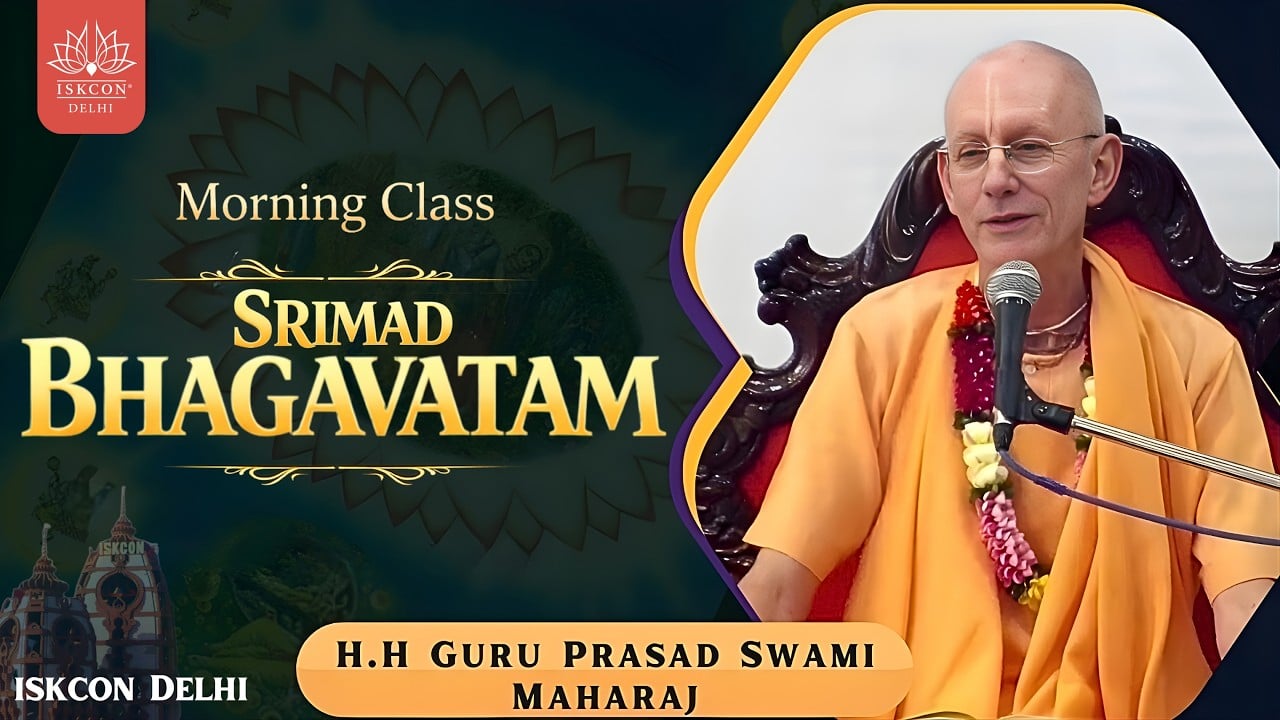
The morning Srimad Bhagavatam class by HH Guru Prasad Swami Maharaj at ISKCON Delhi centers on SB 7.7.55, a pivotal verse that foregrounds the telos of human life as exclusive devotional service to Govinda and the cultivated capacity to perceive the Divine everywhere. Set within the Prahlada narrative of Canto Seven, this teaching distills the essence of Bhakti Yoga: unwavering surrender, continuous remembrance, and an all-encompassing vision that dissolves material distinctions in the presence of Krishna’s immanence.
SB 7.7.55 highlights two interlinked insights. First, authentic fulfillment arises from ananya-bhaktiexclusive devotion that admits no competing ultimate aims. Second, spiritual maturity expresses itself as a transformed perception in which one learns to “see Him everywhere,” recognizing all beings and all situations as situated in relation to Krishna. The verse thus unites ontology (who the Divine is) with praxis (how devotion is lived) and phenomenology (how reality is experienced by a purified consciousness).
This vision is classically attributed to the advanced devotee (mahabhagavata), whose spiritual realization aligns with the Bhagavad-gita’s insight that one who sees the Divine in all beings and all beings in the Divine never loses that vision (cf. Bhagavad-gita 6.30). Srimad Bhagavatam further articulates this apex of perception, describing how the mahabhagavata spontaneously perceives Bhagavan’s presence in every heart and circumstance (cf. SB 11.2.45). Such scriptural cross-currents locate SB 7.7.55 within a broader theological arc that privileges direct God-centered awareness over merely ritual or sectarian identity.
Gaudiya Vaishnava philosophy, as lived within ISKCON, offers a precise theological grammar for this experience through acintya-bheda-abheda“inconceivable, simultaneous oneness and difference.” The Supreme Person (Krishna) and the energies of the Supreme (including all living beings and the world) are nonidentical yet inseparable. This framework explains how a devotee can honor the irreducible transcendence of Govinda while also perceiving His compassionate presence in every facet of existence. The mahabhagavata’s vision is thus not vague pantheism but a disciplined theistic perception grounded in revelation (sruti), realized through practice (sadhana), and authenticated by saintly lineage (guru-sadhu-sastra).
Exclusive devotion (ananya-bhakti) does not imply narrowness; rather, it denotes single-pointed intent. In the Bhagavatam, Prahlada exemplifies devotion expressed through the well-known modes of servicehearing (sravanam), chanting (kirtanam), remembering (smaranam), serving the Lord’s feet (pada-sevanam), worship (arcanam), prayer (vandanam), servitorship (dasyam), friendship (sakhyam), and full self-surrender (atma-nivedanam). SB 7.7.55 resonates with this wider canon by emphasizing that such practices reach their perfection when directed exclusively to Govinda and informed by the recognition of His presence everywhere.
Practically, SB 7.7.55 functions as a transformational lens: devotion reorganizes perception. As attachment to transient categories loosens, vision clears and relational life is reoriented around seva (sacred service). Many practitioners describe the subtle evolution of daily awarenessordinary encounters begin to shine with sacred significance, and one’s inner narrative moves from self-centered calculation to God-centered offering. Emotional life stabilizes; compassion becomes intuitive; and decisions increasingly reflect dharmic clarity rather than impulsive preference.
From a psychological perspective, this shift supports resilience and ethical coherence. One who “sees Krishna everywhere” is less prone to dehumanize others, more able to bridge differences, and more consistent in practicing ahimsa (non-violence) and daya (compassion). In social terms, SB 7.7.55 advances a counterculture to divisiveness: seeing others as connected to Krishna reframes interpersonal friction as opportunities for humility, forgiveness, and service.
Importantly, this vision coheres with the unity-in-diversity ethos shared across dharmic traditions. While the vocabularies differHindu bhakti’s personalization of the Absolute, Buddhist cultivation of universal compassion and interdependence, Jain anekantavada (many-sidedness) and rigorous ahimsa, and Sikh remembrance of Ik Onkar integrated with sevathe moral and contemplative trajectories converge on honoring the sacred in all beings and restraining harm. SB 7.7.55 therefore invites a broad, inclusive sensibility consistent with Sanatana Dharma’s affirmation of spiritual plurality grounded in ethical responsibility.
Within the ISKCON context, the class setting underscores how Gaudiya Vaishnavism operationalizes these principles: nama-sankirtana (collective chanting of the holy names), systematic study of scriptures like Bhagavad-gita and Srimad Bhagavatam, deity worship, prasada-centered hospitality, and guru-guided community life. HH Guru Prasad Swami Maharaj’s emphasis on surrender (saranagati) and vigilant remembrance translates SB 7.7.55 from theological statement into daily methodanchoring mind and senses in sacred sound, aligning intention with service, and cultivating the habit of finding Krishna’s guidance in each moment.
For practical integration, three brief exercises prove effective. First, an intention-setting moment at dawn: mentally offer the day’s actions to Govinda and resolve to notice His presence in at least three ordinary interactions. Second, a “seeing practice”: during japa or kirtan, gently contemplate how people, places, and challenges are related to Krishna’s energy and purpose. Third, an evening reflection: note one instance of subtle egoism, one moment of genuine seva, and one insight about seeing the Divine in othersthen resolve one concrete improvement for the next day. Practitioners consistently report that these micro-disciplines stabilize focus, soften reactive tendencies, and enliven devotion.
Progress along this path benefits from both inspiration and safeguards. Inspiration flows from satsanga, scriptural study, and remembrance of devotees like Prahlada who exemplify steady faith amid adversity. Safeguards include avoiding offenses (aparadha), maintaining humility, and engaging sense-control (indriya-nigraha) not as repression but as intelligent redirection toward Krishna-centered purposes. Over time, these supports protect sincerity and deepen experiential certainty.
In sum, SB 7.7.55 presents a compact synthesis: the ultimate human aim is exclusive devotional service to Govinda, and its fruition is a universal, compassionate vision that perceives Krishna everywhere. This is the mahabhagavata’s hallmarkan integration of clear theology, disciplined practice, and luminous perception. Lived earnestly, this insight enriches personal well-being, elevates ethical life, and strengthens unity across diverse dharmic paths, guiding contemporary seekers toward a spiritually coherent, service-oriented, and inclusive society.
Inspired by this post on Dandavats.