
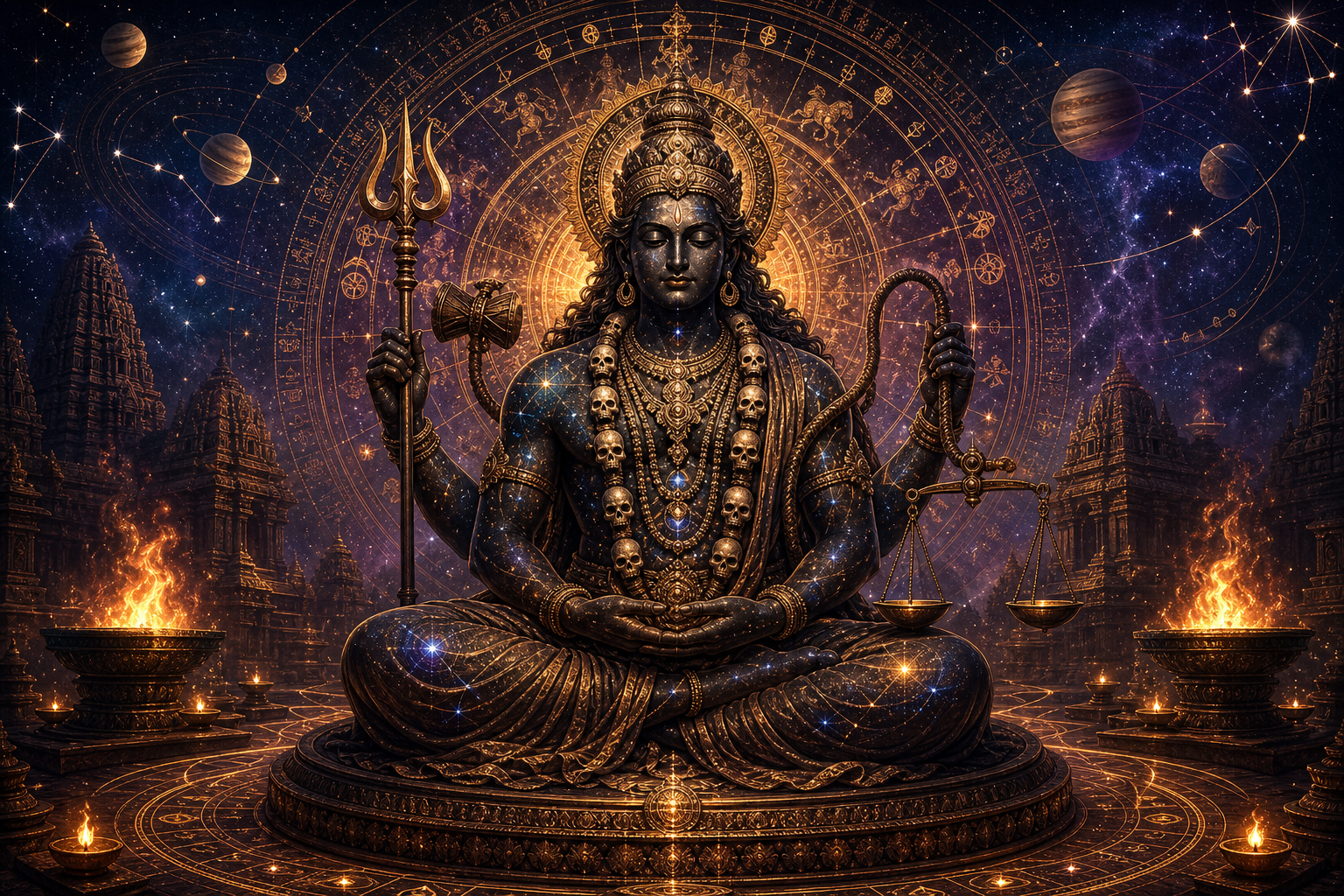
Kalapurusha, the sacred personification of time and mortality, occupies a profound place in Hindu religious imagination, philosophical reflection, and iconographic tradition. The Sanskrit word Kala carries a double resonance: it means time, and it also evokes death. This is not a contradiction in the Hindu worldview. It is a deliberate insight. Time is the power through which birth appears, growth unfolds, decline begins, and dissolution becomes inevitable. Death is not treated as an accidental interruption of life; it is the visible threshold through which time reveals its authority over embodied existence.
The name Kalapurusha combines Kala with Purusha, the cosmic person, being, or principle of embodied consciousness. In this form, time is not imagined as an abstract measurement alone. It is given a sacred body, a symbolic presence, and a theological personality. The Kalapurusha idol form therefore belongs to a wider Hindu method of understanding invisible metaphysical truths through visible forms. An image of Kalapurusha is not merely a sculpture of a deity-like figure; it is a philosophical statement in stone, bronze, wood, paint, or ritual imagination.
In Hindu philosophy, time is never merely mechanical. It is cosmic, moral, cyclical, and spiritual. It governs the movement of planets, the ripening of karma, the succession of yugas, the aging of the body, the rise and fall of civilizations, and the inner urgency of spiritual practice. Kalapurusha gives this immense principle a form that devotees and students of Hindu iconography can contemplate. The idol becomes a reminder that every moment is sacred because every moment is passing.
The idea of Purusha is already deeply rooted in Vedic and post-Vedic thought. The Purusha Sukta presents the cosmic being whose body becomes the universe. Later philosophical traditions use Purusha in different ways, ranging from the witness-consciousness of Sankhya to the supreme cosmic person of Vaishnava theology. Kalapurusha participates in this symbolic language by presenting time itself as a vast being whose presence includes creation, preservation, decay, and dissolution.
This is why Kalapurusha iconography must be approached carefully. It is not always standardized in the same way as popular temple forms of Shiva, Vishnu, Devi, Ganesha, or Hanuman. Its meaning often emerges through association with broader concepts such as Mahakala, Yama, cosmic dissolution, Jyotisha, and the mapping of the universe onto the body. Different regional, textual, astrological, and temple traditions may emphasize different aspects of this figure. The central idea, however, remains stable: Kalapurusha is the sacred embodiment of time as an all-consuming, all-measuring, and ultimately liberating principle.
The connection between Kala and death naturally brings Kalapurusha close to Yama, the lord of death and dharma, and to Shiva as Mahakala, the great time beyond time. Yet these associations should not be collapsed into a single identity without context. Yama is closely linked with death, judgment, moral order, and the destiny of beings after bodily life. Mahakala expresses the fierce transcendence of time, especially in Shaiva and Shakta traditions. Kalapurusha, by contrast, can be understood as the cosmic principle of time given bodily form, sometimes absorbing meanings from both Yama and Mahakala while remaining conceptually distinct.
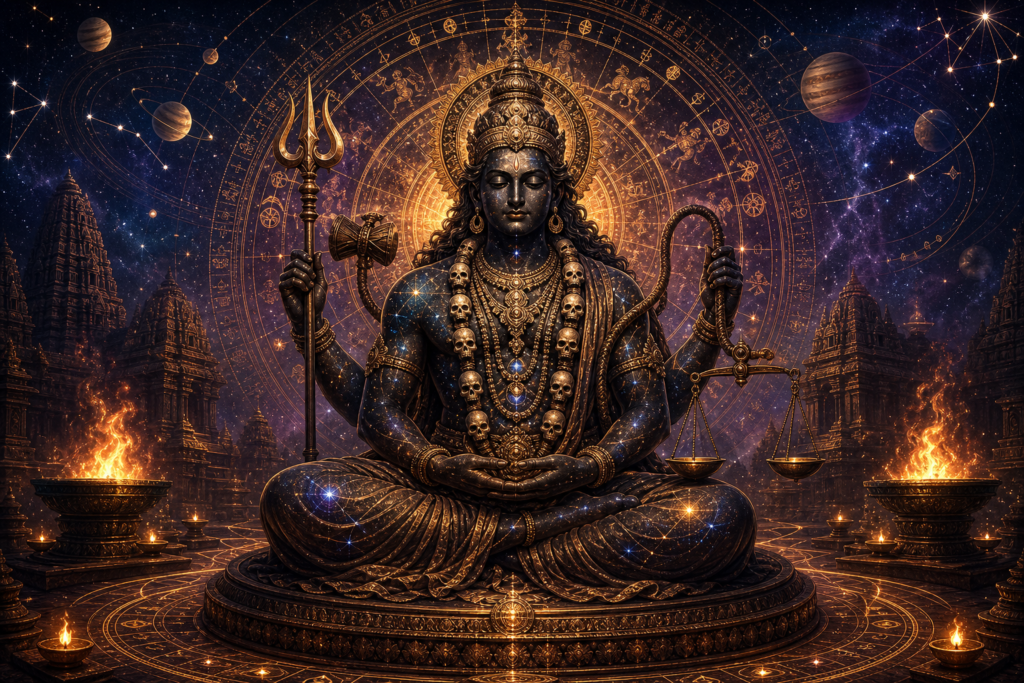
Iconographically, a Kalapurusha form may be imagined or represented with fierce attributes because time itself is uncompromising. Dark color symbolism, flame-like energy, weapons, noose, skull imagery, serpents, trident, drum, or emblems of destruction may appear in related forms of Kala, Mahakala, or time-associated deities. Such features are not meant to produce crude fear. They express the fact that time strips away illusion. Wealth, beauty, status, bodily strength, political power, and intellectual pride all fall under its gaze. In this sense, the frightening appearance becomes spiritually compassionate, because it teaches what ordinary comfort often conceals.
The noose, when present in death-related iconography, is especially significant. It does not simply symbolize punishment. It represents the binding force of karma, attachment, and mortality. The being who is attached to the body alone experiences time as terror. The person who recognizes the deeper Self, Atman, or the divine ground of existence begins to understand time as a teacher. Kalapurusha thus becomes an icon of spiritual seriousness: life must be lived with awareness because it cannot be possessed permanently.
The skull or garland of skulls in related Hindu iconography should also be read symbolically rather than superficially. Skulls represent the equality of all embodied beings before time. They dissolve social vanity. They remind the contemplative mind that the body, however cherished, is not the ultimate identity. In Shaiva and Shakta traditions, such imagery often points toward the cremation ground as a place of radical truth. Kalapurusha belongs to this atmosphere of uncompromising wisdom: the visible body is temporary, but the search for liberation is enduring.
Fire is another important symbolic element. Time consumes, but it also purifies. Fire burns offerings in yajna, digests food in the body, transforms matter, and marks the final rite of cremation in many Hindu communities. When fiery energy surrounds a time-deity or cosmic form, it suggests that time is both destructive and transformative. It removes what cannot last, and by doing so it directs consciousness toward what is not destroyed by change.
The philosophical depth of Kalapurusha becomes clearer when placed beside the Hindu understanding of cyclical time. Unlike a strictly linear view in which history moves from one absolute beginning to one final end, Hindu cosmology often speaks of recurring cycles: creation, preservation, dissolution, and renewed manifestation. Kalpas, manvantaras, yugas, planetary periods, ritual calendars, and life-stage duties all reflect this layered understanding. Kalapurusha is not merely the time of a clock. He is cosmic time, biological time, ritual time, karmic time, and spiritual opportunity combined in one symbolic principle.
This layered idea of time also explains why Kalapurusha has importance in Jyotisha, the Hindu science of time reckoning and celestial interpretation. In astrological symbolism, Kalapurusha is often connected with the cosmic body mapped through the zodiac. Aries is associated with the head, Taurus with the face or neck, Gemini with the arms, Cancer with the chest, Leo with the heart, Virgo with the abdomen, Libra with the lower abdomen or balance of the body, Scorpio with hidden organs, Sagittarius with thighs, Capricorn with knees, Aquarius with calves, and Pisces with feet. This mapping is not merely anatomical. It expresses the ancient intuition that the human body, cosmic order, and celestial rhythm are interconnected.
The Kalapurusha model in astrology demonstrates a wider Hindu principle: the human being is a microcosm of the universe. The body is not isolated from the stars, seasons, elements, rituals, or moral consequences of action. The same time that moves constellations also moves breath, thought, digestion, aging, memory, and destiny. In this framework, iconography, astrology, ritual, and philosophy are not separate compartments. They are different languages for approaching the same cosmic order.
Kalapurusha also carries a powerful ethical message. Since time consumes all accumulated possessions, the wise person is encouraged to ask what truly matters. Dharma, self-discipline, compassion, truthfulness, study, devotion, and service become more meaningful when seen against the inevitability of change. This is why meditating on time and death has never been merely pessimistic in Hindu traditions. It is a method of awakening. Mortality gives urgency to dharma.
There is a deeply human dimension in this symbolism. Every family has witnessed time in intimate ways: the aging of parents, the growth of children, the passing of elders, the fading of old homes, the preservation of ancestral rituals, and the sudden realization that moments once considered ordinary have become sacred memories. Kalapurusha speaks to this shared experience. The form teaches that time is not outside life; it is woven through love, loss, duty, remembrance, and spiritual longing.
For devotees, such an idol or concept can produce both humility and courage. Humility arises because no individual can command time. Courage arises because time also gives the chance to act rightly now. This balance is essential to Hindu spirituality. A person is not asked to deny impermanence, nor to collapse into despair before it. The dharmic response is to see impermanence clearly and then live with greater responsibility.
The relationship between Kalapurusha and death should therefore be understood as pedagogical. Death is not glorified as darkness; it is recognized as a truth that disciplines the mind. In the Bhagavad Gita, Krishna identifies himself with time in a cosmic and awe-inspiring sense, especially as the force that brings beings to their appointed end. This teaching does not reduce divinity to destruction. It reveals that the divine order includes both birth and death, appearance and disappearance, manifestation and withdrawal.
Kalapurusha iconography also helps explain why Hindu religious art often refuses to separate beauty from terror. A sacred image may be graceful, fierce, maternal, ascetic, royal, erotic, peaceful, or terrifying, depending on the truth it embodies. Time is not always gentle, so its sacred form may not be gentle either. Yet the purpose of the image remains transformative. It draws the mind from superficial comfort toward metaphysical clarity.
The worship or contemplation of time-related forms also intersects with temple culture. Hindu temples are not merely places for prayer; they are spatial expressions of cosmic order. Their architecture often aligns directions, measurements, icon placement, ritual schedules, festivals, and astronomical rhythms. In such a setting, Kalapurusha symbolism becomes especially meaningful. The devotee enters sacred space not to escape time entirely, but to reorient time toward dharma, remembrance, and liberation.
The temple bell, the daily arati, the lunar calendar, the annual festival, the repetition of mantra, and the aging of the deity’s ornaments and architecture all make time visible. Ritual time differs from ordinary time because it is consecrated. It does not deny the passing of days; it sanctifies them. Kalapurusha, as a cosmic symbol, gives this experience a philosophical center. Time becomes a field in which divine awareness can be cultivated.
The subject also invites comparison across Dharmic traditions without forcing artificial sameness. Buddhism places great emphasis on impermanence, mindfulness of death, and liberation from clinging. Jainism develops a vast cosmology of time cycles and moral consequence, emphasizing discipline, non-violence, and purification of the soul. Sikh thought reveres the timeless reality through the language of Akal, the One beyond decay and death. Hindu reflections on Kalapurusha stand in conversation with this wider Dharmic sensitivity: embodied life is temporary, ethical action matters, and spiritual realization is the deepest response to mortality.
This shared Dharmic insight encourages unity rather than rivalry. Different traditions may use different metaphysical vocabularies, ritual forms, and theological frameworks, yet they often agree that human life should not be wasted in ignorance, hatred, or arrogance. Time exposes the smallness of ego and the necessity of wisdom. Kalapurusha, understood in this broader civilizational context, becomes not a sectarian symbol but a profound reminder of the moral seriousness of existence.
From an art historical perspective, Kalapurusha also reveals the sophistication of Hindu sculpture and sacred visual language. Hindu iconography rarely treats the body as merely biological. A divine or cosmic body can represent metaphysical categories, philosophical doctrines, mantras, elements, planets, directions, social order, and states of consciousness. The body of Kalapurusha is therefore a diagram of time as much as it is a figure. Every gesture, emblem, posture, and expression can become a philosophical clue.
Because representations vary, responsible interpretation must avoid rigid claims where textual or regional evidence is limited. Some images may be explicitly named Kalapurusha; others may express the same idea through Mahakala, Kala Bhairava, Yama, cosmic Purusha, or astrological diagrams. The academic approach is to examine the inscription, temple context, ritual use, textual reference, artistic school, and local oral tradition before assigning a precise identification. This caution does not weaken the subject. It shows the richness of Hindu sacred art.
Kalapurusha also has psychological significance. The awareness of time can create anxiety, but spiritual traditions transform this anxiety into insight. Meditation on impermanence can reduce pride, soften resentment, and deepen gratitude. When time is viewed only as loss, the mind becomes fearful. When time is viewed as sacred opportunity, the same awareness becomes liberating. The idol form helps the devotee hold both truths together: life is fragile, and therefore life is precious.
The concept is especially relevant in the modern age, where time is often reduced to productivity, schedules, deadlines, and measurable output. Kalapurusha restores a more serious and sacred understanding. Time is not only something to manage; it is something to honor. A life filled with activity but lacking dharma remains spiritually incomplete. A brief life lived with truth, service, devotion, and self-knowledge can possess immense depth.
In this way, Kalapurusha challenges modern assumptions about control. Technology can measure time with extraordinary precision, but it cannot conquer mortality. Medicine can extend life, but it cannot abolish impermanence. Wealth can purchase comfort, but it cannot purchase freedom from decay. The wisdom of Kalapurusha lies in redirecting attention from control to clarity. The central question is not how to possess time, but how to live rightly within it.
The relationship between time and karma is another crucial dimension. Karma does not always ripen immediately. Actions mature across time, shaping tendencies, circumstances, relationships, and future experiences. Kalapurusha can therefore be understood as the field in which karma becomes visible. Time reveals the fruit of action. This gives ethical life a cosmic seriousness: no deed is meaningless, no intention is insignificant, and no moment is spiritually empty.
At the same time, Hindu philosophy does not leave the individual trapped in fatalism. While past action matters, present awareness also matters. Dharma can be chosen. Repentance, discipline, devotion, knowledge, mantra, seva, and inner transformation can redirect life. Kalapurusha is not merely the devourer of beings; he is also the reminder that the present moment remains a doorway. The passing of time becomes the very condition that makes spiritual effort urgent and meaningful.
The idol form of Kalapurusha may also be read through the lens of rasa, the aesthetic flavor or emotional mood of sacred art. Its dominant mood may include awe, solemnity, fear, wonder, detachment, or heroic resolve. These emotions are not accidental. Hindu art often uses emotion as a pathway to understanding. The devotee does not merely analyze the image; the devotee is affected by it. A rightly understood fierce form can awaken moral seriousness more quickly than a purely gentle image.
Kalapurusha is therefore both metaphysical and practical. He belongs to cosmic philosophy, but his lesson enters daily life. To remember Kalapurusha is to remember that speech should be truthful, relationships should be honored, duties should not be postponed indefinitely, and spiritual practice should not be delayed until old age. Time is already moving. Dharma must be practiced while the opportunity remains.
The form also deepens the meaning of moksha. Liberation is not merely a reward after death; it is freedom from bondage to time-bound identity. The body ages, emotions change, thoughts arise and disappear, and circumstances fluctuate. The seeker asks: what is the witnessing reality behind all change? In Vedantic language, this inquiry points toward Atman and Brahman. In devotional language, it points toward surrender to the eternal divine. Kalapurusha, by showing the power of time, indirectly points toward that which transcends time.
This is the paradox at the heart of the symbol. Kalapurusha appears as time, yet the contemplation of time leads the mind toward the timeless. The form appears fierce, yet its teaching can produce peace. It confronts mortality, yet it opens the path to immortality in the spiritual sense. It shows the destruction of the temporary, yet it protects the seeker’s attention from being wasted on what cannot endure.
For students of Hindu iconography, Kalapurusha is a reminder that sacred sculpture is never only decorative. It is theology made visible, philosophy made memorable, and spiritual discipline made tangible. The image invites slow looking. It asks the observer to consider why time is given a body, why death is linked with moral order, why cosmic cycles matter, and why the fleeting human life is considered precious enough to be devoted to liberation.
Kalapurusha ultimately teaches that time is both boundary and blessing. It limits the body, dissolves pride, and ends worldly possession. Yet it also gives rhythm to ritual, maturity to wisdom, consequence to karma, urgency to dharma, and depth to love. In the cosmic form of time and death, Hindu thought does not see meaninglessness. It sees a sacred teacher. To understand Kalapurusha is to understand that every passing moment can become a step toward awareness, responsibility, and spiritual freedom.
Inspired by this post on Hindu Blog.




Leave a Reply
You must be logged in to post a comment.