
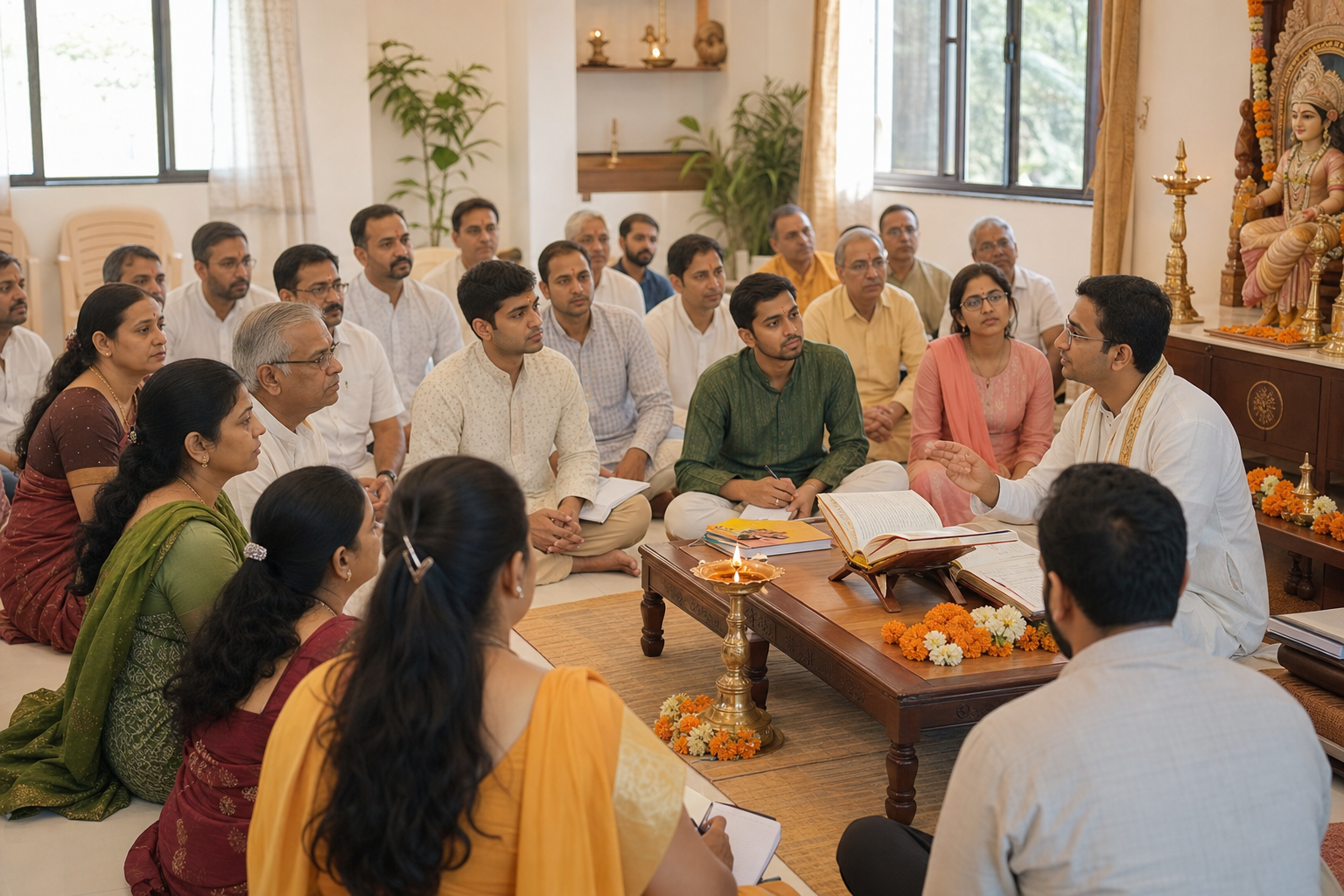
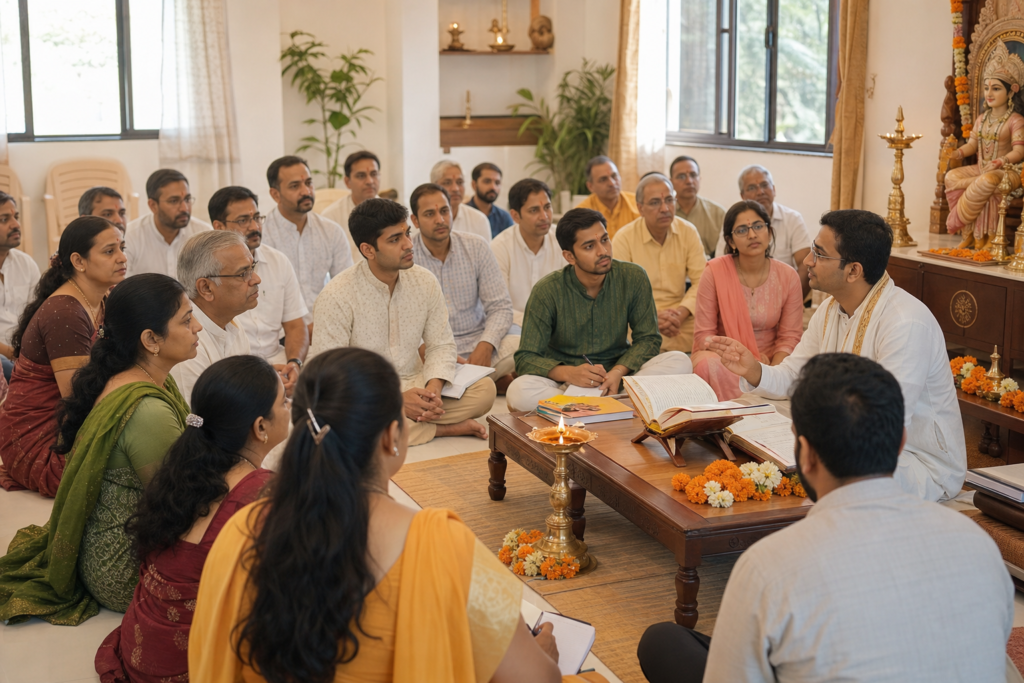
The spiritual gathering organised by the Hindu Janajagruti Samiti in Virar stands as a focused community initiative aimed at strengthening Dharmashikshan, Dharmacharan, and collective spiritual participation among Dharma-loving Hindus. Although the available source information is brief, the event can be understood within a broader pattern of Hindu community engagement in which spiritual education, disciplined practice, and shared devotional activity are treated as essential foundations of cultural continuity. In this context, Virar was not merely a location for an assembly; it became a setting for reaffirming the role of Hindu Dharma in everyday life, social responsibility, and collective identity.
Dharmashikshan, commonly understood as education in Dharma, is central to such gatherings because it connects inherited traditions with informed practice. In many Hindu households and community spaces, religious knowledge is often received through festivals, family customs, temple visits, stories from the Ramayana and Mahabharata, and the guidance of elders. A structured gathering gives this inherited wisdom a more conscious form. It encourages participants to ask what Dharma means in conduct, worship, family life, civic behaviour, and the preservation of cultural values.
Dharmacharan, or the practice of Dharma, carries this learning into daily action. It suggests that spiritual knowledge is not complete when it remains theoretical. It must be reflected in discipline, truthfulness, reverence, self-control, compassion, responsibility, and service. A community gathering dedicated to Dharmacharan therefore has a practical dimension. It helps participants move from occasional religious observance toward a more consistent way of living shaped by Hindu values and spiritual awareness.
The phrase Dharma-loving Hindus, or Dharmapremi Hindus, reflects a community identity built around reverence rather than mere affiliation. It points to those who regard Dharma as a living guide rather than a symbolic label. Such gatherings can be emotionally meaningful because they bring together individuals who may otherwise practise privately within their homes, families, or local temples. In a shared setting, participants are reminded that personal sadhana and collective responsibility are not separate paths but complementary expressions of the same spiritual commitment.
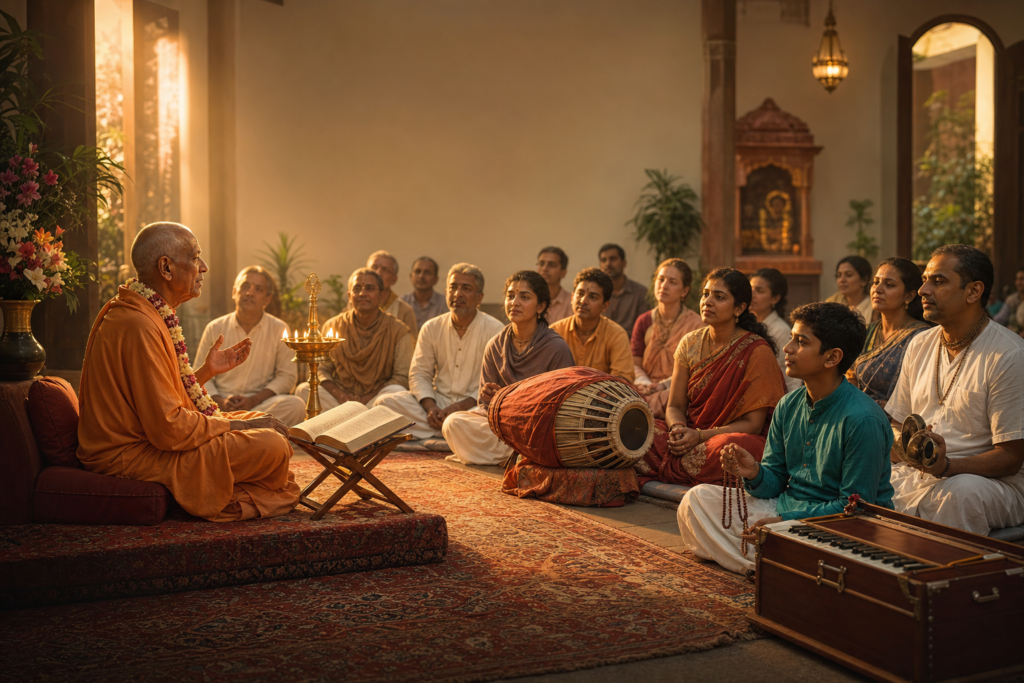
The Virar gathering also highlights the importance of collective spiritual activities in sustaining community cohesion. Hindu traditions have long recognised the value of satsang, bhajan, japa, puja, scriptural discussion, seva, and festival observance as practices that shape both the individual and the community. When people gather for such activities, spiritual life becomes visible and participatory. It moves beyond solitary devotion and becomes a shared discipline that strengthens confidence, belonging, and moral clarity.
From an academic perspective, events of this kind may be viewed as examples of religious socialisation. They transmit knowledge, reinforce norms, and create networks of shared meaning. This does not require grand institutional scale to be significant. Even a modest local gathering can contribute to cultural preservation when it encourages participants to learn, practise, and discuss Dharma with seriousness. The value lies in repetition, continuity, and the formation of habits that can be carried into homes, neighbourhoods, temples, and future community events.
Virar, as part of the wider Maharashtra social landscape, represents the type of expanding urban and semi-urban space where questions of cultural continuity often become especially important. In such settings, families may experience rapid changes in lifestyle, education, work patterns, media exposure, and social expectations. Community-based Dharmashikshan can provide a stabilising framework by helping individuals understand inherited practices with clarity rather than treating them as mechanical customs. This is particularly relevant for younger generations who often seek reasons, context, and intellectual coherence before embracing tradition.
The gathering’s emphasis on participation is especially important. Hindu spirituality has never been limited to passive listening. It includes embodied practices such as prayer, chanting, ritual observance, fasting, pilgrimage, meditation, study, and ethical action. Participation turns knowledge into experience. It also allows community members to witness one another’s commitment, which can deepen motivation and reduce the isolation sometimes felt by individuals attempting to preserve spiritual discipline in a fast-moving modern environment.
At the same time, a Dharmic gathering must be understood in a spirit that supports unity across Hinduism, Buddhism, Jainism, and Sikhism. These traditions have distinct theological, philosophical, and ritual frameworks, yet they share civilisational concerns such as ethical living, self-discipline, reverence for spiritual knowledge, compassion, liberation-oriented thought, and the cultivation of inner transformation. A constructive reading of such events therefore places them within the larger Dharmic objective of preserving sacred traditions while encouraging mutual respect among related spiritual paths.
The role of Hindu Janajagruti Samiti in organising the Virar gathering is significant because organised community platforms can help convert concern for Dharma into structured educational and spiritual engagement. Where informal discussion may remain scattered, a gathering offers focus. It can create a disciplined environment in which participants reflect on Hindu Dharma, examine the meaning of right conduct, and consider how collective spiritual activity contributes to the resilience of Hindu society.
The available report does not provide details such as the names of speakers, the number of attendees, the schedule, or the exact activities conducted. For that reason, any responsible account must avoid adding unsupported particulars. What can be stated with confidence is that the event brought together Dharma-loving Hindus in Virar with the stated purpose of strengthening Dharmashikshan, Dharmacharan, and participation in collective spiritual activities. This limited but meaningful information points to a gathering centred on education, practice, and community mobilisation.
Such initiatives also draw attention to a broader challenge within contemporary Hindu society: the need to connect devotion with understanding. Many people inherit rituals without always receiving the philosophical or ethical framework behind them. Dharmashikshan helps address that gap. It can explain why a practice matters, how it relates to self-discipline and social harmony, and how it fits within the wider structure of Hindu spiritual traditions. When learning supports practice, faith becomes more resilient and thoughtful.
Dharmacharan similarly prevents spiritual identity from becoming merely symbolic. It asks whether Dharma is visible in speech, conduct, family responsibility, treatment of others, and service to society. A gathering devoted to this theme may encourage participants to see Dharma not only as temple worship or festival celebration but as an integrated way of life. This approach is especially relevant to the Hindu way of life, where philosophy, ritual, ethics, social duty, and personal sadhana have historically been interwoven.
Collective spiritual activity also has a psychological and social dimension. Shared chanting, prayer, study, and reflection can create a sense of emotional steadiness and shared purpose. Participants may leave such gatherings with renewed confidence that their traditions are not isolated remnants of the past but living practices capable of guiding modern life. This emotional connection is not opposed to academic seriousness; rather, it shows how religious knowledge becomes meaningful when it is experienced through community, discipline, and continuity.
The Virar gathering therefore deserves attention not because it represents a large public spectacle, but because it reflects a foundational process in cultural life: the steady transmission of Dharma through local community effort. Grand narratives of civilisation are sustained through such smaller acts of teaching, practice, and collective remembrance. When Dharma-loving Hindus gather to learn and practise together, they contribute to the preservation of Hindu heritage in a practical and lived form.
In conclusion, the Hindu Janajagruti Samiti’s spiritual gathering in Virar can be understood as a community-centred effort to deepen Dharmashikshan, encourage Dharmacharan, and strengthen participation in collective spiritual activities. Its significance lies in the relationship between knowledge and conduct, between individual devotion and social cohesion, and between inherited tradition and conscious practice. Within the larger Dharmic framework, such gatherings can support unity, cultural continuity, and a more thoughtful engagement with Hindu spirituality in contemporary society.
Inspired by this post on Hindu Jagruti Samiti.




Leave a Reply
You must be logged in to post a comment.